I feel that the US will now, finally, focus on the US. It's time for that. Instead of their usual imperialistic attitude that involves enticing Europe to boycott Russia, taking out stability providing leaders in the middle east without much (after)thought (or the wrong kind of thought), providing weapons the the Free Syrian Army mercenaries that now fight for the better paying ISIS side (this is not stupidity, it's rubbelization with economic motives imo). Etc. Let the US focus on the US for the next 4 years, the US has enough problems to solve within their borders. Clinton would just intensify the Syria situation, alienate Russia even further, make secret deals with Wall Street and keep things just as they are. And things are not fine as they are.
Yeah yeah, I think Snowden is a hero and I hate Trump for calling him a traitor. Also his abortions views are medieval. But hey, a more balanced anti-imperialist would simply never win in the corrupt, house-of-cards like US.
Whenever I hear those arguments, I have to bring up a point:
There is a very good reason why big, powerful empires always have a big military, meddle and stick their noses into everyone's affairs.
Economic power doesn't come from thin air. It has a lot to do with political power, influence and domination.
Those are two sides of the same coin, they support and nurture each other.
You reach limits of growth when you just trade and build up your own economy.
Almost all foreign policy is dedicated to furthering self-serving goals. Often medium and long term, so not apparently visible. Often related to things the public know very little about. Just as often, completely misguided.
Great point; there is also an additional dimension to this. It is impossible to emphasize just how important security is to the blooming of creative financial institutions and highly specialized & sophisticated economies. Its because the US and Europe have created a system where, say, a legal framework exists to get retribution in case of genuine foul play in either country, that we can have sophisticated trading channels. Without the security and stability provided by an overwhelmingly powerful, but mostly reasonable military, we don't have to worry about our trading networks being taken apart at will (basically, eliminate that risk). If that security apparatus ceases to exist, so will the advanced economy that the west has created (which has been slowly expanding, to other nations as well).
This long perspective is hard to ignore. It feels like we are walking the same historical path now. Let's hope things move slowly enough with respect to security that the trading networks stay intact.
And of course, one major power refraining from blundering into situations tends to create the opportunity for another to replace them
The US has been less militarily active in Syria than in other recent Middle Eastern conflicts, partly as a result of fairly unambiguous policy mistakes in that region over the past decade and a half.
Their place has been filled by Russia. I've yet to see a remotely persuasive argument that Syria is less badly off as a result.
> Economic power doesn't come from thin air. It has a lot to do with political power, influence and domination. Those are two sides of the same coin.
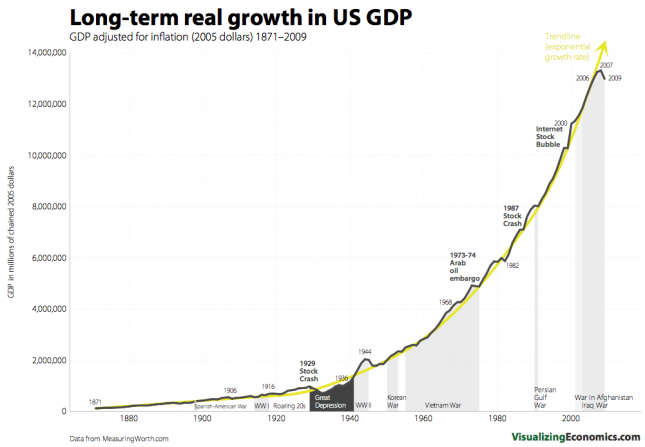
The US managed to create the world's largest economy by 1890, through trade and domestic industry, while almost entirely staying out of major foreign affairs. It wasn't until WW2 that the US emerged fully onto the global stage by necessity due mostly to Europe's disastrous politics and ideologies at the time.
Clearly you can in fact have a massive economy without behaving the way the US has post WW2. Japan for some time had the world's second largest economy, they still have the third largest, and they've managed to mostly stay out of foreign affairs in the aggressive way the US has intervened.
History is complex. And interesting. And often we (and I) get it wrong. So I always enjoy a good discussion. :)
The US profited hugely from slave trade and labor. (Which most Americans usually conveniently ignore) Which helped it build up. So colonialization and domination was a factor for the US before they became a superpower.
It's true that in the earlier 19hundres the US were more reclusive and isolated.
The US economy wasn't in a good state before and after WW2... The war gave a huge boost to the economy and lifted the US out of the Great Depression. That probably laid the groundwork for the huge military-industrial complex today.
The Marshall plan wasn't just good will and benevolence either. A major goal was to create an export market to trade with. The US economy really took off after WW2! ( I can dig up a paper on that). Of course, building up a power base in western Europe to oppose Russia was also important.
Also, the falling apart of the old, Europe based empires from the late 18th century to 1930 and then the WW2 left a power vacuum, which the US filled, together with Russia.
And the world got a lot smaller then, thanks to airplanes, better technology. Nuclear weapons.
The US economy was embarrassing the major powers of Europe post civil war, when it came to almost all forms of industrial output. It was not after WW2 that the US economy really took off, it had been growing at an extreme pace from 1870-1930 - in fact that was the fastest period of growth in US history by far. The great depression was not just a US specific event.
The US ("west offshoots" in the graph, but south america can be mostly ignored until the later 20th century) grew faster then western Europe, but they only really diverged before WW1.
Europe never really recovered from the devastation that was WW1 until the 50ies.
And because of WW2 America accelerated out of the Great Depression and into an even larger and more dominant global economic superpower - an economic superpower that fueled the middle class and all the working blue collar jobs that Trump voters pine for.
The US has about the same share of global GDP today as it did in 1910-1920, before the US emerged onto the global stage. Your premise is wrong. The US was more powerful economically before WW2, than it is today. The particularly robust and brief post WW2 bubble was just that, courtesy of the rest of the developed world being blown up. In about ten years the US will approach $30 trillion in national debt, a sum so great nobody even seriously talks about attempting to pay it off any longer, and interest rates can no longer rise above perhaps 2% or 3% because the US Government would go bankrupt.
We're talking about 1980, not 2016. I didn't say they're the same relative economic superpower today than they were decades ago.
If I wanted to be facetious (this is obviously ridiculous), I would say that the solution to your complaint that America's economy is in decline is to start another war.
Japan gets to claim the US as a major ally though. They get to stay out of foreign affairs in the aggressive way because their friend carries a big stick, protecting them against China (I say this as a non-American by the way.)
>The US managed to create the world's largest economy by 1890, through trade and domestic industry, while almost entirely staying out of major foreign affairs. It wasn't until WW2 that the US emerged fully onto the global stage by necessity due mostly to Europe's disastrous politics and ideologies at the time.
All what this explains is that the potential of the domestic trade in large country such a the US is enormous. Duh.
Japan just like Germany relied on a post-war recovery, the Cold War, the US and invested back into their own growth instead of the military.
In short, no one denied that domestic trade has a lot of growth potential but that isn't an argument that international trade doesn't rely on one's influence and level of defense.
Also, regarding other comments, you always need to properly consider the full context when comparing the past to the present. For instance, until WW2 wars were consider much more of a political tool rather than a disaster. That is a vital point of view the culture of the West only slowly is developing and still in danger to get overthrown.
I wonder if over time (and I'm talking many decades here) there is a shift from the military following the needs of trade to the military being used in a bigger power play that is actually unrelated to trade.
It's important to realize that no voter imagines how US military actions do or don't coordinate or synchronize with US big corp action. That kind of stuff never shows up in the political discourse. Politicians aren't riling up Americans with talk of how military boosts economy. Nobody makes that connection on TV.
From my understanding, some industries depend tightly on the military, and not bolstering your own national industries would be a mistake as all the big global players cheat with nationalistic help.
People aren't going to get more or less imperialism. From George Bush Sr, to Bill Clinton, to George Bush Jr, to Barack Obama, when has the US military + international big corp coordination ever stopped, much less shown variability between presidents? When a president is elected, is there a sweep through the US armed forces command structure? No. Is there a sweep through industry? No. Is there a sweep through the CIA? No. National bureaucracies make plans longer than 4 years, and their programs don't stop executing in-between elections.
What I'm really worried about is what happens in a winner-takes all branches of government scenario, especially when conceivably the majority of the population supports different policies. It makes sense for the ruling party to do a makeover of power, as the GOP has tended toward redistricting as a strategy, and I think that's exactly what's going to happen.
Donald Trump cannot be an independent leader because no ruler manages bureaucracy alone. You must always listen to the bureaucracy machine because it has too many aspects that you don't understand but is someone else's little kingdom. And that's why Donald Trump is nominating all Washington insiders. It's not like Donald Trump decided, "Why not try for business elites through my network, instead of classical Washington?" Nope, didn't happen.
It's never the President that runs the country, it's always the administration. The administration that is never voted in by the people, it is just someone's job. The leadership may enact laws, but it always comes down to ordinary people performing their job at the lowest levels to apply and administer them.
It would be nice if that were true. Maybe Bernie could've pushed the focus back on improving the US instead of picking international fights, but Trump's rhetoric is far more Hawkish than Obama or Clinton.
I remember reading him being quoted as wanting to get out of Syria and to stop antagonizing the Russians. That seems less confrontational than Obama and certainly Clinton's position.
Syria has been Russias client state for decades. We wouldn't have had Brexit, the flooding of the EU with migrants and now Trump if the US didn't decide at some point to try and flip Syria by supporting the most radical Syrian psychopaths it could find.
Well that one failed spectacularly. At least with Trump you can be quite sure that when he finds out who exactly gave the order to support these terrorist groups in Syria, and he will get access to that information soon, then he will lock these people up for life or they might even face charges for treason.
I agree. My impression was that Clinton was at least equally as hawkish as Trump, if not more so. She was (is?) certainly more in bed with defense contractors and the whole military machine--as any lifetime politician really probably is.
Clinton threatened Russia with a military response to a cyber attack. There are reasons to like Clinton over Trump, but a dove-ish foreign policy isn't one of them.
You can clearly tell the extent Trump's isolationist attitude by having John Bolton on as an advisor. Also, the Iran deal? He promised to shred it. The Iranians might finally obtain nukes.
And you believe any agreement will block a foreign power from obtaining nukes? That sounds naive to me--especially when it comes to an exceptionally motivated foreign power like Iran.
An agreement is better than no agreement, and it certainly has worked this far. You're right though, whether it works or not remains to be seen, I am making a judgement on its success so far.
I hear so many educated Trump supporters projecting their own largely sensible wishes and plans onto him since he has no coherent plan and essentially promised nothing, except to build a wall.
I hear so many more educated Trump supporters projecting their own largely sensible wishes and plans onto him since he has no coherent plan and essentially promised nothing, except to build a wall.


Yeah yeah, I think Snowden is a hero and I hate Trump for calling him a traitor. Also his abortions views are medieval. But hey, a more balanced anti-imperialist would simply never win in the corrupt, house-of-cards like US.