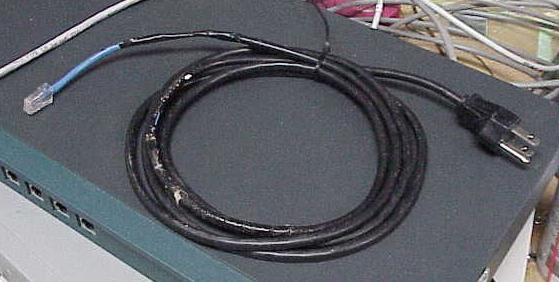
These things are handy for devices that use the higher current when fully operational, but need power for initial setup. In IT, the main thing that comes to mind are managed PDUs. You want to be able to power up the control unit to get things like networking configured, and you don’t want to be doing that while standing in the data center balancing a laptop on your knee. With this, you can get it setup in the office, then go in and start pulling floor tiles to get it plugged in to the high Amp plug with all the settings pre-configured.
To be clear, when you’re doing the setup you don’t have any actual equipment connected to the PDU; you’re just getting power to the unit itself to get power to the management circuitry.
Pretty much everyone that owns an RV (in the US) has an adapter that converts the 14-50P (50 amp!) plug on the RV to a 5-15P that can be plugged into common household sockets. You can't run the A/C without popping a breaker but it'll keep the fridge and lights on.
You say this like it's somehow going to generate 12000 watts, or that somehow having an overbuilt cable is dangerous? Yes, the connector is way overbuilt for running 15amp 120v loads, but that's a good thing. You don't want the connector to be the weakest link.
I'm not sure why you think wattage numbers are more relevant than amperage numbers? Amps are what heat the cable and blow breakers.
Unless it's fused, absolutely nothing about a cable or connector stops you from drawing excessive amperage through it. You use splitters probably every day, and every one of those receptacles is capable of drawing full amperage. If you draw too much you pop the breaker in the panel. The breaker must always be rated lower than the wiring attached to it. Everyone with an old house who has tried to run the microwave, toaster, and fridge at the same time has experienced this.
14-50 plugs are more interesting than all this because they're two hots, a neutral, and a ground. If you adapt it to 120v shore power (with a 5-15 plug) you are using split phase power, so one of the hots will be dead. In theory you could draw 50 amps of 120v through that cable, but the box you're plugging into will pop the circuit long before then. Also, this is why your rooftop A/C doesn't work when plugged into 120v shore power - rooftop air conditioners are usually 240v appliances.
I could point to a giant copper rod being used to carry 15 amps and exclaim “you know that’s a 5 megawatt connector, right?” and it would be the same as what you are doing here.
It doesn’t matter what the potential max capacity of something you plug in is. The breakers on the supply are the limiting factor (they should trip before anything down-line exceeds service).
A toaster has a super high max capacity when you throw it in the bathtub. Doesn’t mean plugging in a toaster is dangerous.
Not true. Breakers are most definitely intended to protect against overcurrent situations regardless of whether it's user or equipment caused. (For example, unintentionally plugging 30 amps of kitchen appliances into a single 20 amp circuit. Don't ask how I know.)
That being said, you should never intentionally rely on a safety feature to cut you out - they exist as a backup in case you screw up. The 14-50P to 5-15P adapter referred to by GP is an example of "I know what I'm doing". Just be sure to double check that you really do.
Edit: Also, consider that if you're in a jurisdiction where it's legal to have a 15 amp receptacle on a 20 amp circuit (many places in the US unfortunately) then a cable like this could allow you to draw a sustained current above what the receptacle is rated for but below what would trip the breaker. That's a fire hazard.
"Edit: Also, consider that if you're in a jurisdiction where it's legal to have a 15 amp receptacle on a 20 amp circuit"
15amp receptacles sold in the US are 20 amp passthrough.
So it is common practice and completely reasonable and safe to put 15amp outlet receptacles on a 20amp circuit because the 15amp receptacle cannot accept a physical 20amp plug.
It is NEC Compliant unless the receptacle is the only receptacle in the 20amp circuit - see "210.21 Outlet Devices".
I knew many of them were rated to 20 amps in spite of the form factor but I didn't realize they all were. TIL.
In that case I guess the cable that triggered the article in the first place is no more dangerous than (for example) the 8 receptacles in my bedroom, all on the same circuit (15 amp IIRC). It's a complete non-issue.
Edit: Are the plug and cable guaranteed to be able to handle 20 amps though? From the pictures in the article, it appears someone spliced a 20 amp receptacle onto a typical (maybe not even 15 amp?) PC power cord.
Right, and you SHOULDN'T use a 20A plug with this 15A receptacle, even though the circuit itself is rated at 20A.
You CAN have a hypothetical 5A plug on a hypothetical 50A circuit. The plug is instructive to the user NOT to pass more than 5A through it, and since the circuit is rated at max 50A, it will not cause a fire at 5A from the abiding user.
In this RV case, you are putting a hypothetical {30,50}A plug on a {15,20}A circuit (VERY BAD!) using this unsafe adapter. Your RV can EASILY exceed the maximum rated amps through this plug (since that is how it is DESIGNED -- with a special plug to set this high-current expectation which shouldn't be intentionally defeated to protect against this user "stupidity") and it CAN and WILL start a fire if someone uses this dangerous adapter, the AC kicks on, and the breaker fails or is not installed properly.
This situation is analogous to cheater plugs. I used a cheater plug with a Macbook Pro in a house with only two-prong outlets, and the aluminium shell felt tingly, but the house electrical system and the circuit design of the laptop motherboard, the chassis design, and SMPS in the charger still DO have other ways of protecting my life from electocution by preventing the chassis from unexpectedly shorting with AC line voltage, even without a proper ground. If these fail, I am dead. Regardless, I was admittedly an idiot for circumventing one safety system to intentionally fallback on others, which weren't necessarily designed to protect against my own idiocy since the assumption was that there is a proper ground.
* FWIW, I have friends in my hometown that are electricians, I helped my dad (properly) wire our basement, and I have an electrical engineering degree myself.
>"you should never intentionally rely on a safety feature to cut you out - they exist as a backup in case you screw up"
I've had to use core drills with inline (inbuilt) RCDs while hanging off rope. Those things draw ludicrous current, and are water lubricated with open thermal ventilation for the motor. It's a given that they trip out.
Unfortunately, as soon as a safety feature is regarded as reliable, it's incorporated into standard operating procedures. See Erlang for a well executed version of this idea!
"That being said, you should never intentionally rely on a safety feature to cut you out - they exist as a backup in case you screw up"
Right, that was my point. Of course, a user-induced intentional overcurrent situation will cause the breaker to flip.
However, to my original point, thoughtlessly relying on a backup safety feature in this case to protect against intentional cases is something that engineers working on the Therac-25 cancer treatment radiation therapy machine did, which ended up killing several people.
The software could be set by the user in the UI to enter a bad state where the high power radiation beam was not collimated (it ALWAYS should be diffused in this high power mode). The software was left this way because there was a hardware interlock to protect against this bad state.
Then, the hardware interlocks that were thoughtlessly removed in the new hardware release (without changing the software code), causing a lot of people to be unintentionally irradiated with deadly doses -- since the engineers originally relied on the "breaker" being there, and then it was removed and/or did not always function properly.
You can look at pilot safety procedures and checks to see how this mentality is properly put into practice. Nothing is taken for granted.
I don't believe this is up for discussion: the circuit breaker is a device that is designed and used to protect a circuit against fault conditions. That's the whole point of their use: if a fault condition is detected, the circuit breaker breaks the circuit to about the fault to propagate or damage the circuit and/or any device connected to it.
This makes a lot of sense. The post definitely lacked context about whether the cable was in use or if it was just something found in the server room. It's a shame the author simply assumed other people are stupid rather than bothering to investigate and understand what's going on.
Indeed; of course there are times it might be necessary to work around safety features. The problem happens when they are not labeled properly! When the end of the cable looks like normal with a standard connector, this type of workaround cable becomes an "attractive nuisance" that people will accidentally use.
If you need to make a non-standard cable - especially if it bypasses safety features - you have a responsibility to mark the cable so anyone that finds it (possibly by accident) will understand the cable is non-standard and dangerous! (alternatively: destroy the workaround cable after using it)
When I used to make an ethernet crossover cable, I would find some way to label it "crossover" and I would put 3 high-contrast stripes at each end with zip-ties so it was obvious looking at either end that the cable was unusual. A non-standard and dangerous power cable should at a minimum have big, obvious labels and warning indicators at both ends!
Not even that. After a fire has started for a completely different reason, the fire insurance company inspector comes in and finds it. You know, the person that loves to find any half reason to not pay you. Why are you even paying fire insurance when this thing even lies unconnected on a shelf.
They are trying to determine the root cause. Hacing it stowed away somewhere, unrelated to the fire is not an issue. But that will give them the nudge to start investigating 'everything electric that was plugged in'. And do you remember that cheap iphone charger and cable you got from ebay for $1? If the report from Fire Department's investigators point to that very corner of the house where the charger was plugged in..... (fill in the gaps.. the insurance investigator will do the same).
Edit: don't get me started on that 3m cable you bought from AliExpress ;)
If the equipment is designed for 20A and plugged into a 15A circuit, wouldn't the 15A breaker trip long before it could start a fire? Seems the main problem would be constantly resetting the breaker.
It's a maximum rating, it's very unlikely that the equipment behind the cable is using anywhere near that. By the way 20A is the typical plug and cable in a home, it's really not hinting at special equipment.
If the equipment really used 20A continuously (100% sure it doesn't or it would be rated higher), it will take a long long time for the circuit breaker to heat up and trigger, like a whole hour. See charts https://en.wikipedia.org/wiki/Circuit_breaker#Standard_curre...
I built one of these to use a surplus APC power distribution unit (basically a really tall power strip with an ethernet port for monitoring) at my house, because the PDU has a molded 30 amp 120V locking plug that I didn’t want to cut off. There’s no 240V or three-phase plugs on the thing, and I’m not running any more or any different equipment than if I used a more traditional cheap power strip. It’s really nice to be able to have a tall sturdy PDU running up the back of my rack instead of that, though!
My adapter is obviously out of spec and I wouldn’t leave such a thing behind for an unsuspecting future tenant to find, but I don’t think there’s anything wrong with it in my particular situation. I love Rachel’s posts but I wish they didn’t have this pervasive air of looking down on the stupid people who did the horrible-thing-of-the-week :/
But it ended up in the hands of someone who didn't. That really makes it a much bigger problem.
"This is OK if used by persons in the know" is not helping: Rachel wasn't/isn't in the know. So clearly, people without the proper knowledge can get their hands on this cable.
I knew it was probably trouble just from a glance. Knowing this topic would bring out every single nitpicker, I did the actual research to be doubly-sure before writing the post.
You might be surprised how much extra shit goes into my posts just to avoid the inevitable backlash. It's not good enough to have a reasonable amount of knowledge. You have to go well beyond into the arcane to avoid the sniping from this crew.
And even then, well, THE ONE shows up time and again.
I also didn’t read that comment as nitpicking. It wasn’t doubting the author knowledge about the criticism, it was mentioning that the author was not aware of the reason of why that was made, was able to have access to it and could have used improperly if she didn’t know any better. But she did.
It is like someone else commented, there are reasonable, ocasional use cases for this that are safe, but the cable should be locked somewhere with the name of the person that knows why it was built in it; so it’s not out in the wild for abuse.
> And even then, well, THE ONE shows up time and again.
I know this is your preferred response to all criticism, but the thing is, to the rest of us you're THE ONE. You swoop in to point out how terrible stuff is, explain how stupid your coworkers are for making it, talk about How It Should've Been Done, and move on to the next project.
I think what they meant was that someone left that thing lying around somewhere where random people would find it with no context. You had no clue what it was but took a second to think about it. The next person might just have used it because it seems to fit.
I would go so far as to say that what you're doing with it is a relatively legitimate use of it, and plugging a machine that demands a higher amperage is unlikely to cause a problem because anything with a standard plug ending is likely to be circuit broken to the correct amperage. The scary device is the inverse of this device.
The inverse - 20 A plug to 15 A socket - would be perfectly fine and conform to code, you couldn't possibly pull an overcurrent that the breaker might fail to detect.
What's really scary is that in many commercial buildings you have combined 5-15/5-20 sockets (this sort:https://en.wikipedia.org/wiki/NEMA_connector#/media/File:Ele...) for circuits fused to 20 A. If you had rigged your locking to non-locking adapter with a 5-20 plug you'd again be fully code-compliant.
Look at the background of two photos! The shelving would indicate the offensive thing was found in a datacenter, it must have been a semipermanent hack, not something that someone might use in their office with the door locked and curtains drawn to set up equipment and otherwise keeps in a locked drawer.
i think the problem is that in general, you can't assume that you'll be the only/last person to use that device, and you can't assume that the next person will understand the context in the way you do. I mean if you're doing it in your home, it's still kind of dodgy, but in a professional setting something like this definitely has no place, temporary or otherwise.
Like the conversations you have with yourself in the shower, for some people blogging is a chance to win an argument you already lost elsewhere. (Or at least one you wish you didn’t have to keep having every few years, which feels a bit like losing)
Rachel happened upon this cable, was curious enough to look into the details behind it and found this out.
Not everybody would look into details. Quite possibly, most wouldn't. I wouldn't, probably. If i happened upon this type of socket that needed powering and found this cable, I'd use it.
Maybe you're hoping that the company only allows people fully in the know near that equipment. That would prevent the problem... but how did Rachel then get her hands on the cable?
That cable doesn't bother me at all. What I find alarming is that it doesn't have a bright laminated warning label affixed to it in a _very_ permanent manner.
On the plus side, as long as the electricians who wired the place up were competent the risk of any harm resulting from ignorance is almost nonexistent. Circuit breakers are quite good at what they do and wiring generally has very wide safety margins.
Edit: On further thought, there is an issue here. Regardless of the breaker, that plug (the 5-15P) and associated receptacle are unlikely to be rated for 20 amps of sustained current. In that case, the breaker might not be able to prevent you from melting something or starting a fire.
Yeah, the breaker in the panel that’s going to trip at half the rated load of the PDU itself? I don’t see a problem here, as long as you’re making sure to stay under the constant load rating of the panel’s breaker.
Sure, a 15A breaker isn’t going to trip at exactly 15 amps because inrush current and all that - but this is no different from using a dumb, unprotected PDU.
> this is no different from using a dumb, unprotected PDU
I would caution that depending on exactly what electrical components are inside the PDU, under certain conditions (say, on plugging it in) it might briefly draw much more current than you would naively expect. (Based on the picture they posted though I doubt that's the case. It looks fairly "dumb" to me.)
For example, "I'll plug this UPS rated at 50 amps into a 20 amp circuit. It's fine because I'm only attaching 10 amps worth of equipment to it!" is unlikely to go well depending on (among other things) the rate at which the batteries charge.
Briefly drawing more power would not really be an issue. Circuit breakers don’t operate as binary devices in the sense that a 15A breaker works indefinitely at 14,999mA and then turns off at 15,000mA. They usually use a bimetallic strip to provide a gradual response (more current = more heat = faster trip) with an electromagnet actuated trip that creates an absolute limit.
Yep, this is a totally dumb one. It is actually labeled "24 amps max, 20 amps max per outlet, 20 amps max per bank", hence the NEMA L5-30P so it can try to make sure that guarantee means something: https://download.schneider-electric.com/files?p_enDocType=CA...
The "banks" are just one half each of the total outlets. The PDU's lil segment display flashes between the integer-rounded Bank 1 load, Bank 2 load, and Banks 1+2 load, and the same data is available with more precision through the serial or Ethernet ports. I have my beefy workstation and NAS on the bottom bank and all my network gear on the upper bank, so right now my PDU is flashing between "3", "0", and "4" amps respectively (rounded): https://i.imgur.com/o50UJoO.jpg
Honestly I'd be more worried about fire hazard if I used an equivalent “legit” setup with three power strips and three Kill-A-Watts.
Really, worrying about 20 amp in a 15 amp circuit?
If one likes to worry about such things, there are much scarier things: unswitched extension cords [0]. One 15 amp plug in input, three 15-amp outlets on outputs. Sold in most stores and used very widely. Nothing illegal about it. Plugs into 15 amp rated outlet, wire itself is rated for just 13 amps, and you can pull up to 45 amps in the worst case (like if you plug in three electric kettles).
At 15 amp circuit breaker will trip in 3-10 seconds if confronted with a 45 amp load.
The number of sockets on an extension cord is immaterial to the available current just as is the number of receptacles on a circuit.
Putting 12 two-socket receptacles on a 15 amp circuit does not mean you can get 360 amps, after all.
The risk with 13 amp extension cords is the gap between the extension cord's safe capacity and the trip point of the circuit breaker. If you plug a 13 amp cord into a 20 amp T-slot receptacle, the breaker will happily supply 20 amps indefinitely even as the cord melts and ignites.
God I wish more people using electrical lawn equipment paid attention to the rating of their extensions cords. Nothing like seeing somebody buy the cheapest super-long cord they can for their electric pole saw and wondering how long before it melts.
I’m going to blame the manufacturers for this one as well, they don’t usually provide current limits meaning you have to grab a table giving safe loads based on AWG and length.
I’m pretty sure I could tow a car with my outdoor power cord/reel.
Or for that matter, with my jumper cables. I paid around $5 more for these monsters than the option next to them, which was flimsy, ridiculously short, and barely had claws. $5. It took me two seconds to make that decision and another 30 to stand there making sure I didn’t misread the prices and then trying to figure out why the others even existed.
I wish UL and other regulatory bodies would take a page from UK electrical standards and require cords that aren't capable of carrying the full amperage available at the socket to have fuses. Voltage drop protection wouldn't be a bad idea, either.
No one should be expected to look up ampacity and voltage drop tables just to avoid starting a fire.
Yes, but if all the wires are rated 15A, and the breaker is 15A or less, there's no issue.
The problem case is putting equipment onto a 20A breaker using 15A wires and plugs.
Or putting 20A equipment on a 15A breaker and wiring. The breaker won't trip immediately. Things will heat up slowly until the breaker trips, and you will have damage.
Wires are generally not rated for any specific current - the insulation is rated for a certain thermal load, and then electricians have a bunch of look up tables for the environment, run length and current to determine what gauge to use.
I see nothing worrying here, this is pretty standard to me.
You have a single 15A input and multiple 15A output, but you cannot use all the outputs at 15A at the same time.
As long as you use it on regular domestic outlets you will be limited by the 15A of your breaker anyway.
This is the same as all the USB hubs chargers. They often have 5 outputs rated 2A each, but the whole hub limits you to 2A total.
Over here in Germany we call the breakers Leitungsschutzschalter, which translates to wiring protection switch. They're specifically sized to protect the wiring in an overload situation, both gradual overloads and short circuits.
The main issue is actually with the slightly-less trigger-happy breakers (class D) needing a sufficiently low resistance on the output to ensure that the magnetic trigger is both reliably triggered if you short the outlet, yet reliably not triggered by the current spike allowed from it's class. They trigger between 10 and 20 times the nominal rating, and 16 A is the typical circuit choice here. Ensuring that you reliably hit 320 A through a long circuit isn't the easiest/cheapest thing.
Class B should be used for home use, and all domestic appliances should not trigger it.
C/D are more appropriate for industrial use, where wiring and devices are designed beforehand, and people (ideally) won't just join together extension cords, and put multiple electric motors on it.
C is quite typical for new installations due to the abundance of SMPS's, which can easily cause issues after a power loss due to the combined inrush current.
But yeah, D is indeed rare, and not typically found in domestic installations.
15 amp Schneider QO breakers are rated to trip in between 3 and 9 seconds in response to a 45 amp load. They are rated to trip a 20 amp load within 50-300 seconds.[0]
Unless your wiring was damaged or sketchy, it will have no issue taking 20 amps for a while. Problem is a (small) chance it could in fact cause issues, possibly fires, possibly at a later date.
People don't usually count consumption of their devices, so plugging in pretty much anything that the circuit breaker will take is a fairly common occurrence.
And if quantity and type of receptacles are intended to be a form of overcurrent protection, wouldn't the UL refuse to certify a duplex 5-15R receptacle for use on a 15 A circuit?
The fact that they do not leads (non-electrician) me to believe that outlet types differ to prevent unintentionally plugging devices into inappropriate circuits, not to prevent intentional abuse.
The present example is just a band-aid fix for cases where lower-current devices are connected in through some intermediate wiring (UPS, extension cord, RV power system, etc.) with a plug consistent with its own, higher ampacity, and in this application, seems no more prone to abuse than a garden-variety 15 A duplex receptacle on a 15 A circuit.
How many of the things with UL stamped/moulded into them that are available for sale on AliExpress do you suppose UL have ever even seen, never mind certified?
Depending on the age and quality of wiring there may be “hot spots” that can start a fire before there’s enough draw to trip the breaker. Old residential aluminum wiring is terribly dangerous for this reason. Corroded wire splices can do it too. That’s why I always solder my romex junctions!
Relative lost his whole house to old wiring in the attic. Staples, aging plastic, and thermal cycling. Roof was engulfed before the smoke alarms went off.
Our fire guy didn't like the unfused kind of extension cords much. One can understand why, you overload the electric lead and hope that the breaker is thrown before the insulation burns through.
It's worse than that! That's a NEMA L6-20, not a L5-20. That means whatever's on the other end is expecting a 240V, 20A source. And you're providing 120V, 15A.
If you're really lucky, it'll start in "safe mode" with a warning light or message. If you're just lucky, it'll refuse to start at all. If you're unlucky, it'll run but silently limit its capability, so you don't know about your ticking time bomb. And if you're really unlucky, the power supply on the other end is a SMPS which will try to pull down 40 amps....
EDIT: Never mind. The photo appears to be marked L6-20R, but that's an illusion. It's actually shaped, and if you squint marked, to match an L5-20R, which is 125V 20A. Carry on....
I have a short adapter like this for my dual boiler espresso machine. You can configure the machine to allow both boilers to come on simultaneously, which brings the machine up to temperature faster, but requires a 20 amp circuit, or you can configure it to only allow one boiler to be on at a time (alternating between the two, when necessary), which takes longer to warm up initially, but allows you to use a 15 amp circuit.
The machine has a 20 amp plug, because it's physically capable of drawing 20 amps. I have a 15 amp circuit, so I took extra care to enable the 15 amp mode and verify that it was working as intended.
These cables can be okay to use if you understand what you're doing and are not violating the rules. They're obviously not supposed to be used to blindly ignore the wire or breaker ratings.
It's like using `unsafe` in Rust. You're still absolutely not allowed to dereference null, even though you might be able to. You're telling the compiler, "I know you can't verify that what I'm doing is safe, but I promise that I've checked it, and it's fine." That's the same deal you're making when you use one of these cables.
In the same vein, it was popular around Christmas to use male to male power cords (known as a suicide cord) to string lights together, they were even available on Amazon:
What's the issue with these? They look as safe as any other fuse-less extension cable to me. As long as you have a fuse somewhere in the circuit, what's the problem?
You plug one end into a hot AC outlet. Now the other end has hot 110-120V AC on exposed pins. Touch them and you are in for a bad time.
A normal extension cord like we've all used has a plug at one end and a socket at the other, so you won't get killed by simply mishandling it.
I love this part of the product description:
"It Can Help Protect Your Family And Keep Them Safe"
Right...
Having said that, the longer Product Description With Every Word Capitalized explains the use case somewhat:
You've lost power and it will be likely be out for quite some time. But you had the foresight to have a generator and one of these cords. You plug one end into your generator and the other end into an ordinary wall outlet. Now every outlet on that circuit will be powered from your generator.
However, your normal fuse or circuit breaker will not protect you from an overload on that circuit, because you've just hotwired your generator into the "house" side of the circuit. So, as the description says, you may be able to power your refrigerator and some lights, but overload the circuit and you may burn your house down.
Also be sure to turn off that breaker or remove the fuse on that circuit. Otherwise you will be having some fun when power is restored!
Oh gosh, it gets even better. Check out the reviews on the Amazon listing!
Finally, I would like to thank the parent commenter for asking an honest question. Perhaps it sounded naive to some, but I appreciate a question like that, as it gave several of us a chance to explain the issues around this kind of electrical cord.
For extra fun, there’s absolutely nothing stopping the generator you just plugged in from feeding power back into the electrical grid if you don’t turn the breaker off.
So the repair crew has the lines deenergized to replace that transformer that blew down the block from you except... surprise! they’re still live!
Someone once handed me one of these when I asked for an extension cord, and I didn't notice. I plugged one end of it in, reached around for the other, and copped 240V AC. Luckily the house had an RCD (mandatory here in Australia), so I just ended up with a very sore arm. I was in a basement alone so it could have been very bad.
Male-to-male cables absolutely should not be made up.
Apparently some people make them for plugging caravans in to external power as a sort of hack.
I’ve always been a bit disappointed that the US never adopted RCD’s at the service panel. I discovered a double-gang light switch box at my house that for some inexplicable reason has a common neutral for lights on two separate circuits, and when replacing one after turning off what should have been the correct breaker I got a nice buzz touching the neutral wire - if the panel had an RCD those lights never would have worked in the first place.
In hindsight it was stupid to not have turned off both circuits anyway, I’m just glad I was wearing sneakers so the shortest path to ground was the junction box itself.
Using a shared neutral for two circuits was a common practice to save on wire. It's allowed as long as the two circuits are connected to different legs/phases of the electrical panel.
More recent versions of the NEC require that the breakers used for both hot legs of such circuits be linked so turning one circuit off also turns off the other.
Common neutrals on residential branch circuits have largely fallen out of favor for new construction due to requirements for GFCI or AFCI protection on most circuits.
For anyone as unfamiliar with the term RCD as I was until now, it is the same thing that in the US we typically call a GFCI or GFI (ground-fault circuit interrupter):
These are usually built into the electrical outlet (or one outlet may provide the GFCI/RCD for several connected outlets). A whole-house RCD as described above would be a wonderful thing.
From personal experience, a GFI-ied house can also be a nightmare. A house can have a lot of outlets. Some of them well-hidden, unused, and long forgotten.
If the “test” button is ever unintentionally pressed, maybe from some furniture or whatever pressing against it, then your whole circuit goes down. But the breaker box shows no fault, and now you get to waste the afternoon inspecting every inch of wall space for an upset outlet.
Yea. I have three of them for my condo. One for the "wet-rooms" (bath and such), one for the electrical stove in the kitchen, and one for the rest. Though it wasn't so initially. Got upgraded about 10 years ago. Now the breaker box says 400v 63A and I wonder how I ever reasonably could use that here.
You have a condo, so the 400v is because the building is being supplied with three-phase power - 63A gives you a total of 25KW which is certainly a lot, but normal residential service is usually 240V @ 100A because of HVAC needs so it’s really more or less the same.
RCD breakers really are a wonderful thing though, I had my second small fridge knocked out because I had accidentally hit the test button of the outlet near the kitchen sink that the dining room outlet was fed from - having it at the breaker makes it a whole lot less confusing and removes the searching for the protected outlet conundrum.
Depending on where you are in the US GFCI breakers might be required these days in certain scenarios. Dual AFCI/GFCI breakers are certainly available at the hardware store. They're expensive though so it seems most people don't use them unless required to (which is crazy IMO).
Related but different, AFCI breakers are now required where I'm at in bedrooms and similar spaces where you wouldn't expect appliances to be plugged in.
Ideally the plug end would be a 20a plug (one blade horizontal), but often in commercial/industrial places you'll find 15a outlets on 20a circuits. If used correctly this would be ok.
They're probably made for all the people renting floorsanders from Home Depot with no way to plug em in.
The scariest adaptors are the ones that dump or fake a ground - and 'cheaters' should be illegal
The circular one is a twist-loc that prevents it from disconnecting accidentally.
The -|| 20A design is great in theory, but you only want to install a receptacle of that type if it is the only one on the circuit (and I mean only receptacle, so not even a single duplex) because what would be the point if you can plug in two devices that both require 20A. I've put these next to a window to power an air conditioner.
The problem with the twist-loc is that the 15A and 20A designs are not compatible. You can't plug a 15A device into a 20A outlet, but 15A twist-loc receptacles are rare. So it is not uncommon to put a 20A plug on a device that draws much less than 15A if say you don't want someone to unplug your router by accident.
The NEMA 'L' receptacles (L5, L6, ...) are locking. When you connect the two ends together you rotate them slightly so they won't disconnect due to vibration, etc.
I've manufactured such a monstrosity for temporary use, because the outlet on the wall used a 15A outlet (the typical plug you see in the US everywhere) but used a 20A breaker.There should have been an outlet on the wall that had the 20A outlet (one of the blades is horizontal instead of 2 vertical blades).
I used a length of 10/2 solid core wire to make the converter. I took delivery of a APC network-switched power bar that used the 30A twist-lock, and it included it's own pair of 20A breakers. I only plugged 10A (verified using a built in meter) of equipment into it till we could get a proper installation.
(I should add this device is not being used in eons and hasn't needed to be used since we've made sure to get the outlets setup right before we get the equipment!)
>the outlet on the wall used a 15A outlet (the typical plug you see in the US everywhere) but used a 20A breaker.There should have been an outlet on the wall that had the 20A outlet (one of the blades is horizontal instead of 2 vertical blades).
Then replace the outlet, don't cover up one problem with another.
The connector bears the name WELL-SHIN, and a UL approval number E115330. Those match and check with the UL database.[1] Well-Shin is a company in Taiwan. Revenue about US$160 million. The part number, WS-111, is the connector only, not the cable assembly.[2]
Well-Shin makes cables, connectors, and all the small metal parts for people assembling cables. Their own line of cables is here.[1] They make some common cables, and this one isn't on their list. The connectors are.
But it's a moulded cable, at least at the plug end. The wires are connected to the metal parts and the housing is injection-molded around it. Only the connector manufacturer can do that. Question: is the twist-lock end also a molded connector? If it is, WELL-SHIN made this, or the whole thing is counterfeit. Either way, report it to UL. They track counterfeits.
If it's not a molded connector, someone cut the end off an extension cord and put that connector on.
> If it's not a molded connector, someone cut the end off an extension cord and put that connector on.
That's almost certainly what was done. You can buy a loose L5-20R at the local hardware store. Typical PC power cables are plentiful and cheap, saving you the trouble of buying and assembling a 5-15P and a length of cable.
Is this actually unsafe? In theory, won’t the circuit breaker flip if the load ever becomes unsafe? ISTM, this might end up being inconvenient (Plug another Computer into the UPS, and the breaker flips), but it won’t be dangerous, unless someone also “upgraded” the breaker.
That happens. 10 years ago or so there was a big explosion at the University of Texas, Austin. The Chemistry Department had a storage vessel for liquid nitrogen. Of course the cold liquid evaporates and creates pressure inside the container. Typically the internal pressure is held at 1.5 bar by means of an escape valve. The escape valve failed and someone replaced it with a solid brass plug. To prevent accidents if the escape valve fails there is also a burst disk that breaks at higher pressure but before the tank itself explodes. That mechanism worked as designed, it released pressure, so they replaced the emergency release valve with a brass plug as well. One nice night the burst pressure of the tank itself was exceeded, and the bottom launched itself through the floor. The top was stopped by a concrete beam, but it did break a few water pipes.
The terrible thing is that this happened in a chemistry lab, where people should really know better. Liquid nitrogen is dangerous in a surprisingly large number of ways: Cold burns when touched, explosions when sealed in a container. And if you're in an enclosed space with it, you've got to be careful not to let it fill the room with nitrogen gas and asphyxiate you.
in a chemistry lab, where people should really know better
Some places are accident factories, where people are encouraged to be team players and not rock the boat even in the face of clear and present danger. Universities can be problematic, when you do your PhD you really need your supervisor to give you a good recommendation.
The top end of the graph is labeled 10,000 seconds. If there's a marginal wirenut connection between the breaker and the powered equipment, you may not want to give it 2.7 hours to heat up, possibly catching fire.
After a century of experience, we now design electrical systems with multiple overlapping safety systems. That photo of the plug shows an earthing pin, after all. That pin does nothing, and is not required for the device to function. It is only there in the event a connection fails and a live wire touches the metal case of the equipment. This is rare, but if you tour the parts of the internet featuring accidental deaths, bad grounding is an entire category of video.
Think of it as a code smell. It not an error, and won't prevent the equipment from working. But it's not good.
I trust the chart because of the source...but my own experience differs - if I'm reading that right, it's saying that it would take 20 seconds upto a max of 400s at 2.5 times rated current: that's 50 amps up six minutes? I have a hard time believing that. Pump 20a though any breaker you find it trips nearly immediately
If power bars and all other manner of plug splitters didn’t exist
If we didn’t already put up to 12 (!!) outlets on a 15A breaker (where I live, anyway — trying to find some US numbers online it sounds like there is no limit there?!)
If you couldn’t trivially create a 24A load on a kitchen plug by plugging two small appliances in on your counter
Then I would agree. As it stands, this is no more dangerous than the things that literally hundreds of millions of monkeys in as many homes and offices are doing every day by accident.
What are the odds that someone willing to do something this sketchy only struck once? I can practically hear them saying "wires are wires" while putting a bigger breaker in...
It's not uncommon to have several 15A outlets on a 20A breaker. So if you plug a 20A load into this thing, I would expect the outlet to overload and fail, but the current through the breaker might not be enough to trigger it.
I might translate this to "If you don't understand what it's for, don't use it for what you think it might be for." Things like this exist, and they are exactly as absurd and dangerous as this, but they aren't for people who don't know what they are doing, they are for people who know exactly what they are doing. It is like a booby-trapped burial site where only the priest are supposed to be able to get in without getting crushed by boulders or impaled on spikes. Unfortunately most code doesn't come with a sign that says "never call this function unless you know exactly how many C level executives are going to be up all night when you do." Engineered safety controls tell you that some things should be obscure and hard to figure out so that people who don't know what the are doing don't accidentally destroy something. On the other hand this prevents knowledge transfer and effective communication, but if it is not obscure some idiot will set both the `--i-know-what-i-am-doing` and the `--i-accept-full-legal-resonsbility-for-the-consquences-of-running-with-this-enabled` flags AND do it in a shell script. This article is spot on, and I have come to think of people who have developed this mindset as having a kind of selective lack of curiosity, say, defensive disinterest -- they see a system that they don't understand, identify that it appears to be dangerous, leave it bloody well alone, and possibly leave a note telling others to do so as well. Those in the know hopefully appreciate when the defensively disinterested warn others off, and as in this thread, take the opportunity to educate about the potentially not completely insane use cases for such things.
So I came across something like this once, UK 13A Plug -> 16A Ceeform Socket in an event and asked the guy (a professional with credentials) about it and he explained that it was actually fine from a safety standpoint: (This happened a while ago, might have understood it slightly wrong)
The 13A fuse was there to protect the thing from drawing more than 13A from the supply. After that it just doesn't matter - under a fault, nothing would be able to draw more than the lowest rated link. It's up to you to be aware that if you push it to 11 then things will fizzle out when the fuse goes, but no damage would be done. In this case it was just a couple of parcans so no issue.
The dangerous combination would in fact be the opposite, a 32A Ceeform plug to 16A Ceeform socket unfused. Then it would be possible under fault to actually pass >16A through a thing only rated up to 16A.
He said something along the lines of a 16/32A socket on the wall just means that the socket is capabale of handling 16A, not actually giving you that (or if it was even switched on) and in his line of work for anything needing more than 'a bit' of power they'd rather just tow their own generator in.
This made sense as in the UK, which is different from a lot of the world, 13A sockets are usually backed by a ring main that will happily give you 32A - hence a fuse is mandatory by law in all plugs to protect the plug and flex leading from the plug to device and anything after that. Conversely, you can buy a cheap car inverter with a 13A socket perfectly legally, but try drawing that full 13A and see how far you get.
Also note I'm just talking about amperage here, the voltage (i.e. blue ceeform 230V) must be the same throughout.
So I discovered something disturbing about UK plugs - yes, the fuse is 13Amps, but it's not like your main circuit breaker which trips instantly - no, those fuses take a long time to melt and break. I discovered this by accidentally drawing 20 amps through a single plug, because I was mistaken about the power draw of the two devices that were plugged into one extension cord. I only realized once I touched the cable and it was pretty hot(not melting yet, but definitely hotter than you want your cable to be) - I got a power draw meter and yep, I was drawing about 4.4kW(~20amps) through a plug equipped with a fully intact 13Amp fuse! I asked an electrician how can that be, and he said that yep, these fuses won't protect you from a higher draw that lasts a few minutes, the current needs to be either super high(like, not 20 but 50 amps) or prelonged enough to melt the fuse.
That has....changed my perception of how these fuses are meant to work.
A typical breaker won’t blow instantly when you exceed the rated current either (unless you exceed it by a lot — like at least 5x). At less than double the rated current you could be waiting several minutes. So it’s not just a UK fuse issue.
This isn’t really an issue. “Hot enough to concern you” is undesirable but not really what they’re worried about so much as “hot enough to combust”.
And the alternative—if it were to blow instantly—is that your fuses would blow any time you turned something on with a high inrush current like a stand mixer or a vacuum cleaner.
Interesting! I did not realise they were so slow to blow.
But I also had a feeling that they may have also been intended as a poor-man's RCD back in the day:
Your washing machine shakes the live loose and it touches the (thankfully earthed) metal case. Then you have a dead short across the fuse which should hopefully be enough to blow it pretty quickly..
I once worked with a very friendly can-do project manager who did something very similar.
He had a deployment project that was behind because the cabinet's PDU needed an L6-30 and the row only had an L6-20. So he went over to Grainger, bought a L6-20 male connector, an L6-30 female connector, some appropriate cable, and made an adapter.
If I recall correctly he'd calculated the maximum draw from the cabinet as right about 20A, so he was really bothered when the facilities manager absolutely refused to deploy with that adapter. (<cough>inrush?<cough>)
It's not horribly uncommon to see 20A rated breakers connected to standard 3 prong sockets and people to have gear with these connectors.
Interesting sidenote, I can tell you at least one NFL and two college football stadiums require these cables to use any broadcasting or recording equipment on the sidelines. And countless venues for live music, usually ones wired before the millennium.
Unless the NEC has changed recently, it's legal in the US to use 20A breakers (with appropriate wiring e.g. 12ga or larger) to supply 15amp receptacles.
I don't know why the NEC allows this given that the practice is banned in Canada despite identical circuit breakers, wiring, receptacles, and electrical devices being used in both countries.
The 30-amp locking receptacle has become the norm at most U.S. and Caribbean marinas, so equipping your boat with a 30-amp inlet minimizes compatibility problems.
I remember seeing USB A to A cables. Actually, I just found one on Amazon. The only reason I know for these to exist is some external HDD enclosures where the designer somehow understood USB well enough to make a controller board, but not well enough to know it should have been a B connector.
I had a Wacom tablet that comes with one of these. The tablet's only input is USB Type C that requires the other side to support the Displayport alternate mode... and computers didn't really have that kind of port when Wacom released it. So it same with a box that has a USB type A port, a mini Displayport, and a USB Type C port. You can then use an A-A cable to plug into your computer (along with the Displayport for video), and then connect via Type C to the actual tablet. In theory, you can also connect the box to the tablet via Type C, and it becomes an extra USB port.
It is janky and every time I go through my cables I say to myself "why on Earth does this abomination exist", but I suppose they had a good reason. Now that graphics cards have Type C ports for VR (apparently), it's not a problem. But it was back when they first came out. They ended up having to use a stupid special cable because they made their device too nice (if you did have a Type C port with video out on your computer, you could still use the converter that you paid for).
I suppose there is some precedent for USB devices that can switch over to being the host. I remember buying a "USB on the go" adaptor and plugging a mouse into my Nexus back in the day. It worked! A cursor appeared and you could move it around.
(Unfortunately, I hated that tablet. My Surface Pro was much better, and it wasn't even designed for drawing. I gave both devices away and now just use my iPad, which still isn't as good as the Surface Pro 4.)
> Now that graphics cards have Type C ports for VR (apparently)
Had. The VirtualLink standard (for which the ports were supposed to be used), was never wildly adopted and is pretty much dead. AMD never introduced Type C ports and Nvidia removed them from their newer graphics cards as well.
Sadly this also means there's practically no direct support for the DisplayPort alternate mode on Desktops anymore, assuming you want a dedicated GPU.
Relying on a breaker to save the day if a device draws too much current from an adapter such as this is a terrible idea.
My issues with the adapter:
- The adapter is allowing higher current devices to connect to an outlet design that only started showing up in the 1960s; connected to “god knows what.”
Some people use two-to-three prong grounding adapters. (NEMA 1-15 to 5-15.)
Some NEMA 5-15 outlets are wired with bootleg grounds.
My Grandmothers’ old house, built in 1837, was upgraded with “knob-and-tube” wiring sometime in the 1910s and had NEMA 1-15 plugs. There’s a certain amount of heat a knob and tube wiring install is designed to allow due to an over current; but this was contingent upon being installed properly, and never modified. The issue today (and in the 1950s) is that many DIYers spliced their safety into a black hole of junction boxes.
Even If it’s a shiny new Siemens Load Center, none of that matters if it connects to wire made during the Ottoman Empire, and illegally spliced into the old breaker panel during the 1970s.
- The breaker box, fuse box, load center.... Well, what is it? It is important to know who made it, and if it was done correctly.
Fuses take time to blow. There could be 10 other things on that branch and it could blow quickly. It’s the big unknown. Did the last occupant get tired of replacing blown 15A fuses because they couldn’t use two kitchen appliances at once, and drop in a 30A?
Same goes with actual circuit breakers. Square D will gladly sell me a single 30A breaker that fits into the spot where I pulled a 15A breaker from.
I bet Federal Pacific Electric would too if they were still in business selling StabLok breakers that cheated their way through the UL tests.... in which their panels are installed commonly throughout the Bay Area. Relying on a Federal Pacific, Zinsco, Wadsworth panel to trip with the correct breaker is too much a liability for most home insurance companies.
If one prefers to rely on circuit breakers, I’d really suggest that they reconsider. Especially during Fire Season here in the Bay Area.
Rachel By The Bay knows what she doesn’t know about the branch circuits in her home. She’s 100% in the right here, as it pertains to her unique situation. Exercise an abundance of caution and hire an electrician!
I'd say such things should exist, sometimes, because the job needs to be done. They should be obvious ugly hacks covered in tape and embarrassing by their existence, to help prompt someone to find a the proper solution.
Hands up whover made an RJ12 fit an MMJ when wiring up a vt terminal serial port
It sounds like the job that needs to be done is ensuring you've adequately planned ahead. With very few exceptions, this is the result of someone trying not to pay what the job costs and just faking it.
Hands up whoever insists on doing site surveys so they can do quality work they're proud to put their name on.
"the show can't go on because the site survey was wrong" won't fly. That's when you bust out the wirecutters and electrical tape. Preperation is great, wonderful, etc, etc; and never complete. Shit happens, be prepared to deal with it.
This seems to be written by someone that doesn't understand electrical wiring. I have (and sometimes use) adapter cables like these (5-15P to L5-20R).
As other people have pointed out, you can draw a lot more than 15 amps through a 15-amp cable by plugging a simple Y connector into the end. That's why 15-amp circuits have 15-amp breakers in the panel. There are a variety of devices that could draw 20 amps (and thus have 20 amp NEMA connectors) but don't necessarily. If everything is wired properly, the worst that happens is you pop a breaker.
I would be more concerned about the gender-opposite of the connector shown (ie, L5-20Plug to 5-15Receptacle). That would allow you to plug a 15-amp rated cable into a circuit which is defended by a 20amp breaker - now the cable is the weakest link.
> I would be more concerned about the gender-opposite of the connector shown (ie, L5-20Plug to 5-15Receptacle). That would allow you to plug a 15-amp rated cable into a circuit which is defended by a 20amp breaker - now the cable is the weakest link.
Huh? Isn't plugging 15-amp appliances (with cables only rated for that) into 20-amp circuits totally normal? I have a few NEMA 5-20 receptacles in my home; in fact I think the latest code requires that kitchens have at least two of them. They accept NEMA 5-15 plugs, and I use them in that fashion without a second thought. You probably do, too.
My understanding is that the circuit breaker protects the wiring in your wall from excessive current. If your appliance may draw more current than its cable can handle, shouldn't it have its own fuse/breaker?
The adapter cable that Rachel mentions allows plugging a 20-amp appliance into a circuit that may actually have a 20-amp breaker, with this plug between that's only rated for 15 amps and doesn't have a built-in fuse/breaker. (I wonder if the cable is at the proper gauge for 20 amps or not.) That doesn't sound proper to me...
Everyone in the US has a bunch of these. 16ga is good for 13 amps. Even if everything is working properly, two 10-amp devices will draw 20 amps and the cable will melt before the breaker pops. If everything is not working properly, and there is a short-circuit, the cable will still probably melt before the breaker pops.
This is why the OP gets it exactly backwards - she is looking at the big cable/connector and thinking "that's dangerous!" No, danger comes from the weakest link in the system, not the strongest. That weakest link must be a fuse or breaker.
For example, "All I know is, if that was my building and they were my tenant, I'd probably sic the fire marshal on them." Well, you clearly don't know very much, and this kind of histrionic commentary isn't useful to anyone.
On the other hand reading the comments I'm pleased to see people chiming in who do know the purpose and legitimate use cases of this little adapter. Personally I had no idea so I'm fascinated to learn, and hopefully one day the knowledge will come in useful. So even though the post has irked me I'm glad to have read it just because of the comments.