I make considerably more than my parents combined when they bought our last family house in 1989. That house is now about twice what I can afford and about 600% what they paid for it. Having doubled in just the past few years.
It’s ridiculous.
My wife and I bought a house in rural Ontario. It appreciated by 25% in two years.
It’s ridiculous.
I don’t want property to be an investment asset. I want it to be a tool, as close to at-cost as reasonably possible. I want everyone to have secure homes. And not just by eternally paying rent.
Obviously there are other factors in play as well -- income inequality, printing more dollars, international & corporate investment -- but low interest rates are likely the biggest influence, and the longer they stay artificially low, the more people assume they will never rise again.
Rates don't have much of an impact on affordability. If rates drop dramatically, then home prices rise in near lock-step, all those looser dollars flowing right back into the housing market. It means that with the same monthly payment, you're able to afford more (and people seem to shop based on what monthly payment they can afford, and are encouraged to do so by everyone from realtors to bankers). The inverse is true, too, with prices falling as rates increase (gee, remember way back in the day when that used to happen? 2018 was wild!).
The OP stated price of the house was 6x, I'm pointing out the contrast in rates is the biggest driver of the change.
Second, you're simply wrong. Yes, of course prices rise when rates drop (that was my original point), but not proportionately, and it absolutely does affect affordability. People flood the market when rates start to drop because they THINK that it's a great deal, and that pumps prices beyond what is proportional. It happened in 2004-7, it happened in 2013-19 (then shit got crazy for even more reasons). Further, the down payment required for an $800k house is a whole lot more than when that same house was $350k -- and people could build that down payment by earning 6, 7, 8% in a savings account. To top it off, the guy buying at 10% rates is likely going to be able to refinance at 7, or 5 or even less at some point during the 30 year life of the mortgage. What is the impact of refi when you start with a 2.75% mortgage? Higher RE prices also raise associated costs -- the transaction costs, RE taxes, overall debt ratios, etc.
Presumably that house isn’t the same house it was back in 1989.
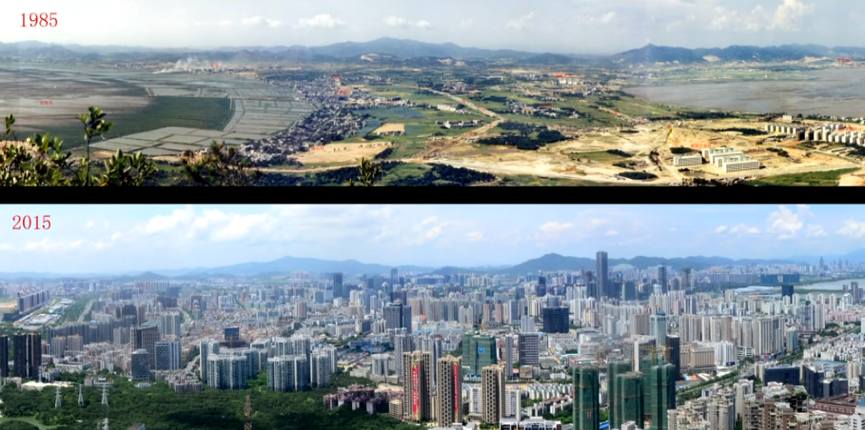
My uncle saw the same change (about 10x increase over 30 years) but his house went from “in the boonies next to farm land” to “desirable suburb of major city”. It was literally a town of 15,000 and is now a part of the greater metro area of 5M.
Same with my grandparents. Their house was on the edge of the city when they bought it and now it’s regarded as a “central neighborhood”.
This is an excellent point. The services in close proximity to most houses has increased dramatically. Recently I read a comment lamenting how "boomers" bought up all the beachfront property and there was none left. This commenter never understood that in this particular community, the beachfront wasn't even connected to the mainland by any roads at the time, the people who lived there were more or less exiled because it was the cheapest area to live due to it having zero amenities at the time. Sure, once the city built the bridges things got a lot better, but in some cases it was 20 years before that happened.
In 1990 the house next door (Bloor West Village, Toronto) sold for 500k. A year later it was worth somewhere between 250-275k. It took all the way to 2005 for it to sell again for 500k. It sold again a few months ago (after a shitty reno) for almost 2 million, It almost doubled in value from what I can recall over the last 2 years. The new owner is a holding company based out of Vancouver. It is sitting empty from what I can tell with the odd visitor every few of weeks.
I have seen Condo's double in price over a period of about 6-8 months Between Oct 2019 to about May/June of 2020) and then go up another 50% after that. House prices are going up over $1k a week and even land that has a road allowance but no road or utilities in Northern Ontario (Muskoka) has gone up over 100 % in the first few months of 2020.
My guess is Toronto real estate will easily double over the next 5 years. The Federal Government and BoC will never be able to raise interest rates meaningfully without collapsing the entire economy. Young Canadians will have nothing but the yoke of debt around their necks and live hand to mouth.
Bank of Canada has already signaled interest rates will be rising faster than expected. They will have no choice - if rates don’t go up they’ll have inflation problems compounded by a falling dollar.
Interest rates will not be over 5 % in our lifetime (50 years plus). Average home price in TO will be well over 2-3 million in the next decade. BoC understands that any meaningful rise will cause economic calamity that will leave everyone naked and hungry in the streets and a collapse of the financial system.
Nope. If they don’t increase interest rates (and they are clearly moving faster than what they said a year ago) inflation will skyrocket and the Canadian dollar will be crushed, causing more price inflation due to imports.
The BOC will have no choice. They’ve just painted themselves into a corner.
A low dollar (within reason) benefits central Canada, with our manufacturing exports. Ontario & Quebec suffered quite a bit when the price of oil (and thus the dollar) was high back about 10 years ago.
When my wife's grandfather passed away (2008 I think?), her mom&uncle sold their neglected and sad old house in Bloor West Village for about $500k, in a pretty bad state.
My wife and I had just bought our first home a couple years before, and we kinda pondered buying the grandparents' place off family, but figured we couldn't possibly swing the mortgage to get the renos done. What a missed opportunity, we'd be sitting on a goldmine now.
The new owner just let it sit there for years; haven't been by to see what has been done to it.
At some point it cannot continue this way. I wonder what will happen when those empty houses suddenly cannot sell for more than their purchase price. Will people start living there because now they aren't a burden to the new owner? Or will the market promply crash so even moderately wealthy people will lose their previously overvalued houses because they cannot pay their mortgages anymore due to rising interests?
You can expand credit forever. Interest rates can go negative.
It is NOT a free market. The Bank of Canada controls the price of debt. Debt is the majority of the economy. It will obviously lead to a sicker and sicker and more unequal (and unfair) economy.
But the Bank of Canada isn't really accountable to anyone. It could continue its path for at least the rest of our lifetimes, in theory.
I feel like my own house here in the US is overvalued by roughly 4x. There's no way a glorified wooden box is worth $2M, especially considering I bought it at one third the price. And the way things are going, it'll probably tack on another million by the time I sell it next year after moving to a state with better climate and less onerous taxation. I bought my first house when I was in my mid-30s. I don't think I'd be able to do so with the price/income ratio as it exists today. Which, if you think about it, is a gaping, self-inflicted wound on society, and a completely unnecessary one. It's not like the US (or Canada) are lacking for land or building materials. It's the politicians getting in the way again.
As an unemployed programmer in Vancouver, I've been thinking about the potential prospects of owning a place, and it seems like an inescapable conclusion that it's just for people who either got lucky with their career early on, or inherited it through some means. I don't think there's much of a controllable path to doing so at this point, it's somewhat all dependent on RNG, which isn't motivating. If I landed a very well-paying gig tomorrow, I'd need to luck into keeping it for at least 2-5 years, and then at best, if I could get a mortgage, I'd then be saddling myself with debt for the rest of my life. Kind of crazy to think about. Thankfully my landlords are cool. Of course, if I desperately needed to own a place, I could luck into a well-paying gig and afford a down-payment in the prairies after a few years, but then I'd be living there, and I'd rather rent here.
Couple of things in contention. First, if work from home remains in place the need to be proximate to the office goes down. This will impact both commercial and residential prices “downtown”. Foreign money will continue to jack up Canadian prices, but Canadians might be less interested in doing so.
Second, if a government makes an active effort to increase housing and decrease house prices they better be a majority. Otherwise they’ll lose to the party that “will defend people’s investments” and quickly stop subsidized construction.
Finally, I have no feeling how mobile people are here. But it doesn’t seem to be high. Folks from Quebec tend to remain there. Folks from the prairies seem unwilling to move east. There’s not a lot of big cities and if the people won’t move demand will remain inelastic.
It's a bit of a guess, but it's my estimation that most people move west in Canada. People in the East move to either Toronto or the central prairies, and people in the central prairies tend to move to Alberta or BC. You can save money moving east if you're location is arbitrary, but I don't think it is for a lot of people.
I moved from Edmonton to Toronto in the late 90s and stayed. But I know very few people who did the same (though my wife's grandparents did the same exact migration.. just 50 years earlier). Most Albertans move west to BC if they leave the province.
The price of housing is determined by the monthly payment that can be carried - after down payment helped by the bank of mom and dad.
In a depressed interest rate environment, a larger mortgage can be carried.
As rates go up, the mortgage you can qualify for goes down and people on variable rates or short terms (common in Canada where mortgages must be periodically renewed) can get in serious trouble.
Drives down wages, drives up asset values. Great for the elite. Furthermore, the new arrivals (from 2nd/3rd world countries) don't complain: they're happy just to be there.
The housing statistics program shows that established immigrants on average own more expensive housing than Canadians (Toronto being the one exception). The newly immigrated on average own less expensive housing than Canadians.
Canada doesn't generally admin immigrants who aren't coming with substantial investment or education. Many are coming here with enough $$ to at least field a downpayment.
People's debts have been going up, interest rates have been lowering, credit card debt is at all time high, gdp to household debt is at all time high, number of investment houses to person is at all time high, immigration has crashed for last two years.
No, I actually agree with you. I don't think the cause of housing price inflation is immigration. I was just commenting on the parent's point implying that immigrants would be poor/lower income.
Immigrants is Australia are not the same as in Canada. Also most all Aussies (and evident with your tone) are rabidly anti-immigrant blaming everything and anything on immigrants.
>its not uncommon to have a 3-bedroom house with 20 migrant men
These are probably workers, not immigrants.
Also, if immigrants were the problem, house prices would be going up when immigration was at all time high not when immigration is nearly zero during the pandemic.
House prices are going up because interest rates are low. They will stagnate when interest rates go up regardless of what the immigration is.
I really despise reading thinly(?) veiled xenophobic comments on HN.
Home ownership rates in Canada are among the highest in OECD countries. Home ownership rates in the 25-44 age range are higher now than 1999.[1]
The government has several programs to “make housing more affordable” which just increases prices. Latest is a special $40k tax exempt account to grow your down payment. Government will also take an equity stake for lower income buyers.
Parents are shoveling money at their kids for down payments because “housing only goes up” and “its now or never”. Average “gift” is $180k in Vancouver for first purchase and $340k for “upgrade purchases”.[2]. Canadians as a whole are shoving cash into real estate like coal into a locomotive.
> Average “gift” is $180k in Vancouver for first purchase and $340k for “upgrade purchases”.
Am I miss-reading the article? It says, "Among the 30% of first-time homebuyers in Canada to get help from their folks on a down payment..."
For "upgraded purchases" it says, "The CIBC report found that the mover-uppers who received help — just under 9% of Canadians — got $340,000 from their parents in Vancouver on average."
The way the article is presenting it it seems that 70% of first time home buyers are not getting anything from their parents?
Edit: [1] is the CIBC report the article is based on. It says "family members" instead of parents as used in a some what loose manner in the BIV article.
Not really, see https://www.oecd.org/els/family/HM1-3-Housing-tenures.pdf Detailed picture is even less optimistic if one reads the details.
Also grouping 25-44 is not very helpful. Like 25 years old is fresh from the university and 44 is a middle aged group.
Homeowners breakdown with paid/unpaid mortgages. Which is quite interesting. Ownership with a life long mortgage is not that good sounding thing. Regardless, it still shows what Canada is in fact not even in the first half for home ownership in OECD.
I’m about to refinance again (in the US) and while I can readily afford our current 15-year mortgage, I’m likely to take out a fresh 30-year-fixed. Why shouldn’t I? It’s almost sure that risk-free rates will rise over that time and may even exceed the mortgage rate during that period.
In such a situation, a lifelong mortgage is exactly what I want to have.
Demand is high. Way higher than supply. Canada has the fastest growing population (in %) in the developed world.
Add here zoning and you get ... any Canadian city with the exception of Calgary and Edmonton.


It’s ridiculous.
My wife and I bought a house in rural Ontario. It appreciated by 25% in two years.
It’s ridiculous.
I don’t want property to be an investment asset. I want it to be a tool, as close to at-cost as reasonably possible. I want everyone to have secure homes. And not just by eternally paying rent.