> The manufacturing complex could consume up to 10 million gallons of water per day, enough to supply a whole town or village. The entire city of Syracuse, by comparison, uses an average of 40 million gallons per day.
We have a lot of water in the area, and foundries are very water intensive. That was a smart long term play of Micron. Very happy to hear about this.
I feel these numbers are always a bit misleading. Sure the processes takes 10 million gallons a day, but much of that water can be reclaimed and recirculated.
> “Conventional treatment of wastewater at semiconductor plants had recycled anywhere from 40 percent to 70 percent of water used in their processes,” explains Govindan. “Some manufacturers still only recycle 40 percent of the water they use.”
> However, over the past two years Gradiant has been working with semiconductor plants, improving their water reuse so that they're able to recycle 98 percent of the water they use. So, instead of bringing in 10 million gallons of freshwater a day from outside, these new recycling technologies mean they need to draw only 200,000 gallons of water from outside the plant to operate.
Gradiant has this cool scheme (from MIT) for distilling water using a carrier gas. The special sauce was a "bubble tray condenser" that condenses water from the carrier gas by bubbling it through trays of progressively cooler water. This provides enormous surface area to get around the problem of mass transfer through the boundary layer.
I also can't take those numbers seriously, since I once saw a documentary about coffee... And they calculated the water of a small river nearby that was partly redirected to wash away the shells of the coffee beans.
This is why it seems so odd to me that companies including both Intel and TSMC keep setting up shop in Arizona of all places. At least NY has ample rainfall and borders two Great Lakes.
Low sesimic activity. You want the FAB to run 24/7 even if that means trucking in expensive water. Any down time will absolutely wipe out any cost savings from cheaper water. Probably even easier still to invest some extra capital to recycle more water.
Somewhat often but minor. I believe it's called glacial rebound. As someone tangentially involved in the optical side of chip fab, I am excited to have a neighbor like this. We work primarily with Micron competitors, but this is good for WesternNewYork.
I feel like naming regions in New York is a fools errand, sure to “offend” everyone, but “western” New York is generally considered to be west of Rochester. Syracuse is about as Central New York as you can get.
>Everything north of ~~Westchester~~ the speaker is Upstate.
FTFY
Similar phenomenon occurs in England, where "the north" and "the south" always begin to the north/south of whoever is being asked. <https://www.youtube.com/watch?v=ENeCYwms-Cc>
Like everything south of 175th Street in Chicagoland is Downstate Illinois. Indianapolis is in the center of Indiana, so they call everything outside the inner ring of suburbs {first half of city name}-tucky, as in a pejorative reference to Kentucky.
Respectful disagree. Upstate and downstate are relative terms meaning "further from / closer to NYC than wherever I live", everywhere but Long Island (which is a separate category entirely.)
There are minor quakes. When the College of Nanoscale Science built the facility for the now defunct G450C initiative, they poured concrete like 30 feet thick to stabilize the building.
Unfortunately while the physical infrastructure was resilient, the business didn’t survive the university president’s conviction for bid rigging. Iirc like $150M of equipment was written off and sold as scrap.
I know chips need to be cleaned with ultra pure water - but 10 million gallons?!
That sounds like a lot. It's like 20 Olympic swimming pools - 30 acre feet of water... That's about how much 7500 acres of farmland uses per day - a decent portion of which is actually just rain...
Is there an easy way to understand why they need THAT much water?
IIUC, there's about ~600 chips per wafer (depends on chip and wafer size), and a plant produces ~30,000 wafers per month. That's ~18M chips per month, or ~600,000 per day.
So each chip needs ~17 gallons of water?! These chips are TINY - like not even a cubic inch. Volumetrically, that's like 5000x as much water.
It gets ultrapurified and used to wash _everything_ all the time, lots of steps are chemically nasty and need to be completely gone before production proceeds.
Yes, and they (universally?) already do recycle substantial fractions (>30%) of their wastewater. It’s a hot area of development. Truly enormous amounts of rinsing, mindboggling.
The city of Syracuse gets most of its water from Skaneateles Lake, a small lake southwest of the city. It’s very clean water, and the city has a filtration waiver that allows them to use unfiltered water from the lake (it’s widely considered to be some of the best municipal water in the country). The city’s treated (and sometimes untreated, depending on how much rain we’ve had) waste water is dumped into Onondaga Lake, which is not part of the Skaneateles Lake watershed.
Most of the rest of the area, outside the city limits (and a few surrounding towns that are connected with the Syracuse water system for legacy reasons), gets its water from Lake Ontario, which is where this plant’s water would be coming from as well.
If anyone is curious, I am happy to ramble on for quite a while about the municipal water systems of the greater Syracuse area (occupational hazard of a couple decades as a firefighter in the area).
When the area was first colonized by Europeans, the major hubs in the area were actually south of Syracuse, along the Seneca and Cherry Valley Turnpikes, which were the original east/west routes through the state, prior to the construction of the Erie Canal (the canal is a significant contributing reason Syracuse became the major settlement and the southern towns are just suburbs now). Due to those earlier settlements though, there were a number of water districts that predate the Syracuse city water district in the southern part of Onondaga County.
Those districts have now all been rolled into the county water authority, which coordinates with the Syracuse Department of Water to deliver water to the surrounding area.
Of interest to firefighting though, this patchwork of water districts that combined over time has resulted in a variety of different threads on fire hydrants, with "Syracuse Standard" and "National Standard" hydrants often being found within the same fire districts. Pretty much every fire truck/engine in the area carries adapters to convert from one to the other.
How weird to see this on HN, I just bought a house 8 minutes down the road from the chosen site. It's completely unrelated, this is the first I've seen this news.
Yikes Toronto. I grew up there (immigrant parents first destination before moving down south) but despise it now for what it has become. An over expensive cesspool of the house owning NIMBY class with terrible traffic and disregard for driving rules or anything really that Canada I grew up in used to stand for like good manners. Lived in Syracuse as well before moving to the west coast. Don’t miss the snow or the cold. Only if there wasn’t so many wildfire.
>An over expensive cesspool of the house owning NIMBY class with terrible traffic and disregard for driving rules
It's actually even worse than that now. With the massive influx of immigrants recently, there are now 2+ families sharing one apartment. It's turning into the worst of the ghettos in many areas. Traffic is worse than ever. GO trains are fuller than ever.
Many people are escaping to Alberta. No respite in sight
I wouldn’t want to live next to a chip foundry personally. Any type of of large industrial operation is going to pollute the air. Check out this interactive map about the likelihood of cancer [1]. Living in areas with high industrial air pollution is highly correlated with cancer.
The dataset you linked to doesn't seem to show any of the chip fabs already operating in the US. Do you have any reason to believe that chip fabs (as they are run these days) are major polluters on par with other industries?
Isn't this just an argument to avoid living in cities?
Basically any large concentration of people is going to result in businesses existing that produce air pollution.
Everything in life is trade-offs. It sure would be nice to live in pristine untouched nature but also somehow have all modern conveniences and also somehow have a high income that is most commonly found in cities...
Like yeah I'm sure some people can square that circle, but most people need to live in places with more pollution than the countryside so they can make a living.
This is not an argument against living in cities. This is only an argument that you shouldn't live next to sites with significant industrial operation if you care about your risk of cancer. Look at the map I posted. There are plenty of places in plenty of cities that don't have elevated cancer rates.
As wtallis noted though, that scary map you linked is an incomplete dataset. Not only does it not include chip fabs, but it also doesn't appear to account for other sources of air pollution. If it was a more general map of air pollution levels in the US, I think you'd see a strong correlation between population density and air pollution levels which makes the trade-off analysis a lot more complicated than just avoid living near a chip fab if your goal is to avoid bad air making you sick.
You’re basically asking for perfect data to answer this one very specific question. You’re unlikely to get it. I’m just presenting what we currently know. PM2.5 (a measure of air pollution) exposure is highly correlated with all cause mortality. You can see additional evidence of this by looking at cancer rates near industrial centers. Chip fabs also emit similar types of air pollution and are regulated by the EPA, similar to other industries.
You’re free to look at this data and say: “well, it doesn’t conclusively prove that living next to a chip fab is bad, so I’m fine with it.” That’s your right. You can live where ever you want. But the data suggests living near industrial sources of pollution is bad for your health. Without any data suggesting that living near a chip fab is neutral to our health, I think applying Occam’s razor is warranted.
I'm not saying living near a chip fab doesn't present the risks you outlined. What I'm saying is it's very likely there are comparable risks living basically anywhere that isn't very sparsely populated, so I think your original post places undue emphasis on one risk among many that should all be weighed in an apples to apples way when making these kinds of decisions.
> I'm not saying living near a chip fab doesn't present the risks you outlined. What I'm saying is it's very likely there are comparable risks living basically anywhere that isn't very sparsely populated
Doesn't this directly contradict the incidence of cancer vs. distance to industrial pollution maps? Like you're literally many times more likely to get cancer if you live near a source of industrial pollution compared to other people who live in your same city but don't live right next to a source of industrial pollution.
Think about it like this: the volume of a sphere increases proportional to the radius cubed. That means the further you get from a source of pollution, the density of that pollution falls off by a cubic of the distance. That's quite a sharp drop off. So small sources of pollution may pose some risk, but due to the small amount of particulate combined with how fast the pollution drops off means it's not so dangerous. Very large sources of pollution, however, may be dangerous for some distance.
My operating assumptions here go something like this:
- Living in a sparsely populated area that is near a chip fab presents X health risks due to its specific kind of industrial pollution.
- Living in a densely populated city without a chip fab presents Y health risks associated with higher traffic, other kinds of businesses that produce air pollution, etc.
I would want to see X quantified against Y in order to make an apples to apples comparison here. If such a comparison is made, it seems likely to me that the health risks are similar. Hence, the only way to minimize your health risks is to live in a sparsely populated area that has no jobs. Anyplace with significant economic activity is likely to be hazardous to your health in some way.
And even if X is significantly more hazardous than Y, okay, then what? "Don't move there" is a lot less helpful than proposing regulations that minimize people's exposure to pollution while still letting us have chip fabs. The damn things need to be built somewhere for us to have nice things, so let's figure out how to do it right instead of just scaring people with (potentially) misleading stats.
It's cheap because it's an awful place to live. You can work in insurance, or hospitality, or for terrible wages in "tech", aka making CRUD apps or doing IT for the aforementioned industries. State taxes are super high and a huge burden. The weather is awful for all but 1-2 weeks in the spring and 1-2 weeks in the fall (hot and humid in the summer, extremely cold and windy in the winter). Schools are generally terrible.
There's a reason housing is cheap and there is a net population outflow out of NYS.
I can’t speak to Syracuse itself, but some of the suburban areas around Syracuse are pretty nice and have very good schools. For example, Fayetteville-Manlius High School is ranked #807 in the entire US: https://www.usnews.com/education/best-high-schools/new-york/...
My wife is from the area and I’ve been there dozens of times. It’s not as happening as a major city, but if you wanted to live in an affordable suburb outside a large-enough city, it would be a fine place to live.
As a parent of kids in the FM district (and an FM graduate myself), it is indeed a fantastic district for most kids. If your kids need any sort of supporting services though, there are much better options in the area. FM fights pretty hard to avoid providing any kind of services.
That being said, there is a _lot_ of privilege in my complaint here. There are plenty of schools in less affluent areas where the idea of even requesting services would be laughable; there just aren't the resources to provide them. FM is frustrating because it _has_ the money, but fights hard to avoid using it.
Personally, the weather variety is one of the things I _like_ about the Syracuse area. I get bored very quickly when I have to spend time in places like California (or the southwest in general).
> The weather is awful for all but 1-2 weeks in the spring and 1-2 weeks in the fall (hot and humid in the summer, extremely cold and windy in the winter).
I did. It's less about how far north, and a lot to do with the lake effect snow the area gets.
It’s an interesting area. It has the opportunity to really bloom but has a couple issues. Climate sucks, it’s cold even for Northeastern standards. The cities all have urban issues like crime, not many upstate cities have really become cute and desirable. That’s mostly the smaller or mid sized towns.
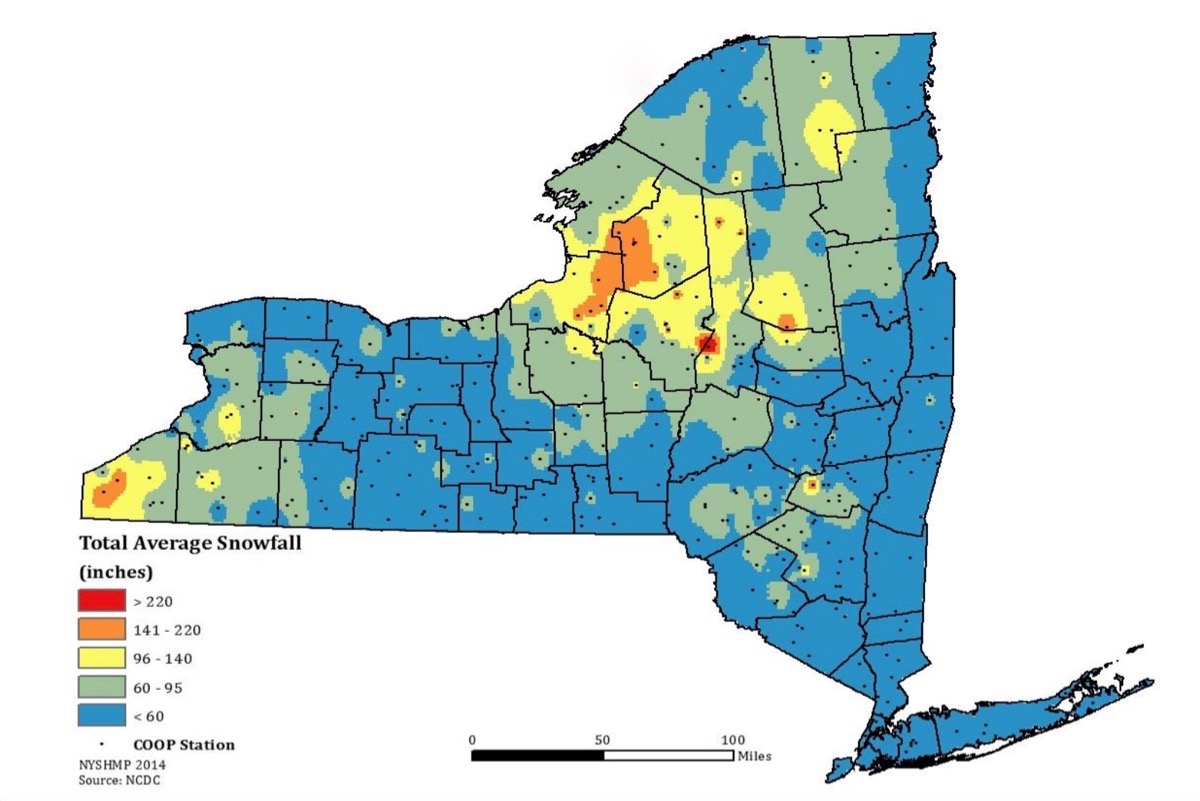
I grew up nearby. Being just downwind of Lake Ontario, Syracuse gets 10 feet of snow per winter. [0] If you're susceptible to seasonal depression, it's a rough place to live. Just 50 miles south (around Ithaca / Elmira / Binghamton), the winters get milder, still dark but less cold and snow.
For decades, the region has wanted for STEM employment opportunities. (It's the rust belt, a lot of industry moved away.) I get the impression Rochester weathered it better than Syracuse, even after the downfall of Kodak. Rochester feels a little more vibrant to visit. That said, to the extent Micron is willing to train people, I imagine they'll have an easier time hiring in Syracuse than a lot of other places.
As a reference, Boston averages 60 inches, which would put it at the lowest scale on this map. So, even the milder regions are still quite cold and snowy!
This seemed like an odd choice - having a chip plant in a small, beautiful tourist town. Then I clicked the link and boom - it's another place with the same name.
It's sometimes confusing how Americans repurposed city names wholesale without the "New" prefix. Most of them are tiny towns, as for example Paris, Texas made famous by the movie.
Of the larger ones, St Petersburg, Florida always weirds me out — it makes me think of Lenin giving a speech at Finland Station under palm trees, dressed in a white suit like Don Johnson.
dissapointed to see expansion in a high tax blue state with a trash tier record on gun rights. i can't find any mention of why they chose it, any ideas why?
edit: looks like water and seismic activity are the leading suggestions?
It shouldn’t surprise you that economic activity is focused in a blue state. Blue states (even at a county level) have the strongest economies and red states are the welfare babies, on average.
idk i've heard a lot of noise on companies paying for female employees to get abortions if they're unavailable in-state and imo it's a pretty good benefit in states with overly draconian laws. so i'm sort of hoping micron (and other companies who choose to expand in states that infringe on people's freedom) will announce a similar program to help employees access and exercise their gun rights.
He seems like a troll but it is curious that such a deal would go through this late in the election cycle, too late to affect races the way it could have in July.
With the exception of the Governor, most of the folks getting face time and taking credit for this either aren't up for election this year, or are running unopposed (or only facing token opposition).
sure, they're a big part of the reason i turned down an otherwise good position in new york state (along with higher taxes making it less competitive, not a big fan of the weather and don't much like the culture as a lifelong Texan).
Where's the logic here? Encouraging employees to abort their babies is in a company's economic interests so that's hardly a surprise. What makes you think gun ownership and use would be beneficial to them?
Replacing a dead employee is more expensive than simply setting up a company where your employees are more likely to stay alive. Also an employee proving their self defense case to the state will have fantastic retention due to the financial costs involved.
If avoiding dead employees is the goal, then setting up shop in a state with strict gun laws is the right decision. New York is consistently in the top-5 for lowest per capita firearm related deaths. New York scores very well for pretty much all preventable causes of death.
Probably a combination of water, seismic activity is not to bad, and blue states generally have better education systems and an easier time attracting educated people. Also NY has been trying to grow the economy in the area, they probably provided attractive incentives.
FWIW, I think NYC is more restrictive than NY state on the gun stuff. At least I know some avid hunters from rural NY, I don't think they have any issues getting hunting rifles, maybe they had to fill out some paperwork or something.
NY State is horrible for gun owners. The only difference between Upstate and downstate is that upstate prosecutors and county police openly violate and refuse the enforce the gun laws since they are so egregious.
Of course, in classic New York fashion the laws are still weaponized against minority groups and local enemies of the county government, which is precisely the reason they were introduced a century ago.
NYS is overall absolutely terrible for gun stuff. Hunting rifles and shotguns are easy, but the current process for purchasing anything semi-automatic and/or a handgun in very onerous. Over a year wait in most counties, years long residency requirements, you have to give up your social media accounts, submit various notarized statements, in-person interviews, etc. If I have a NYS CCW and you don't, I cannot legally take you to a range (or my backyard) and let you try out shooting a handgun. You need to go through the entire permit process before you can touch a handgun inside of NYS. And if you're not a NYS resident? No permit for you, they don't grant them to non-residents.
It's easier to buy handguns in most European countries than in NYS, and that's not a good thing. The entire process is made to be incredibly time consuming, expensive and frustrating, enough that most people will just give up and not do it.
That sounds like a reasonable set of policies, to be honest. Easy to get the kind of gun you would want as an ordinary working tool in the countryside or for home defense. Difficult and time-consuming to get the kind of gun you would want for a mass murder.
Semiautomatic rifles and pistols are the most commonly used guns for home and self defense by a large margin. Being behind a 2 year wait to perform the same background check the federal government can do in 30 seconds makes absolutely zero sense.
It's not a reasonable set of policies though, they're intentionally made to be burdensome and hard to comply with.
Background check: yes, fine. However, these need to be processed quickly to have any effect. If someone is flagged, don't we want to know that sooner rather than later, even if they're blocked from buying a firearm legally?
Submitting social media profiles: What defines social media? What happens if I forget a handle? Are political opinions now going to be a deciding factor in whether or not I can exercise a constitutional right?
No out-of-state licenses issue: There is no good reason for this. If I'm spending time (and money) in NYS, and can otherwise possess a firearm, why am I not allowed to do this when visiting?
No touching of a handgun without a pistol permit: Specifically targeted at making the process onerous. If you're interested in shooting, you need to go through this entire process, and will afterwards be allowed to carry a firearm in public, all before you've actually tried to shoot one (outside of the very basic live-fire training course). Potential law abiding gun owners are very very dissuaded by this.
Residency requirements: Again, no good reason. If I pass a background check, why do I need to live in X county for 3 years before I can buy or possess a firearm?
Drug testing: Nassau county now requires you to submit a urine sample within 14 days of receiving the permit application. The sample must go to a lab with a certain certification, and there are _none_ in NYS, and the fee is $400. If the test results arrive to the county after 14 days, or they claim they arrived too late? Start over and pay the fee again. This has to be repeated every 2 years.
On the topic of "the kind of gun you would want for mass murder": this is a boogeyman in the current media. There are ~400 deaths from _all_ semi-automatic rifles per year in the US, including suicides, justified shootings, murders, mass shootings, etc. There are tens to hundreds of millions of these weapons in circulation, yet so few deaths. More people drown in pools every year than die by rifle in the United States.
We should be looking at the causes of these mass shootings, not trying to make legal access to firearms logistically impossible for all but the wealthy and well-connected.
Don’t forget that Nassau county, NY is now requesting that people who upgrade their pistol licenses pee in a cup to test for drugs. True insanity in NYS.
Even worse: the lab certification that the testing facility needs to have? There are _no_ labs in NYS that comply. You need to go out of state within 14 days of receiving a permit application, to have the sample collected and processed, and the results sent back, within that 14 day window.
To answer your actual question though, the major reasons are access to cheap water (Lake Ontario), cheap housing, cheap/green power (lots of hydro and nuclear in the area), and low seismic activity. The location they selected also has quick access to both I-90 and I-81, the major east/west and north/south routes through the state.
The whole "blue state" thing also helps (blue states invest more in education, infrastructure, etc)
As a lifelong New Yorker who spent some time in Syracuse it’s bizarre to see. It’s a super sparse area with not much to offer.
Onondaga county is pretty decent on gun rights with regards to issuing pistol licenses quickly and having pro gun judges approve them, but you’re still within NYS which is a major headache. Would be better for companies to abandon the state altogether.


We have a lot of water in the area, and foundries are very water intensive. That was a smart long term play of Micron. Very happy to hear about this.