This feels less like it tells us anything about the world but more about how small the author's conception of it is. Reminds me of people who complain about how music is "bad these days" but they're only talking about what they hear on the radio and aren't really exploring what the landscape has to offer
A lot of what gets created is for functional purposes, and it has always been that way. As time goes on, the functional stuff gets torn down and replaced and anything that's appealing or well-built gets to stay. This gives the impression that the past was full of ornate, well-constructed wonders. But is and always has been an illusion
There were probably people 200, 300, 1000 years ago who thought "Everything is so ugly these days" or didn't care. It's not about what buildings look like, it's about how we live our lives
Exactly, music is absolutely incredible these days. In any genre you pick, you will find very inspired, innovative and beautiful examples.
Some people who say "music is bad these days" try to contrast pop music with 18th/19th century Western classical music. But that makes absolutely no sense because there are heaps over heaps of beautiful classical music composed in 21st century. You just need to go out there and find them. E.g. there are Unsuk Chin, Jennifer Higdon, Fred Lerdahl, Michael Torke, James Yannatos etc... There is no shortage of beautiful classical music produced today, if you care to look outside of household names.
Similarly, when people contrast pop music with classic rock (e.g. mid-to-late 20th century Rock and Hard Rock), I think they're once again failing to find the right kind of aesthetics. There are Greta Van Fleet, Heart, Black Rebel Motorcycle Club etc... All kinds of artists who make great Rock music. But since they're not mainstream anymore, they're not exposed to masses as much as Rolling Stones, Queen, Led Zeppelin etc...
Beyond the "good ol days", there's something to be said for mass popularity. When something has its moment, there's a magic in the air. A lightning in a bottle feeling coming from shared attention and excitement.
Sure, modern rock might be technically as good as classic rock, but rock doesn't rule the music world anymore. Honestly music doesn't really rule the entertainment world either.
People in the developed world usually point to the Internet and mobile phones as the most prominent example of big societal changes in their lifetime, and those are obvious picks, but I think the end of rock as the dominant (super-)genre of popular music is overlooked.
You're not wrong to an extent about the good stuff sticking around but I think you're missing the point. It's not like the aesthetics the author is complaining about were chosen for purpose like a farmer painting his barn red because red is cheap. The slice of the economic ladder from which the author cites his examples is mostly rich enough that small variations in cost or performance are not really a driver of styling trends. Widget designers and real estate developers are specifically choosing conformist blandness aesthetics on purpose, not simply tolerating them as a means to some other end.
> It's not like the aesthetics the author is complaining about were chosen for purpose like a farmer painting his barn red because red is cheap
I would completely disagree. "Rich enough" is mostly meaningless, there are a 1000 different subsystems running under this that make a slight deviation in a product increase in price massively. From laws and regulations on consumer products and housing rules, to what gets shipped overseas in massive container ships.
Go by a 'decent' wooden end table, it may cost you around $1000. Now go have a custom end table made to your specifications. Do not be surprised if it costs you an order of magnitude more and takes a year for an artisan to produce.
Modern costs are low because of mass production. When you can create 5 grey SKUs that cover 98% of the market and mass produce thousands to millions of them all of a sudden looking at producing a 'weird red' SKU is going to eat into your profits considerably unless you can recoup that by charging a much higher cost for that product.
I do woodworking and $1000 could get you a really nice artisan-made custom end table. Obviously depends on your specs but it’s hard for me to think of any specs that would make it more unless you were specifically trying to make it extravagant (some rare wood, gold inlays, etc)
The scale still holds true. For an order of magnitude less, around $100 I can get a perfectly workable end table that doesn't look horrible but is rather generic.
Honestly I meant to say dresser as they commonly start at $1kish for a decent one, but end table still works.
I agree with you and also think you're being uncharitable to the author's allegedly narrow-minded pov. I agree there's another side to all this but that's not necessarily discounted by the author's criticisms. We all know the reason not every new building can be the duomo di milano is because money. It's still arguably unnecessarily ugly and the money thing and all its 21st century quirks does indeed become a relentless drag on day to day life no matter how good you are at ignoring it or embracing irony. Worth having public discourse over it
Look at the buildings in this painting: https://fineartamerica.com/featured/view-of-washington-dc-ed... . Do they look exceptionally ugly?
To be fair they look almost exactly like the ones in the "old town" part of the city where I live (just more red and less orange), which is by far the most-visited part of my city (because it's pretty and also walkable).
People take pictures right outside of the places were I live. There are photography events in my neighborhood all the time.
The buildings in the painting sure look more appealing than the brand-new district in my town: https://www.lyon-entreprises.com/wp-content/uploads/confluen...
And yes, the past was much more ornate because architecture was a vector of communication -- administrative/state buildings and religious edifices in particular obviously. Which, as a side effect, produced beauty still revered millennia after its creation.
So maybe we should ask: what's modern ideology saying? And what does it says aesthetically? The answer is for all to see, and for all to debate.


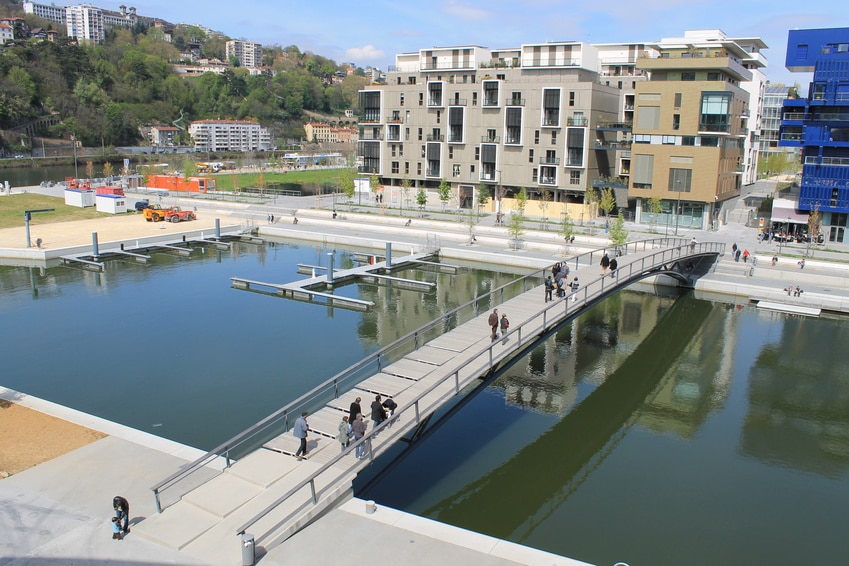
A lot of what gets created is for functional purposes, and it has always been that way. As time goes on, the functional stuff gets torn down and replaced and anything that's appealing or well-built gets to stay. This gives the impression that the past was full of ornate, well-constructed wonders. But is and always has been an illusion
There were probably people 200, 300, 1000 years ago who thought "Everything is so ugly these days" or didn't care. It's not about what buildings look like, it's about how we live our lives