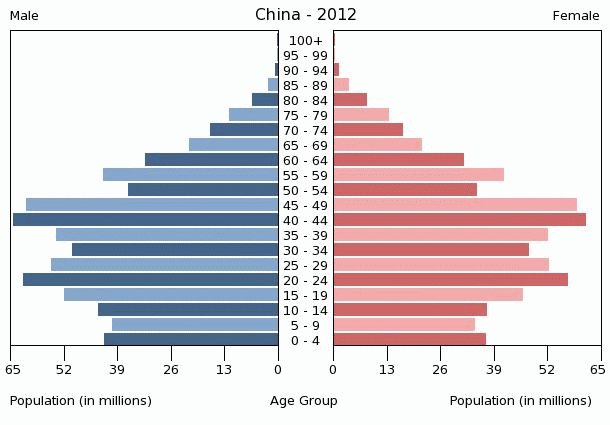
This is great news. One-child has huge negative social implications. When a family has only one child, that child gets showered with attention. In a society where this is nearly universally the case, effects of that develop into social norms. This includes selfishness, egoism, and a lack of sibling-like lifetime relationships.
and all the other resources are poured into one child instead of being spread around several children. Thus only child has higher IQ and development level than when there are several of them.
"A twenty-year tracking study of 3,000 high school students demonstrated that only children have higher IQs than their peers with one sibling -- in fact, "there are marked negative effects on IQ of increasing sib size."
--- end of citation --
There are also similar results of first child having higher IQ than second - as all the attention goes to him/her during the critical first years of brain development while second child doesn't have such undivided attention.
> "A twenty-year tracking study of 3,000 high school students demonstrated that only children have higher IQs than their peers with one sibling -- in fact, "there are marked negative effects on IQ of increasing sib size."
I didn't see any mention of household income in the NYT article. I'm interested to know if the researchers factored in household income because from what I've read, people with higher incomes tend to have higher IQs and fewer children, and intelligence is heritable.
the driver of adaptation, survival and progressive development of the species [and its civilization if any] are not necessarily the ones who live happy and prosperous life.
30+ years ago China made a choice between 2 alternatives - "1B population with IQ 135" or "2B population where 1B has IQ 130 and 1B has IQ 120" (the specific values 135/130/120 are just for illustration)
"By the end of the decade, demographers say China will have 24 million "leftover men" who, because of China's gender imbalance, will not be able to find a wife"
This will be an interesting thing to watch what will happen. Will women receive more power in society because they are more sought after? Will societies 'losers' unable to find wives become resentful and prone to violence or substance abuse? Will new types of un-orthodox relationships become more common? Will marriage/divorce rates increase/decrease? Will men leave for other nearby countries for a better chance at finding a spouse?
Will women receive more power in society because they are more sought after?
No, they'll receive even less power, because they become scarce goods and thus commodities and thus less empowered as people. The ability of a guy to get his pick of the women or maintain multiple women at the expense of other guys will become a status symbol, and nowhere in that picture does one see respect or empowerment for the women.
Will societies 'losers' unable to find wives become resentful and prone to violence or substance abuse?
Yep, as has always been the case.
Will new types of un-orthodox relationships become more common?
Depends what you mean by unorthodox.
Will marriage/divorce rates increase/decrease?
See point 1. I'd wager divorce rates will decrease, though marriage rates will increase (women should have no problem finding men).
Will men leave for other nearby countries for a better chance at finding a spouse?
Almost certainly, especially if the alternative is staying in a lonely environmental shithole.
I think you are missing a very fine point. The wealth gap in China is the only factor that comes into play. Men who cannot find a wife will almost always be in the working class. The middle and upper classes will be fine. Since China treats their working class so poorly, there will likely be no effect on their society socially.
One of China's biggest fears as a nation is the unrest among the working class. They are the backbone of China's manufacturing economy. This is the only thing I would worry about.
Marriage rates might follow the path of South Korea or Japan and fall precipitously anyway. Mostly because women earning major money don't seem to have the urge to rush into deeply patriarchal relationships.
I'm assuming they can just live normal lives? We have millions of males/females who choose to be single, so I don't see the entirety of this group being upset.
Exactly. If anything I think that there's a certain level of habitat healthiness that is taken on a subconscious level. People regulate their own numbers one way or another at some point (hopefully).
For cultural reasons, this is a recurring pattern in Chinese society. IIR my Chinese history lessons, it was usually followed by costly border wars and massive building campaigns to thin out the herd and quell domestic unrest caused by too many men milling about with nothing to do and nobody to do it with.
i think you mean polyandry. polygamy would make the problem worse.
most likely, the men will leave in search of a better life. or stay at home and cause trouble. or the government can organize them in some fashion - military would be an obvious one.
Does anyone know why ethnic minorities are exempt from the one-child policy? Considering all the ethnic-based political tensions in Western China, I don't see how this would be beneficial from the point of view of the Han-dominated government.
Most of the ethnic minorities are so small that their numbers are not threatening to the Han majority. On the other hand, forcing population control on ethnic minorities tends to make them really angry (even more than they already are) really fast. This is part of a wider policy in which, while the government is Han-dominated, its official policy is of neutrality in ethnic disputes, and it even professes a commitment to preserving minority ethnic culture and traditions.
By the article and Wikipedia entry, it sounds like this has been relaxed for most people around China already anyway (since it's handled by the provincial governments).
The best way to reduce human fertility (without child abandonment and forced abortions and other human rights horrors) is to educate the population and make them wealthy... at least to somewhat middle class standards. Then fertility drops to replacement level or near it, sometimes even below. This has been validated countless times in many cultures and seems to be a general pattern in human behavior.
China is slowly doing this, and will do so better if it can get its political corruption issues under control.
China's pollution is definitely a problem, but that stems mostly from corruption, lack of concern, and heavy industry that is largely done in service to customers not in China. The one child policy would not impact this much.
The problem with the "natural" approach is that then you have to deal with 1) natural increase in life expectancy, and 2) immigration.
Because of this, most European countries are still growing, albeit slowly. Japan has all but removed factor 2 and so its population is overall stable, but they're experiencing a slow shrinking of their working population (which brings a lot of economic problems).
They're slowly educating the population and making them wealthy, not slowly lowering the reproduction rate. The reproduction rate is low due to the one child policy. I imagine when the policy is dropped it may spike.
Poorly-regulated economic development is a much bigger problem for China's environment than population growth. Their fertility rate is around 1.5 and their population will peak in the next decade: http://www.economist.com/node/21553056. By 2050, China will be smaller than it is today, but if economic development continues will generate a lot more pollution and use a lot more energy.
In any case, India has managed to bring its population growth under control without resorting to such barbarism. Indeed, by 2050, India will only grow moderately more than the U.S. if current fertility trends hold. What's far more concerning is increases in India and China's per-capita resource and energy use, which could easily triple or quadruple their total numbers even with zero population growth.
Scientists centuries ago could not imagine our modern world, with people living vertically in the sky, in dense urban metropolises, eating frozen food, enjoying vaccines and generally having an awesome quality of life. Just as we cannot imagine advancements that have not yet come, and are led to believe we are doomed to starvation by our current mental constraints. Acting politically on this belief is incredibly dangerous and has contributed to many human atrocities over the years, including the Jewish holocaust, English subjugation and starvation of Irish potato farmers, China's misguided one child policy, and many more.
Be careful of this mental trap. If you'd like to see fewer babies, educate women and give them equality in the workplace and in political power.
Your comment deserves so much attention and praise, it's difficult to put into words. It never ceases to amaze me when I look around and see psuedointellectual arguments for shrinking the population (read: genocide), mandatory birth control, totalitarian systems of government. All to protect against some theoretical future event - global warming, running out of space, not having enough meat to put on our cheeseburgers. Technological advancement and human good-will has historically been way more than enough to thwart these dangers.
Look around. We're living in a world in which smallpox has been completely eradicated. Amazing! And peak oil? With all the advancements in solar energy coming out of our ivy league universities that seams so silly now. And yet we frequently hear so-called "enlightened" individuals calling for policies that immediately lead to suffering and death out of fear that the future holds certain doom.
Technological advancement and human good-will has historically been way more than enough to thwart these dangers.
Erm, that works well and good, until it doesn't, and then you're fucked.
The point is that these advances don't come in a timespan of weeks or months, but years or decades (or centuries!), and when we finally see a problem concretely manifest we may well have no alternative but very nasty population reduction--the trauma of which may result in a near irreversible backslide to barbarism.
"No matter what the technology, a sustained 2.3% energy growth rate would require us to produce as much energy as the entire sun within 1400 years." [1]
I recently came across this blog in an HN user's comment. I found the writing clear, detailed, and well supported with math. The author has a PhD in astrophysics, so I imagine he deserves greater credibility than a pseudointellectual.
So here's what this guy is arguing in the first post: as we extrapolate our current economic growth rate, we begin to run up against thermodynamic limits. Therefore, it's absurd to extrapolate that our economy will grow at the same pace forever. That is, technology can't fix everything.
I would agree that outright genocide is a bad idea. But I think population control has its merits.
On another note, can someone explain to me how the Irish Potato Famine was the result of population policy? As far as I know, the Irish screwed up because they put their eggs in a single basket. I don't see how this is relevant to eugenics.
A 2.3% growth in population for 1400 years would lead to a population of around 4.6*10^23 people. This has nothing to do with reality - the rate of population growth is decreasing and will continue to decrease as countries get more prosperous. The increase in economic output taking place right now goes both towards making people richer and supporting the increase in population. If population levels off, even at some ridiculous level like 50 billion (which it won't), there is absolutely no argument for 2.3% growth extrapolated anywhere near that amount of time into the future without some sort of change in economic paradigm.
The math is fine, the assumptions that undergird that math are terrible. You can see that in a lot of his blog posts. There's another [0] that argues that economic exploitation of space doesn't make sense because it is impractical to ship large numbers of people offworld - which is true, and supported by mathematics and physics, but barely touches (if at all) on things like space-based solar power generation and asteroid mining, neither of which depends on shipping large numbers of people offworld, as colonization presumably does.
The 2.3% figure applies to economic growth, not population growth. The blog argues that our economy relies on energy. In the next 1400 years, our supply of energy must inevitably plateau. Therefore, the economy's growth has an upper bound.
I was using the blog as evidence to support my argument. My argument was that once we hit the economic plateau, our quality of living will decrease if the population continues to increase. Therefore, perhaps eugenics (a la China's one-child policy) won't sound like such a bad idea in the future.
> but barely touches (if at all) on things like space-based solar power generation and asteroid mining
Again, he covers this in his first post via reductio ad absurdum:
> Let’s think big: surround the sun with solar panels. And while we’re at it, let’s again make them 100% efficient. Never-mind the fact that a 4 mm-thick structure surrounding the sun at the distance of Earth’s orbit would require one Earth’s worth of materials—and specialized materials at that. Doing so allows us to continue 2.3% annual energy growth for 1350 years from the present time.
> My argument was that once we hit the economic plateau, our quality of living will decrease if the population continues to increase.
This is totally irrelevant because (as I said) population growth is slowing down and the population is almost certainly not going to continue to increase forever. It's forecast that human population will max out late this century due to declining birthrates in countries that are growing wealthier; hitting the theoretical limits (e.g. max solar output) before then is so implausible it's barely worth discussing.
> Again, he covers this in his first post via reductio ad absurdum:
His assertion that SSP (and everything else) is impractical for sustaining 2% growth for a millennium is true, but practically irrelevant. Space-based exploitation can increase the plateau cap, allowing for higher standards of living for a future populace whose population is level or declining.
I hate to come off as anti-intellectual, but science is bound by the burden of proof and has no capacity to account for human ingenuity or dramatically different models of consumption, production and growth. Yet history shows we can expect precisely these kinds of changes, every time.
There is lots of writing and historical context for how Malthus and his theories influenced the day of the potato famine, google around for it and draw your own conclusions.
... to prove what exactly? That humanity will inevitably overcome the issues which overpopulation begets? That our population will plateau before we reach 250 billion if we close the gender gap? I feel like your comment was really vague, and you answered jrs99's question somewhat obliquely. So I don't know what you're arguing. But if your Amazon link is anything to go by, I assume you predict a decrease in the world's population.
Also, I don't think we can continue to extrapolate history as you imply. I used to think that our age was no different than any other age. I used to think "Humans have always had the same needs, right? Technology simply gives us more effective ways to satisfy them. Technology changes, but Humanity's needs have stayed relatively consistent."
Randell Munroe's project "Time" changed my opinion. To roughly paraphrase, "Whatever civilization comes next won't have fossil fuels to jump-start another industrial revolution." And I began thinking "Huh... I guess that makes sense. Fossil Fuels make us pretty unique, doesn't it? There's a pretty low probability that we'll find an energy source more dense and convenient than Fossil Fuel. Things like solar and fission are certainly nice. But if they packed the punch that Fossil Fuels did, they'd have dominated our economy already! So does Fossil Fuel represent a limiting reagent (chemistry term) on what Humanity can achieve?"
I think you and the astrophysicist can agree that something has to give. And perhaps closing the gender gap will plateau the population before we reach 250 bil. But given this fails and the population reaches 250 bil and we live in dystopia anyways (like jrs99 originally asked), do you still believe that eugenics are inherently immoral?
[I'll take up that offer and start reading up on the famine.]
I guess I am being vague, because my argument distills down to simple optimism vs. pessimism. I can't argue what is not known. We don't know what tomorrow's energy sources will look like. We don't know how to sustain two, five or ten times the population, let alone the exponential growth we've witnessed. Of course something has to give, and it will. Fossil fuels are unique, sure. And of course they are limited.
But imagine how limited people felt in the 1700s when their entire energy and food supply was simply the sun and arable land. I bet that felt rather absolute to them too. I mean, it's the sun. It's pretty fundamental and unchanging. What else could there be? Surely we can do the math on how much farmland there is to work and calculate possible yields and determine the maximum number of humans the planet can sustain. And what should be done with that number?
Yet centuries later we have shattered those limitations many times over, doubling and doubling and doubling the population again.
I don't mean to belabour the point, maybe we will transcend our current limitations (I think we will), or maybe we won't. But even if we don't, let resource scarcity cull and control population instead of policy.
The crux of the astrophysicist's argument lies in thermodynamics. Given the economic track we're on, the demand for energy will equal the entire output of the sun. Not merely the output of the sun that the earth's surface can capture, but 360 degrees' worth of electromagnetic radiation at 100% conversion efficiency.
I too recently thought that humanity probably overcome whatever problems the universe throws. But I don't see how humanity plans to "transcend" the laws of thermodynamics. The least far fetched idea I can think of is antimatter. But handling a substance that volatile somehow seems to me like a very bad idea.
You seem to be appealing to this notion that "There's so much about the universe we still don't know. What the future looks like is beyond our wildest imaginations."
Above is Isaac Asimov's essay The Relativity of Wrong. In a nutshell, an English teacher had expressed disapproval at Asimov's arrogance when he "had expressed a certain gladness at living in a century in which we finally got the basis of the universe straight." To which Asimov responded "[that the teacher] may be imagining that because all theories are wrong, the earth may be thought spherical now, but cubical next century, and a hollow icosahedron the next, and a doughnut shape the one after."
Humanity doesn't know everything. And maybe we never will. But at this point, we're pretty confident that we've gotten down the basics . I.e. Relativity may have replaced Newtonian Physics, but Newtonian Physics wasn't outright invalidated for everyday velocities. By and large, our scientific body of knowledge is logically monotonic. We'll augment our models, we'll refine our models, but it's unlikely we'll ever say, "Newtonian physics is, and always has been dead wrong. We have to start physics from scratch."
> But even if we don't, let resource scarcity cull and control population instead of policy.
And this is a different issue altogether, concerning ethics. As I said before, I think birth control policy is the better of 2 evils. The other evil being warfare resulting from abject poverty. Such policies would prevent a lot of needless pain and suffering. I'd rather live in happier world with less people than in a sadder world with lots of people. It's not like those unborn will mind, because they won't exist.
But maybe you think the parents will mind, or believe in the efficacy of natural selection. Our stances remind me of The Giver/Gathering Blue.
Terrible title for a great book that isn't nearly as alarmist as it sounds. If anything it covers how we're not breeding to replacement numbers and are facing labour shortages as our current population ages in the developed world.
I'm not saying that it's a good policy to limit children. But more to spark dialogue. It's an interesting question. What happens when there are 100 billion people on this planet, and if possible, what happens if one day there are 1 trillion people.
Does it one day make sense to say you can't have more than 1 kid? Is it amoral?
Yes for two reasons. A) You're telling other people what they can do with their own bodies, and that is fundamentally wrong (see the ridiculous abortion debate in the USA). B) It's impossible to apply the rules evenly and fairly, creating (at best) destructive social imbalance and (at worst) an opportunity for slippery-slope eugenics.
I don't think eugenics will be the biggest issue. At that point, I'm pretty sure everybody will openly declare war on everybody else over limited resources. Basically the Civilization V/Minecraft experiments. It'll probably happen sooner than we expect over bodies of fresh water.
i understand why you think it is amoral. However, your definition of something being moral or not is very different from someone else's. Someone might think it is amoral to abort at 8 months, while there certainly are many that think it is perfectly fine to abort at 8 months. Other people are certain that you are killing a human being.
My own view is that none of us actually knows whether it is moral or amoral to abort at any given month.
You have to really think of a world with hundreds of billions on it and how that possibly would change the morality of something.
China's "misguided" one chid policy came at a point where the extremely rapid population growth started in part thanks to Mao coupled with the massive other upheavals the party triggered had caused massive starvation and death.
While there are many issues with it, it also put the breaks on a population growth that was totally unmanageable, and frankly helped mitigate some of the effects of past atrocities.
It's easy to criticise, but it'd have been even easier to criticise the results of allowing the insane growth rate to continue unchecked.
I never said Malthusian theories were _the reason_, only that they contributed significantly. I'm not a PHD in this or anything, your google search result is as good as mine.
Centuries ago people could not imagine humans measurably changing the ph of the oceans, fishery collapse, global deforestation, anthropogenic climate change and an elevation in the extinction rate to rival the great mass extinction events of millions of years ago.
While I admire your resistance to knee-jerk doomsaying, suggesting we're just going to technology our way out of this mess without having to make tough choices about population is blinkered and myopic.