Imagine looking at a reactangle that gets thinner and thinner until it's just a straight line. And then imagine that you shift your point of view, to see that actually that line has depth, and from the side the "line" is actually a new rectangle.
It's not as though the new rectangle suddenly appeared: the new rectangle was always there as one face on what you now realise was a cuboid. However, from your original perspective you couldn't see that face.
This example is not exactly the same as what's described by CCC: I don't know if you could describe each universe as having "new dimensions", and instead of shrinking, each universe is stretching out to infinity, but the "change of perspective" part is a useful analogy I think: each universe only looks like it starts at a single point if you observe it from the the right frame of reference. If you could somehow observe our big-bang from the reference frame of the prior universe it would be indistinguishable from an infinitely spread-out empty universe.
According to CCC (AIUI), all of the infinitely many future universes have already started, but each universe will end before even an instant of time has elapsed for the next universe: that is, "time" as measured in one universe is on an entirely different scale from "time" in another universe.
> According to CCC (AIUI), all of the infinitely many future universes have already started, but each universe will end before even an instant of time has elapsed for the next universe: that is, "time" as measured in one universe is on an entirely different scale from "time" in another universe.
This is superficially similar to the hyperreal numbers, where you can have a set of numbers up to infinity that is strictly less than another similar infinite set.
Is time longer (or shorter) in the next universe? That is, if we could compare seconds or minutes, would the ones in the next universe be longer or shorter?
You could either look at time in the next universe as being infinitely longer, or you could view it as being an entirely different axis from time in the current universe.
I suspect that physically, or even mathematically, it's impossible to draw a distinction between those two descriptions.
I think the argument is that once time stops being meaningful, distance does to, and then “the universe has infinitesimal size and is very hot” is no longer distinguishable from “it is massive cold and empty”.
Massive caveat: I’m not a physicist, and I regularly misunderstand “merely” relativistic physics.
Very interesting idea! Do you have any insights into what then determines the total mass of this new born, infinitesimal, hot universe?
From the infinitely huge and empty universe is born a new universe, but it has some finite total mass. I wonder what describes the amount of mass the empty universe turns into when a new cycle starts.
What you more likely mean is the "absolute" total of both positive and negative energies in the form of light/matter versus gravity respectively. Reminiscent of absolute convergence from mathematics [1]
Amount of gravitational energy is proportional to light/matter, so in theory, we should only need to solve for one thing - the amount of light/matter or the amount of gravity. Since gravity is non-renormalizable (mass -> gravity -> mass -> ........ -> gravity), it's not clear whether gravity or light/matter is more fundamental. They are clearly coupled but one doesn't necessarily cause the other.
Note that the zero-energy universe is highly speculative; in particular there is no good way to define the total energy confined to a volume at large scales and it's hard to say that "energy is conserved" in any way that's nontrivial. (A ready example is the apparent loss of energy in the redshifting of light due to Hubble expansion.)
He doesn't say it's a new universe, e.g. in an interview with Lex Fridman[1] he calls that out and says it explicitly isn't a separate parallel universe. It's more an argument that if you don't have mass because all the mass has decayed, through Einstein's relation of mass and energy and Planck's relation of energy and frequency, and frequency involving distance and time, with no mass, you lose notions of distance and time. Then the infinitly large distant future universe and the infinitely small distant past big bang become indistinguishable with the loss of "large" and "small" to distinguish them. They are both "at infinity", they both "contain" all the energy in the universe, and what we see as a tiny big bang, aliens on the other side saw as a huge expanded universe.
From what I (layperson) can tell, it's like the expand/crunch cyclic universe theory, but without the need to crunch back down again.
What I get from this, and I might be totally misunderstanding, is that we can see it loosely as "zooming out" (or the sake of simplicity) with each iteration, until you're looking at a tiny universe again? So that large vs. small is just a matter of viewpoint.
I'm not sure how to interprete it in that sense, or what the math looks like, I have only Roger Penrose saying "the math checks out" to go on.
Sounds like you're asking "is it really getting bigger endlessly and we take a larger distance as the unit value each cycle" and if so, that feels like the wrong kind of question when talking about distance not existing, but I don't know anything deep about it I've only heard him talk about it in interviews.
I don't really get why you can't reason the other way and say if there are photons and light, then there must be frequency, distance and time, therefore energy, and therefore mass. Heck, maybe that is the same reasoning; there, at the place of infinity, is all the energy and mass which ever was in the universe, all in one place. And what do you get when the whole universe is all in one place? A big bang? Transforming from matter to light (via stars burning and eventually Hawking radiation from the last things remaining: black holes) carries all the energy in the universe off into the distance. Where does it go? Off into infinity. If you take infinity as a place that means it all goes to the same place? Then that process is the "collapse" which brings everything together into the same place ready to be turned into matter again? That's my pop-science understanding of his proposal.
Well, that's not exactly fair; it does make testable predictions, which is nice, and they should be the kind of thing that we would notice anyway (IIUC) as we get bigger and better tools, which makes it cheap to test, which is also nice.
I agree that it's probably not THE ANSWER, though!
mostly hand waving (or quantum fluctuation, or branes, or something like this).
But, since the universe started once, and we are not sure how it got started, there is a chance for something like it to start again.
We will never know, but we do know that universes do start somehow, and the potential ability to detect previous/past universes is very intriguing for sure.
I don't think this is the argument. For someone "inside" the universe it may take an infinite amount of time (as in it will never be observed); however, for some observer in the future it will appear an infinite amount of time ago. Because angles are preserved for all infinity of time there is some information transfer.


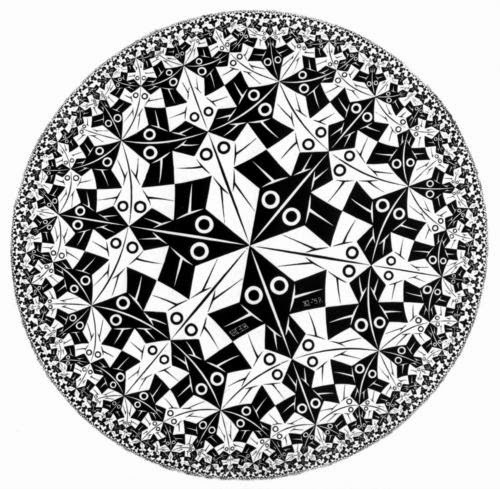
This is the part I don't get. A new universe starts how? Is it just hand waving or is there some sort of explanation for how a new singularity forms?