Imagine looking at a reactangle that gets thinner and thinner until it's just a straight line. And then imagine that you shift your point of view, to see that actually that line has depth, and from the side the "line" is actually a new rectangle.
It's not as though the new rectangle suddenly appeared: the new rectangle was always there as one face on what you now realise was a cuboid. However, from your original perspective you couldn't see that face.
This example is not exactly the same as what's described by CCC: I don't know if you could describe each universe as having "new dimensions", and instead of shrinking, each universe is stretching out to infinity, but the "change of perspective" part is a useful analogy I think: each universe only looks like it starts at a single point if you observe it from the the right frame of reference. If you could somehow observe our big-bang from the reference frame of the prior universe it would be indistinguishable from an infinitely spread-out empty universe.
According to CCC (AIUI), all of the infinitely many future universes have already started, but each universe will end before even an instant of time has elapsed for the next universe: that is, "time" as measured in one universe is on an entirely different scale from "time" in another universe.
> According to CCC (AIUI), all of the infinitely many future universes have already started, but each universe will end before even an instant of time has elapsed for the next universe: that is, "time" as measured in one universe is on an entirely different scale from "time" in another universe.
This is superficially similar to the hyperreal numbers, where you can have a set of numbers up to infinity that is strictly less than another similar infinite set.
Is time longer (or shorter) in the next universe? That is, if we could compare seconds or minutes, would the ones in the next universe be longer or shorter?
You could either look at time in the next universe as being infinitely longer, or you could view it as being an entirely different axis from time in the current universe.
I suspect that physically, or even mathematically, it's impossible to draw a distinction between those two descriptions.
I think the argument is that once time stops being meaningful, distance does to, and then “the universe has infinitesimal size and is very hot” is no longer distinguishable from “it is massive cold and empty”.
Massive caveat: I’m not a physicist, and I regularly misunderstand “merely” relativistic physics.
Very interesting idea! Do you have any insights into what then determines the total mass of this new born, infinitesimal, hot universe?
From the infinitely huge and empty universe is born a new universe, but it has some finite total mass. I wonder what describes the amount of mass the empty universe turns into when a new cycle starts.
What you more likely mean is the "absolute" total of both positive and negative energies in the form of light/matter versus gravity respectively. Reminiscent of absolute convergence from mathematics [1]
Amount of gravitational energy is proportional to light/matter, so in theory, we should only need to solve for one thing - the amount of light/matter or the amount of gravity. Since gravity is non-renormalizable (mass -> gravity -> mass -> ........ -> gravity), it's not clear whether gravity or light/matter is more fundamental. They are clearly coupled but one doesn't necessarily cause the other.
Note that the zero-energy universe is highly speculative; in particular there is no good way to define the total energy confined to a volume at large scales and it's hard to say that "energy is conserved" in any way that's nontrivial. (A ready example is the apparent loss of energy in the redshifting of light due to Hubble expansion.)
He doesn't say it's a new universe, e.g. in an interview with Lex Fridman[1] he calls that out and says it explicitly isn't a separate parallel universe. It's more an argument that if you don't have mass because all the mass has decayed, through Einstein's relation of mass and energy and Planck's relation of energy and frequency, and frequency involving distance and time, with no mass, you lose notions of distance and time. Then the infinitly large distant future universe and the infinitely small distant past big bang become indistinguishable with the loss of "large" and "small" to distinguish them. They are both "at infinity", they both "contain" all the energy in the universe, and what we see as a tiny big bang, aliens on the other side saw as a huge expanded universe.
From what I (layperson) can tell, it's like the expand/crunch cyclic universe theory, but without the need to crunch back down again.
What I get from this, and I might be totally misunderstanding, is that we can see it loosely as "zooming out" (or the sake of simplicity) with each iteration, until you're looking at a tiny universe again? So that large vs. small is just a matter of viewpoint.
I'm not sure how to interprete it in that sense, or what the math looks like, I have only Roger Penrose saying "the math checks out" to go on.
Sounds like you're asking "is it really getting bigger endlessly and we take a larger distance as the unit value each cycle" and if so, that feels like the wrong kind of question when talking about distance not existing, but I don't know anything deep about it I've only heard him talk about it in interviews.
I don't really get why you can't reason the other way and say if there are photons and light, then there must be frequency, distance and time, therefore energy, and therefore mass. Heck, maybe that is the same reasoning; there, at the place of infinity, is all the energy and mass which ever was in the universe, all in one place. And what do you get when the whole universe is all in one place? A big bang? Transforming from matter to light (via stars burning and eventually Hawking radiation from the last things remaining: black holes) carries all the energy in the universe off into the distance. Where does it go? Off into infinity. If you take infinity as a place that means it all goes to the same place? Then that process is the "collapse" which brings everything together into the same place ready to be turned into matter again? That's my pop-science understanding of his proposal.
Well, that's not exactly fair; it does make testable predictions, which is nice, and they should be the kind of thing that we would notice anyway (IIUC) as we get bigger and better tools, which makes it cheap to test, which is also nice.
I agree that it's probably not THE ANSWER, though!
mostly hand waving (or quantum fluctuation, or branes, or something like this).
But, since the universe started once, and we are not sure how it got started, there is a chance for something like it to start again.
We will never know, but we do know that universes do start somehow, and the potential ability to detect previous/past universes is very intriguing for sure.
I don't think this is the argument. For someone "inside" the universe it may take an infinite amount of time (as in it will never be observed); however, for some observer in the future it will appear an infinite amount of time ago. Because angles are preserved for all infinity of time there is some information transfer.
Which of these 6 bullets is fringe? For example, is your first point "you need mass to have time. Massles particles don't experience time" a fringe concept?
The fringe idea is that a heat-death universe looks homogeneous and the Big Bang also looks homogeneous and so maybe we could potentially hook up the t=0 of one universe with the t=∞ of another and get rid of the “well but it takes infinite time to get from one universe to another” by handwaving of “yes but no particle in that universe actually experiences infinite time because they all become massless eventually, so it effectively takes finite time.”
Like, the principle that massless particles cease experiencing time itself is fine, albeit kind of hard to think about (it is a negation of an idea; because they don't experience time they cannot “experience” anything, so I could tell you that “they also see the entire universe except for the thing that emitted them as one point/ray straight ahead of them” but I mean they don’t actually “see” anything so I am describing a limiting behavior here).
Whether you can stitch universes together like this is very very fringe but props to him for being a physicist and looking for some sort of observable consequence of a theory that could have otherwise just been a “yeah the math could go either way on this, think of it that way if you want to but there is no pressure.”
I don't think passing through "infinite time" is a fringe concept in modern physics. It is well accepted that passing the event horizon of a black hole involves traveling through infinite coordinate time from the perspective of an outside observer; however if you change your coordinates to that of the object falling into the black hole, you will see that it takes finite time to pass the horizon.
I think that’s almost it, but not quite (big grains of salt here, I’m trying to remember a talk from a decade ago). I went to a talk of his, and iirc it wasn’t stitching t=0 to t=infinity. It’s was stitching t=0 to t=big enough to be homogeneous enough, but there are still itty bitty remnants of patterns left that might be detectable today.
He reuses a lot of his slides, the one that I have a picture of speaks about taking the boundless expansion and performing an “∞-compression” which I am taking to be a conformal rescaling of the state of the universe at infinity, but I must cede to you that this may be a misunderstanding because he also says on this slide that the Big Bang involves an “∞-expansion” and he certainly doesn't believe that the Big Bang was an infinitely long time ago. In any case what I remember beyond this was that he figured that the expansion at the end of a universe could be used to locate the “cosmic inflation” of a universe _before_ its Big Bang, in the heat death of the prior universe, and it was my impression that it was this “evolution to infinity” of the prior universe but I might be totally mistaken.
Curious. Would you think that if Penrose is correct, that each subsequent universe's timeline would be deterministically exact replays of the former universe, or would they have some degrees of freedom to develop differently?
I mean, whether it’s deterministic is really hard. We’re talking about extensions of quantum field theory and there have existed both deterministic and nondeterministic accounts of quantum mechanics, the deterministic ones generally lagging the nondeterministic ones substantially.
But whether it’s _exactly the same_, I think Penrose would say that they are _almost never_ the same. The question would be whether the Big Bang of this universe is perfectly mirrored in its final state and I think Penrose would say “well all the stuff that happened in the middle probably had some sort of effect on how the thing ended up.” So if we are seeing the black holes of some other universe’s death writ large on our cosmic microwave background, then I can’t imagine our black holes will eventually look exactly the same, will they? (Keep in mind, I’ve only met Penrose once and I embarrassed myself thoroughly at the time, so my guesses about what he would say are terribly terribly weak predictions.)
But maybe they will be the same. I talk a lot on HN about the impact of fixed-point theorems on US politics, but they would also apply here. If the universe has an infinite number of sequences one might expect that it starts to converge on a situation where the black-hole-patterns in are the same as the black-hole-patterns out. Now if that happened one might imagine that, if that fixed point supports life, then there is an infinite replay of nearly-identical life experiences across the many many eons of universe, and then if we treat our existence as “choose a conscious person across the eons to be” we would almost surely randomly choose someone in the oft-repeated universe. And so yes, we would be very likely to say that our universe's end would lead to another universe wherein the exact same people living out the exact same lives having the exact same discussion on Hacker News, haha.
I am a Christian and so these sorts of things are a sort of idle speculation, a joke to laugh at rather than something to inform today’s experience, a slacking-off between meetings rather than a contribution of deep value. But it’s certainly fun and funny to think about.
Maybe the previous universe's black hole evaporation ripples cause enough chaos effect for the new universe to be different so even though the whole system is deterministic, it could always be different because of that effect. We live in a PRNG.
Edit: OOh I have an idea. What if the quantum effect is deterministic but appears random we experience are in fact ripple effects from the previous universes? Has anyone ever tried to measure quantum behavior in multiple simultaneous experiments in a kind of geometrical matrix system to see if there are shapes of correlation?
1. Fringe as in the edge, something completely new very few others are pursuing: idea or viewpoint which differs from the accepted scholarship in its field.
2. synonym for pseudoscience.
CCC is fringe in the first sense. It's not my or other layman job to join discussion or have an opinion. We can just watch the discussion. It does not seem to make sense to other physicists. The observational parts are also questioned. https://www.preposterousuniverse.com/blog/2010/12/07/penrose...
> is your first point "you need mass to have time. Massles particles don't experience time" a fringe concept?
The way it is stated, yes.
A correct statement of an innocuous truth of relativity is that the concept of "elapsed time" doesn't apply to massless particles at all. It only applies to particles that travel on timelike worldlines, and massless particles travel on null worldlines.
However, that correct statement does not imply either that massless particles don't experience time, or that you need mass to have time. Null worldlines in different directions can be used to define time.
In view of my other comment, I should make clear that I don't actually think the first bullet is necessary to Penrose's model. If "time passes" during the period after all black holes have evaporated and before the cosmology "recycles" itself, that does not seem to me to be a problem for the model. (Which of course doesn't mean the model is necessarily right, just that this particular issue doesn't seem to me to be a problem for it.)
The first point is a simple consequence of Relativity, and is as non-fringe as it can be. In fact, there was a nice youtube video about it recently… here: https://www.youtube.com/watch?v=HU6t8QvGZmA
Particles with mass decaying to massless is pretty fringe. To my knowledge, there are no mechanisms for electrons to decay (except for meeting a positron, I suppose).
According to Hawking, they will all eventually evaporate. For supermassive black holes speculated eventually to swallow galaxy superclusters, this will take on the order of 10¹⁰⁶ years.
I think the lack of any remaining mass is exactly what leads into a timeless infinity (heat death), which is then, from a reference point outside the universe, indistinguishable from an infinitesimal singularity, which can then kick off a new big bang.
1) so much non-fringe it boggles my mind. This is basic.
2) let's say 50% fringe, at most.
3) 25% fringe. Most of the relevant science buys into this, and not just b/c it sounds nice.
4) Reasonable conclusion, if the stated theory was true. 25% fringe.
5) This is a multiplication of uncertain conclusions, so let's go with 75% fringe.
6) A conclusion of 5), which would be detectable. At most as much fringe points as 5), since it can be falsified.
There's always wikipedia to grasp basics, and then there's Ethan Siegwl with Starts with a Bang, and if you're still interested there's a lot more including astronomy and physics papers. astronomy.stackexchange.com, physics.stackexchange.com and even your local university.
Edit: Since this has been downvoted, I'm genuinely interested in the reasons and especially the facts you obviously have which I don't. Please let me know where I was wrong!


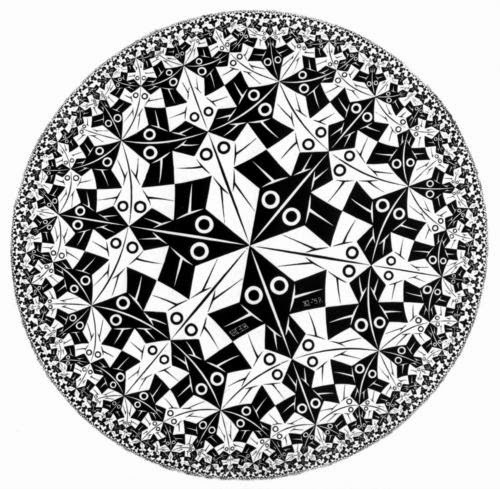
* you need mass to have time. Massles particles don't experience time.
* black holes eventually evaporate due to due to Hawking radiation. 10^100 years or more.
* after particles with mass and black holes have decayed, universe continues to expand without event until infinity.
* signal left from black hole evaporation travels as massless particles to the infinity.
* New universe can start after infinity (aeon). Angles are preserved in conformal geometry but not the distances. New universe starts small.
* You might be able to see the signature of the black holes from the old universe in the cosmic microwave background.