A very sad day for everyone in Europe. The EU is not only about trade regulations, but about a continent who had a not very peaceful history finally growing together. The freedom of movement for European citizens was not only "convenient" but in fact an important civil right. When you live or have a business in one state of the US, you are bound to local regulations of course, but being part of the US granted you a lot of fundamental rights and freedoms. In my eyes, the EU was very much about the same thing. It didn't matter in which part of the EU you lived or had your business. Being part of the EU granted you rights and equal access to the rest of Europe.
The EU in my eyes should aspire, to what the US has achieved already, being a large region, composed of quite a lot of different states, which are united, so that there are no arbitrary geographic borders limiting the freedom and the rights of the individual. This is not always easy, and it means, that the richer parts have to give to the poorer, but that is just basic humanity.
Especially I am sad for the young generation in the UK. A very large part (about 75%) voted to stay in Europe, and this future is taken from them. I would guess no small part of them will try to move to the remaining EU states.
The US did not magic itself into existence as a united state. It began in common purpose with a shared, very strong, external enemy. It then assigned itself a shared dream of settling the content. And, crucially, it already had a shared cultural identity, shared language, and shared religion when it began.
The EU does not have a common enemy to force it together. It does not have a shared language, or culture, or identity. Its dream, while noble, does not speak to ordinary people. And it is pretty damned incompetent at what duties it has assigned itself.
The prospect of a United States of Europe was extremely remote even before today. It's dead, now.
I don't agree with that, the EU has a very strong cultural union that was created by the enunciation of the French Revolution principles. It's not by accident that, for example, there is no state in EU with death penalty. This makes states within the EU very similar at certain levels, otherwise a claim could be made that the cultural delta is the same between two different EU states and between an EU state and US, but this is not true, if you check a bit the fundamental values you'll see that EU nations have a lot in common.
Careful with the French Revolution. I'm sure you know but I was an adult before I understood how insanely brutal that thing was, not only towards former monarchy and nobility but also, or possibly even especially, towards common people.
The revolution set the stage for the modern world though, a world separated in sovereign states (instead of kingdoms) the three branches government etc. etc. For countries that are hanging on the edges of europe, which weren't strongly ethnically homogeneous, like my country, Greece, that style of government was vital for the definition of the nation.
That said, let's not derail the conversation with irrelevant historical anecdotes that are out of time anyway.
The revolution set the stage for the modern world though, a world separated in sovereign states (instead of kingdoms) the three branches government etc
I'm fairly certain that the US was already independent and had adopted the current Constitution by the time the French Revolution happened.
Well, sorry to say this (it might offend Americans), but nobody important at the time really cared. Except for Britain, as the directly involved party. The US at the time was a minor player and its independence and democratic process didn't really affect a lot of people. Abraham Lincoln, ~80 years after the American Revolution was replying to San Marino's government along the lines: you are the only fellow state in the world (San Marino being the oldest republic in the world) in this period of turmoil (i.e. Civil War).
The French Revolution was the event that kick-started the spread of democratic ideas and regimes throughout the Old World. It brought about the downfall of the medieval regimes, the abolition of serfdom and slavery, etc.
The American Revolution was more of a symbolic event at the time. On the other hand the fall of the French monarchy was a colossal event at the time: the new French Republic was continuously attacked by all its neighbors to prevent the dangerous ideas from spreading.
The main difference is that the French Revolution overthrown the old Order.
If you read Tocqueville, he actually clearly comment on the difference, and even impressed with American institution or people, he says that it only works because it was basically a blank slate, and does not believe it could work in Europe.
The American independence did not endanger that much the British Monarchy or British Empire (who happily went on to be the first world power in the XIXth century)
Well, Poland was inspired to adopt a democratic constitution in 1791 and the speed with which its neighbors invaded probably shows that they cared about the spread of democracy too in a more negative way. But yes, that wasn't as significant as the French Revolution.
Ironic that the Poles set themselves back by electing their new right-hardline leader, who immediately moved in to take control over the national television, don't you think?
The elected official in question actually saw no problem with that. To make matters even "better", he is stuck to communist regime / fascist methodology of tightly controlling television and radio... in the age when everybody is on the Internet... awesome!
I know of another guy, over in Turkey, who works the same way... Ataturk would be turning over in his grave if he saw what that other guy is doing in the country he founded.
Anyway, when is Poland holding the referendum on leaving the european union?
Sorry, but you are very misinformed about current events in Poland, as well as the broader geopolitical context. The current party has for the most part used methods that have been employed by every government in Poland since 1989. Purging the national media is standard practice (please see what the previous party did, or the numerous shocking scandals it was involved in). Worth noting is that Polish media are owned (~80%) by German media conglomerates Bauer and Axel Springer which means that the mainstream media are largely pro-German. That is a far more worrying state of affairs than the recent tradition of purges and political jiggery-pokery. I won't get into all of the details, but Poland faces numerous challenges that the Western media never discuss, leaving Westerners horribly misinformed about what's actually happening or why it's happening. What Chomsky calls neoimperialism is very much a factor.
> Ataturk would be turning over in his grave if he saw what that other guy is doing in the country he founded.
Well Atatürk was not exactly a saint, for example I've just learnt the history of İzmir, which had a large Greek population who had been living there for generation and was relocated to Greece after the Greco-Turkish war.
Some of the events around the revolution and the subsequent foundation of the Turkish Republic would now be considered ethnic cleansing now. And the man is still worshipped in Turkey (at least in parts of the country that don't have an AKP majority). In İzmir there is even a Mount-Rushmore-like statue with his face.
This is not to say that Erdoǧan is better, far from it. But Turkey is a complicated country with a complicated history and talking about Kemalists vs Islamists as if they were good guys vs bad guys is a bit simplistic.
Simón Bolívar (born 1783) was an extremely important historical figure. Much of Latin America threw off their European oppressors in part through inspiration Bolívar took from what the Americans accomplished in getting rid of the British.
Clearly the American Revolution was far more than symbolic: it directly, entirely reshaped both North and South America.
And isn't it ironic that this name was used to re-enforce Hugo Chavez's "Bolivar Revolution" aka dictatorship. Now Venezuela is in shambles and the poor people can barely afford food when the government controls more proven oil reserves than Saudi Arabia.
Forget the excessive gerrymandering or his successful change to the Venezuelan constitution which allowed for him to be reelected indefinitely. He was indeed a lot of things, but his legacy will be mismanaging a country with enough natural resources to be one of the richest countries in the world. He was an authoritarian dictator. Faux democracy with fake votes and a press which is govt controlled and a leader that wants to run forever is a dictatorship no matter how you skin it.
Many of your critiques apply to many countries considered democracies. Excessive gerrymandering is an issue in many democracies including the US. Not to mention that in the US minorities are specifically targeted for exclusion. A lot of countries don't have term limits for heads of state (for most of its history the US didn't). Press freedoms aren't what defines what a dictatorship is either. Would Saudi Arabia be a democracy if suddenly all censorship laws are purged from the books?
> Except for the time he lost, and within two days a military coup of the democratically elected body put him back in power
LOL. The coup was done against him after being democratically elected in 2000 but it failed disastrously, making him some kind of a folk hero in most of Latin America. If you don't know this basic fact you really have no business talking about Venezuela, let along calling Chavez a dictator just because you didn't like the guy. Venezuela had many chances of getting rid of him democratically and they decided not to, we all can disagree about how wise a decision it was but that is different matter.
The US independance was completely inspired by the "Lumières" (the philosophical movement of the Enlighteners), which originated in France and led to the French revolution as well as the emergence of true democracy accross Europe. So even if the US was already independant by the time the French Revolution happened, this is only because it was way more complicated to achieve the latter. But let's not be mistaken about its origins.
There was a lot of inspiration the other way too, though.
Here are two little instances I came across recently where the french copied their rhetoric and symbolism from America:
In 1787 Thomas Jefferson said, "The tree of liberty must be refreshed from time to time with the blood of patriots and tyrants". Then in 1793 Bertrand Barère, in an influential speech to the national assembly advocating execution of the king, repeated "The tree of liberty grows only when watered by the blood of tyrants" . In French sources the quote is often (incorrectly) attributed to Barère only.
Similarly, during the American revolution, Americans raised symbolic "liberty poles" in their towns. Directly inspired by this, during the french revolution most cities raised and decorated "Trees of Liberty" in their central squares. King Louis even stooped to visiting and honoring the one in Paris to appease revolutionaries (it didn't help).
(The French took the idea of "watering the tree of liberty with the blood of tyrants" quite literally).
Let's not make nonsensical statements like US independence was completely inspired by the Lumières then.
Most notably, US independence was also inspired by the Glorious Revolution in England (the American Bill of Rights is even based on the English Bill of Rights), about a century earlier.
"The Lumières (literally in English: Enlighteners) was a cultural, philosophical, literary and intellectual movement of the second half of the 18th century"
Yes, but the original claim was that the French Revolution codified the idea of the separation of powers, which is clearly false. The evidence of that is that America already existed with this structure and was obviously known to the west.
Democracy was also known in Greece a couple thousands of years prior. As others have stated, the ideas were the ideas of the enlightenment and while America was a wonderful project, it wasn't the real example to show that these ideas could work -- the French Revolution did that.
Except it didn't work. After overthrowing the monarchy, France went through a number of highly unstable governments until Napoleon ascended to the throne in 1805. That period was called the Reign of Terror for a reason. If you were suspected of being a counter-revolutionary, you could be executed without trial.
After Napoleon's defeat at Waterloo, the French monarchy was restored. When the Second Republic was established after the revolution of 1848, Napoleon III quickly abused his uncle's popularity to establish another dictatorship within five years. This lasted until 1870.
He's right. In a dichotomy of revolutionaries vs. monarchists, Napoleon is definitely seen as the former. It's not really as simple as democracy vs. lack thereof. Many of the most radical revolutionaries were extremely undemocratic. At times during the Revolutinary period even suggesting democratic measures (like implementing the Constitution) could get you killed.
The Franco-American Revolution created via violence or a new model of governance who's moral authority wasn't challenged until the Russ-Sino Revolution nearly 100 years later which was also violent.
Why does HN pretend political revolutions are peaceful?
> Why does HN pretend political revolutions are peaceful?
So HN is a single-minded entity? Just because a couple of people say something you don't like, you paint all of HN, with its 1000s of members, with that?
The UK does not have that shared French Revolution tradition at all, and neither do a large number of European countries that are still monarchies. Instead of a violent French Revolution, the UK had a nonviolent change of power from royalty to the people. Instead of a civil war over slavery, the UK had a peaceful transition where the state bought the slaves from the slave owners. This referendum fits in a great tradition of nonviolent change.
The UK abolished slavery, and even fought commonwealth territories that resisted. Maybe if parts of the US had still been in the commonwealth, slavery would have ended sooner there too.
Let's be honest, it is actually the brutality of the French revolution which forced the British royalty to hand over power to the people. And before doing these "peaceful" transitions, all neighbouring countries tried to smother the French with war in order to preserve the priviledges of the remaining monarchies.
You kinda throwing the thousand years of gradual maturing of democracy in UK out of the window with that common. The "royalty" didn't suddenly give power to the people after seing horrors of French revolution; it happened over ages of internal conflicts and civil wars.
So you are implying that a add-hoc democracy like in the cold war country's or post-war Germany, is not a real democracy? Cause it had no time in the barrel, going to the irish-famine, the scottish conquering s, the Falkland wars, the opium-wars. Dear god, what uncivilized undemocratic huns we outsiders are.
And nothing off value got lost.
Hrm, England had its own bloody Civil War, and if that wasn't enough there was also the Glorious Revolution. These were the 2 events that ultimately gave political power to the parliament.
If you look at the way Western Countries transitioned from one form of govt. to another its seems to have been very bloody. Glorious Revolution, French Revolution, American Revolution, German Revolutions, Russian Revolution etc.
> nonviolent change of power from royalty to the people
So regicide doesn't count as violence? Also, as mentioned down-thread, we had a pretty bloody civil war here, which replaced the monarchy with a 'Lord Protector' which ultimately amounted to the same thing by another name and so we decided the monarchy wasn't that bad, as long as parliament kept the worst excesses in check.
What on earth are you talking about? Not only did the UK have the 'French Revolution tradition', it's arguable that they got there first. I take it you're not that familiar with the English Civil War...
Not that England/Britain didn't have their own bloody, violent civil wars along the way to get there. The English were ahead of the curve by just over a hundred years, as far as executing their king and instituting a military dictatorship goes.
What culture do Germans, Greeks, Latvians, Bulgarians, Fins, and Spaniards share? It takes more than vastly differing attachments to a vague sense of liberalism and a desire to not blow the continent to high hell again.
Coca cola, modern sports, national health care, the Internet, videogames and on a more serious side a higher degree of respect for minorities that countries bordering the EU, no death penalty, gun control, a will to improve civil rights and liberties, ... should I go on?
Once you start meeting people from all those countries you realize even more how similar your cultures are. Some common sayings, some common tales, very similar political divisions, etc
There's a reason why Europe is many times referred as a whole. "They do it like this in Europe", "In Europe they prefer that" (and it's not always ignorance ;)).
> Coca cola, modern sports, national health care, the Internet, videogames and on a more serious side a higher degree of respect for minorities that countries bordering the EU, no death penalty, gun control, a will to improve civil rights and liberties, ... should I go on?
This is interesting to me. As an American, our national identity certainly looks similar; it's composed of favorite pastimes and products and shared political values.
But is that true in Europe? The cultures of European countries are much older, predating capitalism and the democratic governments they have today. Most of them are more or less homogenous, whereas the US has always been a nation of immigrants, and the whole "melting pot" idea has been around for most of our history, even if our behavior and policies sometimes clash with it.
Also, I'd argue some of the nation states in Europe are invented, like Italy and Germany, which each were basically just a bunch of city states that were more or less force ably amalgamated into one country. I don't know much about modern German or Italian nationalism, but I think that might have a negative impact on an overall European identity.
Granted, I'm speculating here. At the end of the day I'm an American who doesn't know what he's talking about. Though I do think it's telling that a good number of things you offered as components of a shared European identity were invented in America.
> There's a reason why Europe is many times referred as a whole. "They do it like this in Europe", "In Europe they prefer that" (and it's not always ignorance ;)).
Do actual Europeans say that? Sounds more like the typical American who just got back from a vacation in Europe.
As a non-american / non-european, I find this interesting.
For a lot of things, I see countries of the EU are _more_ unanimous on topics than the US is internally.
The death penalty is a prime example. It varies state to state in the US, but (AFAIK) is consistent across EU countries.
Gambling is another, I didn't realize it was actually illegal in some US states. I'm not aware of any individual countries in the EU that differ from the majority there.
> For a lot of things, I see countries of the EU are _more_ unanimous on topics than the US is internally.
The death penalty is a prime example. It varies state to state in the US, but (AFAIK) is consistent across EU countries.
Ah. I wasn't trying to say we as a country have univeral political positions, but rather shared beliefs and values. Americans certainly don't agree on the death penalty, gun ownership, the limits of free speech, or hell, even gambling, but most everyone believes in things like one man one vote and equality (once again, even if we behave differently sometimes for the latter).
Gambling actually is a big point of contention in the EU, because countries try to control it/grab profits from it and regularly get in conflict with the free market rules. E.g. Germany is under pressure because most German states only allow state-run organizations to offer sport bets, "to limit gambling addiction". Which would be ok, but at the same time they heavily advertise for it, which made the argument hard to believe to EU courts. (State monopoly on gambling is just so very, very profitable...)
I disagree. I do not identify with New Yorkers (or north east coast), Florida, Texas, California, Oregon, the rust belt, or the southwest. You probably guessed by now I'm from the Midwest. I also don't identify with the blacks, Hispanics, Cubans, Irish or Italians. All of these have rich and interesting cultures. I respect them, but they are not mine. When I meet one of them, we often have difficulty finding commonality. My point is that you would be hard pressed to find one specific example of something that relates to all American backgrounds. I think this is a good thing.
Let's start from the basics: All nation states are invented. You've mentioned Italy and Germany. Let me add the UK (England conquered others), Spain (Castille and the Kingdom of Aragon merged, then Castille imposed their culture over the years), France (many different tribes and many different languages apart from French), Belgium (what is Belgium?), etc
Even some more homogeneous (apparently) countries are melting pots. Romania: Some regions speak only Hungarian (and they're not bordering Hungary) and some others speak also Ukrainian. Their borders have changed a lot in the last 150 years. Hungary itself is nothing like it used to be (and it was the same country / empire with Austria... go figure!). Let's also not start with disastrous examples like the former Yugoslavia...
The difference is that the US assumed and took advantage of the "melting pot" idea whereas nationalistic views in Europe have been making the world think we have some special character or culture (and each of us different than its neighbour). Two World Wars mostly based on nationalism haven't helped either.
In many European countries it is frowned upon to worship the national flag or at least it's considered potentially close to extreme right wing and racism. Why? Because as opposed to the US flag which represents a melting pot and freedom, European flags represent nationalistic ideas. Ask and Englishman about Saint George's cross or a Spaniard about their flag. In both cases they'll only wave the flag during sporting events like the current Eurocup. Outside that, the above applies.
> Though I do think it's telling that a good number of things you offered as components of a shared European identity were invented in America.
Globalisation. Also, America didn't just happen. America is a branch of older European cultures (British, Irish, Dutch, Spanish and French at least), so in a sense the American culture is child of European culture, hence why it's not difficult for us Europeans to make it our own too.
American ideas and ideals come from Europe and / or Christianity. Some of them even predate the idea of Europe, coming from the Romans or Greeks. This is a long heritage than you guys and us have shared for long time. Globalisation is just making the rest.
> Do actual Europeans say that? Sounds more like the typical American who just got back from a vacation in Europe.
Not unheard of, specially if we're talking to someone not European. A clear example is political views: In Europe we consider American elections a choice between right wing and righter wing ;) whereas some of our social democratic (or labour) parties might look communist to you guys.
Times change and this might not be true anymore in a few decades, but a majority of Europeans would always choose Democrats over Republicans (and Bernie over Hillary).
As a European I say that you are wrong. Of course there are quite a few right wing extremists in Europe, but in general we are very happy with people from other European countries coming to study or work in our own home countries. (Those who come to beg are seen as more problematic.)
In addition, we as everyone else are capable of identifying with many things, and what is important at the moment depends on the context. When I speak to an American or Chinese, I'm European, when I speak to an Englishman I'm a Swede and if I speak to another Swede I'm from Stockholm.
In Catalonia, I identify as someone from Barcelona.
In most world affairs, I identify as European.
It is human nature to look for your own identity; and sharing that with your neighbours substracts from your own personality. On the other hand, against external competition you would look for group membership.
What I'm saying is, the Brits are not special or different on their aspirations than their neighbours. Their main difference is who owns the media and the aspirations of those media moguls.
Don't forget morality. There are many atheists in Europe nowadays and not all countries are Catholic or even Christian, but I think we share a very similar set of moral values.
Sorry, I didn't mean to imply the foundations of mathematics and physics are European. Rather that mathematics, physics, etc... are themselves the foundations of the Western civilization.
But to the news at hand, many English people don't like to be referred to as Europeans. They don't think they have much in common with Spaniards as an example.
And no offense or disrespect, but Spain has a history with Latin American countries that they don't have with the Germans. That cannot be ignored.
Spain has a history with Latin American countries, that's true. It's something that all former colonial empires share. UK has also a history with the Commonwealth members.
Said this... do you seriously think that UK is closer culturally to India than to Germany?
I think you are putting words in my mouth. I was talking about Spain and Latin American history because the parent was saying they feel closer as a Spaniard to Germany than Latin American countries. I think it's plausible that history has something to do with that.
The UK sees itself as an important world player in its own right.
EU membership challenges that, because in the EU the UK is one country out of many - and not even the most important one.
Of all the countries in Europe the UK has been least able to deal with the loss of empire in the previous century, and hasn't yet worked out a way to look forward to the rest of the 21st century instead of back to the 19th.
This is unfortunate because there's a lot of talent of all kinds. But it's trapped in a political and financial wasteland which is built on a bizarre nostalgia for the glory days of the 19th century.
If the UK had been like this in the 18th century, the industrial revolution would never have happened here. We'd have been pining for the old pre-civil war monarchy instead of building a future.
There is a difference between wishing/thinking to be different and actually being different. The moral code, greater world view, etc. is very much alike. We celebrate our differences, as we should, but it seems that Britain forgot the common base we share. I fear it will hurt them more than they realize.
Spain was ruled by the Habsburgs for a long time, the same dynasty that infested central Europe. Spain also fought central European powers regularly, intermarried with them, so on and so forth. It's crazy to say that half a millenia of Spain and Central Europe being entwined politically is somehow less of a cultural bond than colonisation, where slaves were shipped out-of-sight, out-of-mind to produce wealth for the people 'back home'.
> What culture do Germans, Greeks, Latvians, Bulgarians, Fins, and Spaniards share?
What culture does a hill billy from the Ozarks share with a Bostonian? (And no, it is not a function of social status only; it really are deep cultural differences.)
> What culture does a hill billy from the Ozarks share with a Bostonian?
TV.
From east to west to north to south everyone in the States has this common bond, television, and through this medium our "culture" is propagated.
Flip on the TV in Europe and not only will the language very likely vary from country to country, so to will the content, which is based on the cultural norms of that particular country (or language group from which the country evolved).
Also, given how new the country is, the "united" in United States is easily traced to the American Revolution and Civil War. In Europe there is no such common identity given the rich and varied history.
in europe most of the the time if you turn on the tv you _will_ find the same stuff.
Holliwood movies, Game of thrones, Kommissar Rex, the borgias, eurovision song contest, european football championships, local versions of "the billionaire" or "big brother" etc.
Did you grow up in southern europe in the '80s? Then you probaly watched the same dubbed animes like "Captain Tsubasa". In eastern europe? Same, but this time it was Krtek.
Are you a kid now? Then you are likely watching Masha & The Bear across the whole continent.
>in europe most of the the time if you turn on the tv you _will_ find the same stuff. Holliwood movies, Game of thrones, Kommissar Rex, the borgias, eurovision song contest, european football championships, local versions of "the billionaire" or "big brother" etc.
That list sounds more of a reason to being done with Europe rather than an argument for its shared culture.
Bostonians generally don't believe in exceptionalism. Ozarkians tend to, but I know liberal citizen-of-the-world people from, and actually residing in, the Ozarks.
Anyway, exceptionalism isn't really a common bond.
Whatever is happening between football factions in Euro16 is nothing specific to international European matches; violence is very frequent even for national ones.
Actually Finno-urgic languages include Finnish and Hungarian; but also include others like Estonian, and many others besides in Russia, northern Norway, Sweden, etc.
Celtic languages (Scottish Gaelic, Irish, Manx, Welsh, Cornish, and Breton) are all distantly related to Latin, and probably closer to Latin than other branches of Indo-European.
Basque is a language isolate spoken in parts of Spain and France. There's also Turkish - part of Turkey is in Europe, but not in the EU.
What is the explanation for part of Turkey being in Europe and part in Asia? AFAIK, that is not common, right, for a country to be part of two continents?
An bhfuil Gaeilge agaibh? I was correcting someone who didn't think that the Celtic languages and Latin were in any way related. That is not true: https://en.wikipedia.org/wiki/Italo-Celtic explains this, even if the similarities are no longer obvious. Hungarian is unrelated to Latin.
No, I'm Brazilian/Hungarian. I've been here for months and still can't even figure out the structure of sentences, much less their meaning (unless it's obvious from external clues). I've always thought of myself as having a knack for languages, but Ireland humbled me. I can write Klingon, but I wouldn't be able to read safety warnings on the train were they not also written in English below.
Which makes me want to put up some bilingual fake warnings with jokes written in Irish and innocent information written in English as if it were a translation from the text above.
It'll be fun to learn Irish from my daughter as she starts school in the next months.
That does not mean that English is a Latin descendant.
English sits on Germanic/West Germanic/Anglo-Frisian branch of the language tree. The Germanic branched together with Romance, Slavic, Celtic, Baltic, Helenic from the Indo-European/European branch, but Latin belongs to Romance, not Germanic.
Perhaps that is because the language tree does not effectively express multiple inheritance.
Multiple invasions of Britain by different ethnic groups have patched together so many language roots into English that the conjugation of the core existence verb "to be" is just an aggregation of the same verb from seven or eight different languages, pasted together in one etymological mishmash.
At some point, English started stealing vocabulary from any language used in international trade, and simply invented any new words that needed saying, using whatever etymological root that was convenient or marketable.
At some point, the Normans and Picards hammered enough French words into Middle English that there should be at least a second root extending into the Romance branch from English.
How else would you get "milk" from a "cow" (Germanic), but get "beef" from "cattle" (Norman), and refer to them all as "bovine" (Latin)?
Those trees are not a terribly good metaphor, though. English is more "descended" from its Germanic roots, but it also has enough in common with Romantic languages that I think it is reasonable to say that it descended from both.
Some significant portion of English is descended from French (which is descendant from Latin).
Edit: But taking some vocabulary from language does not mean being descendant. Half of the world uses the term "e-mail", but they still are not English.
What about Greek, the family of the Slavic languages like Polish, Czech, Slovak, Slovenian, Kroatian, the family of Finno-Ugric languages Finnish, Estonian and Hungarian, the isolated language Basque and finally the big share of the Germanic languages: English, German, Dutch, Swedish and Danish?
If we want to define language as a common value for the European Countries, then it might be some Indo-European proto-language (even then it's not clear where Basque comes from).
I agree that Latin had a huge influence in most of the European languages, but this mostly through the Roman Empire and later through the Catholic Church.
That's something they share with South Korea, Ethiopia or Russia. I would not call them as a culturally coherent group - thus I would not hold having a major christian population in a country very uniting. Especially since parts of those are protestant and partly catholic - and that creates hugely divisive cultural views on e.g. womens rights even today. So one could claim 'christianity' a thing which culturally divides them as well.
> I don't agree with that, the EU has a very strong cultural union that was created by the enunciation of the French Revolution principles. It's not by accident that, for example, there is no state in EU with death penalty.
The conjunction of those two sentences is a bit hilarious, considering the wanton abuse of the death penalty during the Reign of Terror.
And I think that the lack of capital punishment is an indicator of one of the EU's problems: it's stunningly undemocratic. Polls (until recently?) have shown for decades strong popular support for capital punishment, and yet countries have been forced by the EU to ban it.
The death penalty is prohibited by protocol 6 of the European Convention on Human Rights [1]. Ratifying the convention is a requirement for joining the EU, but it isn't the EU that is doing the banning. The ECHR is an instrument of the Council of Europe, which is not connected to (and pre-dates) the European Union.
I am unaware of anyone in any of the EU countries who support the death penalty nor capital punishment. It is overwhelmingly frowned upon. Now I admit I haven't asked everyone in every EU country. And I'm sure there are those in Central/Eastern Europe who still support it (I know life was especially brutal under the communist regimes).
Polls (until recently?) Which polls? I'm honestly curious.
Well, I'm in an EU country, and I support the death penalty for the most severe crimes; as execution method I only propose that the condemned shall be kept in prison until he or she dies. A lethal injection or bullet in the neck is too easy.
While you're mostly right (and associating the abolishment of death penalty with French Revolution made me chuckle too), it's not actually true that the EU banned death penalty outright. EU institutions surely oppose death penalty, and there would be political/diplomatic repercussions if a member state tried to restore it, but this is not imposed upon any state in legal sense.
There are of course lots of principles that European citizens all share. But there are also some principles that they don't. France, for example, is significantly more socialist than the UK.
Unfortunately the EU sees differences as a disease which must be wiped out with always the same prescription: more EU. Literally so. They talk of voting as a "contagion".
I'd like to see some evidence for your statement. Subsidiarity is a general principle taken into account for all EU decisions. It's the opposite of "seeing difference as a disease" IMO.
Just look at how they talk. Voting is a contagion that might "spread" to other countries, as if it was the bubonic plague. The EU has constantly increased its power. The goal of the people who actually run it is federalism. They hate the idea of countries picking and choosing integration from a menu, they are literally dead-set against the idea.
And why would you insist on a deal being all or nothing, bad with the good? Because you know that's the only way to get the bad ideas through. Same reason Congress attaches riders to bills they know will be strongly supported, when those same riders got rejected earlier.
As an immigrant living in London the "bad" ideas are in the eye of the beholder surely? Can you enumerate a few ideas that are bad?
Also, to me an institution keeping the peace also trying to contain the "contagion" of instability makes perfect sense. It's what I want and I contacted all my representatives to that end.
- Treating low taxes as "state aid" (EU Commission will be setting tax rates across the EU soon, just wait)
- Having a Parliament that can't make its own laws
But if you asked others you might get an answer like "the euro".
The EU has no relevance to peace or war. The USA is a much more strongly federalised union than the EU and had a brutal civil war. Most wars today are civil wars. There is absolutely nothing that'd stop the EU having a civil war even if it was incredibly federalised and had become practically a single country, like the USA. What has kept the peace in Europe was avoiding a repeat of the Treaty of Versaille, nuclear weapons, NATO, and the fact that European countries are now all mature democracies (the latter is imo the most important).
Exactly that's what sickens me the most. Not many politicians actually champion democracy and the populace's ability to decide for themselves what they want. They only want more power for themselves.
> Unfortunately the EU sees differences as a disease which must be wiped out with always the same prescription: more EU.
I don't see how the EU has pushed or facilitated any kind of political homogeneization. Apart from the short rise of the liberal democrat party, it seems UK politics have been the same for centuries.
The great irony is the EU motto is literally “United in diversity” (In Varietate Concordia). Apparently what they really meant was “United > diversity.”
I would think two World Wars fought over the continent would be more incentive to make it work. Considering how long ago the French Revolution took place it does seem no one there learned much until so many were killed it appalled all involved.
One major advantage the US has is a single main language. That is something that will in time possibly occur within the EU but language is a barrier that cannot be over estimated
When Napoleon took the reins of government, he decided to call himself an emperor rather than a king. Emperor is a temporal title, it's not intended to be passed down to heirs the same way a throne is. French emperors rule at the will of the people, and it's up to them to decide whether they want a monarch or not.
Napoleon III, the last French monarch, was captured during the Franco-Prussian war, and after his death, the French decided they'd had enough of monarchs and the third French republic lasted until WWII. It was replaced by the Germans with Vichy, and then after the war, the fourth and fifth republics.
It's highly unlikely that the French will ever accept another monarch. There are Bonapartist and a Orléanist (Bourbon) pretenders to the throne, but none hold any public office. If the government falls apart again like it did in 1958, it should be replaced with another republic as it was then. Nobody can really rule out a third French empire, but the trend of democracy worldwide has been towards devolution of power rather than centralization, France is more likely to break apart than it is to re-imperialize.
> EU has a very strong cultural union that was created by the enunciation of the French Revolution principles. It's not by accident that, for example, there is no state in EU with death penalty.
This is a somewhat funny thing to say, considering how many people were given the death penalty in the French revolution and its aftermath. Executions for "crimes against liberty" and whatever are estimated to have been between 16,000 and 40,000. [0]
Wait, hold on. Are saying that the EU doesn't like the death penalty because of French Revolution principles?! This is the same French Revolution that famously involved the guillotine, no?
No, we all agree that, both historically and presently, our political leaders are incompetent and not to be trusted with such a sharp blade. They get children's scissors and should be happy about it.
It's all relative. I live in Eastern Europe part of EU and I can tell that either it's London, or Stockholm or Vilnius, they all look and feel very alike. Biggest difference is amount of non-white people in western cities.
It's not enough to have things in common. The point the previous post make is that it requires a common enemy to forge unification as strong as the US and even here there are talks about some states wanting to go independent from time to time.
Without this external factor it's hard to find something to really feel the same about.
And yes. Leo Strauss was of that opinion and you will find a whole suite of argument that talk about how the middle east became the new enemy out of need rather than actual threat.
This was part of the PNAC (Project for New American Century) which identified the need for a new enemy after the fall of the wall.
Now whether they were actually successful is another discussion but it was part of the Bush administrations fundamental belief as several of it's key members where students under Strauss.
Actually, the US did kind of magic itself into existence due to a domestic labor and civil rights dispute. The states were primarily independent after the declaration of independence. It was not until Shay's Rebellion 10 years later that spooked the aristocrats into drawing our current constitution.
And to bypass your essentialized romantic patriotic history for a moment while utilizing your "common enemy" rhetoric, the EU has many common enemies and innumerable common and unique struggles. Consider immigration, the struggle for democracy, ecological responsibility, social justice, annexation by Russia. All issues individually more compelling than the rich coalescing their power to maintain control of the poor in a relatively isolated country with the population of Houston. The EU has so many good reasons to exist.
Yeah the original post above is pretty starry-eyed and ignorant of American history. Forget the Shay Rebellion, we also had a civil war to sort out the "shared vision" thing. Lots wrong with such a silly analysis, so dunno why it spawned so much discussion.
The point stands though. US of E would be a beautiful thing.
> Its dream, while noble, does not speak to ordinary people.
Maybe not ordinary old guya. Many young people have a cosmopolitan attitude. They see themselves as Europeans first, and they like the freedom to live and work anywhere, not just within some postage stamp sized area like Slovenia.
I disagree that the dream is "dead"---in fact, Brexit might make it easier to integrate, since the biggest integration opponent is now gone
Can you give some examples of such central planning, and your objections to it? FAFAIK the only "planning" the EU does is to regulate exploitation of the commons (like fisheries). Other than that, the EU mostly concerns itself with setting minimally accepted baselines for all member states to follow (i.e. harmonizing existing policies).
From what I've been able to find, the EU established a common format for VAT invoices, so it's now easier to scan and file your tax receipts, especially when dealing with businesses in many different countries. Also, VAT declaration forms now have a similar layout in all member countries.
Also, it appears that for international consumer sales, the seller may now apply its own country's VAT instead of needing to know the VAT regulations of the buyer's country.
There is always a new biggest integration opponent. I don't know who it would be right now, but I could easily imagine France if Marine Le Pen becomes their next president.
Germany has benefited from being able to be a swing voter in the council votes due to QMV. With the UK gone it will now have to nail its colours to the mast if it wishes to resist significantly more redistributive and socialist policies supported by the southern countries, instead of acting as a decider knowing what the UK will do. This could change the politics in Germany in unpredictable ways.
The U.S. Congress is also pretty damned incompetent at its duties. In many ways the EU institutions are functioning better than their American counterparts. Sometimes it's better to have 20 different opinions to reconcile, rather than two polarised factions that can't concede on anything.
Yes, but too many of the EU leaders and elites want to create a United States of Europe, with the Commission/Parliament hybrid as an even more dysfunctional equivalent of Congress (imagine how productive Congress would be if everyone had to speak through an interpreter).
It's actually worse than that though. The EU Parliament doesn't really deserve the name. It can't actually initiate legisliation, so it's meaningless for EUP parties to have any actual policies, so they don't, so there's no formal opposition either, so nobody cares about them and ... therefore ... (phew) turnout in European elections is extremely low. Most people can't even name their MEP, and why should they be able to? That MEP has no power to speak of.
Federalists (like me) who want to create United States of Europe usually want to get rid of the current institutions, and replace them with proper executive and legislative entities, elected by European citizens.
But the focus on Commission/Parliament is misguided: they are a just a smoke screen, as neither has much power. In the EU power is held by the European Council and The Council of the European Union [1]. These two institutions are composed, respectively, of the head of states (Merkel, Hollande, Renzi, Cameron, etc.) and the various ministers of each branch of government (economy, education, agriculture, etc.). The former controls the commission, and the latter holds most of the legislative power.
[1] Not sure I got the English name rights, as they are pretty confusing.
The elites are one thing, and actual European people are another. Of course the elites have a disproportionate amount of control but that's true of any institution but it doesn't invalidate the institution. European people by and large enjoy a better quality of life because of free trade, movement and most importantly peace. That there's one set of scoundrels at the top vs another isn't as important as is made out. At the end of the day all that will happen in the UK now is a new set of elites take control (the old rule Britannia brigade that were previously on the wane) and there won't be the buffer of a larger enveloping organisation to help smooth over the bumps. Britain has been declining recently because that's what happens to spent colonial powers, not because they were in the EU.
Of course people benefit. And if the EU had never existed, many of those same benefits would have been created via a patchwork of treaties and deals anyway.
The EU is not a choice between integration and chaos, despite what Brussels wants people to believe. European economies were integrating before the EU anyway.
Many benefits for sure, especially if you live in one of the richer countries. But what the EU gives you are certain rights, which are guaranteed to any EU citizen. Movement is no longer governed by treaties, but a right. As a business, you have the right to sell across Europe, without local regulations being able to ban you unilaterally.
Good luck selling software across the EU if you live there. Check out the new VAT rules the EU imposed. It's less paperwork to sell to everywhere but the EU, which is madness.
Your payment processor tacks on sales tax. Just list where you have nexus. You get a number at the end of the quarter that you pay when you file taxes.
With VAT, you have to keep careful track of input VAT and sometimes later claim repayment from various governments.
There is a lot of obligatory registration and document submission.
The velocity of legislative change is high, especially when summed across member states.
Small entities have an incentive to underreport. Thus, a lot of enforcement activity is targeted at small entities.
> European economies were integrating before the EU anyway.
No no no, the EU is an artefact of that integration. Just because it's grown a head and legs, and started to talk isn't an excuse to kill it though. Better off talking back. But when the quality of representative you send over is Nigel Farage you can't expect much of a conversation.
Definitely a frank discussion to be had about the behaviour of the EU (in particular the EC) and maybe such a discussion will be the good that arises from this ill wind.
People vote for Farage because the only difference between MEPs is how much of a symbolic protest against the Commission they will make. There's no other difference: it's not like an MEP can introduce a bill to change freedom of movement or reduce the EU's budget.
So the UK sends Farage. He achieves nothing. Nobody cares, because nobody expected him to achieve anything anyway. No MEP could.
Yes you are right. Political parties need to present a Euro agenda that their representatives will commit to advancing. Currently we only have the false dichotomy of (a) do what Brussels tells us or (b) tell Brussels to GFT which really isn't good enough. Sending the prime minister over there every 6 months or so to "get concessions" that the representatives should have been coherently campaigning for in the first place doesn't count.
As a german, there is a reason Hitler create a centralized government tuned for efficiency; and there is a reason Germany was rebuilt as an inefficient bureaucracy.
Because in the latter you only get to move fast on something if every single involved person has a natural understanding that this is the right thing to do, has to be done, and why did it take so long?
Inefficient government makes it harder to move against your own population without open military action.
Was the US an european colony? With people speaking French, English, Spanish and Portuguese? I guess it was a mix and match of many human being that decided to be free : no more, no less. Freedom was the driver, not the enemy.
Also maybe you should consider the actual state of US : What's the percentage of english/spanish people speaking? What about Catholics/Jews/Muslim? Should we expect an USbreak ?
Saying that, I do not believe that we need a common enemy to be united. There is better values and challenges for all of us : environment, peace, love. Europe will stand strong, refine its vision to the current context. After a few years, UK we be back and we will all make love peacefully in a better environment.
Huh, I'd argue that the united states as we know it today is wholly a product of the civil war. Before that Virginians felt loyal to Virginia, New Yorkers felt loyal to New Yorkers, and frankly the United States right before the civil war was not all that different from the EU today. They spoke Spanish in California, the western territories, and Florida; French along the Mississippi river, etc.
I think this view of the US having a shared cultural identity at any point before the 20th century is very far-fetched.
Agreed we tend to reason from the perspective that we are in and see all things thru that lens, but antebellum America was a very different place from where we are at today. At the onset of the war and even before with the nullification crisis even antebellum America was very different than early post revolution America.
Federalization, centralization and bureaucracy are the natural order of empires and America has been on a slow roll towards them since at least the early 1800's and the barons. Honestly probably since it's inception, Hamilton was a devout federalist and Modern America would be a realization of his dream. I think Jefferson and Franklin would be horrified to say the least.
With all that said, it always seemed to me that the EU wanted to be America 2.0 and modeled the empire and not the early confederation that got us here. America used to look like a coalition of distinct states where basic rights (albeit for only some at times), where guaranteed so that a citizen has a host of options to find a representative government. More and more the states look like cookie cutter copies of each other and more and more legislation gets pushed to the federal level because there is little distinction between them. This makes for an efficient business environment but it comes at the cost of a representative government for the people. From the outside it seemed to me that the EU tried to fast track this homogenization in the interest of being a competitive business environment.
In my view the EU took it one step further and fully embraced unrepresentative bureaucracies and set up, for the better part, a technocracy. The people of Britain felt that they had no reach into these un-elected representatives and therefore made the choice to exit as it was the only ripcord they had.
"They spoke Spanish in California, the western territories, and Florida; French along the Mississippi river, etc."
This is a completely inaccurate and hamfisted statement.
By the time of the Civil War, California was already predominantly Anglo. The only Spanish speaking parts at that point were the southern part of the state, which was sparsely populated compared to the Bay Area.
Florida was already filled with Anglo settlers as well. Spain had a number of horrifically protectionist policies that doomed their outlying North American colonies to poverty and depopulation, making them extremely vulnerable to infiltration by settlers from the US, who ironically, were illegal immigrants.
I should've been less broad, I wasn't saying that the entire state has Spanish speakers, just that a very large community was there. There was a significant Spanish speaking population in California though, they are called californios and I believe they were a significant minority (probably 1/3 of the population) at least in 1850.
Also you're right,I was completely wrong about Florida.
>> The EU does not have a common enemy to force it together. It does not have a shared language, or culture, or identity. Its dream, while noble, does not speak to ordinary people. And it is pretty damned incompetent at what duties it has assigned itself.
I believe mentalities are changing slowly. My generation (generation "Erasmus") is the first that identifies itself more as an European citizen than a national citizen [1] but our parent's generation doesn't feel the same yet.
By the other hand I think the main reason for Brexit is economics and not identity: UK thinks that they are not having a positive ROI by staying in the EU. Puting it roughly: Germany "exchanges" money for leadership. Peripheral countries "exchange" leadership for money. And UK? The "exchange rate" doesn't seem favourable..
> The prospect of a United States of Europe was extremely remote even before today. It's dead, now.
Not necessarily. There's no reason why the UK would have to be a vital part of that union. Quite the contrary, in fact: the UK has always been the biggest opponent of such a closer union. Without the UK, it's possible that the EU might actually be able to move ahead in that direction again.
The EU, to me, is basically the Fourth Reich. Germany failed to rule the continent militarily, so they did it instead economically. The Euro is backed mostly by the strength of the Deutschmark, the ECB is in Frankfurt. They are dominant on the continent politically and economically.
If the other 20-something nations are ok with being basically ruled by Germany, that's fine. But no way in hell would Britain want to play second fiddle to Germany. Ever. They have always seen themselves as slightly more separate, more different, more "special" to the rest of the "the Continent".
But there's no way the UK was not a vital part of the union. 5th largest economy, a very strong military, still large sphere of influence outside of Europe. Losing Greece is one thing, but the UK...I don't know.
The entire world is moving in a direction I don't like. Populist policies, protectionism, "us-vs-them"....that usually leads to war.
There's a theory that after war, the people want to make it never happen again. Then they get older and die, and the fourth or so generation lacks all of that experience or motivation, and so someone is bound to start a war because people don't learn from the past.
The EU itself is likely still very far from starting that war. China and its superiority complex seems much more likely if they can find someone willing to stand up to them. Or maybe Russia is going to overstep its boundaries for real sometime. Either way we're probably close to our 80 or so years of "Western" (relative) peace, certainly fear and populism are not helping to avoid that path.
Or they want to make it never happen again so they institute hundreds of bureaucratic processes that only a select class of insiders have the ability to navigate, thus forming the political power bottlenecks which will lead to the corruption and waste that sparks the next war.
The EU, to me, is basically the Fourth Reich. Germany failed to rule the continent militarily, so they did it instead economically. The Euro is backed mostly by the strength of the Deutschmark, the ECB is in Frankfurt. They are dominant on the continent politically and economically.
Well, ok, so what is the US then? It may have a few centuries of a headstart, but it's the same thing, with 13 colonies invading the rest of the continent. You just overlay the Third Reich onto the new union.
If the other 20-something nations are ok with being basically ruled by Germany, that's fine. But no way in hell would Britain want to play second fiddle to Germany. Ever. They have always seen themselves as slightly more separate, more different, more "special" to the rest of the "the Continent".
The UK is as important as Germany. But they didn't want a closer union so they just stayed out there while Germany played a more active role. So did France, by the way, but they're looked upon as losers so that makes Germany the "ruler" in the eyes of people.
And yeah, UK was special over a century ago, maybe they need a few decades to realize they're not anymore.
But there's no way the UK was not a vital part of the union. 5th largest economy, a very strong military, still large sphere of influence outside of Europe. Losing Greece is one thing, but the UK...I don't know.
It was. Greece is too, but they can also leave if they want. It would just completely destroy them.
The entire world is moving in a direction I don't like. Populist policies, protectionism, "us-vs-them"....that usually leads to war.
One thing which excited me about the EU was, that the peoples of Europe unified without a war or an enemy at hand. That would be an incredibly good sign for humanity and give hope to some future, where the globe isn't split into entirely separate nations.
They are not buying end products. Germany supplies plants (!) for conventional military production. And Rheinmetal financed creation of testing grounds at Mulino.
http://jbpress.ismedia.jp/articles/-/44305. Despite official sanctions Germany and the US (!) continue to supply Russia. Just like the US sold to both Russia and Germany before WW2.
The experiences of the second world war definitely played a role as something that should be avoided at all costs and put up infrastructure and friendship against, so it wasn't really without a war.
> The US does not have a common enemy to force it together. It does not have a shared language, or culture, or identity. Its dream, while noble, does not speak to ordinary people. And it is pretty damned incompetent at what duties it has assigned itself. The prospect of a United States was extremely remote even before today. It's dead, now.
FTFY. In all seriousness, this whole UK thing sounds like a good excuse for California and The Bay Area to attempt to secede from the union. I'm about sick of our broken consensus mechanisms here.
Unfortunately this will also be reflected on other countries, give it a few months and we'll be dealing with the same kind of shit in Italy, France etc...
The saddest part is that older people(fact) practically decided for the future of the younger ones.
The backlash towards older people in UK isn't because they decided the future for younger ones, it's because they decided the future the media and politicians don't want. Unlike most European countries, in Poland young people, especially the ones just entering the voting age, vote overwhelmingly right-wing, and they are also criticized. But this time it isn't "deciding future for younger ones", it's "lack of experience and wisdom that comes with age".
Well the young people have to note live in the world much longer. They have to get educated, finds jobs, develop their politics, grow their selves. The old people mostly have done all that and don't have a primary interest making those things easy. The ramifications won't be felt for perhaps 3 years and then not fully for perhaps a decade.
It's not sad, to me (not the parent) that the voting power of each person is the same; it's sad - though expected - that older people seemingly looked to their own interests and not those of the people who will have to live through it more.
>"that older people seemingly looked to their own interests and not those of the people who will have to live through it more."
You're making assumptions there as to peoples' individual motivations. Just because someone voted in a way that you deem is not in the best interests of another group doesn't mean that they didn't have that group's best interest in mind.
I personally think this is a good thing for both young and old people. So in your mind, me voting to "leave" would actually be me not-voting in the interests of the young?
You're right of course, the young people (I'm off course talking in generality of the modal opinion) could be misguided in what they wanted, but they wanted it.
I suppose it's also possible there was a cadre of older people who felt the young would be better out of the EU - the same problems but no say in how to fix them and less cooperation, that's got to help /s - but who choose to keep silent about that position?
On the other hand, I have three children and I'm voting to make life good for them more than myself. They are old enough to vote, yes, but they have far less experience of looking at political life than I do. I'm not at all ashamed to vote the way I see best, and perhaps even tell it to my kids, even if I don't think it is wise to push that too much, or at all indeed.
Think of that quote attributed to Churchill - not liberal at 20 has no heart, and not conservative at 40 has no brain.
> that older people seemingly looked to their own interests
That's an assumption. You could even look at it another way and say it's the other way around where they've lived in the UK prior to being in the EU and know what the UK is capable of on it's own.
> Do you think the vote of young people should weigh more than the vote of old people?
Sure, why not? At a shareholders meeting, people with more shares get more say. Young people had much more at stake in this vote than old people.
This isn't like a normal election where there can be a course correction in a few years. In all likelihood this was a once in a generation decision, and the old folks voted to take away young peoples' right to live and work anywhere in Europe.
The case could be made that not letting the people who will have to deal with the consequences for longer have a larger say is also discrimination. To be clear I'm not advocating for this to be put into practice however I do think that elderly should vote with this point in the back of their minds.
By this line of reasoning you could indeed decide to give less of a voting power to old people, arguing that all political decisions have important long term consequences.
There are plenty of reasons why that would be unacceptable, and I'm sure that's why human right conventions prohibit this kind of discrimination.
“A society grows great when old men plant trees whose shade they know they shall never sit in.” I'm curious how you will act when you have grand children.
i used to think the same when younger... not anymore. old have experience, true. Most of it is coming from different era, different world than current one. Apart from basic moral principles, for which you don't need age to conform to, their experiences didn't transfer well. Most of old are more or less completely lost in current fast-pacing world. they cling desperately to anything/anybody that still speaks to them and makes sense to them, no matter the content.
I can see it clearly all around, including my family. my parents, and I love them with all my heart, have simplistic views on politics (although both have university degree). easily to be persuaded, missing bigger picture and view beyond couple of months/years. my grandparents, they are completely lost in this world. they mostly look only what would affect their pension payouts and medical care fees. it doesn't matter if a proper gangster would be handling small financial favors to them, they would go that way.
older people are more invested? nope - we young will live much more of our lives in system that is coming compared to them. We have much more motivation to live in system that is stable and working well in long run (>20 years). it's fair to have same voting rights, but how much do we expect from usual > 70 years old in terms of clever voting decisions? Zero, and politicians know this, hence campaigns are quite emotional to work with them.
My 94 year old grandfather flew a spitfire in WW2 and voted in he said precisely because he remembers the mess the UK was in before joining the union - the British economy and infrastructure was in a sorry state in the 70s.
> My 94 year old grandfather flew a spitfire in WW2 and voted in he said precisely because he remembers the mess the UK was in before joining the union - the British economy and infrastructure was in a sorry state in the 70s.
That was due to Labour's insane economic policies and the Tories failure to fix them. It wasn't until Margaret Thatcher became Prime Minister that the UK started to be well-run again.
"Well run"
The housing insaninty is a direct effect of her crazy policies.
Yes, she did do some good, but at great, needless cost
It's like amputating both legs and a hand just because a pinky went bad...
> But old people have more experience and more are more invested
In what way are they more invested? They have ~5-25 more years left and then it makes no difference to them. Furthermore, they're likely pretty settled in their life and already retired.
Young people are still building their lives, trying to establish their career. They're likely going to be denied the opportunity to live and work in 27 countries. I think it's pretty disgraceful that they've torpedoed our future based on their hazy rose-coloured memories of some supposedly-better past.
"Denied the opportunity" is a gross exaggeration, given in most European Union member states the number of foreign-born residents is made up primarily from people born outside the European Union. EU member states are generally regarded as generous when it comes to migration, much to the dismay and consistent criticism of their respective tabloid papers.
I'm also skeptical of your conclusion as to why people voted leave. In case you missed the poll, it wasn't just the 65+ age range that voted this way. Even down to the 25-49 group you're looking at a 45% leave vote. Age distribution isn't equal either - the majority of the UK falls in the 25-64 group band, which varies between voting leave or voting remain depending on which poll you look at.
"It does not have a shared language, or culture, or identity. Its dream, while noble, does not speak to ordinary people."
I think you speak of real challenges that the EU has; but to put it in context, other countries have similar challenges. Spend some time in the US, and you will see cultural and language differences among the states. You can also find the same differences in India and China.
Assuming you are American, like me, it's very easy to see the differences in European culture because each state is still a sovereign nation. Chinese and Indian states don't bring their separate flags to the Olympics, so we just assume it's one culture. We go out for "Indian" or "Chinese" food in restaurants that gloss over their internal differences.
You make it sound as if we are living the dawn of Nation-states. We live in a globalized world. Nations are now trading areas. EU is well positioned as one, (if it ever manages to become productive). No nation is an island in this world (including britain). UK will now have to re-pick its allies, and pick them carefully. I can see the pieces of commonwealth that are left in europe denouncing their british past (Gibraltar is a start).
Gibraltar, Scotland, Northern Ireland (what will become of the peace process?). Effectively the UK is left with Wales. Is it even a 'K' any more? Would that take the 'G' out of GB?
Wales isn't and wasn't a kingdom, the union that formed GB was that of the Kingdom of England and Kingdom of Scotland initially under personal union of King James. The Welsh counties were annexed to England long before that in a similar way to the other counties of Britain.
The geographical state of Wales being birthed now never was a unified Kingdom though it was very briefly conquered by Gwynedd (Northern principality in Wales), only for so much time as it took the English crown to realise and quell the 'rebellion'.
For GB there are about another quarter million people who are subjects of Her Majesty who remain in overseas territories.
Yeah, but it's used as a shorthand for the full name of the UK: "The United Kingdom of Great Britain and Northern Ireland". If Northern Ireland leaves, that makes it "The United Kingdom of Great Britain". If Scotland leaves, that makes it ... what exactly? The United Kingdom of England and Wales? I guess they'd also have to change the flag but I'm not sure what a cross between the English and Welsh flags would look like.
You're mistaken. We became Great Britain when England and Scotland unified. When all the peripheries split off again, it'll be back to good old England with John Bull, warm beer and less jobs.
Personal attacks and uncivil comments generally are not allowed on HN. Please edit the nastiness out of what you post here, regardless of how wrong anyone else is.
But the arguments at the time of the referendum didn't get stronger. The EU would require Scotland to join the Euro, join Schengen (means a border wall), and the primary argument for an independent Scotland was "we'll take all the oil money for ourselves". But now oil is cheap thanks to US fracking and the North Sea oil industry is going bust.
I think the future probably has more devolution in it. Which is fine.
One of the key arguments against independence was uncertainty over if/how soon we would join the EU. At the time that vs just staying in. Now it's vs definitely leaving. So while the argument hasn't changed the alternative has.
We've also had almost 2 years of Westminster failing to deliver any of the promised devolution. We get these things are slow to happen but there's been pitiful progress towards them so far. Lots of people voted No on the basis of more devolution.
So while the arguments haven't changed the alternative to independence has for the worse. I'm honestly struggling to see a future without an independent Scotland tbh.
The delay on devolution was caused by the SNP insisting that it still receive the same or bigger subsidies from the rest of the UK, even though that struck many as unfair (part of independence is paying your own way). It's not like Parliament refused to hand over powers.
IIRC part of this argument was that Scotland contributed more than the uk average as well, they most per person outside London/South-East England. Additionally parliament haven't been particularly forthcoming over tax rights, easiest way around that argument was to split income tax into a federal and regional income tax and let us set the later.
Northern Ireland won't split from Great Britain. Too many people there are too heavily invested in their identity as British and would happily follow the rest of the UK over the edge of a cliff so long as they get to keep their Union Jacks and framed photos of the Queen.
Sinn Féin have called for an Ireland-wide referendum on unification because obviously they have. Even if you grant that they don't have the ulterior motive of being Irish Republicans and that they genuinely want Northern Ireland to remain part of the EU (and there's no reason both of these things can't be true), that's probably the only way to ensure that the six counties of Northern Ireland do remain part of the EU in some fashion. And, of course, if it did pass, you'd simply end up with a resurgence in sectarian violence as Unionist hardliners rebel.
You're probably right on all counts apart from leaving Great Britain (though its's also possible you're right on that too). As an Irishman I'm not sure a united Ireland is desirable as the problems of the north may spill into the south. I would personally support an independent Northern Ireland in the EU more than a united Ireland.
Actually I think this makes the eventual prospect of United States of Europe more probable, not less. The UK is the country who has most strongly opposed political integration in the EU. It has a history of watering down, or outright vetoing, proposals that would delegate more sovereignty to the EU or make it more tightly knit.
Unfortunately, with euroskepticism strong also in countries like France, it seems improbable that we are going towards an U.S.E. any time soon. But if Britain were not in the EU in the first place, maybe we would have achieved it already...
You say that like it's a good thing, but you should take a good look at what the EU is about. You may think that it's all about open borders and greater cultural and economic exchange, but at its core it's a vehicle for big business to control politics in the region.
You may think this is some form of conspiracy theory, but there's very strong evidence for it. I would recommend starting here...
I saw it till about 23 minutes. The ERT did not seem like a secret organization to me. They left the building, which the NGOs had 'occupied' to go for lunch. Leaving all their documents for them to copy. Are there any ground breaking revelations after that (i.e. after 23 minutes)?
Also, in general, whats wrong with multinationals having a strong influence in the present world? They are the modern day 'kings' replacing their medieval counterparts. Of course I am not arguing for blanket powers for them at all. We of course have checks and balances like regulators/auditors/politicians. Even take the example of #Brexit, it happened didn't it? If corporations had absolute power it would not have.
The point is what's good for society in the long term? Who knows best? No easy answers. But I am willing to err on the side of doers (with checks and balances of course) rather than pure career politicians.
Russia is not an enemy of the EU, although the NATO countries in Europe and Asia (Turkey) often treat it as such.
EDIT: Maybe some minority circles in the Russian Federation want to make it an enemy of the EU or the rest of Europe, but most people, rich and poor, don't want to. The former because of trade opportunities and the latter because of shared cultural heritage.
i agree most common Russian people are very europe-friendly, but the guy up there, for whom they repeatedly vote for, is quite old school and crystal-clear in his intentions (what else to expect from ex-KGB guy).
and old school means invading central European countries at whims (Czechoslovakia, Hungary, we have not forgotten), building iron curtain and so on. Or Ukraine now, exactly same approach. This is what world sees, so yes, Russia is the biggest threat to Europe, at least on par with current mass immigration.
Trying to argue that Putin is a common enemy doesn't fly. John Major (former PM) tried that tack, nobody cared. Ukraine broke up in a nasty civil war between pro-EU and pro-Russian camps. Putin hasn't done anything that seriously threatens even the eastern countries, let alone the UK.
Europe goes more to the east than some UK :) in fact it seems to be stopping just right before that these days. It seems to be your personal UK-centric view.
trust me, people from central/east Europe feel very threatened by Russia's attacks on Ukraine. You haven't been through in past what we have been and obviously it's sometimes hard to learn from other's lessons...
Maybe they feel threatened but that doesn't make their view necessarily realistic. They hate Russians out of a deep seated distrust that has its roots in historical Russian expansionism. Whilst I do understand why they think like this I also think their world view is not reflective of actual reality on the ground in the post-Soviet American expansionist world.
A less sophisticated schoolyard bully than the US, but otherwise pretty much the same. It would actually make sense for Europe to make friends with Russia; they're, after all, kind of closer (geographically and culturally), and on the same slab of land.
Russia has been "sharing" culture with Romania and other eastern countries for decades during USSR. No, we do not have the same culture and we do not share the same values.
Friends you say? Oh, that's rich. Maybe when they give us back our national treasure, along with Basarabia and Northen Bukovina, which they took with the Molotov–Ribbentrop Pact and apologize for crushing the national identity of those regions, for starving them to death and for the mass deportations and killings, maybe then we can be friends.
But that will never happen, especially given its leadership. So until hell freezes over, they can go fuck themselves.
I see the point, but to be honest, many European countries (my own included) suffered greatly under Nazi Germany - including mass deportations and killings (but maybe sans the starving part), and yet we've forgiven the Germans. Sure, the USSR times were more recent than II WW, but I hope in years people learn to forgive Russia for the soviet times too. Keeping an "eye for an eye" attitude can get you only so far, and it's better to be friendly and work towards ensuring atrocities such like these don't happen again.
Germans went to apologize and pay retributions. Also considerable soul seeking that lasts many decades now.
Russians (there are exceptions certainly, but statistically) are proud for the oppression they did upon the neighbours and cherish it as their golden years and action plan ahead.
Lie. For most people in Russia Stalin is just a figure of USSR past that they do not care much about. Few people which try to bring Stalin do not have wide support and they do not make your words true.
Not the same. Both aim to project geopolitical power, sure, but US still a political entity in the western tradition where totalitarian rulers are not accepted, and Russia is of the eastern tradition where total rulers are admired and loved.
Most of europe falls to the western category (roughly).
There is a east/west divide in political sensibilities, it's as old as antiquity, I don't know where it's coming from, but it's a real effect.
There's a gradient of sophistication between western and eastern. Seems to me that Westerners like to hide things under the logic and courtlaw rug while easterners are more crude in how they express painful issues. For the East, West is devious, to the West, East is barbarian.
There's a very simple real world test - Korea. Russia created North Korea, US created South Korea. So ask any other developing country - who would they rather be allies with?
No, but we do this after we were asked by the legit government and according to international law. While the US did that out of their own whim, even when UN said clear "NO".
Wait. Last time I checked it was the US which was bombing the hell out of Syria while claiming to fight against ISIS. Russkies are actually supporting the legitimate Syrian government, also saying they fight against ISIS.
Ehm... You are bad at history. Russia withstood several Polish invasions, several Swedish ones, several German ones. It lost Crimean war to allied 'EU' forces, but in the end took peninsula back by peaceful means. What you are referring to was WW2 and its not that simple. Would you like your parents burned in Auschwitz or similar European institution, or have their chance in Siberia?
I think you'd want to dive into history books. Almost all European contries (that were close to Russia or Russian Empire) did that at some point of time.
The EU has many enemies. Bureaucracy, Greed, Idiotism to name a few. But Russia is not among those. Russian military is fueled by German tech and French avionics, Germany is a primary market for Rusdian gas. Kohl sits in Gazprom.
Crimea had a referendum. Opinion polls and independent studies in the time since have shown that the referendum results match other forms of polling, it was not rigged. They wanted to join Russia, mostly because since the fall of the Soviet Union Russian salaries are now 10x higher than Ukraine despite starting in the same place.
People who try to argue that the cold war is still running don't get anywhere with me.
That's absurd, there was no referendum if special forces and unlabeled army forces of an invading country is there to "enforce peace" - and the rest of the world doesn't share that naive view and continues to punish Russia for it through trade deals and embargoes, lowering the quality of life of Russians and devaluing the ruble while increasing import costs for them. Tell me, how's that been going for Russia?
Well, I agree we shouldn't be encouraging it, but when I pay attention to the shadow government players like Kissinger and Brzenski, they seem hell bent on bringing back the Cold War (I call it the neocold-war), mostly because while no one really speaks about it publicly, resource wars are on the horizon.
Referendum was organized under supervision of Russian special forces and Russia acknowledged this. By all laws it was a military operation which is normally called annexation. Hitler made the same annexation in his times.
Interestingly, the survey conducted in 2013 in Crimea doesn't show any sign of Russian language discrimination at that time.
Which proves one more time that all Russian propaganda was just lie.
And you intentionally or unintentionally support Kremlin propaganda.
This was after the democratically elected president of Ukraine was overthrown by undemocratic means (protests) and went into exile in Russia. This subtext is conveniently ignored because the president was pro-Russia.
The Ukraine is not Europe (at least not if you contrast Europe and Russia like that) and the Crimean Peninsula has a disputed past.
Calling Ukraine "Europe" (again: in contrast with Russia) really just masks the power struggle that was going on before the annexation and the (Russia-supported) civil war. Ukraine was originally part of the "buffer zone" between Russia and the NATO. Both EU and NATO (i.e. US) were trying to change that (not that Ukrainians really complained or anything -- the prospect of EU membership was obviously exciting for many of them).
Does nobody remember the infamous "F### the EU" wiretap? It may have been published by Russia (though that was never confirmed AFAICT) but it was authentic.
Certainly. It was a part of the Roman Empire, state language is French, and most money flows from France. Its apity, that geographically its Africa. I propose to rename Northern Africa the Special European Economical Interest Area.
Israel, Georgia, Armenia and Azerbaijan (and now even Australia!) participate in the Eurovision Song Contest. So I guess the concept of Europe is flexible enough to allow for that.
As a Dutch citizen I very much feel kinship with people who happen to be from the other founding countries D, F, B, L, I. I speak their languages, I know their typical strengths and foibles, I've visited their cities, I know their history. We've been together for 70 stable years. The ministers of those countries are convening right now. And I very much agree with the words of the German minister Steinmeier "that those countries won't let anybody take that union away from them".
The US took over former land claimed by France and Spain. Very few Spanish and French actually lived there. It was mostly territory claimed by Spain and France, but almost totally unsettled. The land was populated with Indians, but they had already seen their populations ravaged by European disease.
Somewhere like Illinois is littered with places named in French or Algonquin, but there is zero culture leftover.
Parts of Lousinana are all that's left from France.
I can't believe Nigel Farage and a lot of pro Brexit campaigners have been calling it UK's "Independence day". Apart from being a very bad (purposeful?) analogy, it's seems to me pretty disrespectful to their own and to US history. I'm not from USA (or UK) but would love to hear how US and UK people feel about it?
>I'm not from USA (or UK) but would love to hear how US and UK people feel about it?
I think it sounds like populist grandstanding. We've been hearing that sort of thing for a year now. We (the US) seem to have a lot of people buying into it though. We get to see first hand how stepping back from globalization looks like before we vote for it ourselves come November.
I can understand the US shared dream, but are you really serious about the other points?
In what is today called United States of America in the beginning there were indeed people with different languages, religions and radically opposite culture.
Manhattan, hearth of New York and global economy, was Dutch.
California (or at least part of it) was Mexican.
The vast majority of the land was inhabited by Native Americans.
And you are telling me that a United Europe is more difficult than unify that unbelievable potpourri that was US at the beginning?
Before the Brexit that was an ongoing process that slowly was moving toward a common goal.
Now I'm not sure if Europe still exists.
As always democracy proves itself very dangerous.
If I'm ill I go to the doctor, I don't start asking around common people opinions.
"The US did not magic itself into existence as a united state. It began in common purpose with a shared, very strong, external enemy. It then assigned itself a shared dream of settling the content. And, crucially, it already had a shared cultural identity, shared language, and shared religion when it began."
People keep making this comparison, but they also keep forgetting two elements:
1. After the revolution, parts I and II, as part of the shared dream, they identified an even better external enemy, one which was not only weaker but could easily be vilified.
2. Then there was that whole civil war thing, which killed something like 2-2.5% of the population. (I know, that's low by European standards. For comparison, WWI cost France something like 3.5%. Anyway, still...)
>I know, that's low by European standards. For comparison, WWI cost France something like 3.5%
That's only a matter of timing. If the civil war was delayed 50 years and was fought with WWI tech, it probably would have killed way more people. Trench warfare, machine guns, etc, just ate up lives.
The EU has done a pretty good job. You'd have a hard time finding a 70 year period before the EU where none of the founder members were at war with one another.
that's an arbitrary number. The EU was officially created in 1993. So a better question would be, can we find a 23 year period before the EU where none of the founder members were at war with each other? Yeah you can. About 3 of them.
The EU traces its origins from the European Coal and Steel Community (ECSC) and the European Economic Community (EEC), formed by the Inner Six countries in 1951 and 1958 [..] The Maastricht Treaty established the European Union under its current name in 1993
If your position is that every major treaty establishes a new Union, then the EU is less than 10 years old (Treaty of Lisbon, 2009). Otherwise, the EU originated in 1951.
That has almost nothing to do with the EU and almost everything to do with NATO, the massive number of US troops (they outnumber all European troops in Europe), nuclear deterrents, and shared foreign policy goals (i.e. managing the rise of China, combating terrorism, and deterring Russian meddling).
As a person who currently resides in Europe and expects to continue living on this planet for another 60 or so years, I ask, I plead - could people please consider trying to make things not go south? Petty political and economical differences are not worth another war.
Just in case people thought I was rooting for mess over peace. I'm just trying to find why things aren't stable so we can try to keep them stable longer.
Why do most societies resolve internal stress by communautarism, law of ancestry, blind and stupid racism. Why not by gathering and looking at what's wrong then fix it with wisdom.
I wasn't thinking you're rooting for war - but I had that on my chest and had to say it. I see people sometimes saying things like "oh well, every civilization has to end at some point", or noting that Europe is long overdue for another war. It's as if people didn't realize the war isn't some abstract shifting of borders, it's mostly innocent people dying terrible deaths from bullets, hunger and disease. While it is a true historical fact, it's something we should focus on figuring out and, as you said, "fixing it with wisdom".
Maybe I'm too sensitive on this topic, but ever since the Crimea debacle I've become much more worried about instabilities in Europe. I have only ~300km to the Ukrainian border. There are nights when I hear some weird aerial noises and I wonder if that's a missile, and if this is the day when my city turns into a CoD: MW map.
I'll add that I'm 101% against war. But again I'm a drop in the ocean. And again, society is too keen on forgetting the horror of the past while stepping on the rage pedal. Crimea worried me too. I didn't expect a big country doing such a violent thing. I hope Russians demote Putin ... I like to dream.
One can be for free movement, free trade, peace and 'growing together' without being Pro-EU.
The EU is not a abstract entity that only lives of ideas. Its a concrete implementation of these ideas (and many others). This implementation I judge to be deficient. The issues are to many to list here, but I just wanted to state the principe.
Europe can achieve most of the things you want without the EU. Switzerland has many of those things with the EU states. You can easily have all these contracts as bilateral contracts that everybody signs. Then you can do the joining and leaving independently, creating much better incentives for both the people who create the contracts as for the participants in the contract.
Their are already tons of things like that, and their could be more. Look at ESA for example.
> This is not always easy, and it means, that the richer parts have to give to the poorer, but that is just basic humanity.
You totally falsely imply that the richer part "HAVE TO" to give the poorer parts money to achieve these goals. That is totally false. Only with a currency their is a real issue and that is solvable even if you want a common currency without massive redistribution.
What you are doing is deceptive, you are making a operational argument for a issue that relates to moral. If we choice this kind of redistribution, we should do it based on MORAL properties and not operational issues.
Switzerland and Norway (where I'm from) has the worst of it. They're essentially member states without any voting privileges. We pay a large sum of money each year, and we implement a most of their laws, without any representation in the union proper.
The voting privilege is really not that important. Switzerland does not get forced to implement laws that they don't want. Currently Freedom activists in Switzerland try to fight new surveillance laws, that would be required if we were in the EU. German and Austria have a huge amount of problems because they are in the EU.
Switzerland also has more freedom to have other international agreements, both with states in and outside of the EU.
Switzerland and Norway can join the parts that they like and avoid many others. They have agree to pay certain amounts but they not immediately have to pay more if the EU sets up something new. They have much more control over their spending.
I am not against many of the things the money are spent on so the fact that we are paying, is not that relevant. It is relevant that we have control over it. In Switzerland I can get a bunch of people to sign something and the population will vote on the issue. That why we are not in the EU in the first place.
> Obviously, you can't affect the laws in the EU which as an EFTA member you don't have to implement.
Sure, as an EFTA member we have a veto, which we always never use because it always trigger repercussions or sours or relationship with the EU, on which market we're completely dependent.
That being said, I don't necessarily think Norway should be a member of the EU, as I think we'd be too small to make a significant difference. UK on the other hand, had a lot of sway within the union, and it's sad to see them leave this behind for a potential "Norwegian solution".
This is correct. It is possible to have co-operation, trade and agreements of all sorts without having an additional layer of government (and a rather unaccountable form of government, at that).
>The EU is not only about trade regulations, but about a continent who had a not very peaceful history finally growing together.
Only there is not much "growing together". Besides the bureaucracy there were certain large countries (and alliances) pissing all over smaller ones, in things from trade agreements to fiscal policies and other decisions.
A lot of people seem to value vague unity, but this was the opposite of democracy, where rampant groups with no official standing (the ad-hoc "Eurogroup" for one) and bodies no one voted for, where ruling a whole continent.
So, valuing this kind of faux unity is, for me, like saying "It was nice when the US, Canada, India, Australia, England, Scotland, Ireland etc were united -- under British rule".
>so that there are no arbitrary geographic borders limiting the freedom and the rights of the individual
Borders in Europe are the opposite of arbitrary: they are based on culture, history, economy, popular revolutions, sovereignty, and lots of other factors.
(In a continent like Africa yes, a lot of borders are arbitrary, because they were decided and drawn on some map from colonial powers dividing their lands -- the will of the local people, culture, etc be damned).
And borders are not some plight on the "individual". They are a large-scale extension of their individuality -- ensuring the individuality and independence of their way of life at a larger scale.
There's a whole order of magnitude difference of 350 million people (most of which have different cultures and priorities, not to mention interests) voting for what happens in your country of 30 or 20 million. Even worse when the decision is left to some bureaucrats in the pockets of big business.
>In my eyes, the EU was very much about the same thing. It didn't matter in which part of the EU you lived or had your business. Being part of the EU granted you rights and equal access to the rest of Europe.
Well, if you could have that without the political power plays, coercion, disregard for democracy, and plundering of lesser countries, that would be great.
I think you hit on something that's been bothering me here in the US too: The federalization of state freedom. That is, when a super-state entity like the EU or US federal government passes laws which restrict the freedom of the states to implement their own distinct solutions.
I'm not super familiar with the EU agreements, but the US Constitution was supposed to restrict federal power over the states. An unfortunate loophole was found through taxes. Citizens pay federal taxes, then some amount of those taxes flows back into state power. The federal laws I'm discussing don't have criminal or even civil penalties, but rather restrict or eliminate this flow of funds unless the will of the federal government is met. Sure, the states can technically do whatever they want, but these are very large funding streams that they will be missing out on. That's like saying I can technically choose to not work... It's true, but it's also a sure way to end up in a bad spot.
The Supreme Court does seem to reign in that technicality (as you put it). For instance, there were some provisions of Obamacare tied to funding that that the SC voted were invalid.
But in general, you're correct. Incidentally, this change is actually Constitutionally-valid in some sense, in that a Constitutional amendment needed to be passed (income tax) in order to give the Federal gov't the money to bully the states in the first place.
While I feel like voting to leave is the wrong step here, and will undoubtedly lead to some problems in the immediate future, I do find some truth in your post. The unity of the EU has always felt ethereal to me. It has never felt like the EU was one entity. I'm hoping that this sparks a movement toward something that IS more unified, and more representative of the needs of the individual member states. Even if the EU dissolves entirely, perhaps this will mean adoption of common treaties and policies that are drafted during the preparation of the UK to leave.
I agree with you. I thought that both Jacob Rees Mogg and Nigel Farange made some pretty strong cases for a lack of ability to have a fair hearing for redress of grievances. Mogg relates the story of a constituent who was a farmer and had a cow die between Christmas and New Years when the post office had limited staff. The farmer had mailed the forms on time and the holiday hours caused them to be received late in Brussels and the farmer was fined. When Mogg wrote a second time, he was told someone would pay the fine: either the UK or the farmer. Bureaucracy has risen to idiotic proportions.
Farange reported the moves between offices that occurred twice a month and the lavish EU spending on administration. Both noted there was no way for the people to vote down laws or vote out these bureaucrats.
Statist bureaucrats too often spend the people's money with little regard for return on investment. They are the brightest people in the room - just ask them. They don't face the same restraining force as the business owner whose customers can go elsewhere if they don't think they are getting value for their money. As the Brexit folks framed the issue, this was about being responsive to the people, giving them the ability to vote out the whole lot and get others who will be responsive to the people paying the bill.
We have the same problem here in the US. There really is little difference between the establishment Democrats and Republicans. All are big government types who focus on policies that benefit their big donors. They are spending us into oblivion and devaluing all our assets by flooding the economy with more printed fiat currency. Our unfunded future liabilities are even worse. We need to do our own house cleaning.
So I say "Happy Independence Day" to the folks in the UK and hope my neighbors are looking closely enough at our own situation and will will band together to do our own house cleaning this November.
As an aside, for me this is a sterling example of the dangers of "direct democracy", that many see as the solution of all evils that plague the political process.
The majority of UK lawmakers (democratically elected by the same people that voted the referendum) were in favor of staying in the Union: even a large number with conservative and traditionalist background (including the PM).
Yet the future of the UK (and EU) was decided by people (on both sides) that cannot possibly have an idea of what the implications of this decision will be, and that can be easily swayed my media and influenced by emotions.
Representative democracy has its faults and inefficiencies, but if the alternative is to have gut-reaction votes and petty nationalism decide the future of a country, count me out.
I find it quite dangerous to think most people are too naive to vote on important issues.
Trained politicians are also very much impacted by gut reactions and irrational behavior (though in favour of one's own party/career/etc).
People don't necessarily all use the same objective functions. I think many were disappointed by the EU as they perceive it as an economic-only enterprise, where not everyone wins. I think many could be OK with a lower GDP, and a slower and more local economy, etc. It's not so clear on the long run what will actually be the best for UK and its people.
In Switzerland, people vote on different issues about 12 times a year. Some of these issues are quite complex and technical (for instance, how should benefits of some state-dependent companies be handled, etc). Some are easy yet extremely consequential. Usually there is no particular tendency to fall for the easy stories based on gut feelings. In general I think that able to vote is more important (mostly for stability), even if it leaves a door open to populism.
> I find it quite dangerous to think most people are too naive to vote on important issues.
I disagree. Sure it's possible to have a public educated enough to decide whether being in the EU is a good idea, (hi Switzerland), but the fact of the matter is that this doesn't apply to either the US or likely the UK.
It's possible to have a nation where direct democracy is effective, but I'd say it's more the exception to the rule.
So how did you establish "the fact" that the Swiss public, in particular, is "educated enough" and the US and the UK public, in particular, are not? Is there a standard somewhere, a test that was done, or is it just the good old "seems to me"?
> how did you establish "the fact" that the Swiss public, in particular, is "educated enough"
I didn't - I said it's possible.
> the US and the UK public, in particular, are not?
To me this seems a self-apparent fact, but I admit it may not appear so to others. I'm not sure specifically where I'd lie my standard, but I'd say the public support for Donald Trump falls dramatically below wherever it would be.
I agree. At minimum, these kind of decisions should require 50% of all eligible voters to to agree, not only 50% of those who cast their votes, or alternatively 2/3rds of the cast votes. Also, this kind of decision could require some kind of multi part vote. I wonder, how the results were, if they had to cast a vote again in a few days.
Here in Germany, we have a strict representative democracy. But we have regional elections often enough, that the government gets to feel, if voters no longer agree with it. So it is a balance between short term popularity a long term considerations.
I am with you 100 percent. I would say that one of the primary examples of the problems with direct democracy is California. Here you have a very liberal state, but because of the proposition system, when it comes time to vote on some of these issues only the crazies com out to vote.
But isn't this the point of direct democracy? That you can elect someone (a MP) to represent you in most issues you care mildly about, despite not agreeing with them on some very important issues. You get to vote on those issues separately.
Disclaimer: I voted to remain (I fit the demographic of the 16 million - postgrad degree, professional &c).
The leave voters I spoke to kept mentioning 'feeling in control' and concern about EU immigration and benefits. Also 'don't want them to ignore us'. Basically, bye election rhetoric. They bought the suggestion that 'a deal will be done' about England's access to European Economic Area as more or less certain.
I hope they're not. I will welcome all the remain territories back into the EU with open arms but I think people should learn to live with the consequences of their small minded decisions. We've been hearing all this nonsense about leaving for years and quite frankly I'm sick of it. Cameron thought he could play politics and look smart and instead he got royally shafted. He will live with the consequences for the rest of his life for sure. If people want to be selfish, greedy and easily manipulated puppets then they should be made live in the world they have chosen. For the rest of us we can continue on with our progress unimpeded by small-minded BS.
Ironically, I heard that access to European Economic Area means european regulations, european migrants, european workers. Basically everything they hate
I completely agree with you that in many situations like this where there is a direct democratic referendum, many do not know what what will be good for them. However, I am weary that having a small group of politicians tell the people what is good for them is much better. I'm not sure there is a clear solution.
I think it's a mistake to compare this to direct democracy. If referenda are the appropriate tool for anything at all, it for determining the consent of the governed.
For some, like Germany, the EU is great. Their export-oriented economy coupled with control of the ECB and the Euro currency means they get to export their goods to the entire continent without tariffs. Someone like Greece/Portugal, who are not manufacturing/export economies, in the meantime get to enjoy endless debt and with no control to print and devalue their own currency, are essentially fucked. Forever. Is the EU "great" for them? I dunno.
Portugal is in trouble, so is Italy. The upcoming Italian banking center crisis, which is pretty much inevitable, will reset any economic gains from the last 5 years quite nicely. France is doing okay-ish. Definitely second fiddle to Germany though.
Speaking of Germany. Their bone-headed fear of - gasp - inflation and austerity measures are dividing Europe, not to mention Merkel's idiotic handling of the refugee crisis. Euro-scepticism is growing. Fully 1/3 of Germans are now Euro-sceptics. Let that sink in for a moment. Right-wing nationalism is increasing. Marie Le Pen and Geert Wilders are growing in popularity. If that's not a failure of Euro-liberal policies, I don't know what is.
I don't think what happened yesterday is great. But portraying the EU experiment (I call it that since it still might fail) as some kind of giant happy family and the UK being the unhappy, ungrateful child is grossly inaccurate.
The EU project has been in trouble and under pressure for a while now. I'm 100% convinced this is only the first domino to fall.
Sorry, but if your country's economy is not producing anything worth exporting and, you know, selling to others in exchange for money and jobs being created by that growth, then there's nothing the EU or any other union can do for you - or is, for that matter, taking anything away.
Greece actually was doing ok before the Euro even though they never produced anything of value. Tourism was basically enough. What they had, that they've now lost, is control of their own currency and sovereignty. And if you control your own currency, you can at least inflate your way out of some debt. At least you could do that, yes? And then - boom - your country just became a cheap tourist destination and cash starts flowing in.
Now, the Greeks don't even have that. They're basically a collective EU servant class. Portugal is in the same boat. Italy is not too much better.
That's your precious EU with a single-currency-under-German-control right there, Bud.
Have you a source for that? Would like to read up on that. I was always under the impression that Greece was already not that stable financial before entering the EU, and that they faked their economic data/audit with the help of a bank from the US to get into the EU (and EU politicans knowing about it but ignoring it).
> Especially I am sad for the young generation in the UK. A very large part (about 75%) voted to stay in Europe, and this future is taken from them.
That's indeed really sad. Young Europeans have enjoyed a freedom to choose where to study, live and work that was unprecedented in Europe. What will come next, with the resurgence of nationalism and bigotry in Europe, is very difficult to say, but I see no good coming out of this.
Freedom to study, live and work anywhere in EU for European was an incredible privilege and liberating. Unfortunately no one had thought of millions of non-Europeans actually getting into EU in such a short time as it has last 2 years.
It needs to show that it can provide solutions for the euro financial crisis and the refugee crisis. Solutions that are sound, long term and have popular backing.
It has shown that it cannot.
And thus we europeans are better of with a smaller, simpler european cooperation of independent nation states.
At least this should be the very real threat the EU politicians should operate under.
> And thus we europeans are better of with a smaller, simpler european cooperation of independent nation states.
They can only, by definition, find a worse solution than EU. The migrant crisis needs a solution at the scale of the continent. Individual nation state cannot deal with a crisis of this magnitude efficiently.
Without the EU, Greece, Italy, the Balkans would be left on their own to deal with the migrants. Northern and eastern nations would tell them to fuck off and keep their money. That's it.
EU is the primary channel for negotiating a long term solution. If it cannot find one, no one can.
>The migrant crisis needs a solution at the scale of the continent.
The migrants NEED to solve their own problems where they live. All the western nations mucking around over there need to get out and let them sort their own stuff out and we would not have these problems in the first place.
>Without the EU, Greece, Italy, the Balkans would be left on their own to deal with the migrants. Northern and eastern nations would tell them to fuck off and keep their money. That's it.
And the better alternative is that they feed every person who decides to come their way and go broke? There is nothing wrong with a country defending its own border, just like there is nothing wrong with you locking your door at night
>EU is the primary channel for negotiating a long term solution. If it cannot find one, no one can.
The EU does not negotiate on some important topics. The EU vilifies anyone who brings reasonable arguments against welcoming massive amounts of people into their countries against the will of the inhabitants of those countries..
"Individual nation state cannot deal with a crisis of this magnitude efficiently."
They absolutely can! Britain is now able to say "no more migrants are allowed into the UK", and it will now happen! That is a working long term solution for Britain.
This doesn't help OTHER EU countries of course. But why should Britain care? Those countries got themselves into this mess, so they can solve it on their own.
My impression is that the migrant problem developed itself especially because there was the idea that Europe has to accept migrants (which just invited them in more to a level that surpassed the capacity of individual nations).
>Individual nation state cannot deal with a crisis of this magnitude efficiently.
Not sure I buy that assertion. It actually seems easier for the handful of small political units directly affected to decide and act on than a giant EU bureaucracy. Which in fact is true in many other instances as well.
I think this is the most important misconception GB always had about the EU. It's a union which means, having a well tempered partnership should be the goal - not cherry-picking like the UK often did.
Or, to resemble a famous quote: Ask not, what the EU can do for you - ask what you can do for the EU!
As someone who voted to remain I have to say if I was from one of the other EU countries I would be happy with the result. Short term it's going to be difficult for the EU but if they can hold things together it'll be good for them to have gotten rid of a partner that isn't fully in and wants special privileges. That just creates friction.
We are not ready for further expansion of the EU project.
If this causes the EU to split in two parts: A smaller but stronger EU politcal/economical union and a broader but weak trade cooperation amogst european countries. Then Denmark will probably end up outside the political union.
We too had a number of referendums, more than one voting "no to EU" but always our representive polticians chose to negotiate a deal and create a new referendum which just scraped a yes.
The UK being out adds legitimacy to the "being out" case which EU opponents in Denmark and other places will use.
The dissatisfaction with the EU will much more visibile after this.
That is sad. Blaming the EU for what esentially is a global recession, a period of wealth redistribution fostered by globalization and technology, and massive demographic movements caused by multiple crisis around the world.
Getting out of the EU will not solve any of that. It could be that isolated countries will do better economicaly, and will be able to isolate themselves from the problems happening around them. It could be that you stay rich, or become richer, by closing your eyes and ears to the suffering happening around you, while the rest are left carrying the burden.
How sad.
The EU is the chance of Europe to be heard around the world, a great project being squandered by some right wingers opportunists.
That said, there is still a long way from the vote you mention (which basically boiled down to "do we want to give the EU more power?") to a full blown exit from the EU, which I don't imagine would garner nearly as much support as the other vote.
That said, I'm certainly not that happy with the EU myself (also Dane), and really think it needs to shape up, but that is more related to the abundance of literally retarded regulations that they force down upon member countries.
These are difficult problems without a good answer. Will the smaller independent nations be able to provide a better answer to these problems? I seriously doubt they will.
In the case of the euro crisis smaller independent nations have already proven that they can. The UK is not in the euro, it was hit as bad if not worse than any other EU nation during the financial crisis but because it still retained control of its currency and had a functioning central bank it has dealt with that crisis while the flaws of the euro are still unresolved and have effectively been brushed under the rug.
Make no mistake, if the EU had competently dealt with the issues with the euro the UK would not have left.
USA, Australia, Canada, Japan ... all had their challenges with immigration and fiscal/monetary issues and have been able to find suitable solutions without their federation/country falling apart.
I don't think an undemocratic government is required to achieve freedom of movement across the EU states. The problem however is that this is the only choice we have right now (and I sincerely hope the brexit will lead to a more democratic EU, instead of a collapse).
Personally I think an undemocratic central government limits your freedom a lot more than any other benefits that might come from supporting such a government.
> I sincerely hope the brexit will lead to a more democratic EU, instead of a collapse
I really hope so. Right now most decisions are taken by the Commission and the ECB, which are neither directly nor indirectly elected by the people. A bit more democracy would help here.
Although I'm a firm believer that too much democracy is bad: see the topic of the day, where old and/or provincial people (fact) just voted hundreds of rights away from the younger generation and from urban people.
I'm sure our media will widely publicize any and all troubles brits will face in the coming months / years by not being part of our union and this will hopefully help reduce support for the most troublesome nationalist parties.
On the other hand, the UK never really played fair with the rest of us, what with keeping their own coin and having "tax haven" rates. So I'm not entirely sorry that they left. I'm sad for their younger people, of which I personally met a few in many occasions. This was a decision made against their will, which is never a good thing.
Most decisions were. Post-2009, legislation has to go through Parliament. The Commission remains the initial proposal engine, and makes executive decisions on some things, but in reality most of the urgent matters are dealt with by the Council, i.e. the elected heads of state. Commissioners these days are just people saying "wouldn't be nice if we did this and that?" and then elected MEPs hammer out details and eventually decide whether it looks sensible or not. A lot of Directives are actually fairly-generic guidelines anyway and can be "interpreted" at local level.
> and the ECB
Central bank independence is widely considered a pillar of economic stability. I have my problems with the ECB (mainly that they are fairly powerless in real terms), but not about being nominated vs elected.
So uhm, this trope that the EU is full of "unelected" people is not really up to date, although it was true in the past.
"Right now most decisions are taken by the Commission and the ECB, which are neither directly nor indirectly elected by the people. A bit more democracy would help here."
The ECB was modeled more or less after the German Central Bank who made the German Mark a huge success. There are good reasons to NOT make the central Bank "democratic" or a toy of politicians.
A great example of what you get when financial decisions made at the current political whim is the looming unfunded pension crisis in Chicago / Illinois, New Jersey. There are a lot of places right behind those as well. Super easy to make promises for when you no longer be around to deliver on... Esp if you need votes now.
Chicago and Illinois are terrible examples. Their collapse is due purely to graft and deals between insiders, and there has never been a change in whim. Financial decisions were made by unaccountable appointees for the benefit of their friends and relatives.
The EU "central government" is made of the union of the governments of the constituent states of the EU. I'm absolutely in favor of directly electing a EU government instead of using the intergovernmental approach, but who will convince state governments to accept that?
Being a part of the EEA and not the EU basically means that you accept most rules from the EU while not being able to influence anything.
The UK really has put themselves in a bad situation here. The main reason people voted to leave was immigration and to "take back power Brussels" and because they were convinced by the campaign that they could still get all the benefits of EU if they left. How will these people feel when they realise that they're going to need to join EEA which will mean the same level of immigration and less political power?
I've hard it said that Norway would easily be in the top EU countries when it comes to speedily and effectively implementing EU directives in law, if they qualified for the list. On the other hand, they remain outside the widely impopular agriculture system. Those things really highlight that "leave" in itself means nothing. Would the EU skeptics of the country be content if the UK only left the EU itself and remained with all the agreements?
I don't really understand the immigration situation. I know "uncontrolled EU migration" was the focal point of the leave campaign, but if the UK has not been part of the Schengen Area, then what controls did the UK lack?
Also, I thought the way immigration numbers were used in the debate was appalling. If I remember correctly:
- The UK deals with 300,000 immigrants per year, of which 50% from inside the EU.
- The immigration target set by the government was 20,000 per year.
- That means the UK government was already allowing 150,000 of non-EU migrants in the country. And for these migrants, the UK does have full control.
How come everyone in the UK accepted this rationale as a valid argument against the EU, instead of a failure of the UK government?
They had no control at all over EU migration, basically. They are not part of the Schengen Area, which means that they have their own visa regime (with respect to non-EU nationals), and they have systematic border controls (passport checks) at their borders (air, train and ferry terminals, since they don't have a Schengen-Area land border). The main content of the Schengen Agreement is the removal of systematic border controls.
The free movement of EU persons (and their families) holds in the whole EEA, independent of the Schengen Agreement. There are also EU rules about where refugees are settled, but the UK already had an opt-out from those.
Yeah that's something missed by so many (and hardly pointed out by Leave - what a crap campaign).
The EU is not the only way to get the good bits of European integration. It badly needs some competition. I wish the UK would create a competitor to the EU and start advertising the new union to EU member states.
> I would guess no small part of them will try to move to the remaining EU states.
You seem to underestimate the language barrier. I once talked to a few British young people about which country they would like to move to and I recall they mentioned New Zealand and the US, none of them mentioned any country in continental Europe and when I asked why I got confirmation that language issues matter.
That's one reason among many why Europe can't quite work as a federation as the USA do.
Since we're swapping anecdotes - I've personally known 4 monolingual English speakers, who've lived and worked in the EU (Spain, Switzerland and Germany) and got long fine. They weren't monolingual when they left.
so wrong... when you live in non-english speaking country, you will be quite isolated from the rest of the world, even if your freinds speak english. it's just they won't speak english all the time...
In some regions in the South-West of France the majority of immigration comes from UK. In some small towns almost 1 out of 10 inhabitants is British [1]. Admitedly these are mostly old British people looking for some nice place to live with a lower cost of life than UK.
Only in the main cities. Just outside the boundaries, and you will face some language barriers. Language barriers also with small to medium businesses interaction.
To be honest, it is not just a language barrier, how about cultural barrier and others.
EU was never about the people. It was and is all about banks and corporations. When they had enough for themselves and to provide enough scrapes for people to keep everyone happy all seemed well. The moment they started bailing in states to save banks and corporations (selling this as German 'austerity' fiscal policy) it all started cracking. So - to more and more 'Europeans' EU means a never ending future of joblessness and 'austerity' imposed on them by fat cats in Brussels, Berlin, Frankfurt, Paris, etc. It is unfortunate that extreme right wings and nazis are capitalizing on this frustration but somebody eventually would.
Funny you say that. If I remembered correctly it was the UK that blocked a lot of the banking reforms because it wanted to protect their financial industry... Not the way around.
"EU means a never ending future of joblessness"
Weird independent projections in this European country talks about new 140.000 jobs in a period of three years and we got horrific terrorist attacks in March which has a big negative economic impact.
Maybe with regards of new jobs it has also something to do with political choices ?
And global warming means some places actually get colder. You can't cherry pick things out of context.
wrt political choices, it'd be nice to choose for ourselves, which is one reason for the Brexit. Brussels doesn't exactly lead the way wrt good immigration policy.
>It is unfortunate that extreme right wings and nazis are capitalizing on this frustration but somebody eventually would.
Somebody eventually would, and in 2008 it was considered of paramount importance that it not be extreme left-wingers and communists. Stomp the Communists, get the Nazis.
> A very large part (about 75%) voted to stay in Europe
Can you share the source of this data? I'd be interested in investigating.
I agree with everything that you said. Taking a glimpse at the history of the EU starting from the 2nd WW, Bretton Woods, Nixon Shock brought us 2008 is very well documented in Varoufakis latest book[1].
I travelled lately from Greece to Bulgaria and to Turkey. Having border controls really feels like 1980 and I believe it adds NOTHING to security. It's just a sign of hostility towards the neighbour country. Ideally borders should be like the ones the Swiss have with Austria or Austrians with Czechs.
But unlike technology, society progresses in cycles... My hope is that brussels will get re-shaped in a more democratic way, stop abiding to stupid rules and start looking after the prosperity of the remaining members of the Eurozone. But doesn't look good :-(
> I travelled lately from Greece to Bulgaria and to Turkey. Having border controls really feels like 1980 and I believe it adds NOTHING to security. It's just a sign of hostility towards the neighbour country. Ideally borders should be like the ones the Swiss have with Austria or Austrians with Czechs.
UK border controls, though, probably aren't going to change much. They never had open borders, although they did - and will probably continue to - have mutual agreements on somewhat less strict border formalities with most Schengen countries (eg. a national ID is enough to enter, no passport required, but you still have to go through passport control).
That's true. But I strongly advise to use your passport (if it's a biometric one) instead of the id card if you come from an eligeable country. Especially when entering the UK in Heathrow.
A biometric passport of those countries gets you through the automated passport control gates, which makes the whole process significantly faster an much less painful.
Maybe. But to my recollection a passport is required to use those gates.
If I recall correctly:
  Minimum age requirements; kids are not allowed
  A biometric passport
  A passport from an eligable coutry. Essentially the EU, Island, Norway, Switzerland and potentially a few more
According to the polls, the 18-34 age group were mostly in favour of remaining, whereas 45+ where mostly in favour of leaving. There are other divisions across the country - Scotland and London were distinctly in favour of remaining, and economically deprived areas tended to favour leaving. The BBC has a good summary of the results here: http://www.bbc.co.uk/news/uk-politics-36616028
Wait and See. Uk is not out of the EU yet, nothing has been triggered officialy in either side and the frenchs like me who remember the 29 May 2005 referendum http://pa.oxfordjournals.org/content/59/1/98.abstract knows that referendum results can be forgotten and ignored quite easily.
It's sad, but it's also not a given that this is bad for the EU. The EU today is much too occupied with staying where they are, instead of thinking about where they're going. The leave camp offered a story of future prosperity, making things better than they were before. The remain camp's argument reduced to "things are as good as they can be, and leaving will make it worse". The remain camp's future was definitely bleaker. Maybe this vote can galvanize the EU leaders into thinking about the future, instead of narrowly focusing on maintaining the present.
What the EU needs is a story about its future identity. What should the european values be? How do we bring more of those values to the EU's citizens? In other words: how do we make the EU better for those already in it, instead of just talking about how to preserve the status quo? Unless and until the EU develops a vision for future prosperity, it will keep facing "no" votes from its citizens. People want to believe their children will be better off than themselves, and they'll vote for anyone who promises them that. Who can blame them?
Without considering the result of the referendum, do you know of any other country that would allow visiting citizens from another country to vote on something so serious?
Just for point of discussion since since you only mention living in the UK for over 5 years but if someone had resident for 6 years or over then they could apply to become a UK citizen. For most nationalities (but not US I seem to remember) you could become a joint citizen so wouldn't really have to give anything up in the process.
If becoming a UK citizen is not something someone aspires to then surely a point could be made that that person is not invested in the future of the UK.
If you've only been here for 5 years and want(ed) to become a citizen in the future then you have my sympathies.
For disclosure, I'm British, pro-immigration and voted to remain in the EU; I feel sad today.
> Without considering the result of the referendum, do you know of any other country that would allow visiting citizens from another country to vote on something so serious?
Yes, UK European Union Referendum, 2016. Resident Irish and Commonwealth citizens were allowed to vote.
Scotland Independence Referendum 2014. Resident EU citizens also were allowed to vote.
I applied for citizenship already once but since I couldn’t prove I was in the country the entire time during my first year since my employment was a bit random at the time I got rejected.
My only option is to wait another year so in can prove it even though if they really wanted they could probably check their own records to see my immigration activity.
It's quite difficult to get citizenship I know someone who got a 10 page letter citing a lot of random legal clauses for why she got rejected.
Hell it looked almost like they were trying too hard and felt borderline racist to me but I could be imagining things.
That's interesting. I am in a similar situation as you. But I have been living in the UK a lot longer (since 2005, so 11 years). I'm 20 years old, so I have now been living in the UK for a much longer proportion of my life than in any other country. It's annoying that I don't get to vote in something as important as this.
I'm sure there are plenty of British citizens who are expats living all over Europe, and despite the possibility that they have been living outside the UK for a large proportion of their life they are still eligible to vote. Perhaps I am wrong and there is some rule against this, so please do correct me if that is the case. But if it's not, then how is this fair? Why do they get a say in the decisions a country is making without being a resident of that country?
I will most certainly be attempting to apply for citizenship. Unfortunately the prospect of being rejected, for something which will quite likely be very random and illogical (likely designed to catch as many people out as possible), makes me worried. From the (admittedly quick) research that I have performed to date, it seems that just the act of applying requires a significant sum of money (around a £1000?). If my application gets rejected, then will that money essentially be gone?
On top of all that, I am still a student, it's not easy to part with £1000 under these circumstances.
For what it's worth in the case of these 2 British expats living outside the UK for long periods they lost a legal challenge against their ineligibility.
But why on earth would you have bothered applying for citizenship since being an EU citizen already gives you the same rights. I think if people had actually thought ahead of time that brexit would win you would have seen a huge uptake in citizenship applications.
Why not? As an Irish citizen living in the Uk I get to vote in British elections and frankly would find it annoying if I couldn't. Note that I can't vote in Irish elections, but British people resident in Ireland can.
It's their country, not mine. I didn't know about your right to vote in elections but I'm more comfortable with that than I would be about you having a say in the EU referendum.
Sorry I don't get you. I was able to vote in the EU elections, as were commonwealth citizens. What I was taking issue with was the insinuation that it is ridiculous to think that EU citizens should have been able to vote.
OK, I misunderstood. But, to answer your question I didn't intend to imply it was ridiculous but I don't think any EU citizen (regardless of national citizenship) should have a say in the UK's membership of the EU, not least because they would be somewhat biased.
I don't know what the actual rules were regarding eligibility, but I am a permanent resident of the UK and not a British citizen, and I voted yesterday.
See that's the problem I'm still being treated as a foreigner even though I've been living here for years and have been contributing to the British NHS service, paying British taxes and in all generating wealth for the country.
All the obligation but I don't get a say on what my new home country should do? Does that seem right to you?
Sorry, but you are a foreigner. Your not a British citizen. In Australia we have people who are Permanent Residents. They have rights to work in Australia, but they are not citizens. They don't get to vote in elections.
It appears to me that as an EU Citizen in Britain you are the equivalent of a PR.
I'm not sure why you feel that the franchise should be further extended to cover people who work in the UK, but are not citizens.
The EU is not a political union. It is an economic union. This has been the problem from the start. People want it both ways when it suits them.
At least you get access to a bunch of benefits thanks to the UK (used to) being part of EU. I'm a non EU citizen working in the UK and I don't get any of that if I lose my job. I don't have any problem with not being able to vote.
Although funny enough, my spouse is Australian, and being a commonwealth citizen, he can vote here
Them's the rules. General elections in the UK are open to British, Irish and Commonwealth citizens residing in the UK. As set out in the Representation of the People Act 1918.
It's perfectly fine. Just go through the naturalization process that is available to you, swear allegiance to the Queen and you can have your say in the country's future.
Being a citizen is more than being a tax payer or generating wealth.
Isn’t it absurd that as someone who lives somewhere and pay their taxes you can’t have a say on local politics, just because you don’t have a piece of paper that says you have the right nationality? As a French I can live 10 years outside of the country and still vote for the mayor of Paris. You don’t even need to live in Europe to vote for European elections if you have that paper that says you’re “French”.
You've been very unlucky in that the referendum came before you could become a citizen, but I do believe it is right that the poll was restricted to citizens and certain classes of other permanent residents[0].
You contributed to the British NHS and could use their services. It doesn't make you British. Just like buying any other service usually doesn't make you a shareholder in the company which provides it.
I think it would be worth (re?)considering what should meaningfully constitute citizenship. Allegiance to your monarch? Participating in communities? Bringing your country's hono(u)r and values everywhere you go? Committing to a certain number of years of residency? Going to war for some politician's economic or expansionist dreams? Feeling more connected to other citizens who vote with their fear and raw emotions, rather than to some reasonable foreigner?
As it stands, the definition of citizenship from my own practical point of view is, "You've been a permanent resident for long enough, have picked up the language in the process, know a few history facts and the National Anthem, and are willing to give up your previous country's citizenship for us".
With all due respect, that's a lousy set of criteria for whether or not I get to vote in a country that I care about, whose people, policies and politics I follow closely, and that I consider a long-term home for at least a good portion of my life.
Being a citizen is definitely more than being a taxpayer. But then, look at what your criteria would be, and apply that same standard to born citizens. Being born in a certain place, or to a certain set of parents, is obviously a much better criterion to judge people and their connection to a country, is it not?
Obviously that's what people have decided on and continue to uphold. I just find it hard to follow that reasoning.
What is weird is that english is the de facto language throughout the EU. There is so much integration that the new regulation will have to effectively re-establish the rights lost by brexit. UK will have to essentially become switzerland. I cannot see it being differently without people from both sides literally rioting.
Switzerland had to agree to freedom of movement of persons in order to get a free trade deal with the EU. The UK, on the other hand, is flat out opposed to freedom of movement, so it seems unlikely they'll manage to get the same conditions as the Swiss with regards to trade.
The Leave campaign was very contradictory on this point. They wanted to prevent EU citizens from freely moving to the UK, but they also claimed they could still get access to the common market like Norway or Switzerland. But you can't. They come together.
And if they did decide to get both, they'd end up fairly close to the current situation, but without a vote in EU matters. It's possible the Leave campaign may have mislead the voters on this point.
The UK may well not exist for much longer, get used to talking about England please.
Two and a half years is a long time, you may well find that enough people have sort of forgotten about EEA free movement of people requirements by the time it comes to actually leave EU and gain membership of EEA. Remember, 'enough people' is only about 500,000 or so, and that will be in the context of a general election.
> The UK, on the other hand, is flat out opposed to freedom of movement
50% of the UK is flat out opposed to freedom of movement. In fact I'd wager it's even less than that since freedom of movement wasn't the only talking point of Leave.
It wasn't? It sure was the point that got the most coverage, at least here on the mainland. Other than "the EU is corrupt because we don't control it", what were the Leave side's arguments?
Freedom of movement seemed like the main issue, well "immigrants" really. It could also be a problem for people voting to remain. Indeed we weren't in the Schengen Area say if you wanted less movement within Europe then Remain could have been the right vote.
The other big issue was the money we pay to Europe which was exaggerated; has the falling pound wiped out that 'saving' yet?
"What is weird is that english is the de facto language throughout the EU."
I recently visited the swiss/french border region around Geneve. I can assure you that english was not really a good option for communicating there outside of airport.
The outright disdain shown for democracy here is shocking. The EU is a completely undemocratic institution with a huge amount of control over member nations. Having an organization I have no say in control my life and my country is insane. Especially one that threatens sanctions against member nations that elect "wrong" governments, where "wrong" means "opposes any EU policies". The US wouldn't be united if the citizens of the individual states had no vote in the federal government.
MEPs belong to EU political parties, and serve the interests of the EU, not the member nation electing them. And again, having people in France elect representatives to create laws in the UK is absurd.
Freedom of movement is an ideal to aspire to, but maybe the reality we live in now is that immigration needs to be managed to maintain social cohesion. People need time to stop thinking of themselves as British or German first but rather European. Eastern European countries need time to develop. The Eurozone needs time to stabilize. Eventually I think the EU will get there, but maybe for now, the survival of the European project depends on reconciling ideals with realities.
People need time to stop thinking of themselves as British or German first but rather European.
This. But I will add that it is mainly the English that do not consider themselves part of Europe. You'll find much more European identity on the mainland, or north of Hadrian's wall.
> People need time to stop thinking of themselves as British or German first but rather European.
Things like this is what's pushing people to brexit. 20 year old sheltered college liberals who never saw life outside their rich parent private houses telling people what to think and what is best for them. People are tired of being called -ists and -phobes, and this vote result expresses the sentiment.
Just because some people think globalism is cool, doesn't mean everyone wants it. Globalism isn't some universal goal everyone should be moving to. There are tons and tons of people that don't want globalization, and they were silent for a long time, but their patience is running out. UK is not some kind of exception, same thing on the rise is in US and many other countries too.
That's true about wages (although some are close to South Europe at least). How is that hindering the EU though? Do you mean workers migrating for higher pay? Is that not, economically, beneficial for both parties?
Overall for a country it can be beneficial to have immigrants, but it can be hurtful to low-skilled workers in that country to have to compete against the foreign workers. Higher skilled workers usually have less to worry about as connections, language skills, and industry-specific experience give them an incumbent advantage. I realize one of the founding goals of freedom of movement was to allow workers to be able to move to countries with greater opportunities, and that that is overall a good thing. But politically speaking, how do you ensure that you don't alienate large swathes of the working class, and make sure that their needs are attended to as well? As globalization and technology displace more and more jobs, it becomes very easy for people to fall into the trap of joblessness. They then fuel the radical right movements that are springing up across Europe.
This is a conundrum indeed, managing the line between what makes sense (economically or otherwise) and what's acceptable to an population. The coming wave of automation related job displacement is gonna make immigration related job loss look like a small thing.
I keep getting back to (forms of) basic income when thinking about how these scenarios would play out.
But the difference is the US is a political union and the EU is not. In fact truthfully the EU is flawed as the 'freedom of movement' implies political union, which it is not. And this is what has lead to brexit.
The euro is flawed[1] for similar reasons. The economies of southern Europe are too different and its impossible to adjust as the flow of labour is limited due to cultural and language difficulties.
As an older person, I'd say the younger generation is worth more than others. I want to prioritize young people's futures over mine. The opposite -- sacrificing the next generation's well-being for mine is downright criminal and an abuse of power.
Of course, it's not a dichotomy. I think we can both have reasonable welfare.
I took it to imply that the youth will have to live with the consequences of this vote for a much longer time period than the majority of folks who voted to leave.
Isnt that exactly what the people do not want? I for one moved away from the EU, also because i did not like how my country was slowing losing its sovereignty and with that their traditions and national proud (in a good sense, not the nazi one they have a lot of that right now).
The US was a dream to follow, but it has also become a nightmare. The US federal state has become quite horrible over the years as well.
My conclusion is that current day democracy does not work at the scale of hundreds of millions of people. The US, the EU, Russia and China are all examples of that in different ways.
We need a new form of democracy which scales better than the one we have today. Only then can we try to build sustainable unions on this scale.
I have no answer to what that would look like though. I can only guess at some of the components.
I think it would greatly help if people who vote were required to demonstrate that they understand the underlying facts to some degree. In addition to making sure everyone has the means to freely access and learn these facts. Once you know the facts, it's much easier to draw correct conclusions.
On the other hand, democratic elections as we know them skip the basic-understanding part entirely and go straight to the debate, denounce & convince part. Having that would be fine if people actually had a solid base from which to judge these arguments.
Personally, I wouldn't mind if there were a test similar to driver's license tests, far less involved but still a bit of a hurdle, and the voter base shrinking to a much smaller but on average much better informed populace.
Again, this has to come with completely free, government-sponsored access to time, opportunity and information for any citizen, so that even the poorest homeless person has a reasonable chance to take and pass that test. In that sense, it's a fragile system that can (maybe too) easily be rigged against the poor and struggling by educated and potentially malicious actors.
>Once you know the facts, it's much easier to draw correct conclusions.
I disagree. Facts can and do often get in the way or confuse people - and oversimplifying the facts for mass consumption has its own problems.
What if the facts are data/statistics? Depending how they get massaged you can have wildly different conclusions and both still be "right". Or voters not willing to investigate the data themselves (or lack the ability to perform statistical analysis) could be easily influenced by how the data is presented, if the data is presented in a manner meant to make drawing the "favored" solution easier.
What if the information presented is meant to mislead people with facts? Such as the old "ban dihydrogen monoxide" campaign.
I can't remember the city (state?), but they held a vote to ban Uber. The way the phrasing was to accept/decline the ordinance to outlaw Uber was so confusingly worded I read it several times and still wasn't sure if I was supposed to vote "yes" or "no" on the ordinance... was it saying "yes" to the new ordinance to overrule/replace the old ordinance or was it voting "yes" to keep the old ordinance? If I voted "yes" was I voting to outlaw Uber or allow Uber? I have a feeling it was intentionally made as confusing as possible.
Canada and Latin/South America have been fighting the same fight for ages. Doesn't work. "Europe" = EU, "America" = US. Sometimes even "Africa" = South Africa (depending on the topic). It's a large enough territory and it has the name of the continent in its official name. Good luck trying to correct people.
Here's an idea: a map of countries overlaid with membership in the various "EU" groups (i.e. including EC, EEA etc), membership in UEFA, membership in the EBU and participation in the Eurovision Song Contest (per year). That should answer the question of Europeanness of individual countries once and for all.
I found this image[1] that shows the overlap of Council of Europe, European Free Trade Association, European Economic Area, European Union, Euro Zone, EU customs Union, Schengen Area. Unfortunately my source is a tweet that didn't mention original source.
Once a political unit gets too large things get weird. There exists an optimum complexity for political units for them to function effectively or you get fragmentation.
Bah. Thats the kumbaya message the champagne left have been pushing for several decades at this point, while the finance right have been fleecing everyone under the guise of "one market".
That's what's different monetary-policy-wise. California, for instance get's like 10 cents on the dollar back from its federal tax burden. Those 90 cents are used to shore up economically (and perhaps other kinds of) backward states like Mississippi. Nothing like this happened in the EU. Germany keeps a lions share of revenue and sends a tiny trickle back to the EU. This was never going to last long. Britain has probably only hastened the inevitable.
That last paragraph is the clincher for me. A 60 year old is going to see maybe the next 20 years of long term effects pass them by in their old age. A 20 year old is going to see a lifetime of the consequences of this split, with special emphasis in their youth and entry in the job market and whatnot. Very very sad that the future of today's youth was just put in jeopardy. It crushes me to think of the hardships ahead.
> The freedom of movement for European citizens was not only "convenient" but in fact an important civil right.
Borders exist so the concept of freedom of movement is not absolute. Now, maybe that's a bad thing and we should abolish all borders all around the World. I feel that would be unreasonable though, but it's probably debatable.
How did you get to "absolute" and "all borders around the World", from "an important civil right" that we granted outselves within the regions we control?
To be faire the UK never totally adhered to the EU, they didn't adopt the euro, they are not part of the Schengen Area and they were against a lot of decisions and slowed the the EU contruction.
I see this break-up as an opportunity for the EU to grow faster without the UK slowing it down and with 2 leaders at its head (France and Germany).
And anyway, economically speaking, the UK will probably make a treaty with the EU that will be similar to the current situation.
The danger is that it gives ideas to quit the EU to other members.
The UK was one of the biggest proponents of the eastern expansion (2004 expansion) to take in Hungary, Poland, Czech Republic, Latvia, Lithuania, Estonia, etc. They were such big proponents that they didn't stipulate any national limitations on new members working in the UK immediately after accession, like most existing EU countries did. A move that, at the time, UK elite thought was illiberal.
The UK, little more than 10 years ago, was pro-immigration via EU in a way that seems inconceivable now. The UK's anti-immigration response today probably owes something to those decisions. Turns out those other EU countries knew a thing or two about immigration after all.
> The EU is not only about trade regulations, but about a continent who had a not very peaceful history finally growing together.
I feel like the EU has been becoming more of a ruling political power than just the trade regulator it began as. I think the recent increase in EU laws is what set this into motion. I agree that the EU is beneficial for trade, but I don't understand why they've started trying to make political moves impacting citizens day to day lives
The problem is that the EU countries have a long history of fighting against each other and their cultural differences are too big to keep them together. There isn't the sentimental feeling of America in the EU, people don't feel themselves as European and since the current situation in EU is bad, the feeling of being independent has grown a lot.
I beg to differ. The more people from any single European country travel across Europe, the more they figure out that there are almost zero cultural differences between their countries.
Things that people used to call 'typically French/German/Italian/Spanish/Slovak/Greek' are increasingly seen as typically European. I can't back this statistically, but virtually all the people I met in my life who have lived in at least two EU countries think this way. I honestly can't think of a single person who I've known and thinks otherwise and I should know because this topic almost always comes in discussions when you get to know somebody.
Of course, there are some minor cultural differences, but these are not particularly larger than the ones found in the US, India, China, Brazil, or the Russian Federation for that matter.
> The more people from any single European country travel across Europe, the more they figure out that there are almost zero cultural differences between their countries.
Have you actually travelled in Europe? Germany is radically different from France; both are radically different from the UK, and let's not even start to talk about Eastern Europe.
Germany, France and the UK are very very similar compared to the US, North Africa, and the further reaches of the Union (e.g. Bulgaria). Asia might as well be on a different planet.
The degree of deference to authority, the specifics of the rules of the road, the level of interference of governance - these things vary, but they're within a spectrum. Things go off the wall different outside Europe.
There are differences, but the similarities are bigger IMHO. I say this with the experience of having lived extensively in the UK, US, Sweden, work in the NL, and travelled to 40 countries on all continents.
The difference in culture between the UK and other Northern European countries is often exagurated. Many say that the UK is more like the US. In my experience this really isn't true.
You can feel European and (as in my case) Danish at the same time, and I do. It's not mutually exclusive.
I think the problem with EU is primarily one of communication. The member states should do more to inform the public of what is going on in the EU, and EU should do more to avoid negotiations behind closed doors (because how can you ever trust a process like that?).
> You can feel European and (as in my case) Danish at the same time, and I do. It's not mutually exclusive.
No, it's not mutually exclusive but the order matters. IMO American first see themselves as American while here a French guy will see him as French and then maybe European. That's the sentiment I'm referring to.
> When ... in one state of the US, you are ... granted [a] lot of fundamental rights and freedoms. In my eyes, the EU was very much about the same thing.
That is absolutely what the UK has never wanted from the EU. I would wager a good chunk of the Remain voters would have voted against a 'US of E'.
The primary difference between the States and the EU is that the federal government is checked by the power of the state governments. The EU has no such check.
It is good news for Europe (and bad news for the UK).
You don't have to be a fan of the bureaucratic EU but leaving was madness. They have now all the disadvantages and no advantage. The UK will likely have to pay MORE to the EU than before if they want to keep access to the EU market (see Norway who pays more per head already while not being a EU member).
And the EU gets a chance to restructure. A good day for Europe and a bad day for the UK. Would be insane if Scotland and Northern Ireland now want to leave the UK.
Biggest Idiot of them all: Camerone. Wanting to leave the EU for years, then becoming an advocate of staying. He got what he asked for. At least he took the consequences. But all in all an idiot extraordinaire.
> Would be insane if Scotland and Northern Ireland now want to leave the UK.
One of the larger vote swingers for Scotland staying part of the UK was that they would have had to renegotiate their membership with the EU from a weak position. Scotland overwhelmingly voted remain in the EU referendum last night, so arguably the SNP now have a valid mandate to hold another Scottish referendum on membership of the UK.
It's like they had a housemate they didn't really like, but who took them to all of the cool parties. Now they won't even get to go to the parties anymore, and I don't blame them for wanting to move out.
Arguably London is larger both in population and economy than Scotland and Wales combined, and also overwhelmingly voted remain. If there is a referendum on whether London should leave England, I know which way I'm voting..
I would dearly love to vote to uproot the contents of the M25 and place it somewhere picturesque and better connected, perhaps on the foothills of the Alps.
The unskilled, or partially skilled working class in Britain had to compete with immigrants from poorer EU countries for jobs and the immigrants also drove down wage rates.
The leadership of the EU is able to dictate treaties to member countries, but the leadership (unlike the President of the US) is not elected by the people, but rather appointed by elites. In other words, the leadership of the EU had no mandate to govern by the electorate of the EU. This favored policies that favored elites, but not the working class.
The rise of Trump and of Sanders was caused by the Republican and Democratic political elites and media elites that ignored the suffering of the working class. Working class in the US has to compete with illegal immigrants for jobs while at the same time having their wages depressed.
It is against the law to hire illegal immigrants, but they are hired anyway.
Meanwhile firms are exporting jobs to Mexico, China etc.
Recently Carrier air conditioners closed a factory in Indiana and moved the jobs to Mexico. There is a video on youtube with the Carrier leadership acting terribly towards the factory workers in Indiana. Only Donald Trump spoke out against Carrier exporting jobs.
Trump may not be able to "fix" the problems, but at least he's not a member of the Republican or Democratic elites that simply ignore the plight of the working class.
The UK withdrawal from the EU was most about economics for the working class and lack of autonomy for voters. The situation was created by British political and media elite who by and large simply ignored the complaints of the working class.
PM Cameron had the hubris to call for the referendum because he that it was impossible that he would lose.
The EU leadership and the leadership of individual EU member countries need to start listening more to the citizens, the electorate and less to their clueless elites.
They need to take into account the job concerns of the working class in member countries instead of just ignoring them.
This is all probably because of a structural problem in the EU that makes it basically not a democratic institution elected by the people. If the EU has any chance of a successful union, they need to ensure that all leadership offices are elected, much as they are in the US.
"The greater the diversity in a community, the fewer people vote and the less they volunteer, the less they give to charity and work on community projects; In the most diverse communities, neighbors trust one another about half as much as they do in the most homogenous settings."
I am not a lawyer nor a native english speaker, but in both cases we have a central power which limits the powers of the constituting states. In the USA you have the constitution, in Europe its the treaty of Lisbon. And there is a high European court which is the counterpart to the US supreme court. So I am not sure what the fundamental difference is you are referring to.
Both the EU and US structures of individual rights are based on philosophies of pre-existing, fundamental rights; both the EU and US have governing documents which establish legal rights grounded in those concepts of pre-existing, fundamental rights.
it's not sad, it's a good news. The EU was only about trade regulations, nobody is thinking that we are EU but only think I'm French, I'm German, etc. How do you want that this is working? US have done nothing special, they only use the same money, and it's still splitted in "nation" then it's the same, different rules, different culture (rage against Spanish in some state, rage against black in other). We are not united, we are all alone in this war. When people will start to say "I'm a citizen of the world" and stop thinking that they are "French, US, etc." maybe the world will go better.
This was your best argument? I don't have been there then I can't have a judgment? Do you really thinks that people from Las Vegas take care of other states when they get all the water from other state? are you telling my that this is a global country where problem are solved in a global manner? No. This is true everywhere, even in UK you have not the same culture in the nord than the south.. check the result of the votes... even in my small country you can see the difference of culture between big town and small town.
You tried to compare the US to Europe impying that US states are functionally equivalent to countries of Europe, sharing only currency but differing in laws and society (and, weird example you gave, the people they hate). Cultural differences in the US are largely regional, usually having little to do with the borders of a given state. The federal government is made up of officials elected and appointed from all states and is governing over all of the US. Laws enacted by Congress aren't then approved or enforced by state legislatures, they are decided by those elected to the national legislative body by all citizens of the US. So yes, this is a country where matters are largely decided at the federal level. You overestimate the influence and power of state (and local) governments.
Maybe you'll visit some day and see what it's actually like!
I can visit, I will probably do it but this will not teach me everything's in two weeks or more. What you didn’t understand (my bad explanation) with my statement is that people can live in a big country, have almost the same rules, votes globally etc. there still will be a huge difference between culture of people (rich, poor, etc.) It’s why the EU is falling down, everybody does not pull at the same rope. People still use history to say that they are a country when we are just the same, human mixed by a million of years of sex. It’s just a loop, “country” like cells get bigger, fall and split. Let’s do it again and hope that we can do things globally.
That wasn't an argument, it was a question. One that was asked because what you said seems so ignorant that the best explanation for why you'd say it is that you've not been to the US and have no real understanding of how its government works in practice.
You can go to a country and still don't understand how he works. You can also live in a country and still don't understand how he is working it's not a proof of something. There's a lot of debate between local power and government power but hey I don't know how it work. Thanks for the nice exchange and the arguing.
UK was not part of Schengen. As such, it was always more difficult to go to/from the UK. Foreigners having a Schengen visa (work permit) still need an expensive Visa to go to UK.
Then there's the pound instead of having the Euro.
What was more easy is _permanently_ moving from UK to e.g. Spain (which happens a lot). Finding work in another EU country and being able to live there without too much hassle.
That's false, Schengen only regulates border checks, EU citizens had the same right to move to the UK as UK citizens moving to a Schengen area country.
> UK was not part of Schengen. As such, it was always more difficult to go to/from the UK. Foreigners having a Schengen visa (work permit) still need an expensive Visa to go to UK.
UK opting out of Schengen has nothing to do with it, EU citizens are visa-exempted and I as a European have traveled to the UK many times without a visa.
Completely false. EU citizens do not enter the UK on a visa waiver. They enter exactly the same way as British citizens. (i.e., show your passport, go through with no questions). A US citizen enters the UK on a visa waiver. The duration of their stay is limited, and there are limits on what they may do while they are in the UK (most importantly, no working).
Please, after all the lies of the leave campaign, can we stop casually spreading utterly false information?
The thing is, even "informed beleavers" don't know they are spreading misinformation. A lot of them have no idea what they're talking about. Most of them don't even know the EU of 2016 is different from the EU of 2008.
i'm confused. I can go from Copenhagen to Stockholm to Helsinki to Berlin to Paris to Brussels without once being asked to show ID but the moment I tried to go the UK I had to show ID. Not having to show ID = freedom of movement. Having to show ID = a chance to reject your movement = not free
Fly between Berlin and Paris, and your luggage and ID will be checked at the airport multiple times. Not because you're not free to move, but to check you and your luggage for security concerns, and sometimes even precisely to check if you're free to move (e.g. flying from the US to Germany as a European, how does one know you're not a Nigerian who has a tourist visa to enter the US, but no visa to enter Germany, rather than a German returning home from the US? By checking your ID)
Having to show ID or getting inspected doesn't violate the notion of free movement in the way that this term is used.
It's just that it's not commonly done in most modes of transport between most borders, e.g. cars between the Netherlands and Germany. But the UK is not alone in this, take the eurolines like I have half a dozen times (a bus network commonly used by poorer people, including poor immigrants) from e.g. the Netherlands to France and you're guaranteed to run into checkpoints. And if you've got the right ID for which there is freedom of movement, you're free to move.
"Freedom of Movement" in EU context does not mean "I can travel without border checkpoints". It means that you have to right to travel to, to work and to stay in all EU member countries. Yes, the UK checks your passport and luggage when entering the country, that doesn't mean that they can deny those rights from you if you are an EU citizen.
What? I haven't been stopped on a border a single time while travelling within Schengen.
At the same time, crossing the Channel tunnel or taking the Eurostar means having to get through border control, handing out your passport and sometimes, if they feel like it, having to answer questions on what you're going to do in the UK.
Taking the Eurostar from Brussels to Lille (because it's sometimes cheaper than a regular TGV, or because the timing is better) is even more bothersome because they get double suspicious that you only want to go to France instead of all the way to London.
One simple example, when you come back from an international trip to your native country you still need to go through the border even though you have freedom of movement there
If you're totally free to travel, why do they check people at the border? I'm pretty sure that they can refuse entry (else I'd like to see a source that they cannot). As such, not free to move.
Don´t know what you did, but the last time I got off the plane in London (travelled from Germany), I showed my Personalausweis ("small" passport, everybody in Germany has one) and were good to go and leave the airport. No checks, no questions, nothing.
Well, I've never taken a plane within the EU, but usually the border checks are before boarding, not when you get off the plane. Similarly, the border checks are in Calais for Eurotunnel and in Paris or Brussels station for Eurostar.
You have to embark and go through border checks 30 minutes before departure with Eurostar, that's a fact. Whether you will have to answer questions is very random and doesn't seem to depend on whether you give them a passport or just French ID. My wife has a Canadian passport and a French residency permit and this does make them ask more questions though.
Eurotunnel checks were lighter when I used to take it, but that was before the Calais crisis so I would guess it has become more bothersome lately.
In any case, you just can't say it's as easy as just hoping in your car and driving to Belgium and back to fetch your beer.
But... I'm really not. I know very well the difference.
I guess I misunderstood what was being talked about, but I was actually trying to make the point that movement between Shengen and the UK is different from movement within Shengen.
Specifically, I was answering to this exchange:
>> it was always more difficult to go to/from the UK
> This is not true.
by saying that it is actually more difficult to go to/from the UK. Which it is.
I'm guessing you're from UK? Travelling to UK always means a passport check and usually answering a few questions. This is pretty much every single time.
If I go to Indonesia for which I need a Visa on arrival, they asked me zero questions, nor said anything. I handed them the money, they gave the visa (etc), done.
For many countries I don't need a Visa for. Saying EU is freedom of movement, but then narrowly defining this something else is moving goal posts.
I have various foreign colleagues (non EU). They need a Visa to go to the UK. UK being part of EU or not does not make that much of a difference for them at all.
The effect is whether you can easily work in another EU country. But that is just one part of "freedom of movement".
Nobody said that UK/Schengen is on a level to EU/US. It's just way more complicated than Schengen/Schengen which has no check at all and there's zero risk to be turned down at the border.
You have a funny vision of what "complicated" means. Needing only your everyday national ID for travelling (without the need for visas, passport or permits) and saying "hello" to an officer is not something difficult for many people.
UK/Schengen and Schengen/Schengen are so close compared to EU/Rest of the world, that the differences are imperceptible.
> UK/Schengen and Schengen/Schengen are so close compared to EU/Rest of the world, that the differences are imperceptible.
But they are so much perceptible, when you live inside Shengen. Nobody says it is complicated (as an absolute) to go to the UK. But it is more complicated (as a comparison) than travelling within the EU. I don't even understand how that can even be in question.
See, when I'm traveling from Berlin to Poland I have no delay. I only notice the border because speed limits are now different. I do that on a regular basis. Last time I traveled to the UK I actually had to wait in line to show my ID. It's less of a hassle than crossing the border between Botswana and Namibia, but more than between Ger/PL. It does take noticeable time. There are people commuting across the border in many regions of europe and for them, 10 minutes every morning do add up.
I was travelling the past month from Dublin to Nice and on my way back they wouldn't let me board the plane because I "just" had an Italian national ID and they wanted to see an actual passport. Been traveling for more than 10 years within the EU and never had that happen to me before. After about ~10-15 minutes of arguing with border control that you don't need a passport to travel within the EU (I don't even own one) was granted access to the plane with a scoff and a "just get your damn passport next time and don't waste our time" line.
Just saying that it very strongly depends on the person at border control at the airport and a lot of different circumstances, you can get pretty tight checks from EU to EU too.
Dublin isn't in Schengen, so you actually do need a passport to travel between there and a Schengen country. I'm Irish, and can confirm that this baffles citizens of most other EU nations.
That's not true. Schengen is about lack of border controls. Being able to travel without a passport (using only national ID) is a EU thing. As a Polish citizen, I can travel to UK or Ireland without a passport, but I still need to go through a border check. Going to e.g. Italy I don't go through any checks.
You don't need a passport to travel to Dublin from mainland EU. You just need an EU ID card. The fact that it's not in Schengen just means that there are a bit tighter "passport" checks and controls and usually it takes a bit longer after you land to reach the exit. That's my experience with it at least, as somebody who's lived here for almost 2 years and been traveling all over Europe.
I haven't traveled Dublin/Nice but I haven't seen any border control at an Airport for Schengen/Schengen flights for a long long time (or car/train travel for that matter). Airlines sometimes check ID cards though and those people might not be up-to-date with regulations.
As other comments have noted, the point is that the EU will not want to give the UK a good deal on leaving, because the EU does not want to give any encouragement to the other countries which want to leave the EU (some of which want to leave more strongly than the UK do - apparently).
Secondly, why would the UK end up with a Norway or Switzerland deal, when the UK is the 5th largest economy in the world? This is unprecedented. This isn't some one sided negotiation.
The EU needs the UK. If you sift through the garbage press, you'll see that the BDI in Germany - "The Voice of German Industry" - says that trade curbs against the UK would be "foolish". Of course they would be! Do you know how many German cars are sold in the UK each year?
"About a fifth of all cars produced in Germany last year, or around 820,000 vehicles, were exported to the UK, making it the single biggest destination by volume." Source: FT.com
"The UK is the fourth-biggest export market for German engineering companies, with sales of €6.8bn last year." Source: FT.com
The scaremongering goes on even after the vote has been called...
Not true. It is the reverse because the UK runs a gigantic trade deficit: in 2014 they exported 472 billion USD, but imported 663 billion USD¹. In fact the UK is the second country in the world with the largest trade deficit (behind the US). A huge portions of UK's export go to Europe, therefore the EU has definitely more say when it comes to negotiating trade deals with the UK. I would be very worried for my economic future if I were a UK citizen...
Let's do some math. UK exports to the EU amount to approximately 300 billion USD. Assuming 1 worker produces 200 000 USD worth of goods, then the UK-EU trade is linked to 1.5 million jobs in the EU, or 0.3% of the EU population.
For comparison the UK-EU trade is linked to over 3.3 million jobs in the UK,¹ or 5.1% of the UK population.
0.3% vs 5.1% → the UK needs EU more than the EU needs the UK.
Not in this particular case. Like others have pointed out, it is not in the best interest of EU to give UK a sweet deal and it is not that hard to understand why. UK has had a sweet deal with the EU full of exceptional treatments. It can veto anything it wants and frequently exercises its right to do so but does not contribute much to the common piggy bank. But now UK wants to leave altogether, will not contribute financially at all but will have an even better trade deal? What message does it send to those who are loyal members of EU? That they will be financially penalized for their loyalty? There is no way Britain gets a decent deal at all.
I read that about 5% of EU's trade is with UK. It's not insignificant but it's not the end of the world if it goes down to 0.5%. We will fuck UK over, good riddance, we will be stronger without UK, now we will finally pursue tighter integration without fear UK will sabotage such attempts.
This is just a ridiculous brinkmanship issue all the way around the table. The current situation with the exit vote wouldn't have been necessary if the concerns of the Leave side had been taken seriously by EU leadership (more local governance, for instance).
Now we're in a sorry situation where each party's incentive is the opposite of what is required for a healthy economy, and the important decisions require referendums and take a very long time. The fact that the vote to leave was mostly supported by older voters is a tragedy for the future generation, who do not have a straightforward way of having their concerns heard in the coming decades.
no, now incentives in EU are to have healthy EU economy, without caring about UK one. this means rest of states will stay together for example. which could mean punishing UK financially for this silliness. you express UK-centric view, this is EU-centric one that goes beyond individual state/industry. UK goods become more expensive? well then some intern EU ones might become more interesting.
We are tired of your exceptionalism. You had a great (unfair for the rest) deal, and you were still complaining. We do not care one bit about the “concerns of the leave side“. Just go.
This is the reason why I think losing the UK may not be all that bad for the EU. The UK got a very sweet deal, and was very obstructionist in return. Leaving and getting a reasonable deal outside the EU may be better for the EU, and maybe the UK will be happier there.
I think vindictive sanctions or refusing new trade deals with the UK would be stupid, childish and harmful for the EU. I hope they work together on a reasonable and fair deal. And then maybe the EU can move forward towards a closer union, and maybe also address some of the problems with the EU, because it's hardly perfect.
That's not a "deal"... and not how things work in real life.
There'll be negotiation and both the EU and the UK will get less than they want. There'll be free trade for sure, ironically there'll most likely free movement too.
More importantly, the UK will get less than they currently have. There's no possible way a new deal is going to be better than the already very sweet deal they currently have. A fair and reasonable deal will probably be something like that Norway and Switzerland have, which is very similar to what the UK currently has, but loses them their vote in the EU, and doesn't give them most of the things the Leave camp promised. A deal that gets them everything the Leave camp promised is impossible.
It is possible that the UK gets a slightly better deal than what Switzerland and Norway have, because the UK is bigger, but it's still not going to be a lot better. Certainly not in the current climate.
- they have taken everything from the EU, and given little in return.
- they have dragged their feet for 40 years, preventing EU progress
- they have forced on the EU expansion to the East (which I welcome), and then complained that too many poles are migrating to the UK
- they have prevented political integration and shoved down our throats a neo-liberal EU
- they have been treated excepcionally well by the rest of the EU, with excemptions and rebates. How have they thanked us? By continuing to blame all their problems on the EU.
And now they leave.
But I do not loathe them (my personal experience with british people is excellent). I think that you, as a country, have been extremely unfair with your EU partners, and basically betrayed the European project, and the trust that we have deposited in you.
So, the only thing left now is just to accept things as they are: you have chosen to leave, so please do it immediately. Do not burden us with your petty politics. We are not interested in knowing if the next prime minister is going to have the majority to invoke article 50 or not, or if you will have a new referendum, or if Scotland will split from the UK. We do not want to wait for 6 motnhs, or 2 years, or 10 years until you get your house in order. We do not want this uncertainty anymore. We have respectfully waited the last two years (?) for your referendum to be held, but now we have had enough. David Cameron has organized this mess, and he should bear responsibility for making it legally binding.
The strange thing about this for me, is that you had an excellent experience with the British people but now you are effectively calling for them to be crushed by this, at least, the 48.1% who voted remain, plus all the young people who couldn't vote but would have voted for remain.
I do not want to crush anybody. I want to salvage what is left of the EU. We can not allow for uncertainty, since now we'll get 20 more referenda all around the EU.
YOU have decided, and must take responsibility. We can not wait for years while your jonsons, farages and whoever sort their internal politics.
Cameron called the referendum and assured in case of defeat he would activate article 50 immediately. He must deliver. You have two years time to negotiate anyway.
I am sorry for the UK, I really am. I think you were an important partner, even though a bit unfair. But we must respect your decission: we can not pretend this is business as usual. The british people have voted, and we must respect that.
Specially sorry for the remainers, but this is something you need to sort out internally.
As in your other comment, it's true also that despite 'paying more into the EU than receiving' directly, the benefits have been large. In fact the whole argument that the UK will be better off financially leaving is missing the point. The UK received big benefits from being in the EU and trying to calculate some in/out net contribution is again, missing the point entirely.
However, and I know this will grate horribly, but the EU might have to wait, whether it likes it or not. If article 50 is not invoked, no one can force the UK out. What's more, there are gathering suspicions that the UK could consider a second vote in some months' time. Only by waiting could this happen.
For context: I am British and do not want to leave the EU, despite my best efforts to find the positives in my other comments. I think that the UK had a good deal before and was able to influence policy from within. Now we will be punished by the EU and break up internally.
But beyond all of this, I don't want to live in a country where people have voted so stupidly, and so nastily. One
of the leave campaign's biggest claims has been proven to be false. Actually proven to be false. And people voted on that. This in my view is almost grounds for a voiding of the entire process. I feel ashamed of my country and I'm a "true" Brit by their standards. I consider myself lucky in that I can leave and live somewhere else, and this is what I intend to do. I no longer feel a part of the country of my family and of my life so far. And I didn't see such a strong feeling coming until it hit me with the leave vote.
I see your point of view, and I'll try to explain mine:
This has been a big blow and, unless we act united and fast, the EU is going to crumble. You say that, due to how the referendum has played out, it would be better to repeat it in some months time. What happens in those months? Nobody knows, but probably very big damage for the EU and for European countries, while financial havoc paralizes the economy.
And afterwards? You vote again? Leave again? Why wait more then? Remain? Can the EU really deal with such unstability, a partner which does not accept a role alongside the rest of EU members, constantly complaining, penny pinching and accusing the EU of all imaginable problems? We have frankly had enough. I understand this is not your personal stance, but that is the UK's attitude.
I think that “what is done can not be undone“. Lets try to craft a deal which suits both parties. It could be that lots of EU agreements can be salvaged for EU-UK cooperation.
If we were talking about this last week, I would support you, but reality has kicked in, and you wanted leave. This is not a game you get to play again and again. This was a one-man bet, and the whole country played along. What a disaster!
Yeah, the damage to the EU is also a huge issue. It's terrible it's come to this.
There is precedent for a second referendum - Ireland did so in 2009 on accepting the 28th Amendment. I admit, this is a lot bigger.
I think the context here which may help this to make more sense to those outside: a lot of British people voted for leave on false claims. Ok, lots of elections have false claims. But these were enormously misleading and widely spread. It seems like there are a lot who regret their decision, though I'm not sure what % they represent. If there is a general election called early with a party that explicitly backs EU membership winning, then there's no way we can leave without another referendum. And if we vote to stay, I think there would be grounds for the EU to get us to accept a lot of things which we might not have before.
But yes, it's a totally miserable situation for everyone.. you know what, I'd even say it's miserable for the politicians who 'won'.
Crazy isn't it.. again, I'm just ashamed my country can come to this point. The leave side didn't even have a plan as to what to do.
Johnson doesn't look like he wants to go through with it. He looks like he just woke up and found that he got some girl pregnant that he doesn't even like.
But did they campaign on facts? Did they have a plan? Are they going to use this plan for brexit? Where is the plan?
I understand that the plan is maybe not detailed, but I assume they have some kind of detailed roadmap on how to proceed? The Scotland independence referendum had a very detailed plan, hundreds of pages long.
The other issue is the British government: that Cameron did in fact not prepare for losing is his biggest blunder, and history will judge him for that.
Thats because (overall)you are richer: the EU works at the region level. Besides, the EU is not only money, there are also intangibles.
Besides, you are counting only EU related expenditures. Are you counting indirect benefits? How much money makes london operating EUR finantial center? And lots of other indirect benefits.
There are no circumstances whatsoever that the EU will give the UK a trade deal like Norway / Switzerland / Iceland / etc. without the UK paying for the EU budget and allowing free movement of people, for example. All the things that the UK population voted against are exactly what prevents them from getting a trade deal. Something will have to give.
If you want to go with the rationalist perspective you seem to be advocating, then the UK government will have to be anti-democratic and strike a deal explicitly against their citizen's declared interests.
(This vote is particularly vexing for me since I'm Irish (voted stay) and now will have to sell my house in order to leave. Quite upsetting, overall.)
People in the North are UK citizens already (and free to also get Irish citizenship). I believe they mean they're an Irish citizen living in the UK (maybe England itself) and they're worried that they might not be able to stay living there.
This is pure bullshit. Lot of the illegals cannot even read and write. They don't know the language. Most of them are also not refugees. They will be liabilities. The skilled labour from the Eastern-European countries is an asset on the other hand.
Actually robots will take away lots of jobs. Why do we need more unskilled people in our lands, when soon even the skilled labour will be automatized, and unemployment will grow further?
> Lots of the illegals cannot even read and write.
Except they can. Many Syrian refugees are proficient in English, and many even speak German. There was strong collaboration between German and Syrian universities historically.
(I'm not saying that everyone can read and write, but then again, Western societies have a surprising number of total and functional analphabets.)
And re the automation argument: Automation only takes away medium-skilled jobs. Jobs are for unskilled people because they don't require training, and that's also why they are a poor fit for robots. (Robots don't like irregular situations and need programming for new tasks, whereas you can easily explain a new task to a human worker in a few sentences.)
I always laugh at how people equate more people in a country with growing unemployment rates. If this really worried you, you would move to outlaw procreation, since procreation produces new workers to compete with you about 18 years from now.
> If this really worried you, you would move to outlaw procreation, since procreation produces new workers to compete with you about 18 years from now.
Only if the birth rate is above replacement which it isn't in any developed western country.
> The rest of Europe's countries does not have delusions of grandeur and feel disenfranchised by foreign workers making minimum wage.
There are many reasons to leave the EU, other than "delusions of grandeur" (the US seems to do pretty well..) and xenophoia. Perhaps the UK wanted to make choices without being slandered like this.
What choice? You can wish that the refugee crisis would not exist, but the choice has been made when deciding whether or not to be the 6th largest weapon exporter.
Acting like an overrun victim now is a bit schizophrenic and it's sad to see 52 percent small minded bigots pulling down a country in this way.
Riiiiiight. And in NATO, all NATO members are "equal" too, right? The US is just as important as Bulgaria, they're just "members"? Germany, where the ECB is, which is the most powerful economy in Europe, which basically controls the single European currency, is "just another country" in the EU, with an opinion that matters just as much as that of Portugal?
Yes. I am German and pro-European and I would happily take a deal that our GDP will be cut 20% if UK's GP is cut even 10% in return. Not to punish the UK, but to firmly establish the principle that leaving the EU is painful. While this might not be the optimum from an economics point of view, it serves to keep the European Union alive - which is much more important in the long run (no more war etc...).
I suspect you will find that your enjoyment of self harm is not shared by most Germans.
Not to punish the UK, but to firmly establish the principle that leaving the EU is painful
Do you realise how crazy you people sound? "There's no punishment for leaving the Mafia, you just have to understand the principle that it will be as painful as possible".
The EU has warped into an ideological disease that sees European people's turned against one another by an absolutist religion that sees diversity as a flaw to be fixed and believes its own hype about stopping wars.
The EU does nothing to stop war. If turning Europe into a single country could stop war, there'd be no civil wars, but today the only wars are civil wars.
It does not matter much if it is shared by most Germans - what matters is if it is shared by a small elite of German, French, and EU Commission/Parliament leaders. Do you really think the German population will rise up if you tell them "Hold up, discriminating against the UK in derivatives clearing rules will cost you 0.0x% of your GDP!" And to most people (outside of the UK), it is quite obvious anyway that contracts negotiated between friends cannot be transposed 1:1 into a relationship between entities who are not friends.
"We will fuck UK over"
"Now we will finally pursue tighter integration"
I have to say, with this kind of attitude, I am even more glad that the UK has left the EU. Who would want to be partners with this kind of spite and hatred?
"the EU" can speak only in treaties, and so has not spoken yet.
But yes, multiple people connected with the EU government have been making statements to this effect: out means out. It is not in the EU's interest to give the UK a more favourable deal than it had before, because that signals to other member countries that leaving has financial benefits.
A more favourable deal than the UK already had is indeed unlikely, because the UK already had an unreasonably sweet deal. But I really do hope the EU will give the UK a fair deal in the coming negotiations. There's no point in needless hostility. Unless they want to make good on that World War 3 scare.
Be able to set immigration to points based - like the US, Canada, Australia. Why should we discriminate against Indians, Chinese, Bangladeshis, Africans for the EU? I like immigrants and I think they help our economy, but I want this to be run better.
I don't agree with how the EU subsidizes e.g. French farmers at the expense of e.g. African farmers.
To not be a part of what seems to be a failing system and having to answer to the un-elected European Commission, and to therefore avoid being swept along in integration which isn't so good.
It might sound odd, but I didn't vote for leave. But I can see that now that this is what we have, maybe there are some reasons to be positive.
> Be able to set immigration to points based - like the US, Canada, Australia. Why should we discriminate against Indians,
Because EU people are not immigrants. That's the whole point. They are citizens, which happen to be born 1000 km to the east and in a different historic region - but they are citizens. There is no discrimination here because you're comparing apples and oranges.
One day, if globalization advances far enough, we will have the exact same conditions for all (or most) of the world, in some form or another. But brexit is a step back from this, not forward.
> I don't agree with how the EU subsidizes e.g. French farmers at the expense of e.g. African farmers.
Don't you think not having enough local food production to feed the population is a liability of any sovereign nation? Personally, I think there are "strategically important" industries (like food, steel, weapons) that countries need to protect to remain sovereign, by subsidies or other means.
EU state aid laws make it illegal to prop up industries, though. The only reason it works for farmers is because..well...who knows? The UK would really, really like to give some state aid to a few steel companies right now but it blocked from doing so by the EU.
The protection of badly run farms is a shocker. They are hopelessly ineffective. New Zealander here - NZ dairy facing tariffs because of European inefficiencies annoys me.
I can actually understand, to some degree, the fear of refugees, of Muslims, etc. But your fear of other European citizens boggles my effing mind, it really does. You're so worried about Polish people somehow destroying your "Britishness", but Bangladeshis and Africans - totes ok? No problem there for you?
Why are you scared of refugees and Muslims? Doesn't writing it down show you the insanity of that statement? They are fleeing horror and have a different narrow minded book to that which the locals subscribe. It seems to me that looking different is the key problem.
I'm not scared of refugees and Muslims. The people that vote UKIP are. But they're scared of Europeans it seems. Sorry, I'm liberal and all that as well, but in all honesty, somebody from Poland is less likely to be a strain on your social safety net, is more likely to be educated and be able to hold a job than an illiterate goat-farmer from Timbuktu. Just thinking about it logically, right?
So why are UK's xenophobes more afraid of the Polish Plumber than the Bangladeshi Goat Farmer??? That's what makes no sense to me. If you're going to be scared that your "Britishness" is disappearing, fine - but at least be logical about it. Who's more a danger to your way of life? Someone from 400 kilometers away or someone from 10,000?
This comment breaks the HN guidelines by calling names and being uncivil. We ban accounts that do this, so please don't do it. Comments on HN need to be civil and substantive.
It's 5% for Europe on average, but for Germany and the Netherlands it's much higher (15% for the Netherlands). No politician in his right mind is going to risk that to spite the British.
Leaders of EU countries are generally not in their right mind though. Merkel has flat out said that the EU for them is an emotional issue not a logical one.
This vote will set in motion a chain of events that can reshape politics across the continent. The EU leaders who have little to lose will use their votes to force the UK's main trading partners (Germany, Netherlands, Sweden etc) to start a trade war with the UK, at the same time as the UK is wanting to sign trade deals. This will piss off the populations in those countries. Referendums may well follow there too.
Note that "deal" will have to replace the existing decades' worth of detailed regulation argued over by many government workers ad infinitum, on a thousand topics. And the treaty says that such a deal is only accepted by a unanymous vote of all EU members.
If the UK leaves this decade, it will be without any deal in place.
"As of date X, all existing EU regulations remain in force. Changes to UK law that overlap with existing areas of EU regulation will result in a notification to the Commission".
Done. There is no need to 'replace' detailed regulation on a thousand topics when, as you observe, it is already implemented in UK law.
Tarrifs, sure, but tariffs are the boring part. What about freedom of movement? What – most importantly – about unified regulation?
Differing regulations create trade barriers and much of the work the EU did was unifying exactly those myriad different and sometimes contradictory regulations. That way someone making something in Germany only has to adhere to one set of regulations (and not, in the worst case, maybe even open different production lines for different countries) if they want to sell something anywhere in the EU.
How does the UK plan to be involved there? Realistically they can't if they are outside. So it's adhere or be out of the common market … this is the UK losing some of their power because they are unwilling to cooperate. Not even ill will involved
This is not the EU trying to do something harmful. If you don't cooperate and participate in something complex like unifying regulation you obviously lose power. It couldn't even be any other way!
I mean, what do you even expect the EU to do here?! Roll over and say that the whole EU will adhere to all UK regulation from now on? Accepting that the UK unilaterally gets to dictate regulation? That’s obviously not fair. The EU cannot give that kind of power to the UK. That would be monumentally unfair to all members of the EU.
It's already fucking hard to unify regulation and it's hard to find a way to somehow respect everyone's interests. How should the EU even react to the UK saying that they don't want to play ball anymore? There is no way except to give the UK an unfair amount of power or less power than they have inside the EU.
And the second solution is the only plausible one to me.
You should look into the reasons why people wanted to leave. I for one accept there will be a period of economic uncertainty, but consider it worth it in order to remove ourselves from an undemocratic institution that has power to set the laws of its members. I'd be for a democratic union, but I'll not be losing sleep over leaving an undemocratic one, even if it's a messy divorce.
Completely undemocratic, with representatives chosen in democratic ways, membership proportional to population (with UK getting the break there), laws voted in a democratic way.
The European Parliament isn't the central body of power in the EU. Only the European Commission can propose new laws.
To give you a quick introduction to the EU's legislative process... There are three main groups involved in putting together new EU legislation: the European Commission, the European Parliament and the European Council. In terms of democratic debate, the European Parliament is where the bulk of elected representatives sit, with the Council being the 'upper house' (equivalent to the House of Lords in the UK). However, neither the Parliament nor the Council have the power to propose new laws, they can only discuss proposed laws put forward by the Commission. Therefore, it is the Commission that controls the agenda for the EU.
EU Commissioners are not elected democratically. Furthermore, they are required to take an oath to put the interests of the EU first, and not take any instructions from the countries they are from.
In addition to all that, the Commission has very close ties to big business. There are reasons why TTIP and CETA are being pushed forward even with resistance from MEPs. I'd recommend checking out the documentary The Brussels Business for a look into the ways the Commission and big business work together.
> EU Commissioners are not elected democratically.
Well, they are suggested by the democratically elected governments of the member states and either accepted or rejected by the democratically elected European Parliament.
> Furthermore, they are required to take an oath to put the interests of the EU first, and not take any instructions from the countries they are from.
As they should, they are to work in the interests of the EU, not a single member state. German ministers are also required to serve the whole federal republic appealing to individual states is not looked upon very favorably.
> In addition to all that, the Commission has very close ties to big business.
Hopefully we can solve at least some of the issues with corruption and lobbying when the most corrupt country in the world[1], which has worked against workers’ rights and increased regulation to ensure public health and safety in the EU for the last four decades, leaves.
> "Well, they are suggested by the democratically elected governments of the member states and either accepted or rejected by the democratically elected European Parliament."
We're not talking about some inconsequential civil servants, we're talking about the leaders of the EU. If you want to call the EU a democratic entity, you should at least be able to vote for who runs it.
> "As they should, they are to work in the interests of the EU, not a single member state. German ministers are also required to serve the whole federal republic appealing to individual states is not looked upon very favorably."
The point I was making is that they aren't placed to represent the will of the people that put them in power. They represent whatever pushes the agenda of the EU forward, regardless of whether that serves the member states or not.
> "Hopefully we can solve at least some of the issues with corruption and lobbying when the most corrupt country in the world[1], which has worked against workers’ rights and increased regulation to ensure public health and safety in the EU for the last four decades, leaves."
Best of luck with that, with the lobbying machinery that exists in the EU you're going to need it. There are over 30,000 lobbyists in Brussels, in terms of volume it's second only to Washington DC.
> We're not talking about some inconsequential civil servants, we're talking about the leaders of the EU. If you want to call the EU a democratic entity, you should at least be able to vote for who runs it.
The UK and German cabinet (including prime minister/chancellor) are also not elected. Should we not call these democratic entities either?
> "The UK and German cabinet (including prime minister/chancellor) are also not elected. Should we not call these democratic entities either?"
I'm not aware of the situation in Germany, but I can tell you that in the UK they are elected.
First of all, the leader of each party is elected. There's due to be a Conservative leadership election soon due to the resignation of David Cameron, so you can follow the build up to this election if you're interested in how it works.
Secondly, whilst the positions in a cabinet are selected by the leader of the party, the available pool of people that can be part of that cabinet are all voted for democratically. Therefore, if they do a poor job, they can be voted out at the next election.
In contrast, you have no power to vote out Commissioners who do a poor job, and without that you basically have no power over the decisions they make.
On the other hand, the President of the European Commission is elected not by a popular vote, but by the popularly elected European Parliament. The members of the cabinet (the commissioners) are proposed by the democratic governments of the member states, and the cabinet as a whole is approved or disapproved by the popularly elected parliament. The same parliament can remove the commission.
In short, the Commission is not directly elected, but selected and approved or vetoed by elected officials, and can be removed if it loses the confidence of the democratically elected legislature.
Not over everything. And the system is democratic, but it does decide against the UK vote more frequently than most other countries. In that sense you can claim that the EU does not represent the UK very well.
HoL can't stop legislation, only delay it, and by convention they never delay manifesto pledges.
If the HoL stopped being anything more than a handbrake on laws it'd be abolished too. And as for the monarchy, well, nobody cares whilst the Queen is so disciplined about staying out of politics. If she dies and is replaced by Charles, and he doesn't change his ways, expect a constitutional change soon after.
And still it's unable to e.g. abolish the travesty of European Parliament's monthly travel to Strasbourg. Is that according to democratic will of European people? Hardly not.
It's not a hugely significant thing - maybe costs just a hundred million € per year, or a bit more, not a lot in EU context - but its symbolic nature about the essence of European Union is telling.
All democratic polities have weird little quirks which are unpopular but never remotely likely to become an election defining issue
I mean, the UK has a House of Lords...
All in good time. The push for elected peers in the House of Lords is not off the cards. To me the next big push for greater democracy is to go for proportional representation in the House of Commons.
If you look at the continued sanctions against Russia, it's definitely possible. Never underestimate political demonstrations of power regardless of money involved, just remember the Berlin Air Lift...
That's the whole point. Politicians send messages of their power rather than of their economy.
Well, the people have sent their message.
The North of England has seen their manufacturing base migrate to the cheaper countries of the EU while the SE reaps the rewards of the service economy.
yes, we already have the far right in france and the netherlands calling for their own referendum, the EU can't risk losing these countries and others as well, so they are willing to go to great lengths to not give these countries more reasons to leave
However, the UK economy is relatively small compared to other EU export markets. Specifically, this means that as a percentage of the total, it's not going to move the needle nearly as much as it will in the UK.
It's definitely going to hurt, but it's nothing like the pressure that will be on the UK.
Tariffs aren't the only factor in the assumed business losses, and they're probably not the biggest.
It's the loss of things like financial services companies based in London being able to readily "passport" their services into other EU countries without relying on local branch offices somewhere in the EU that will really hurt.
When it comes to passporting rights, it's very much in the interests of the EU to tell the UK to bugger off, and let the London HQs relocate a whole bunch of jobs to Frankfurt or Paris or Tallinn if they want to carry on doing business with EU nationals. This is likely bad if you work in some London-based back office role for a big European bank; really bad if you're a London-based fintech startup aiming to serve most European markets.
So the net "winner" for financial services might be Germany? If I were looking for a new financial head office, I would be inclined to locate it in the EU's largest and most stable economy, right?
London is only the financial powerhouse it is because of its dubious status as the least regulated economy with access to the EU market. If they lose said access, that role naturally goes to Luxembourg, the next-least-regulated economy, and that's where these services will move to.
just as an aside, Luxembourg is not really an unregulated economy. it's very popular for fin companies because in addition to access to EU, the regulators (so I hear from my peers in legal) are very proactive speaking to companies to make it easier to set up there, and are quite prompt and more flexible than other countries in assisting companies on ambiguity in interpretation of regulations.
The city may lose up to 30% (google Euro clearing and ECB. I was always a big issue). It will move to Luxembourg, Frankfurt, Paris and Dublin. Possibly Scotland if Scotland decides to secede - a vague possibility.
The optimum strategy would be to create a regional organization with standardized trade rules, tariffs and other co-ordination structures.
Since it is clear that the optimal economic outcome is not being selected, the optimal Political outcome will win.
EDIT: to elaborate on what I mean. I think that this event has more to do with political points being earned, and poor leadership than it has to do with actual good economic sense.
In such an arena, most of what the HN crowd tends to be focused is less applicable.
What I expect to happen is that life will continue as normal. Any premium which was built into the Pound due to reduced transaction costs with the EU will be priced in very quickly.
What matters is what penalties the EU decides to apply on the UK, in order to set a precedent. I expect the precedent to be onerous - sufficient for the UK to pay with its larger economy, but much harder to cover for any smaller state planning to leave.
Unfortunately this is the worst kind of conjecture - guesswork by someone not currently in the market.
That’s a lie. The EU was never intended to be solely a free trade area, it was conceived as an ‘ever closer union’ and a lot of work has been put into it becoming one since 1952.
De Gaulle certainly was right in vetoing the UK application repeatedly, given how much harm they have done to the common European project and long-time peace and prosperity on the continent.
Who is talking about ceasing all trade with the UK? The biggest changes will not come for net trade volume but more through a shift in supply chains. Politicians on either side will now have to make very bold promises so that businesses don't feel things are too much in limbo and pull the plug on their investments into the UK (factories, headquarters, ...).
the OP's proposition implied that it is the EU's dominant strategy to cut the U.K. a punitive deal that trades off short-term pain for the long-term pain of dissolving by attrition due to other nations leaving.
Tarrifs are not the problem. Even without tarrifs there are additional costs involved, mainly because both sides can't trust the other sides' regulations.
Yeah, so what? UK will keep importing after brexit even if trade agreements change... UK will import at higher prices maybe. Else, where will they get the merchendise from?
On the other hand, EU could import less from UK, since (probable) taxes will increase the price => EU will consume more from it's own production and have less imports from UK. So to me, if it's about jobs, UK jobs are at risk, not EU.
Transportation and smaller market will keep import prices from these oversease sources pretty high. EU only has to sell a little under (but more than what it's selling now, with the internal trade agreements) to keep it's upper hand.
Of course, EU would be ratarded to have some silly new agreements to throw the trade prices over the roof. But this is a situation which can be exploited in EU advantage and in no way in UK advantage.
"Shipping freight rates for transporting containers from ports in Asia to Northern Europe fell 17.8 percent to $540 per 20-foot container (TEU) in the week ended on Friday, a source with access to data from the Shanghai Containerized Freight Index told Reuters."
You generally have 40 foot containers, not 20. But then double above freight. With how much you can fit in there, it is nothing. You can fit 3 cars in a 40-foot container (though normally you'd use special vessels for cars).
Japan has trade deals with the EU making this possible. The UK will have to renegotiate all those deals themselves (or just copy and paste the old ones? what was the point of independence then?). What happens in the mean time? Is the UK going to remain part of the EU until all those deals with China, Japan, the US - to name a few - are made? It's a huge endeavor and a lot of question marks. I do not envy your position.
There is no free trade agreement yet. There are, however, a number of agreements that cover bureaucracy regarding import and export, as well as other relationships. Maybe most of the UK's non-EU import regulations are negotiated partner for partner by the UK government. In that case, nothing would change. But I doubt that ongoing relationships between global partners and the EU do not have any effect on the UK. See http://ec.europa.eu/trade/policy/countries-and-regions/count... for an overview.
Maybe it's possible for the UK to get custom tailored agreements that are more beneficial. But I'm afraid that until all of that is settled, a lot of time will have passed. Negotiation about the FTA between EU and Japan has been going on for about four years now. Other fora of exchange have been established decades ago. Until the UK can benefit from their own negotiation efforts, the EU might look more attractive to Japanese investments and trade.
International trade is complicated and takes time but the Leave campaign made it look like everything's going to be fine in just a few years.
Hopefully, since that would have the least negative fallout. The untangling of connections across the Channel will take some time.
OTOH, looking at other possible referendums across Europe, I would like it to be clear what an exit from the EU entails as soon as possible. I don't think leave voters will get what they had hoped for, vide https://amp.twimg.com/v/6ca5195b-a8a5-4b20-b209-92440b9a25d6
Honda threatened before to move it's Swindon plant to the continent. They also buy many assambley parts from EU countries. Let's see what happens next.
It is convenint for them to have a plant in UK while UK is part of EU (because they sell UK made cars to EU countries with the current trade agreement) but if agreements change and imported goods from UK to EU get higher price:
- Will Honda keep UK plant to sell higher priced cars to UK (due to higher priced of imported parts from EU)?
- Will Honda move the plant to an EU country to have better prices to a larget market?
How how does this work in the UK advantage, again?
You can't avoid losses because you can't let goods cross borders without oversight.
The EU has vital interests in controlling the consumer goods available in its market. If we don't have a say in, for example, how they control their food production, we can't just take their word on it.
If you now think, let's just assume the British government does its job correctly in that regard, and we'll be fine, you're wrong. Companies often know which of their products are going to end up in exports, so they know where they don't need to follow the rules.
EU as a whole perhaps. But not individual countries. For individual countries (e.g. Netherlands) political games will just increase the amount of people wanting to leave.
Source? Also poorer areas of the country(like Wales, which inexplicably voted to leave) received majority of their help from EU,not British government - and now can they expect the British government will match those contributions? How and with which money?
It's widely known we're a net contributor to the EU, it's not disputed at all. Money doesn't magically appear in the EU coffers, as the UK is one of the strongest economies in the EU, of course it's a net contributor.
The exact figure is disputed, leave were saying £450 million per week, remain were saying it's £150million per week.
To avoid larger losses later on. Tarrif prevent relocation if industry to cheaper working environments. Why would the EU want cheaper business in the UK ti compete with an advantage?
It goes both ways. New trade barriers will be bad for the UK and for the EU. Worse for the UK of course, because it's smaller. It's a larger percentage of UK trade than it is for the EU.
The same economic theories that lead to the conclusion that low tariffs are good place the same importance on the free exchange of goods as the free exchange of labour. The treaty of Rome is the governing treaty in the EU in this respect and it has provisions on both. Since it is precisely the free exchange of labour that the UK wants to eliminate, they will need to violate the treaty and lose the free exchange of goods. How this will affect the application in the UK of existing trade agreements between external countries and the EU is another question. Since the bureaucratic process of bringing goods to the UK will be different than bringing it to the EU, foreign countries will likely take the stance that those trade agreements no longer apply to the UK.
That's not true. It's only true if both sides can compete on equal terms. The EU guarantees that. Without Britain in the EU, there will be situations where tariffs are beneficial for one side.
"Generally" strongly assumes equal or even perfect competition.
For example say Country A and B trade coal and agree to no tariffs. Country A now cuts back on worker protection and wages, such that their coal is cheaper. Country B's only other chance than doing the same would be to raise a tariff to keep its own coal competitive. That's why Country B wants a say in Country A's labor laws.
And this is exactly the reason for a supra-national body that comes in with annoying regulations and red tape that stops you from competing with Johnny Foreigner in the full-blooded way you want to.
You're confusing economic theory with reality. There were already plenty of conflicts in many sectors (eg fishing) and now each EU country that think they can gain something in any sensitive sector by having tariffs on UK products will push in that direction.
When talking about trade deficits, I always like to remember what one of my econ professors said about treating them as scorecards, which is usually misleading.
Exports are things we sell, imports are things we get to keep.
For real. Any time I hear popular macroeconomic metrics, I become deeply skeptical of whether there's gonna be anything worth listening to.
It's like taking your temperature. Sure, it could mean you're going to die. Could also mean you've got a healthy immune system fighting off a disease. Could mean it's time to stop wanking in the sauna.
Another way to view it is as the difference between a country's production and consumption. A trade deficit implies that the country consumes more than it produces, while a trade surplus is the other way round.
Specifically the Euro (rather than the EU) stops the German currency from appreciating massively and making their exports more expensive. That has been a massive boost to the German economy over the years.
Not only has it been a massive boost to the German economy, it has been at the explicit expense of the economies of Greece, Italy, Spain, etc. And how people can see that and be ok with it, I don't understand.
The EU under the Euro is the Fourth Reich. Nothing more, nothing less.
Which is what Greece, Italy etc would be doing if they weren't in the Euro. Germany wouldn't devalue as that involves increasing money supply which would drive inflation, the German post war banking system is built to have a massive fear of inflation.
True, but... other countries around the world are producing the very same things, even cheaper, but they are taxed in the EU. China has no major deal with the EU for this reason. UK leaving would open to that possibility that Switzerland decided to open in 2010, balancing what comes in and what goes out and both countries got a major boost in respective goods. Swiss got access to the manufacturing in China for Swiss high tech companies and China got access to the major luxury good produced here, plus bank services, med techs and collaborations with universities like ETHZ.
Not really. Germany has a large surplus because of the Euro. The common currency means Germany's currency is weaker than it would be otherwise thus it's exports more attractive. And countries like Greece and Spain have strong currencies than they otherwise would have. Thus their industries and workers compete at a disadvantage.
I agree that the eurozone economies are very different, and I can't see how that will be resolved without dismantling the Euro or kicking some of the weaker economies out
The US has a real central bank, automatic stabilizers, and large federal transfer payments to compensate economically weaker states for having to trade in dollars.
This is partly true but it is also a question of price. German does not pay her engineers and can just undercut competitors. Also, what do they get in exchange? Lehman certificates and Greek government bonds.
Germany has always exported a lot but also imported a lot. The crazy export started just in the 90ies. It has been very unhealthy.
But they benefit massively from being in the Euro currency. Imagine how high the Deutschmark would be. The German exporting machine wouldn't be half as effective.
I find the whole argument X needs Y foolish. It is so much similar to Donald Trump's China hatred.
Members of EU benefit every-time they export something to a large market such as UK (e.g. Cars). Members of EU benefit each time they willingly import something from UK (e.g. Tea). Either ways if EU wants to protect interests of its members it makes sense to trade with UK just the way it did in past. Any "revenge" is likely to hurt EU members whether or not it hurts UK.
UK survived before EU and will continue to survive beyond EU too. In fact I think with better immigration policies and freedom from red tape of EU, UK will be better off economically. The very presence of EU in my opinion is against principles of democracy. People of England basically accepted restrictions coming from Brussels who were not voted for by them.
>In exchange for access to the common market, Britain had to accept an external tariff and, over time, a deluge of regulations from power-hungry Brussels. The former makes imports more expensive in Britain, while the latter makes British exports less competitive globally.
> Jean-Claude Juncker, the current president of the EU Commission, summed up the decision-making behind the introduction of the single currency thusly: "We decide on something, leave it lying around and wait and see what happens. If no one kicks up a fuss, because most people don't understand what has been decided, we continue step by step until there is no turning back." [1]
Why do most Brits still assume the UK is a large market compared to the rest of the EU? The UK is no longer the empire it used to be, it is weak on it's own. The UK GDP is about ~$2.5 trillion, the EU GDP (sans UK) is ~$12 trillion. The UK economy is puny compared to the mainland Europe. I very much agree that a good trade deal would be beneficial for both sides, at this point the EU is under strong pressure to make an example out of the UK secessionist tendencies and the power is squarely on the European side.
> at this point the EU is under strong pressure to make an example out of the UK secessionist tendencies and the power is squarely on the European side.
If that is indeed true then I think every other country should leave EU with the urgency of a man whose hair are set on fire. It clearly shows that EU is not something that protects the interest of its members but a bureaucratic agency who is interested in expanding authority.
If UK wants to trade with EU, UK still has to follow all EU regulations. If UK wants to trade with EU, UK still has to follow EU immigration policies. If they want to avoid those things, they don't get access to the single market, there's no way around that.
If you're so sure the UK will be better off economically, you should put your money where your mouth is and trade against the overwhelming deluge of financial analysts who say the exact opposite. Last I checked the UK banks were down ~30-35% today, sounds like a cheap deal for you.
How is that in my way different to how laws are drawn up in any other country? If I, as a Londoner, voted for a labour mp but am then forced to accept laws imposed by a majority Tory government, then what's the difference?
I am quite certain the exports will still go there, but to say its not true ignores the true financial impact which is other countries will consider leaving. That is the big bugaboo and cannot be under estimated.
The ideals of the union certainly haven't been held up with what has actually occurred. The fear factor being put out about doom and gloom for UK people's is mostly engineered by those who profit off the union and don't see the same margins with a separate UK or worse other drop outs. With a union marginal countries can be propped up to great profit for the financial groups but without one, who knows.
I don't know how you come to that conclusion. The UK has a trade deficit with the EU, which means we buy more from the EU than we sell to it. From the EU perspective, the UK is a good customer. Like it or not that counts for something.
Wherever the UK citizens choose to, just like it's up to EU citizens whether they want to buy from the UK. We have a global market, (for the most part) anyone can buy anything from anyone else. The UK is likely to experience price rises for EU goods, and the EU is likely to experience price rises for UK goods, but if customers still want a particular product and can afford it even with the price rise then they'll continue to buy it.
> "Apparently the pound just fell to a century-wide low..."
That's just the markets reacting to uncertainty. The future is indeed more uncertain, so it's to be expected, but uncertainty does not necessarily mean a downturn in the long run.
> The scaremongering goes on even after the vote has been called...
The terms are simple: You can't have free movement of goods without the equally free movement of people. As long as people in the UK are ok with the free movement of people (even though the fight against it was a big part of the "Leave" campaign) then I would see no reason why us, the rest of the EU people, should impede the UK products' access to the European market. You can't have your lunch and eat it too, meaning you can't be against free movement of people (against "immigration") and then expect us to accept your economic products. It's not "scaremongering", this are the true, hard facts.
>The terms are simple: You can't have free movement of goods without the equally free movement of people.
Why not? No movement is absolutely "free" of course, but we get lots of goods from (e.g.) China, while it is not that easy to immigrate into China. There are many big trading nations that are not at all that free about moving into them (for instance, Singapore).
The people in UK seems to think that their island is rather full. Those of us in the remaining EU need to reassess the idea to push deeper and deeper political integration towards a federal wannabe-superpower.
> while it is not that easy to immigrate into China.
Care to mention why? In my quite limited circle of acquaintances I have 3 people who now work in China, and they seem to have had no problems with getting work permits in there. One of them is even a guy in his late 20s who's now working with kids under 7, which would have been an issue in other, more "liberal" countries, but I digress. I'm from Eastern Europe, if it matters.
> Why not?
Because if you make superior products to out internal, home-made ones, and then flood our market with those products then that means our domestic producers go out of business and we lose our jobs (while we happily buy your better products). We want to have the chance to share in your country's superior economic power (which, let's not forget, also depends on our cash, it depends in our buying your products) by working for your country's companies, if need be in your country. It's as simple as that, any other outcome is economic colonialism.
>I have 3 people who now work in China, and they seem to have had no problems with getting work permits in there.
I have myself worked in China thus I know the process (well, the process 16 years ago). Yes, it is easy for a professional who goes there to be a well-paid expat. Income differences are huge in China. But the forms really look like the Chinese are concerned about immigration of people who come there to exploit the welfare state (even if it is actually rather non-existent).
>>Chinese are concerned about immigration of people who come there to exploit the welfare state (even if it is actually rather non-existent).
That's literally the same concern everywhere. Polish people are concerned about immigrants coming there to claim their benefits, even though the immigration is literally non-existent, and Polish welfare pays something like $60/week if you are unemployed so it's not exactly something people would come here for. It's just people being fearful of issues that don't exist.
Some concerns are more justified than others. Looking at Calais jungle, the concern about continued and increasing immigration to UK is fearful of issues that actually do exist.
Immigrants hiding in trucks in Calais to get to Dover are not going to care if the land on the other side of the channel is flying the EU flag or not. They are doing it illegally so they will continue doing it anyway.
You likely are highly qualified. This is different than e.g. the large number of people who came to germany last year where many (I suppose) don't have a good compatible education. Also you have a job, this is different than when you get a permit to e.g. enter China without being able to support yourself. - What do you mean with the remark about the guy working with kids? What issues?
> What do you mean with the remark about the guy working with kids? What issues?
He's a teacher at a kinder-garden teaching English. My reply was a little far-fetched, I agree, but that job is usually not given to men in other parts of the world because reasons. The guy has no convictions or anything like that.
3. Chinese have a race based idea who can be Chinese. The idea is that sooner or later all foreigner may leave and should leave. If there is a huge economic downturn, China may even throw most of them out.
Do you know what you get if you marry a Chinese? A tourist visa!
Because it's part of the same deal. You can't take one part of the deal and refuse the other part. The EU is really not going to make a special exception on this for the UK. In fact, I think the time of special exceptions for the UK is over. The UK will have to learn to accept fair deals.
I think they are confusing free trade with the single market. Free movement is a condition of membership of the single market. Single market means not just lack of tariffs but also harmonisation of regulations.
And on the other hand countries outside the EU but inside the EEA still have very low barriers to trade - Norway, Switzerland or Iceland are not exactly going down the drain. The rest of Europe still buys crude oil, high-tech cuckoo clocks and fish fingers.
Don't know about Iceland, but Norway and Switzerland have had to actually adopt the EU norms without having any say in how those norms get adopted or decided. That's the reason they didn't go "down the drain", I think you forgot to mention that.
Trade norms are not a bad thing, even if some in Britain wanted to continue to sell bananas by the lb. Most everyone is happy with having trade norms, and in particular, having the same norms everywhere (not just in EU but world-wide, starting with things like the metric system).
Unfortunately, even within EU the influence of small countries on trade norms is rather negligible. We also get lost of proposals for regulation of things we don't want and could avoid outside the EU.
Note that I'm actually for the continued EU membership of my country. I just find it abysmal that the pro-EU camp is often in denial about things and too enthusiastic for deeper integration towards USE.
Of course. Also there are trade barriers inside the existing EU. Disbanding them is extremely controversial (just imagine what would happen if Bulgarian Uber drivers using Romanian-registered vehicles started to offer rides in Paris.)
> (just imagine what would happen if Bulgarian Uber drivers using Romanian-registered vehicles started to offer rides in Paris.)
That's what already happens now, in a way. My brother (I'm from Romania) used to be a farmer his whole life until his early 30s, when our accession and integration into the EU made it very hard for him to live from working his land. That's when he switched jobs and became an international truck driver, because his cows' milk could not compete with the rest of the milk coming from the other EU countries. Right now he's on his way to France, from where he'd probably carry some stuff to the Czech Republic. That's how a single market should work: a Romanian driver working for a Romanian company carrying stuff from France to the Czech, the same as it happens in the States.
What's happening with Uber in Paris and the other big French cities is an economic anachronism.
> just imagine what would happen if Bulgarian Uber drivers using Romanian-registered vehicles started to offer rides in Paris.
That would totally work. It wouldn't make much sense to register the car in Romania though since the registration fees are probably the least of your costs and the hassle outweighs the gain. That's why you're not seeing it. But I regularly get drivers of foreign origin in the cabs I'm taking in Berlin.
My point is that this situation is already reality and the taxi drivers don't react violently - at least not because the new driver is Bulgarian or Romanian. You are confounding two issues: Free movement of people and labor and the Uber-mess. French taxi drivers react violently against Uber, no matter where the car or driver is from.
There's no trade barrier involved in the uber-mess. Rendering a local service is subject to local regulations that Uber tries to skirt. Uber is flat out illegal in large parts of Europe, for example all of Germany. So your point here is moot.
The EEA countries are still required to offer freedom of movement between their countries and the EU. Unlike the UK, Norway's even part of the Schengen Area which abolished boarder control between them and most of Europe, though that's optional.
China and the US are not the EU. Freedom of movement is part of the same deal as the common market. It would be like California deciding they don't want to let people from other US states in.
'Most' but not by much margin. Which means, if you are looking to curb immigration, that there are two parallel but independent issues to resolve. The UK has in recent years tightened restrictions on many visas for non-EU nationals including those for foreign spouses (minimum income rules, capacity to speak english), post-study work and shortage occupation work (many occupations taken off the list as they were being filled by EU nationals).
From what I recall of the most recent stats, which were unfortunately released just a short while ago and may have pushed some votes to Leave, there has been more net migration into the UK over the past few years from EU nationals than from those coming from outside the EU.
I feel like you have to be a lot more explicit about the connection between your statements. You word things as though one implies the other but they seem independent to my eye, and the independence belies your point
You're shifting goal posts. The statement was free movement of people. You cannot freely move to UK, it is outside of Schengen. Stating that free movement is not free movement is illogical.
No, you're misunderstanding. Intentionally or not. Freedom of movement, in EU terms, is not the same thing as Schengen. It's part of the common market. It's a common market for goods and labour. So people have to be able to live and work wherever they want.
It's one of those rules that makes the EU more than just a pro-corporate alliance. It actively tries to increase the freedom of its citizens. Member states can't just pick and choose which of those freedoms they want and which they want to deny. It's a package deal.
There, I fixed it for you. You don't need a VISA, you don't need a permit. I know plenty of Europeans that moved from the UK to mainland Europe and vice versa. (That's right - we are all Europeans...)
As the original poster, my intention was to talk about the free movement of people which implied the freedom of employment. Sorry for the misunderstanding, as I'm not a native English speaker.
Me neither (Dutch), I do not think it makes sense to apologize for not being native speaker. You meant something else, ok, let's move on.
You only meant freedom of employment? I'm annoyed that UK asks questions while in loads of non-EU countries you just wave an EU passport and it is like an open border (no questions, nothing).
Freedom of movement doesn't mean without a passport, it means as a UK employer I can employ any EU citizen just as easily as I could a UK citizen. Completely separate from Schengen.
This is also a very astute comment I think. The EU and those with interests that are similar will need to increase scaremongering even more to try and prevent other countries from leaving the EU. I wonder what will happen at Greece's next bailout/imposed conditions breaking point...
Increased scaremongering to try and force countries to stay seriously risks having the opposite effect. Look at it like employee retention. Are you going to call everyone into a meeting and yell at them and tell them will be unemployable if they leave, or maybe a better strategy would be to offer some flex time and a couple extra vacation days.
Anecdotally, the things that have made me most likely to stay at a job is seeing a few high-profile people leave, only to come back with horror stories about their other jobs.
I honestly believe I work for an amazing company so the metaphor may not be perfect, but if you want to increase confidence temporarily you could certainly try to manufacture these circumstances. In my case I think they're genuine, which does actually give me significant pause any time I think about how much of a raise I might get, or where else I might go.
This is precisely the case. The integrity of the entire block is now in question as any trade with the U.K. Will now jeopardize some interests internal to the eu. Nationalism is inevitable. Let's hope this does not culminate in war.
pre-WWI / WWII had its fair share of military alliances. None of those alliances were threatened and we know how that turned out.
Imho I think the threat of greater force does not prevent nations from taking drastic actions when pushed against a wall.
Civil unrest is caused by large unemployment especially of the young, which in turn leads to nationalistic and isolationist policies breeding bigotry and violence that are seized upon by demagogues. These are warning signs of something to come. The weird thing is they seem to be popping up all over both in eastern and western europe over the course of the last decade.
The US election in turn I think will definitely tilt the balance. From what i have seen it is not looking good on this side of the pond either.
I agree with you that high unemployment leads to civil unrest, and you can only hope that trustworthy individuals can fill the power vacuum that leads to. It's not a completely hopeless situation, you've got groups like Podemos in Spain pushing forward, and I think the likes of Corbyn in the UK and Sanders in the US represent the interests of the working class and middle class of their respective countries (even if Sanders doesn't get elected, he seems to be inspiring more people to get involved in the political process to push for the things that benefit the majority).
As for isolationism leading to war, I think this I think has been blown out of proportion. Of course in extreme examples it can happen, but I'd suggest at most we'd be looking at Australian-style economic protectionism rather than North Korean-style isolationism.
I do not want to seem like the guy holding the doomsday banner. I totally agree with you that there are still ways of righting the ship and isolationism is not a contract for war, I am simply pointing out that the similarity to what we have seen in history before is uncanny and we must heed those warnings.
To avoid sounding cliche, I hope we remember history...
The scaremongering is exactly the thing that has to stop. It's undermining the EU. A European Union of Fear doesn't work.
The EU simply has to ensure its rules are sensible and fair, and offer the UK a fair deal. The UK will still be better off than non-EU countries, but not as good as EU members. Members who want the full benefits will stay.
The public opinion that will be the most hostile to the next Greek bailout is the German opinion (French and Italians support it because they think sooner or later it will be their turn). I don't think the Germans are hostile to the EU yet. But if that happens it is the end of the EU.
This is exactly the kind of lose-win or lose-lose discussion that everyone (well 49 % of people) wanted to avoid. Asking who will profit from this or who will be on top is not relevant probably, because each side will lose now (at least in the short term) the question is just how big the losses will be. Also, bear in mind that the UK will not only have to rearrange its terms with the EU, but with more than 50 non-EU countries as well.
Leaving the economic impact aside, the societal and demographic implications are just as important (for me) and a very hard to predict. Great Britain might very well fall apart over this, as Scottish politicians already announced that they will push for a leave if the UK leaves the EU.
For me, this thing is just the biggest and most catastrophically failed political gamble of the century. Times are strange indeed.
The people in N. Ireland have been resistant to a referendum because it's just asking for too much trouble. Few people here want this region to destabilize. However there are two outcomes that I believe would convince residents to risk the trouble of a referendum. 1. If Scotland leaves, or 2. If border/trade restrictions with Ireland become unbearable.
Scotland maybe, though if people have any sense they'll make sure the business is all done first and tell them to cool their heels.
Northern Ireland has absolutely no chance of seceding, they can't go it alone as a separate country, and there's absolutely no appetite for unification from either side.
>> "there's absolutely no appetite for unification from either side."
There is now. Leaving the EU actually brings the Ireland debate away from typically nationalist/unionist politics to actual real issues. If the Republic has to secure it's border with the North (as I believe countries on the border of Europe are required to do so) consider the impact on people who live in border towns. A lot of people living just within the north side of the border work in the south and vice versa - they would have to go through border control every morning and evening. And what happens to the large number of ROI citizens living and working in NI (and vice versa). This actually opens the debate on unity up and brings it past the typical dividing line politics. It will also likely fuel nationalist support as the democratic will of people in NI (and Scotland) is essentially ignored thanks to people in England. It's a very strange situation. I think it's still highly unlikely but if Irish unification is ever going to happen this will be the catalyst.
>A lot of people living just within the north side of the border work in the south and vice versa - they would have to go through border control every morning and evening.
It's just not that there would be border control, there's also question would they need visas to get through the border control?
A visa agreement is very easy. I don't think that's going to be a big problem. But the border checkpoints, they will definitely have to come if NI doesn't reunite with Ireland.
Get real. Stopping at a checkpoint is not going to drive an bid for reunification. You're also forgetting about the majority of people in the republic who simply do not care, or have become completely jaded with, the north or border areas. The further south you go, the less people care.
>> "Get real. Stopping at a checkpoint is not going to drive an bid for reunification."
No need to be condescending. Border controls are one issue. I didn't say they were the only one. Today's decision is going to cause many issues for Northern Ireland and if a persons daily life starts to get affected by the decision they might eventually be willing to put to the side their built-in unionist/nationalist mentality and figure out what's actually best for the people. I don't know what that is but ruling out unification or independence would be silly.
I'm fairly concerned that Northern Ireland has high potential to become a bloody battleground. IRA activity will certainly increase.
Scotland is less messy and would separate fairly easily imo (but you never know British nationalism is on the rise so letting them leave could be seen as something to prevent at all costs)
>> "I'm fairly concerned that Northern Ireland has high potential to become a bloody battleground."
This would be the first time that those who want Irish unity could actually sway a significant number of unionist voters. Violence would ruin that opportunity so I doubt it would happen. This vote has increased the possibility of their goals being achieved politically. If anything I would expect violence to rise on the unionist side if it did look like a border poll was going to take place and not go their way.
A big part of the reason I wanted to remain was to avoid another independence referendum. It looks like it's probably unavoidable now. And it's going to be another horrible round of extremely divisive, poisonous political activity that will leave a lot of people unhappy no matter what happens.
But this time I might actually vote for independence because I'm not sure a Britain outside the EU is one I want to live in.
I think the next Scottish referendum will be a much harder decision for each voter personally. The previous one obvious wasn't a throw-away decision either but Scotland and England being separate EU member states would have meant little difference in daily live for most people.
Now the next referendum will be a lot more significant since it'll effectively be a UK vs EU decision. Either you follow the English into isolation or you suddenly have a very real border between England and Scotland with customs&immigrations checkpoints and similar things.
Why would you think Scotland get to join the EU automatically? There's plenty of speculation Spain won't want it and will veto because it might fuel Catalan independence.
Scotland is part of an existing member state of the EU, but it is not a member state of the EU. Were it to become independent, it would likely have to join the EU as a new member state.
There's perhaps an argument to be made that if the UK broke up, each successor would have a claim to be a successor to the UKs treaty obligations and benefits in general, which might carry some weight (though would be extremely complicated for a treaty arrangement like the EU) if it happened before the UK formally started the process of withdrawing from the EU (if it happened after that, even viewing Scotland as a successor to the breaking-up-UK would leave it a short-term member of the EU in the process of exiting under the Article 50 process, inheriting the exit date that the UK has, and needing to negotiate its own exit agreement if it wanted anything but the default exit terms.)
I don't want another independence referendum: I have a visceral distrust/dislike for politicians anyway and I definitely didn't want a Scottish Parliament in the first place!
That being said, I reckon they will have another indy referendum regardless but I also see three potential scenarios that might stop it going ahead:
1. Britain prospers like crazy now we are out of the EU
2. The EU collapses (I think this is likely. Maybe not in the next 2 years but likely!)
3. A bunch of other countries decide to flee the EU as well. This would bring about 2 I reckon.
Imagine if Germany decided to leave! That would kill the EU stone dead I reckon.
I might be wrong but wasn't one of the arguments made to Scotland to stay in the UK that they need it for the upcoming referendum on decision whether the UK is going to enter the EU or exit the EU. Scotland for sometime voiced their desire for the UK to stay in the EU.
The UK had a good deal. They had what Norway has, plus actual influence as a full member, plus many opt-outs. They've rejected it. What kind of good deal would they even be looking for?
With regards to trade tariffs, nobody expects the deal to be as good as the ones the UK had in the EU. However, in order for EU members to protect their own economies, you would expect some form of trade deal between the EU and the UK to be hammered out. The Eurozone isn't exactly in great health right now, even before Brexit, you'd expect politicians to want to perform some form of deal, even if it's only for the sake of damage limitation. The EU may want to make an example of the UK and drag these talks out, but I expect economics will win over political maneuvering in the end.
An example of a good deal would be: UK companies get access to the entire EU market if they follow EU regulations and UK citizens get freedom to move in the EU, and in return the UK also implements those regulations and gives EU companies free access, and gives EU citizens freedom to move in the UK.
That's worse than what the UK had, because they wouldn't be part of the EU decision making process anymore and they'd still have as much immigration as now, and that's supposed to be the sore point. So I presume they wouldn't go for such a deal, but it's also hard to see the EU going for a deal this good.
I doubt the UK would go for that deal either, so it's debatable whether it's a 'good' deal if neither group (on the whole) is likely to be interested in it.
I'd suggest the deals made will be based on trade tariffs and product standards. Deals that required dealing with EU regulation or free movement of labour aren't likely to be popular in the UK.
If the EU drags its heels, the UK will probably use it's position as a member of the British Commonwealth to push for increased trade between Commonwealth countries whilst it waits for EU trade deals to get ironed out.
Well, the EU can't make such a deal without freedom of movement. All those countries the UK doesn't want EU immigrants out of? They aren't going to sign off on any deal without that.
And good luck running your NHS without EU doctors...
This! In the last years my country, Portugal, has been seing a mass exodus of highly qualified young people (many nurses and medical doctors) mostly to England. If there are many restrictions to move to UK, I don't know if they will start moving to central europe (as outside france, we do not have any cultural proximity to other countries)..
Either way, it's a lose-lose situation for both countries.
Yes. And I can tell you, as someone living in such a country, they're extremely hostile to the non-EU countries. And typically involve respecting EU naming rules (can't call it champagne!), food products held to much higher standards than EU manufacturers, and quotas.
Held to higher standards than EU manufacturers? That would be odd. The point is that in order to sell on the EU market, you have to meet the standards of the market.
> "they're extremely hostile to the non-EU countries"
Can you give me one example?
As for Champagne, its a product from the Champagne region of France (similar to how Prosecco is from Italy), I don't see why it's a problem to call similar products from elsewhere sparkling white wine.
If you're referring to Champagne, then the answer is to build up your own brand. If I was in the drinks industry and produced cola, I don't have the right to sell it as Coca Cola. It's the same thing with Champagne.
> "It will probably also have to allow in EU exports which could threaten parts of their economy."
Of course they'll have to let in EU exports, just like the EU will have to let in UK exports. Why? They're all members of the World Trade Organisation.
The EU is set up to allow the member countries to cooperate more closely, through lower trade barriers and suchlike. The idea that leaving the EU means zero trade is absurd.
Of course the UK must negotiate with all the other countries it wants to trade with as well, not just the EU. But look at TTIP, that kind of thing takes decades.
The Leave campaign is fooling themselves over their negotiation leverage.
The EU has some interest in cushioning the drop in trade, but it is a lot less sensitive to it, than the UK economy. There is no free trade without certain agreements, and these will at a very minimum include full freedom of movement for EU workers and enforcement of the full set of EU trade regulations.
You've forgot to look at the other side of the coin. Due to the EU trade tariffs with Asian and US countries, many non-EU manufacturers took advantage of the "final fabrication" loop-hole and the huge EU subsidies aimed at helping poor economic areas of the UK gain jobs, and set up fabrication plants in the UK.
Asian car manufacturing were and are heavy investors in the UK, in order to produce vehicles for the UK and EU markets [1].
Those perks have just evaporated, along with the jobs. The blue collar workers that heavily backed a Brexit, have shot themselves in the foot. It makes financial sense for Toyota who sell 90% of their UK produced vehicles to move away from the UK and back into the EU zone. They have just lost their EU trade tariff benefits and been hit by the GBP/EUR drop, making their cars 8.5% more expensive to 90% of their customers.
  Those firms would be hit hard by a Brexit, losing preferential tariff and
  customs treatment in Europe. Toyota, for example, exports 90% of its U.K.-
  built cars.
If you haven't got a job, you can't buy German cars anyway. The argument is mute. This vote is going to have a huge impact on jobs, since being part of the Eurozone was more than just British imports.
This is pretty reckless risk management on Britain's part: to place so much weight on a question of just how a future, unclear negotiation, subject to who knows what bureaucracy and other countries' own interests, will turn out. It's very vague to just say "well we're trading a lot, so surely we're very important" without any supporting evidence or precedent: it makes all sorts of unjustified assumptions.
Keep in mind, if Scotland leaves the UK in favour of the EU, England is in deep shit regarding natural resources. REmember why those English mine towns were closed? Not much money to be made there.
"Do you know how many German cars are sold in the UK each year?"
So what you are saying is that brits will stop buying German/EU cars? Where are they going to buy their cars from? It's not like UK has some meaningfull car making industry, they moved all factories away. Not everyone can buy an Aston Martin.
I think that as long as the price for an EU car will be just below the price for importing an equivalent car from US or Asia, brits will have no other choice but to buy from Germans, even with new taxes added.
BMW will become a slightly more premium option if there are higher taxes. Meanwhile asian-made cars (like mine) will likely occupy the same market position they did before. Depends on the strength of Sterling as well of course.
That's unlikely. The current trade deal with countries like Japan, is direct with the EU powerhouse, not one single country like the UK. The size of the EU has a much stronger bargaining power than the UK can ever hope to achieve.
More importantly, your UK purchased Japanese car is most likely fabricated in a UK or EU factory. The UK factories exist simply because Japanese manufacturers then have direct access the the EU market without tariffs, and take advantage of the EU subsidies in order to set up and operate.
Those subsidies and tariff benefits just evaporated. The EU market for their vehicles is much larger than the UK. It now makes sense for them to move their final manufacturing inside the EU zone and out of the UK. Bye bye jobs. The only benefit is that the GBP devaluation buys more Euros, so if you still have a job in the UK after this, you can buy your Japanese European made car cheaper as an import from the EU.
I mostly agree but I think you have it backwards when you say a devalued GBP buys more euros. A weak pound makes it more expensive for me to buy an imported car.
The UK makes a lot of cars for the BMW corporation (Mini, Rolls Royce). Easy to see how at least the Mini production would move to other BMW plants, if any tax barriers get into their way. And I wonder where Tata, which owns another large chunk of the British car production would continue to manufacture in Britain.
> Secondly, why would the UK end up with a Norway or Switzerland deal, when the UK is the 5th largest economy in the world?
As of now, France is the 5th largest economy of the world. The Pound collapsing has already bumped the UK down.
Yes, eventually there will be a relatively free trade agreement in place. But still the UK will have to abide to any European regulation, if they want to trade. Just that they do no longer get a vote on those regulations.
For just the exports to the EU. I've seen this view several times in the thread, but never acknowledging that it's a small part of the economy that will have to do that.
Even the biggest economy of the world, the USA, is currently trying to negotiate a free trade agreement with the EU. Because they think everyone gains long term from such an agreement. It would be peculiar if England could do easily without one.
...through stupid yes/no referenda. No voters included people opposed to the whole idea, people disagreeing with some small part and also people who thought it didn't go far enough, but mainly people who wanted to protest the national government at the time, as usual.
The Netherlands has unfortunately become much more Eurosceptic since, but let's not conclude too much from those referenda.
It's based on fiction, but the problem is that the fiction is created by politicians (who want to get credit for good news and blame the EU for bad news) and by the media (to get views, you need simple concepts and play on emotions). They are the PR machine.
Education is the only thing that can work against it, pray that your people value it over other things.
This is a huge part of the problem. National politicians love using the EU as the scapegoat for their own unpopular proposals. Your favourite law rejected by parliament? Lobby for it in the EU, and blame the EU for it. The EU really does need something that stops that kind of abuse.
With PR machine, I mean the EU itself organizing ways to teach the people. Simple suggestion: iirc a lot of people think the EU costs a lot of money. Well you could post an add in each country with a pie diagram of the countries spendings.
"your people"? You mean that from the perspective of the politicians ? Or from my perspective ?
I wrote a lengthy article on this when James Dyson made the same arguments.
In short, I'm very unconvinced. In negotiation, the person who cares less wins. Individual EU countries - who would have to vote on any deal - care a lot less about their exports to the UK, because they're a small percentage of their economy, than the UK cares about its exports to the EU, which are just under half of all our exports.
I find the '5th largest economy' argument vacuous. When the UK joined the EU in 1973 it was the world's 5th largest economy and represented a much larger portion of European GDP. In spite of that they were forced to accept the terms of the EEC and the terms of the French President Pompidou. Why would being the '5th largest economy' have a bearing this time?
> because the EU does not want to give any encouragement to the other countries which want to leave the EU
That's not the only reason. UK is taking advantage of its position as a global financial hub in the EU. It's in the EUs interest to make the UK less attractive for foreign investment.
It's not completely one-sided, it's rarely black and white. But you can't seriously say that they are on equal footing when trying to do trade agreements. The GBP has taken a nosedive already...
The largest importer of champange in the world? UK. Not per capita either... just the largest, in front of the US. The UK has a ton of money for luxuries and all kinds of things that the healthier economies of the EU desperately want access to.
That may be so, but - at the risk of sounding like a 'Brexiter' - at least the UK has its own currency! It can be devalued. The UK has that control and can be competitive. What would happen to one of the EU countries if it voted leave but had the Euro?
They would start printing their own currency. Impossible to keep having the same currency at the same exchange rate if you leave. It's going to end up like Argentina when they wanted to keep a fixed rate with the USD. To be seen who's going to be Argentina and who the USA in that case.
By the way, this is the very problem with the Euro. If you want to have the same currency of (let's say) Germany, you should perform like Germany, or better. If you are less efficient, in any way, you're going the way of Argentina, even if not as quickly. This is why the EU should have one real central government, maybe USA style, and local governments should be like the governments of the US states.
> This is why the EU should have one real central government, maybe USA style, and local governments should be like the governments of the US states.
OK, where's the central government going to sit? In Belgium? No, I don't the Germans or the French would tolerate that if they have to give up their power to act as nations and have their PMs demoted to the role of state governors. None of the member countries would either.
And who among them thinks anything like a Jefferson or a Hamilton? And which portion of the citizenry would even buy into such a debate?
And then there are all the language and cultural differences - actually still a problem for the EU.
Next thing you know, we'd have yet another war in Europe.
Agreed. We shoUld but we won't for a long while. We're not a nation even if it would be safer if we were. But see how young people vastly voted against Brexit. This referendum wouldn't have won in 2026 and there is hope for becoming one nation. 100 years?
Underlying a lot of this is the fact that not everyone can perform like Germany, because, by definition, not everyone can be a net exporter. Germany has benefitted greatly from the Euro to get to its position as a net exporter.
"USA style" not without actual democracy, or you are going to see A LOT more EU-exits ! For example if TTIP imports ridiculous patent rules, I'm voting leave too. Right now the EU is sane, but I draw the line at stupidity.
I've lived in a country with high double-digit inflation through the 1990s (in one year it even surpassed 100%), I'd say be careful what you wish for. People seem to forget that paper money is just that, paper, and is based mostly on trust. Once trust evaporates (even if temporarily) shit's gonna definitely go wrong. But, hey, at least the decision is yours! You've got freedom!
Greece could have had it way, way worse. Ask the Argentinians, ask the Bulgarians who lived through the 1990s (I remember some of them passing the border to us (I'm from Romania) in order to sell whatever they had around the house just to have that extra cash that would pay the bills), ask us, Romanians, ask the Russians who lived through the inflation of the early '90s. You'd get only one answer: If you think things can't get worse than a certain point then you're wrong.
Because they would desperately need to float its value down to regain competitiveness. Now they can only do it by lowering wages through massive unemployment, civil unrest and layoffs in public sector.
Sweden also has it's own currency. Sweden is in a similar situation as Britain, and their closest neighbor (Norway) has never been in the EU. I'm not saying "Swexit" is imminent, but of the northern/western EU countries it is perhaps the most likely.
Countries have used foreign issued currency before; while it's likely that the same impulse that led a country to leave would also lead it to adopt is own currency, there's no fundamental reason that would have to be the case, they could afford one (or more) existing major ) or even minor, though that's less likely) currencies. That obviously leaves them at the mercy of monetary policy focused on others needs, but it may also reduce uncertainty due to lack of established trust in the new government translating into volatility of the new currency.
How much of that is just money markets running scared and doing stupid things. The value in 2-3 months time will be much more instructive than the night of the vote.
But keep in mind that for the last 2 years the GBP has been on a general downwards trend [0], and in the lead up to the vote (the preceding 10 days) there was a rally that boosted the value by at least half of what was lost.
The raw value of the figures seems scary (lowest value in 30 years, value of the pound dropped by 13%), but the reality is that after dipping very briefly to "the lowest level in 30 years" the GBP is currently about the same as it was in Feb this year and the value is down 4% from 2 weeks ago (not great, but nothing like a 13% downwards plunge).
Edit: Also worth noting, the FTSE is up from the start of the month, and roughly equal to what it was at the start of the week. Aside from a big dip and a bounce, it's literally like nothing happened [1].
Unfortunately the market can stay irrational longer than I can stay solvent.
That doesn't mean I'm not in a place to comment on what the market is doing - especially when it's a pattern that is repeated again and when major events occur.
2-3 months after the event will give a better idea of how the market values the decision to leave, rather than 1 day after.
A good 1/2 of the "tumble" was only added in the 10 days leading up to the decision [0].
You're explicitly claiming that it won't stay "irrational" in the 2-3 month time range. If you actually knew that with any degree of certainty, you would be able to profit from it. If a pattern actually does happen again and again, you can profit from it, it's really that simple. If you haven't done so, you're just a pundit.
No I'm saying in 2-3 months time there will be a clearer trend of how the market values the decision compared to 24 hours after the event.
I don't know which way that trend will go, just that it will be clearer.
Edit: Also, keep in mind that all of this is in the context of the post of was replying to, trying to point out that the pound hasn't "tumbled".
You can't take the highest point from just before the result was known, and the lowest point from the few hours afterwards as a representative point of how the pound is doing in response to the news. If you put it in the context of a few weeks, or a few months, things are much more sane.
Despite all the sensationalism that the pound reached it's lowest point in 30 years, the pound is currently at the around the same price it was a few months back (currently only trading at a couple of cents lower than what it was back at the end of Feb - $1.37 vs $1.39).
I agree that people summarize things in a sensationalist manner, and that cherry-picking endpoints is unreasonable. I disagree that the pound hasn't tumbled: it did in fact drop substantially in a very short period of time. I also don't really agree that you get a clearer understanding of the market response in the long term. In the short term, it's very clear that the market is reacting to a single event. In the long term, you have to try to separate the effects of this event from all the others, which is dramatically more difficult.
Also, even if you don't know which way it'll go, you are making some claim about how the market will behave. It sounds like you're predicting a decrease in volatility? Ok, you can bet on that. If not that, then what? If you aren't predicting something that can be bet on, you aren't predicting anything at all.
This is a non sequitur. There is a myriad of reasons why one might not profit even if they're completely right about the market. For example: just can't be bothered.
In case you didn't notice, the pound just went down the toilet. A ton of GBP is not worth all that much suddenly.
And as you say - the English need the foreign booze, so low tariffs are in their interest. The French don't want or need IPA or scrumpy, so they don't mind tariff barriers so much.
I came to HN for a reasoned and sensible discussion of Brexit, and all I got was this lousy tee-shirt.
You are saying that France can easily impose import tariffs against the UK with no repercussions because the UK wants wine but doesn't need cider in return. This is the worst game of Civ ever played.
France has 3 big car manufacturers, Citroen, Renault and Peugeot. They sell lots of these small cars in the UK. Many Britons holiday in France (and own property there). The French economy doesn't want to take a hit on manufacturing, exports and property prices as well as tourist francs (remember those?).
Imposing tariffs on the UK would be a disaster for the French economy. It isn't going to happen. European manufacturing tariffs would be akin to routing a percentage of all trade out of Europe and into Asia.
Well, is a little more complicated than this. The group PSA (owner of peugeot and citroen) is not exclusively French anymore. After the low sales in the austericide years was rescued by Chinese investors (Dongfeng motor corporation). The Peugeot family has lost the full control of their companies by first time in 200 years.
And if someone wonder why EU didn't just try to do something to help those european companies that employ thousands of european people... Because Germany motor companies pushed hard against.
In case you didn't notice, the pound just went down the toilet. A ton of GBP is not worth all that much suddenly.
If by "down the toilet" you mean back to February 2016 or early 2009 levels. It's hardly way off recent historical lows. If we see £/$ parity, then we might have an issue.
The EU is talking survival. The UK will get indeed a bad deal. And the rest of the EU will stick together even closer. I hear "fiscal harmonization", e.g. common taxation is the new big thing.
That's an irony. If done properly they should be the main beneficiaries, as they're poor. One of the big fuckups with the Eurozone is that there's no redistribution between states, something that helps the USA work as a currency union of states.
But that's because all european politicians at that time completely discounted the fact that the vote could go that way. If only they had looked at polls then they would have realised this was a very serious risk.
I'm pretty sure they didn't actually discount it, they just didn't acknowledge it in public. That's a very common strategy if you have a preference. Don't talk about the other option in public, but prepare for it behind closed doors.
The politicians themselves I agree with you. But an unlikely Brexit is the view I mostly heard from political commentators at that time and I think Cameron's move was perceived as an empty threat.
Primarily, they could have called off the project for political union and concentration of political power in Brussels (including the ridiculous monthly ride to Strasbourg). Concentrate on enabling free trade, not building a federal superstate. Also, quit bashing "unpleasant" euro-sceptic elected politicians (by unelected EU officials).
(As an example of the EU gravy train, the former prime minister in my own country, Jyrki Katainen, first screwed up things home and then landed on a nice job in Brussels - because he kept saying nice things about the European project. This is one more little thing that has turned me suspicious of the whole project, a project I didn't vote for when I voted for EU membership 22 years ago.)
Simply: admit out loud that they got it wrong and they have to change direction.
It really sounds like there is a need for more integration but of the democratic kind. A prime minister who screws things up at home should have no shot at being "elected" to a position in Brussels. This doesn't mean that the EU project is bankrupt though.
That's how most of the Brussels bureaucrat got there, it's common in my country too. And it does mean the project is bankrupt — the people in power, the ones actually making decisitions (i.e. the Comission and to a lesser extentent, EP), are out of touch with the people (or, frankly, reality). National parliaments have very limited ability to affect things, most of the law is pushed down on them as EC directives. That's the very definition of a dysfunctional political system.
Yes, EU needs to be more democratic, very much so, but "more integration" would only accomplish the opposite. More power to "local" parliaments would be more democratic, or making the European Parliament matter (i.e. be the sole legislative body, which it isn't now) and make it visible locally so that voters care.
Polls are generally unreliable, they are only recognised as such in the UK.
They would have given him a better a deal on immigration, which they thought was an absolute non starter, and was the main grief against the EU. I think it would have made a difference.
Reality is boring most of the time. It will be fine in the end. The UK isn't going to sink into the sea or become the North Korea of Europe. The EU won't fall apart, it might need a little adjustment, and one or two additional countries will consider leaving, depending on the kind of deals that the UK can get.
I don't expect anything fantastically interesting to happen. The rest of 2016 will be a little bumping as everyone adjusts and then that's it.
> So the pound falling to the lowest point in decades is just unfounded panic?
At this point yes, no one has any real idea of the out come. Investors are just dumping pounds and British investments because they have no clue as to what is going to happen. But, just in case it's bad, money is moved to investments that is perceived to be safer. The UK isn't even out of the EU yet, and it won't be for years.
I'm not saying it's not going to be bumpy, or that the British aren't going to become a little poorer. It's just not going to be the end of British economy. It won't devolve into a third world economy, and certainly not over night.
$4 trillion a day changes hands on the foreign exchange market, and half of that is in London. England is going to be OK, people. Project Fear has been voted down, after all.
This happens primarily because the city of London has a lot of exceptions provided to it by the EU and becomes an attractive place for the Americans, Chinese and Japanese institutions to funnel money into EU markets. It is really in a role similar Hong Kong vis a vis China. With Brexit, EU every reason to promote places like Luxembourg and other financial centers as the financial hub and end exceptions that make City of London competitive. Banks being banks will simply close offices and move business across the water.
Multiple banking houses have at least indicated that they're willing to migrate. Even more important, a lot of financial products in the banking/insurance sector rely on passporting, that is if they're accepted in one EU country, they can be sold anywhere in the EU. That country used to be England up to now. Given that nobody knows if/when the real separation will happen, I fully expect banks and insurances to hedge their bets and start moving that to other countries.
No, it's not evidence since evidence can only be gathered post-fact. Just don't be surprised if they follow through, because well, they told you before which consequences the change would have.
Well so is the parent comment which is arguing essentially that things are fine today and so they will continue be fine in the future.
I'm simply suggesting that may not be the case since EU is now likely incentivized to disrupt the current status if only to set an example. Rather than disrupt physical trade that is linked to export oriented mainland jobs, financial sector may be a riper target as barriers to moving these jobs are low (essentially no capital investment), disrupting it can be used to create jobs on the mainland and can create a punitive effect on UK.
London is very expensive. Banks already have significant motivation to move operations somewhere cheaper, and have been doing so when they can.
That said, whilst it may seem tempting to run to the EU, other countries have been wanting to kill off the city and take its profits for their own for a long time. In the event of a remain vote, they may simply have been emboldened to outvote the UK and do it anyway, hence the focus in Cameron's negotiations on protecting the City. He knows it is vulnerable.
The banks now face a choice. Which is more risky/expensive. Needing to go through separate EU regulatory processes and get an EU "passport" via a subsidiary. Or relocate to e.g. Paris, and have all their activity be regulated by an EU now dominated by socialist governments rather than just some of it.
Fearmongering, nothing more to see here. Like I said, there is no current evidence that this will happen. BTW, threats from banks do not constitute evidence that they will do something perceived by a losing political faction as negative.
All the banks operating out of London have contingency plans that, at the very least, will move their primary legal entities to continental Europe.
If this had happened 10 years ago they would probably have moved them to Ireland but that won't happen now.
This isn't scaremongering. It's just the way the banks have to do business. It doesn't directly mean that all finance jobs will move to the continent. They won't. But there will be a slow migration over the next few years.
It is also highly likely that, over the next few years, the EU will implement the finance reforms that the UK has been blocking e.g. the transaction tax. It is almost unthinkable that they won't implement that for UK banks.
It is also wholly in the EU's interest to delay a trade deal on services and financial services in particular as the UK has a significant surplus wrt the rest of the EU. It's more questionable over manufacturing as we run a deficit. How quickly we can negotiate a deal will be a toss up between industry that will want one and politicians who are likely to cause a fair degree of pain pour encourager les autres.
> Out of interest why do you suggest that if the banks move they wouldn't move to Dublin?
Because some have been there and it almost took out the Irish economy. They, the Irish, won't allow that to happen again any time soon. The fact is that the Irish economy is quite small and banks' balance sheets are quite big.
Realistically, only Germany, France and maybe Italy would be big enough to take a significant chunk of the UK banking sector.
Of course the EU will continue to threaten the UK to "reconsider" its decision. But the fact remains that countries like Switzerland and Norway are much better off in economic terms by not having joined the EU in the first place.
Citizens of the UK have to ask themselves if they are going to allow the EU to threaten them into submission.
I am now 100% sure that the EU is done, this is it. Le Pen will win the next elections in France and then they'll leave too. Same goes for the Dutch.
Eh, no. 58% wants to remain, 26% leave (numbers as of two weeks ago). The Dutch realize much more than the Brits how much we depend on tight integration with others (as a small country, as a heavy trader, but also as less inward-looking as the Brits).
Switzerland and Norway have joined the EU in all but name (and voting rights) economically; all the trade-related EU directives apply and their borders are actually more open and let in more EU migrants per capita.
Of course the UK has the option of going for the same deal, but if they do, a lot of the Leave voters are going to feel very, very betrayed.
Switzerland and Norway are better off by agreeing to terms which the Leave campaign explicitly does not want.
They also have significant strategic advantages which the UK is just lacking, and their economies are rather small. The UK can't get a better deal even if the EU wanted to give it to them. Which they don't by the way!
I wonder if it's possible for example the Netherlands or Germany to make a seperate trade agreement with England.
But i think that in the long run some company's will act as proxy's to deliver goods and workers, so nothing will change, just some other way's of looking at it..
"Trade curbs" are not within the discussion. But without EU regulations applying to Britain, you can't simply continue international trade without additional costs. Even without additional taxes, there is a lot of added cost in bureaucracy and handling.
UK to EU exports 45% of all exports. EU to UK 6%. EU will be just fine. It's not as if import/exports will cease to be either. UK will be hurt, EU not so very much.
I wonder, how many of these cars are assembled in Britain? And how much of the supply chain is inside Britain? Will it still be economical to import parts from the EU and assemble in Britain? Maybe the supply chain will be built inside Britain, maybe assembly will shift away from Britain. This is relevant for German as well as Japanese cars. And it's not only cars.
Whatever bilateral deals will be made post brexit, there will be a lot of shifting going on.
> I wonder, how many of these cars are assembled in Britain?
Over 450,000 Nissans are built every year in Sunderland; when it opened the plant was considered the great hope of the area, which had been devastated by the decline of British manufacturing in the 80s, and Thatcherism in the 80s.
80% of those cars are exported within the EU.
An overwhelming majority of Sunderland voted to leave.
Let's hope Nissan is not going to pull out in the coming years (supply lines, export issues).
But should that that happen, what would those people who voted for leave in Sunderland make of it? Would cognitive dissonance kick in and the blame again be placed on the EU or are they going to call for the head of Boris Johnson and Farage?
Britain has very little manufacturing left. The financial industry on the other hand will be hard hit as power and influence moves to Frankfurt/Berlin.
NATO's time has come and gone. Europe needs to defend itself against Russia. It's not like they lack the resources; the only thing they lack is the will. No one wants a strong German military because that has always led to catastrophe in the past, but maybe it's time for them to re-arm. I mean, what are the odds that they'll produce another megalomaniac?
Europe is defenseless without NATO. All EU countries, with the exception of UK (yes), Greece (historically strong army because of Turkish threat) and Poland (rich experience with Russia) fail to meet NATO requirements on army spending. EU armies are disfunctional and barely able to provide symbolic support for the US Army in operations (remember Libya? EU couldn't sustain a few days of air-only operations).
It may very well be that NATO is done. But if it is, it's because of EU members that lack any will to defend themselves. So how do you expect EU's own defense to be any better than NATO backed by USA's might (politically ambiguous as it may be these days)? Again with the exception of Poland, whose EU-hated government is serious about defending the country, but that's too little, too late.
Estonia also meets and always has met NATO spending requirements [1], because of a long history of war with Russia. It's a national priority and was the #1 issue discussed even in the 2015 elections.
Finland doesn't meet the 2% GDP requirement (neither does Greece, though) and isn't NATO member, but we are the one the very few EU countries that maintain a relatively large conscription based defence forces with relatively modern equipment.
Pretty good I would say. At the moment a lot of Germans are pissed off at Merkel for "letting so many immigrants in", so I wouldn't be surprised if they elect someone who is very much right-wing next time and supports deportations or even worse. I'm pretty sure that in years after WW1 people were saying that odds of having another war in just 2 decades are extremely slim. And yet.
Europe can't even bomb Libya without US help. I don't want to hear how NATO is obsolete when we're deploying a couple brigades to the Baltics and Eastern Europe because Europe is militarily a nullity.
We are all talking about economics but the whole deal is way more noble than mere money.
No European ever has never think "woow this shinny $consumer_object is been produced inside the EU so I don't get to pay the import tax" but every single European younger than 50 at least once in its life has open up the Ryanair website and thought "for 30€ I guess this weekend I will be in London/Paris/Berlin/Madrid/Rome".
The whole point of the European union is to be able to watch rugby with the English, get drunk in Berlin with good beer, being lazy at the seaside for a whole day with the Italians, have sex (or at least try to) with smoking hot French girls. And yes I can use the most stupid stereotypes because we all know that those are just stereotype and we can make fun of each other like only good friends can.
The most infuriating thing is that the oldest part of the English population is taking aways these opportunities from the youngest British.
> The most infuriating thing is that the oldest part of the English population is taking aways these opportunities from the youngest British.
I think that's the second most infuriating part of it.
The areas of the country that overwhelmingly voted against "unlimited immigration" from Europe have predominantly the ones that barely received any immigrants. Whilst London, which is destination numero uno for EU migrants, overwhelmingly voted in favour. (the EU migrants themselves didn't get to vote)
Obviously there will be exceptions: rabidly anti-EU Boston, Lincolnshire actually does have more EU immigrants per capita than anywhere else and the British population is genuinely very unhappy about it, but assuming I can find a suitable dataset to run the analysis, I'm expecting areas which disproportionately voted Leave to be almost perfectly inversely correlated with how likely they actually are to be "swamped" with EU migrants
And make no mistake about it, there are plenty of other arguments that have been made for leaving the EU, but it's the one on migration that has got usual non-voters from council estates in Sunderland queuing to place their ballots, not concerns over banana directives, the transparency of EU political processes or enthusiasm about the opportunity to negotiate new bilateral trade deals with the Commonwealth.
TL;DR: "Polling showed the areas that had the most to lose and the least to gain from the Brexit are precisely those where the referendum saw the most support. In other words, the places — the most export-heavy regions —most hurt by the economic disruptions caused by Brexit could be the places that pushed hardest for it..."
Fun fact: Ryanair exists because of EU free trade law. It's an Irish company, and the Irish government wanted to continue to protect it's state owned airline (Aer Lingus) on the lucrative Ireland/UK route, so tried to ban Ryanair from operating it. But EU law required that both countries had to veto the airline or route, and the UK (under Thatcher) were pro-free trade, so allowed it. Hence Ryanair was able to grow.
I think you'll be surprised how many people spend their time traveling around Europe having fun, being lazy, drinking beer and having sex. I mean, it sounds idyllic, but how many people -- particularly working classes -- do that?
I don't buy the idea that people only travel into Europe because of the EU. Freedom to travel is really freedom to work.
Sure, of course... But simply having the possibilities is nice...
Anyway for youngish people, at least in my friend circle, is pretty common.
Yesterday I was having dinner with an English friend, two weeks ago I spend a week in Berlin, pretty much every year we have a family trip somewhere in Europe.
Sure, I am young, with a lot of energy and money are not a huge concern right now; but most of my friends are in my same condition.
And actually I am a pretty cheap folk and I don't spend much money...
What exactly would stop you from doing that after Brexit? Are the borders of Europe suddenly closing to the English now? Are prices of plane tickets going to rise signifcantly?
For me, flying to Florida from Toronto is only $300 - that price is not bad to me but I'm not familiar with Ryanair.
UK has visa free access to 174 countries. EU can tank its tourism industry out of spite if it wants, but it won't be matching the decisions of the rest of the world when it does so. Weekend tourism is not exactly going to be banned unless the EU goes entirely mad and self destructs.
I'm a Canadian who just spent 4 months working in London at the end of last year. I was absolutely stunned at how often my coworkers would travel.
I would be excited on Monday to tell people what I got to see on the weekend, and coworkers would tell me about Barcelona and Greece etc. Just wild. The flight/train prices are so absurdly affordable that it just makes sense, personally and professionally, to travel.
IMHO, the opportunity was taken away by Merkel, not the older English population.
Merkel welcomed migrants/refugees into Germany which ultimately meant EU due to no border control. This opened the flood gate and increased the fear factor in older English people.
I'm not talking about if it was wrong/right. Just stating an event.
Those poor refugees from afghanistan, iraq, syria and libya. All countries recently bombed/invaded on the orders of the older english population. In a messianic quest for security as America's sidekick.
It is still an issue on a practical level. Last year of the 160K asylum seekers in Sweden less than 500 found a job. That's of a country which has a population of less than 10M. How is Sweden's benefit system supposed to cope?
Is Scotland going to be exiting the UK next? Guess we'll see in a few years.
Hard to know what will happen here, but I suspect once the UK (or what's left of it) signs a trade deal with the EU, they'll get the same deal as Norway - all the compliance with EU regulations, with none of the say. I suppose people may be happy with that deal, as long as they can get to say they're "free".
I'm hoping this somehow leave the EU in better shape, perhaps more cohesive, perhaps reforming in ways to minimize chances of anyone else leaving. As a Bulgarian (not living in Europe) this makes me somewhat bitter - seems Englishmen can't accept belonging to a club we also belong to.
I feel that the growth of Fascist sentiment worldwide can't possibly be a coincidence. Globalisation and it's benefits are being questioned.
People are disappointed. Even this vote , is actually a vote of dissatisfaction against the status quo. They just managed to direct enough of that anger against the EU.
I'd like to suggest the following three hypotheses and hear what you guys think :
1. As growth slows , liberal democracy ceases to be the status quo. It's much easier for a demagogue to whip up sentiments against the "other" when people feel that they have been left behind.
2. The media has always been a gatekeeper and helped keep the more extreme voices out of mainstream discourse. The internet breaks this dynamic and now disaffected majorities can coalesce across regional boundaries within a country.
3. The Western working class has realised that globalisation doesn't seem to be raising everyone's living standards. It's more of an equalisation where large numbers of people in Asia are lifted into the middle class while the western working class stagnates.
Why should the citizens of a country be in favor of an economic policy that screws them in return for making the richest .001% of the population richer, and raising the standard of living for foreigners living in a mud huts to being slaves in a factory? This was apparent all along, but the people voicing these concerns were ignored or marginalized by the one sided economic voices in the media...
So to part 2:
The problem is that the economists you hear on the news telling you what needs to be done are wrong worse than 50% of the time (austerity, free trade with countries that don't have equivalent economies, you name it). In the US after Trump (who I mostly disagree with) started calling out Carrier for closing a US factory to offshore the production, I heard a couple economists taking about how if carrier didn't move all their production offshore no one would be able to afford an AC unit.
To which, I was frankly shocked. central AC units, which are mostly assembled from 3rd party components, many of which are already made in china/etc (unless you get lucky with a us built emerson/copeland compressor) are extremely high margin businesses. The assembly costs in the US are a tiny fraction of the installed price of a AC unit (which are dominated by your local AC installer). Worse, prices rarely decline when production is off-shored, rather the savings tend to go back to the execs and majority share holders. Or worse, are used to buy or block smaller more efficient competitors.
So, for a news organization to not vet this before allowing some doomsday economist to come on and talk about how the price of AC units are going to spike if carrier isn't allowed to fire a bunch of $20/hour employees in favor of a bunch of $5/hour ones, while playing tax games with the profits (aka book the majority of the profits outside of the US to avoid taxes) is just insane. Heck carrier has a gross profit margin of > 50% (its higher than Apple!).
Bottom line, I think pretty much everyone I know is now trained to disbelieve anything heard on the news from a self proclaimed economist.
> I blame the greed of the elites for (potentially) killing the goose that lays the golden eggs.
Greed is a powerful addiction.
The elites won't stop trying to concentrate more and more wealth at the top, even when they know it will increase the chance of something like Brexit actually happening (which cut their wealth, at least temporarily, considerably).
Not sure if you're aware, but WE are the global elite. If you earn more than $34k per year, you are in the global top 1%.
So next time you negotiate your salary, or try to make more bonus at the end of the year, I want you to think about your addiction to greed. You just want to concentrate more and more wealth at the top, even when you know it will increase the chance of something like Brexit. Clearly that's your motivator.
If that doesn't work for you, try coming up with a more realistic model or how wealth actually moves, and what motivates people. Parables about the seven deadly sins make for entertaining and convincing story telling, but are not good models for reality.
The absolute amount a person is only loosely correlated with their standard of living. Especially when the amount of free time they have/etc is factored in.
Even in the US, 34K a year is a living wage in some parts of the country while in others its extremely hard to survive. Beside the obvious cost of living expenses for house, transportation, food, there is also the question of, how your making the 34k a year. If you can earn it in less than 40 hours a week you have time to supplement your income growing a garden, fixing your own car, or spending time tutoring your children. OTOH, if it takes 80 hours a week to earn that then you pretty much have to pay people to take care of all the little things you could be doing yourself.
First, many many people make $34k/year in US. But do they feel like they can control their life and destiny? I doubt it.
And yes let's say I make $100,000/year. Would I or most others be happy with it? Surprisingly, no. They probably want to make a little more to get a boat, or even a bigger saving for their children.
I disagree with #2. The media have always said they are the gatekeeper (or the fourth power or any other labels) but it's a self assessment. Yellow press, tabloids, etc. feed off of extreme or stupid opinions that get labeled as `politically incorrect but true`. This becomes the visible mainstream discourse but time and time again elections and referendums show this is just opinions and sale driven editorial politics.
The Internet didn't break this dynamic, it's just another media in the end (regarding the press) with a louder audience for the same ideas. Moreover the fragmentation of countries into regions doesn't follow from that. It comes from national politics. National politics that just get votes and support from following point #1. And inevitably leads to a blaming game (they are a lot of Nigel across Europe).
I might be wrong and I don't have time to word my opinions like I would, sorry. Just my 2ç in the wee hour of morning.
> Notice how the media tries to black out Trump's insanity...
Completely not true. They air hours upon hours of uncut press conferences. They could easily summarize the press conference in a 90 second piece ("Chris Christie endorsed Donald Trump today..."), but they don't.
> Notice how the media tries to black out Trump's insanity but it gets so much attention on social media that they're forced to cover his tweets.
What? They love covering him because they get so many viewers. Hell, they're partially the reason he catapulted into the limelight--had they treated his antics the same as the other politicians' he'd have received far less air time than he has so far.
Your characterization of conservatives as "fascist" or anti-democracy is an accusation without merit (as is the oft-made, and IMHO completely unjustified, comparison of Trump to Hitler).
As someone who grew up in the Rust Belt, I think #3 hits the nail on the head. For as long as I can remember, the area where I grew up has been struggling economically (it was hit hard by waves of factory closings starting in the 1980's). None of the politicians from either party seemed to care.
Now suddenly there's a politician who seems to care about this issue, has a real shot at being President, and is different enough from the usual run of politicians that he may be paying the issue more than lip service and may actually be able to effect change.
For a lot of people, this is a powerful motivation to get out and vote for him despite his obvious flaws, especially when his opponent is not only as "establishment" as they come, but her husband literally brought us NAFTA.
To (3) I would add a "prisoner's dilemma" dynamic -- theoretically it's better if every country "cooperates" and gives all their effort to putting the benefit of the world as a whole above the benefit of their country (that's the vision of globalization). But if some countries "defect" and focus on themselves first, then whoever "cooperates" feels exploited (and not wrongly so). A lot of people I know feel like some countries (especially China) are defectors in this game and we shouldn't be suckers, so despite the theory, the practical thing to do is look out for ourselves first.
> Your characterization of conservatives as "fascist"
Farage is clearly fascist, and has been for many years. His fascism was identified while he was at school and it hasn't decreased since then. (Albeit it he no longer marches through villages singing Hitler Youth songs.)
People keep using the word "fascist" however that's incredibly hyperbolic. Conjecture and smears like this really make me disregard much left-wing analysis, seeing that is highly impartial.
* He wants small gov't
* He believes in democracy
* He does not support ccontinuing costly wars and meddling in other countries affairs
* I'm not sure he's suppressed any political groups
Both sides are acting on extreme emotions these days, and on the other side of the coin, the outsiders are people who disagree with liberal policies.
4) an economy built on borrow and spend (essentially betting on the future) now coming in terms with built up debt, aging population and slowing economy
The main voices for Leave where strongly pro-globalization. So it'll be interesting if they try to use this as a mandate to go even further on all this stuff.
Is the UK unique in having pro-immigration, anti-immigration parties? It boggles my mind, and doesn't get discussed much even in the UK. (I suppose Trumps incoherence, and lack of walking the talk, is actually very similar, now I think about it).
I agree with you 100%. What's sad is that airing sentiments like yours is now considered anti-status quo, and therefore invalid. I suspect much of the positive polling for so called "fascist" candidates stems from dissatisfaction with that same status quo that invalidates these arguments.
I especially agree with your #2, but I warn most people will disagree. It's so foolish to think the Internet does not mean anything. I'm so disappointed when I travel somewhere and people mock my desire to secure a SIM card as quickly as possible. Why is it so frowned upon to connect to the Internet?
What's strange to me is that so many people seem upset about "stagnating" at such a high standard of living. Most of the people driving anti-globalization are flirting with the highest quality of life of any humans to live. But because it's not slightly better than that, they're flailing around trying to find someone to blame. I think this all has much more to do with a changing "way of life" than economic factors.
You need to connect it to the perceptions of growing inequality.
As long as your life is visibly improving , you don't mind that some people are doing insanely well. But it's much harder to stomach when you're struggling to get by.
I agree with your assessment. I think I would remove #2 and swap #1 & #3 - i.e. The Western working class has realized that globalization hasn't raised their living standards resulting in (or as a result of) lower overall growth and this causes liberal democracy to cease to be the status quo.
In some countries the 2% votes to join different EU treaties and no one complained that 2% was to little to decided something that important. In most cases the people of the EU member countries was never even asked in they wanted to join the different treaties.
If the UK had voted to leave, with only a 2% margin, would you have complained that it was to little to determine something of this magnitude and called it ridiculous?
Regardless of the outcome, the EU needs to re-evaluate how it operates and if it needs to change drastically. I'm a fan of the idea of an EU, but in it's current form it's an almost unmitigated disaster and a role model for people wanting to circumvent democracy.
Very believable to me. Sinn Fein has predictably already called for a vote in Northern Ireland. Calls are growing for a second referendum in Scotland. There are even those wanting independence for London...
Scottish independence is likely - the question is just how firm the polls need to be before the SNP go there again.
The Northern Ireland potentially rejoining The Irish Republic is a bit surprising to me. Does anyone know if there's actually any chance of that happening?
The chance is very low given the amount of unionists, but that won't stop this being used for what its worth to force re-assessments of agreements etc. Expect the Northern Ireland government to be given a slew of new devolved powers etc. over the next few years as concessions to prevent growing calls for it.
Depends on the number of unionists who are more pro-EU than pro-UK. It's not as likely as Scotland leaving (which is very likely), but I suppose it could happen.
It's not cynical at all. Look at the media reports coming out now from Scotland and Northern Ireland. Leaders are already talking it up and it's hard to deny the strength of their vote to remain within the EU.
I don't know why you're getting downvoted. Even though they semi-recently voted to stay in the UK, they were by far the highest area to vote "Remain" - 95.91%
My post was not bringing much to the discussion - I edited it to clarify my thinking. As British as the people of Gibraltar may feel, I don't think their patriotism will prevail over the prospect of being stuck from the main landmass by a border garded by a revengeful EU... Revengeful being the operative word, since there was always a crossing since the UK is not part of Schengen; but at least they were part of the EU.
I don't know if you have ever been to Gibraltar, but I have friends who have worked there, and the line that separates it from Spain is (always have been) really porous. If customs are implemented again it will just going back to the really good old days of smuggling.
I have no doubt things will keep chugging along, but the time and energy wasted through customs for the commuter working in Spain would be a major pain.
I worked there. The lines sometimes took hours. Saw cars dismantled trying to find drugs/tobbaco. I left after 5 months as I couldn't stand the border anymore. Sure, if you need a visa, things will be harder, but really doubt the queues will be much worse since Spanish border control most of the days are spiteful as hell
It's too early to even say that. No-one has ever left the EU before, there aren't even any rules drawn up. Absolutely possible that they could include the ability for independent regions to retain membership.
Yes there are, it's Article 50 of the Treaty on European Union. Scotland, Gibraltar, or whatever other country/region, will be considered as new applications for EU membership as the previous application was by a "different" country. This was reiterated by the EU during the Scottish referendum, this is no different.
Technically, this is no different. However, in practice I can understand if EU people had a motive to try to keep member countries in one piece (Catalonia is next in line). And if EU now decides to take its gloves off, it can "easily"[1] tell that Scotland or any other part of UK is very welcome to stay in EU if they so wish. It would be interesting times on the British side of the negotiation table once Scotland, Wales, North Ireland and City of London decide to split from UK and into EU...
[1] I am no lawyer nor politician, I have no idea how easy this would be from any practical point of view
the thought of the vast majority of EU countries approving EU membership for an independent Scotland and Spain vetoing it because of implications for its internal politics is an interesting one I hadn't thought of...
Venice want to become a city-state republic again, and the Italian islands also made moves about wanting independence.
Italy is very aware of this, and in the past last time someone tried a independence stunt (some guy built a artificial island and declared independence) Italy bombed the shit out it.
Italian and Spanish "estabilishment" politicians are probably panicking now, since independence movements might consider UK leaving the EU, and the potential for Scotland to leave UK, "inspiration" to make their own moves.
Wales is little England†, the Welsh voted overwhelmingly to leave. Check the stats again. You're right Scotland and Northern Ireland though. Also the City of London is the small Square Mile at the heart of London geographic area where all the finance happens, that big round thing roughly coinciding with the M25 orbital motorway is called Greater London or just London! :)
† This is not meant as a nationalist slur, or a conflation of identities - it is meant in terms of political sentiments and voting patterns. Scotland and Northern Ireland are far more devolved.
The EU is chock full of exceptions and asterisks and different arrangements for different territories. It is completely possible that in the withdrawal negotiations Gibraltar, for instance, could end up with some kind of unique status.
Any application to the EU can be vetoed by any member state. In the case of Gibraltar, given it is seen as tax heaven and it is a well-known smuggling hotspot, I really doubt Spain will accept it as an EU member. IMHO, Gibraltar is going to really suffer from Brexit.
I think they would. From their point of view it would be an improvement over the current state of affairs. As the border controls would go down. (Even though I think that would be a remote possibility.)
Ooh, good point. Gibraltar is a very interesting case. As far as I understand, they really strongly want to stay in the UK and not join Spain, but they also really strongly want to stay in the EU, presumably because of Spain.
That's a tough one. No idea how that will turn out. In my mind, I now see lots of bits and pieces of the UK becoming parts of Scotland.
I've driven past Gibraltar. My initial intention was to go visit, but they have a significant border. The UK is outside of the Schengen area, so Gibraltar is there checking passports just like they will be in a few years when out of the EU.
If the Scots were to leave now (which IMHO is much much more likely now), Churchill will be rolling in his grave. The Great island itself surviving virtually intact from WW2 only to break itself apart due to something like this.
Though one could of course, consider this part of the ongoing aftershocks from WW2 which Britain never fully recovered from (i.e. final nail in the coffin of the Empire, its virtual indebtedness to the US), which led to what are probably the most US-like, capitalist-minded policies of the entire EU. Policies which, although making London the financial powerhouse it is, have undoubtedly alienated its rural areas, and have led to the referendum result we are seeing now.
"The Anglo-American Loan Agreement was a post World War II loan made to the United Kingdom by the United States on 15 July 1946, and paid off in 2006. The loan was negotiated by John Maynard Keynes. The loan was for $3.75 billion (US$57 billion in 2015) at a low 2% interest rate; Canada loaned an additional US$1.19 billion"
Indeed aware of that loan. "Virtual indebtedness" in the sense that the amount was relatively small to the UK when it was eventually repaid, the terms of repayment were very generous, and the repayment itself was very much the fulfillment of a legal requirement, and not something anyone would think the US would have pressed if more time had been requested.
The interesting thing to consider is that although the repayment terms were generous given the general context of the Marshall Plan, the US should probably have had to go an extra mile given the UK's contribution of its Tube Alloys program [0]. This nascent R&D project was moved over to the US, expanded and upgraded - and nowadays we call it the Manhattan Project.
Apart from being wrong about how the EU is government, I think you might want to look into Churchills views on Europe.
Churchill argued for a European super-state. He was the architect of several of the early steps towards European integration, such as the Council of Europe and the European Convention on Human Rights, and he wanted a European army.
Correct me if I am wrong, but from what I have read of Churchill's thoughts on the matter (only his biography), he believed that Europe should be united but that the UK wasn't to be a part of it. Did I miss something?
It's unclear. I'm not sure if he said something explicit either way. In his speech proposing a Council of Europe and a Unite States of Europe, he says that Great Britain and the British Commonwealth of Nations and others should be friends of the new Europe, but when the Council of Europe was first created, and Churchill was actively part of that, the UK became part too.
He also at one point proposed outright union between the UK and France.
The important thing to consider, with respect to his United States of Europe speech though, is that when Churchill spoke of this, the UK still had an empire - it was a super-state, though one in decline, and the Commonwealth still meant something more than a loose association. He was speaking from a position where the UK was already "spoken for" so to speak.
Yet over the years afterwards he was one of the driving forces of European integration, including for the UK, but of course he did not see how far it was going.
That's the stupid thing. The high working class turnout to vote leave means that the EU labour laws can be repealed (work time directive, gender equality, etc.). Who do you think is likely to get hit hardest by that once the Tories start pushing through deregulation?
Unfortunately, this is the argument that won the day. 25 years of tabloid brainwashing has irreparably damaged UK public opinion.
Yes, there was a democratic deficit in the original EU structure. It was addressed in the 2009 treaty, and it keeps getting addressed with more and more decision-making powers slowly moving from Commission to Parliament. But it's too late, people think Bruxelles decides banana sizes and we can't have that.
Unsurprisingly, who was among the first journalists starting the whole "crazy bruxelles" meme? One Boris Johnson.
Ironically, there is also a democratic deficit in the UK. The House of Lords is not elected at all, and the district system ensures that minority opinions do not get represented in the House of Commons. As a result, UKIP is far bigger in the Europarliament than in the House of Commons.
There are elections. But how many MEPs can you name off the top of your head? I can't name a single one... I think that's the perceived issue with EU law making.
Bottom line, UK citizens are represented in the European Parliament, and have a say in EU legislation. If there is a majority in a democratic parliament, well, so be it, democracy works this way... and if the Conservative party decided not to join the EPP, that's the party's decision.
It's a logical fallacy to say that "the country's laws were decided by politicians the people did not elect.", when indeed they are elected by the people.
Actually, the commission is multi-party, split between mostly EPP (Christian Democrats and the like), PES (in which Labor is a member), and, yes, one British Conservative Commissioner.
The UK has zero members in the EPP because the conservatives decided to go it alone; they still have votes, they've just decided to form their own parliamentary bloc, the AECR.
They have the right to be upset. The losers in any political system have the right to be upset. But they lost fair and square in a democratic system, and do not have the right to slander that system and its institutions.
I think that the EU will see the UK leave as a slap. So it will definitely slap back, especially Germany. I think with this result UK gave the ok to Germany to actually push UK's economy into a devaluation and then e.g Berlin can become the new London of Europe.
I don't think the UK is going to get the same deal as Norway or Switzerland especially since the UK doesn't want to get involved in the free movement.
It's not about getting revenge, more so about making an example out of the UK to send a clear signal to other countries where nationalist anti-EU movements [1] are on the rise. If the UK does not suffer serious consequences, other countries might get some ideas about maybe doing the same.
This is the dilemma, I don't think the EU does want the UK to suffer just out of spite, but they can't give them a generous deal considering EU stability.
By the way: Berlin and London Stock Exchange markets want to merge, the UK leaving the EU is more of a problem in that regard http://www.bloomberg.com/news/articles/2016-03-16/lse-agrees... (though they said they want the deal to go along no matter the vote)
[1] Front national (FN) in France, Alternative für Deutschland (AFD) in Germany, Partij voor de Vrijheid (PVV) (Party for Freedom) in Netherlands, nationalist movements in Poland, Hungary, ... Election in Spain might also not turn out to result in a EU-friendly government... (seriously could go on...)
If the EU behaves in that way, given its current state, it will break apart all the more quickly: you need an army to be able to bully your client states into submission.
Sorry that I have to say this, but that's very simplistic.
If two parties agree on any contract or trade agreement, the parties are not always of equal weight and do have their own interests at heart. The UK needs the EU more than the other way around, so the EU has more pull and will make use of it. So "bully your client states into submission" is not a fair description to use, to put it politely. You could say that about any deal where one party has an advantage.
In my opinion, the EU needs the UK more than vice versa: it has spent decades stumbling from failure to failure, both economically and politically, and has very few member states with support strong enough for it to count on. Attempting to punish the UK now would be suicide.
One reason the EU stumbled so much was that there was one large member country that opted out of many of the bigger EU projects. Maybe with the UK gone, it will be easier for the EU to get things done. But it's more likely to lead to a complete disintegration of the EU with more countries leaving.
> the EU should focus on actually making the EU work well.
The EU works pretty well. Just last week one of my Romanian work colleagues paid an Irish company (Ryanair) only $80 euros for a 2-person airplane trip to another European capital (Rome). All that would not have been possible without all of us being in the EU. For comparison, just look at how crazy expensive airfares are in the States for similar flights. And I could find other, numberless examples from the day to day life with which people have accustomed themselves, they have started to see them as granted, but which would have not been possible without the EU. UK's decision is sheer idiocy.
> For comparison, just look at how crazy expensive airfares are in the States for similar flights.
I assume you're referring to the cost of a comparable domestic flight within the US.
How can you credit the success of the EU for your $80 flight ticket and then compare this to the US? It obviously goes without saying that the US is a far more effective and integrated union than the EU (the EU is not even a fiscal union). I suspect the difference in flight costs has more to do with population sizes than "political unions".
It's because the powers-that-are in Brussels have actually fought against the airline industry's oligopoly, unlike what happens in DC. That's why we have more decent airplane prices compared to the States. That's why we have low-cost carriers being allowed to compete in the market, unlike what happens in the US (with one exception , I think). That's why I said EU is behind all this.
I looked up the distance from Bucharest to Rome it's 700 miles. The same distance as Minneapolis to Denver. The cheapest price I found quickly booking 2 months in advance was $34 (eu) and $90 (us) respectfully.
Interesting price difference. It seems after a little bit of research this has to do with reduced demand for air travel in the us. But if it were to be something the eu has done, which largely generally surrounds higher regulation and the suppression of competition. How has it done so?
Show me a human institution that's not "better than nothing"; it'd be charitable to call the governing processes of the world's wealthiest and most stable countries "messy", on a good day.
I don't think they threatened, they warned, they chose their words wisely and it's not just a problem for the UK, but also for Europe. It's normal that when you leave a single market of that size, basically abandon established trade agreements with such an important partner, that the consequences are severe.
That being said it's not so much about "unfair consequences" or "punishment" directly, it's more about "not giving special treatment", ... "out means out", interesting times ahead.
No they threatened. Obama threatened the UK of no trade deal. France threatened to flood eurotunnel with migrants. Germany threatened of no trade agreement. People, and Brits in particular, always respond to threats the same way: "fuck you!"
They don't have one, and they assumed they would get one. Why? Obama just clarified: you do not have it, and will not get it. Why does the UK think they deserve a trade deal? Just because?
> Germany threatened of no trade agreement.
Same here
> France threatened to flood eurotunnel with migrants
France has a huge refugee camp in the border with the UK, which France is keeping out of the UK just because of the agreements that the UK has with the EU. Why should now France carry the cost of keeping those immigrants out of the UK? They obviously want to go to the UK, so let them.
Do you really think that the leaving the EU has no consequence? It is not punishment, it is just voluntarily deciding to renounce the benefits of a club.
When you resign your Tennis Club membership, do you complain that you are not allowed to use the showers, and to play in the courts? Those are automatic things, which come by leaving the club. You also spare the monthly rate!
We shall see how these threats pan out. To me, they look like desperate attempts to prop up a failing institution, rather than serious statements of policy.
Actually, the migrant camp agreement is between UK and France, not UK and EU. (Hard to find the reference now since 90% of the results are related to brexit when you search and I don't have much time)
How many other countries police their egress borders though? When I cross a country line, I fully expect to be greeted by the border guards of the country I'm entering, not the one I just left.
Exactly. That was a favour France was doing the UK as a sign of good will, internally risking huge amounts of political capital. It seems leaving the EU will reduce the amount of good will France is ready to spend for Britain.
I know about that, which sorta validates the gp post. This isn't a EU thing but UK-France thing which shouldn't matter if the UK is or is not in the EU and France threaten to cancel the agreement if the Leave campaign wins.
It seems it matters. It seems that having a hugely conflicting refugee camp in your territory is something you are prepared to do for a close ally, but nothing you will risk for a comercial partner.
The EU was more than a market for the UK. You'll eventually see that.
> Why does the UK think they deserve a trade deal? Just because?
Well, there's a four-hundred-year-old "special relationship" between the two that Obama unilaterally has decided doesn't mean anything.
> When you resign your Tennis Club membership, do you complain that you are not allowed to use the showers, and to play in the courts? Those are automatic things, which come by leaving the club. You also spare the monthly rate!
> Well, there's a four-hundred-year-old "special relationship" between the two that Obama unilaterally has decided doesn't mean anything.
You'll keep your special relationship. You'll simply not get a new trade agreement. There is already one with the EU, which you are leaving. You are also getting out of all the rest of the EU agreements.
But don't worry: maybe you get a trade agreement with the US after all: you are more than welcome to start negotiating dupes (or improved versions) for the agreements than you consider interesting, but it does not follow that your potential partners must agree, not even that they have any interest whatsoever in negotiating with you, which is what you are implying. Maybe they have, maybe not. For starters, a new agreement is definitely extra work, which some may just not want, or maybe even not be in a position to dedicate resources to.
You are now free to fight for your interests. The rest too.
> Um, the EU is hardly a tennis club.
The analogy applies at the tennis club level or the galactic empire level: out of a club is out of a club. It is not "out of the bad things but keeping the good things". The club got you those good things. Now go fight for them on your own. Hey, maybe you get an even better deal!
The problem here is that most talking heads are demagogues piggybacking on popular sentiment and ignorance, unfortunately.
The British people didn't say "fuck you", they said "we don't really know what we want". I mean, 52-48 is not insignificant, but it's also not a "clear, strong message" for leaving - it's a message from a divided nation who is quite literally not sure what it wants. Just sit in a restaurant tonight and look around - whatever your opinion, half of the customers agree with you.
The issues at hand are very complex and quite simply too much so for most voters to even get an idea of what's at stake. As with any such referendum, the overwhelming majority of the votes are cast emotionally. You cannot get such a massive amount of people to think through the implications rationally - they go with their gut.
So again, the message here is "we have no idea what we really want", not "fuck you".
Which talking head demagogues - the ones scaremongering in support of Remain, or the ones favoring Leave?
And are you actually saying that such important decisions shouldn't be left up to voters? If so, then should choosing leaders be left up to voters?
It seems pretty clear that many (not all) of those who voted Leave were in fact telling the EU and the scaremongering demagogues for Remain, "Fuck you." And some other portion (the sets probably overlap) were saying something like, "This EU thing isn't working out like you said it would, so we want out." Not, "I don't know what I want."
I think the population has a right to vote. I just don't think most people are fit to vote on every particular issue. It's en emotional vote and it could have swung one way or the other. Interesting times!
It seems that the vote is actually not binding. The parliament might still decide to stay in. While this would be another hit against the trust in democracy, I wouldn't bet GB is actually leaving. Very similar to Switzerland and the "foreigners out" vote.
Being unsure would favour the statu quo. The statu quo is not what won. You have 52% who wanted to change the statu quo, and the 48% who would be divided between unsure and in favor of the EU.
Yes, to an extent. 52-48 is quite too close to mean anything other than "the Leave vote won". A lot of voters could have changed their minds either way had the vote been a week ago, tomorrow morning, or in a month.
"I mean, 52-48 is not insignificant, but it's also not a "clear, strong message" for leaving - it's a message from a divided nation who is quite literally not sure what it wants. Just sit in a restaurant tonight and look around - whatever your opinion, half of the customers agree with you."
Not entirely sure of your general opinions on voting, but for the most part, majority is majority when it comes to democracy. You can't now claim "oh but it isn't victory by a significant margin, therefore people didn't really know what they wanted to vote for." The message is: "52% of the voters at the time wanted X, therefore democracy-dictates we do X". If it's good-enough for electing our leaders, it's good enough for a referendum.
But does it matter what Obama threatens the UK with?
Because he's gone in five months. Assuming the UK doesn't leave Europe till the negotiations have been sorted out (so maybe a few months from now) then it's unlikely he'll be doing much negotiating in regards to a possible UK/US trade deal. Matters much more what Clinton or Trump thinks of the whole idea...
The EU needs to move carefully now: it must not punish, or slap, or threaten. Just accept the result, making clear the benefits of EU membership to the rest of the members, including suspending the benefits that the UK had.
Calmly, but clearly.
This will be good for everybody: UK will be happy being free (a feeling which will trump any disadvantage they may be getting by leaving the EU), and the EU can proceed with greater political integration.
We were never not free, that is what is so sad about all this. That was nationalistic bullshit to whip up the less educated in support of Leave.
As a Brit I am in despair this morning.
I'm assuming you are in US. Imagine the feeling you will have the morning Trump wins the presidency. This is the same feeling. A gut punch. My Facebook feed is full of very upset friends. It's really depressing.
> "That was nationalistic bullshit to whip up the less educated in support of Leave."
I do wish people in the Remain camp would stop with this. Just because people voted to Leave, doesn't mean they were uneducated. I was on the fence about whether to stay or go for a long time, it was only after I put in research that I decided to vote to Leave. Despite what you see in the mainstream media, it's not just a bunch of racists voting to Leave. In fact, I really wish I could've voted to stay, but I didn't want to compromise my principals to do so.
If you want an educated voice that was in favour of leaving, watch this clip of Tony Benn...
There was pro-leave bullshit, but there was also pro-remain bullshit. Characterising anyone who disagrees with your position as ignorant, or less educated is the height of arrogance.
If you have so many pro-EU friends, it sounds as if you live in a bubble. You need to get out more. It is very depressing.
I was rather undecided, leaning towards remain, until I started examining the posts by my friends. I examined most of the quotes and figures they mentioned in each article. As a result, I think my 'leave' friends are insane, because I found all of the 'leave' articles were utterly disingenuous about their quotes. They repeatedly misquoted newspapers known for extremely poor (third rate) coverage, and some of the information was downright fabrication. On the other hand, the articles posted by my friends who supported the 'remain' camp frequently listed what I consider to be 'first rate' sources (The Office of National Statistics, etc.), and the quality of the information was much higher and truthful. I found only one or two misquotes, and no fabrications.
Obviously, that's purely anecdotal, but it seems to mirror the experiences that a lot of 'remain' voters have had.
Yes the statistics suggest that older, less educated voted more for Leave.
But aren't those also the ones who have been hit hardest by Globalization? Isn't that the big divide we're seeing here: the fact that high skilled and well educated have greatly benefited from the EU. Meanwhile the working class have faced stagnation.
Leaving the EU gives up power, economic might, and so on, but I don't find it so surprising that so many would risk such a decision in hopes of breaking away from the status quo.
The recession has hit the Whole world, not just the EU. countries outside the EU also have inequality problems, arguably more so.
You have decided to leave beleaving that being independent will improve your chances of facing global problems: globalization, immigratiin, inequality, tidal movements in the labor market due to technology disruption ... It is not a given that global problems can be better confronted by withdrawing from international organizations. Time will tell.
But even if you happen to ne succesful in that front, the political damage, for the UK and the EU is huge. The EU is much more than a market, and the UK is about to realize about it.
You can focus on global problems if you like, there is no guarantee the EU will help there, you've cherry-picked your concerns: what about non-global problems, what about global opportunities?
Interesting. Will this outcome have a profound impact on tangible aspects of your daily life? If so, what are it's most salient features?
Or are you mostly just lamenting your contrymen's xenophobic and isolationist attitudes, without necessarily foreseeing a particular measurable change in your life?
It will have a direct, negative affect on the economy in general and the service sector in particular for the next 5-7 years. Anyone in an occupation affected by international trade (not just with the EU but also where the UK was used as a conduit to the EU) will be affected. As well as students, farmers, public sector workers, pensioners. Amongst others.
It has had an immediate effect on me and my co-workers (been working since 4am). It is entirely possibel my job will move to continental Europe some time over the next few years (I may or may not go with it).
It is also entirely possible that it will cause a second Scottish referendum and possibly a Northern Irish one too. My current plan is to agitate for London to secede from the UK. Not sure that'll work though.
I feel with you my friend, but your (older?) countrymen have taken a very unpleasant decission, hoping that british exceptionalism will bring everybody ringing at your door. But we in the EU are getting a bit tired of hearing that you brits are so special, and that you deserve this treaty, and that exception, and that you will negotiate a better agreement, etc, etc.
Pretty sad and angry today, but you turned out indeed to be quitters.
People like you will be the ones suffering the consequences the most, so I wish you all the best!
> hoping that british exceptionalism will bring everybody ringing at your door
My guess is that they are hoping that the economic loss will be short lived and people will want to continue to trade with the 5th largest economy.
My objection isn't that somehow we'll turn into a banana republic. My guess is we'll drop 3-5% GDP. It's that building growth in a slow global economy is painful. We've spent the last 8 years going through that pain and we'll just have to do it again. It's like shooting yourself in the foot but without actually being on the front line.
Where I have a feeling my view diverge from yours is that the only good reason I see to be in the EU is economic. The single market has been a success and good for the UK. The rest, not so much. I think it's a mistake to leave the EU but not an unqualified one.
As a British citizen I have an EU passport and have the right to visa-less travel anywhere in the EU, and the right to live, work and study work anywhere in the EU without having to apply for paperwork or visas. I can just decide tomorrow to move to another EU country and that's it.
I think it probably will, but I'm not sure, and I certainly don't know how. That's why I asked.
I am very interested in hearing about the concrete manifestations of policy changes on economic activity, public health, national security, the environment, etc. I honestly have no idea what the implications of a Brexit will be with regard to these things.
In politics, though, such discussion is often drowned out by people's quests to self-identify as whatever kind of person (eg. liberal) and make note of cultural differences between themselves and the opposition (how they're uneducated or xenophobic or not globally-minded, in this case).
The GP seems confident that a Brexit is an extremely bad thing. I have no a priori reason to suppose otherwise, but it would be a lot more useful if they would explain what negative consequences they foresee.
For one, and by definition, broken agreements and extra burden to paimfully craft new ones. Work duplication. Petty fighting for minute details with each potential partner.
Next, broken trust. We have spent years negotiating with the UK, accedimg to ever increasing demands, accepting expansion of the EU to the east at your behest (and then complaining about too many poles), etc. Luckily we did mot accept Turkey (which I actually supported, but in the current situation would have been a further destabilizing factor) at your (and USA's) behest.
And now you quit. You shatter all we have built together. Not nice. Resentiment is bound to take hold of lots of europeans against britons. I for one do not welcome you anymore. I hope all agreements with the UK are declared void, students are not accepted in university exchange programs, that you have to pass screening processes (like all mon-EU people have) to enter and set shop in any EU country, that you have to prove cultural and language integration whenever you decide to permanently move to another EU country, that you are only allowed to move if you have a work permit and a work offer, etc.
In short, the EU should put back all red tape that belongs to any non-EU member. And each piece of red tape will be romeved, or not, after long negotiations, which the EU will agressively stear to defend our interests.
Is this retaliation? At all! YOU have decided this. The club you are leaving is all that, and much more. You are leaving ALL that behind.
Will this happen? Is this in the EU's interest? You bet. Maybe not strictly in our economic interest, but defenitely in a political sense.
We have been dealt an existential threat, and we need to show the remaining 27 members how cold it is outside.
The reactions of EU polititians have been cristal clear: we are cutting ties with the UK, fast and furious.
Boris can pretend to continue to be european, but we will not necessarily welcome it.
Sorry to hear that: UK has been bitching about the EU for a long time, so I hoped that getting out would just be something to be extremely excited about.
But my other point stands: I think this will definitely be good for the EU, if contagion can be avoided.
I heard there are a lot of tech companies that already bought land in Ireland as a hedge against the Brexit, and that's where a lot of the tech jobs are going to be going. (Albeit that's only one industry, and I doubt that the financial industry would go in the same direction.)
They already have low paid customer service and ops in Ireland. They won't get engineers to move to there. Like finance guys and the promise of tax free living in Dubai - at the end of the day they don't twant o be in a backwater.
Dublin is by no means a 'backwater' - Google and Facebook's EU headquarters both sit in Dublin, as well as large outposts of a number of global financial institutions. There's a lot going on in Dublin, not to speak of its history, accessibility, and affordability compared to the canonical 'tech hubs'.
Let's not forget that there are many engineers who don't live in the Bay Area, NYC or London, for whom Dublin may be quite attractive. And while it may not be on the level of those three regions, it has a lot going for it in its' own right.
They do need the HQ for tax reasons but they wouldn't need to hire that many people (more than in London for example). They do that because they want to.
I work in IT in Dublin. There is a growing IT sector, but the larger companies here are a lot of support and infrastructure (Goog Amz etc).
Not saying there aren't plenty IT jobs, but you can't look at size/investment alone without looking at what kind of roles are actually there.
I'd also note that while companies get plenty tax breaks, actual income-tax is pretty high. Accommodation is pretty pricey near the centre too, though not as bad as London.
Whatever "formally" means, many US companies (Facebook and Microsoft are the best known examples) attribute their european earning to Ireland in order to enjoy a low tax bracket.
Apple's EU headquarters is based in Cork comprising some engineering as well as support, financials.
Dublin in particular is incredibly dynamic right now. And it's a lot better than where most London tech companies are e.g. Canary Wharf, Stockley Park etc.
Look, it's not malicious or punitive, but just consequences. The UK has basically said "we don't want to pay the price for access to the common market". They had a pretty sweet deal. What incentive do the other countries have, who also pay for access in one way or another, to give the UK a better deal? None. The EU describing/following through the consequences of leaving isn't bullying - everybody knew what would happen.
Look. You're renting an apartment with four other people and you're all sharing the rent. Then one guy decides that he only wants to pay the rent for the square meters that represent his room, but he still wants to get access to the kitchen, living room, bathroom and have free access to the fridge and free use of the stove.
At least one major investment bank has told its HR staff it is planning to move, and will start processing redundancies or staff transfers as soon as possible. The people and the money started preparing to move months ago - the question is just how much of it.
In any case, expect a lot of the money to pile into other currencies and not get spent as people try to ride this out.
Because the anti-immigrant nature of the Leave campaign e.g. from UKIP suddenly makes the UK look a lot less inviting. If the Visa situation doesn't get a whole lot worse.
The exchange is getting hammered, as expected, as equities are extremely liquid and the first thing that gets sold off during times of uncertainty/volatility.
I think a more interesting metric will be the price of land in London and the change in the rate of flows in/out of the property market in the coming weeks. Less liquid, less prone to volatility, more indicative of long-term economic trends for the city.
The FT is reckoning on a split across the Eurozone:
"But, as a small city with a population of less than 700,000 people, Frankfurt is seen as provincial and unpopular with staff. Dublin is English-speaking and attractive on tax grounds, but it is a relative backwater. The most likely outcome is that foreign banks with large operations in London will shift staff to a spread of eurozone locations where they already have operations — including Frankfurt, Dublin, Paris, Warsaw and Lisbon. That would fragment the financial services industry in Europe, potentially weakening the continent’s ability to compete internationally."
I can't say I'm afraid, I was told so in confidence by someone in HR at a major one. They'd already delayed salary reviews etc. over the last few weeks for this reason too.
Short term it is going to be bad for the UK. It will have to renegociate trade agreements, this will create lots of uncertainty which isn't good for the economy, and also lots of market volatility.
Long term the EU is going nowhere, it is dominated by socialist countries that will go the way of Argentina, a slow but steady decline (well under way). And the migrant crisis, which is likely only at its beginning (look at african demographic projections), combined with Brexit and the rise of populism all over Europe, will likely put such a strain on the EU that I think its days are numbered.
So on the long run, I think the UK has probably made a wise choice.
100% wrong because of one unavoidable fact: people are ageing.
Without young immigrants and their higher birth rates there simply won't be enough tax revenue to cover future social obligations. We know what this game looks like: Japan. A country looking at a steady and certain decline in quality of life. This is what the UK is going to be like.
The EU is absolutely going to be dominant in the future. Collectively it has an economy that is more varied and flexible and the single market is invaluable. As a startup or prospective exporter being able to try things out in your local market (of 500 million people no less) is the reason the US is so successful.
> And the migrant crisis, which is likely only at its beginning (look at african demographic projections)
African demographic projections which shows Africa's population growth slowly dropping? Coupled with economic projections which shows most African economies growing at far faster rates than Europe? With some African countries, like Nigeria, likely to overtake the UK in total GDP (not per capita) over the next 20-30 years? Largely as a result of massively improved stability and fewer wars over the last decade.
Africa has plenty of challenges, but they're mostly headed the right way. And they're also slowly but steadily moving towards a far more ambitious union project than the EU, with several of the African Union pillars (regional closer unions like ECOWAS serves as "first stage" integration) hard at work at monetary unions and extensive integration.
Of course things can change - nobody expected Syria to blow up the way it did and more than we expected Yugoslavia to collapse as violently as it did.
But at the moment, countries like Nigeria are seeing graduates etc. returning in droves from the UK because the opportunities there are immense, cost of living low (though housing prices in parts of places like Lagos can rival London) and growth at levels you can't hope for in the UK.
It's not an "if". It is being matched. I said growth is subsiding, not that their populations are not still growing. But the economic growth far outpaces the population growth most places.
> But if I was a young african male, I would try my luck in Europe.
If you were a young African male with the means of getting to Europe, there's at least half a dozen African countries where your economic prospects over the next 20-30 years would likely outstrip going to Europe unless you are in a tiny minority with skills that are in very high demand in Europe.
Of course something totally unexpected could happen overnight (well, it did), but when you have several dozen economies most of which have been experiencing extremely rapid growth for many years now, and decades of trends towards reducing poverty across most of the continent, it is fairly reasonable to assume that the trends will continue for a while.
As it stands, they'd need to see a total catastrophic collapse of the economy of most of the African continent, with no subsequent recovery, for economic growth to not outpace population growth over the next few decades.
I think the past few years of economic growth in Africa had much to do with QE, and since QE stopped expanding, we have seen all EM economies suffer. I am not sure you can extrapolate this growth for the next 30 years.
Where do you get that idea from? Africa's growth has been going since ~2000, really taking off in 2003-2005. Nigeria's GDP grew by about 520 billion USD, or about 1000% from 2000 to 2014. In 2015 it was hurt somewhat by lower oil prices, but is still growing.
I'm sure you can't extrapolate it and assume it will stay the same for the next 30 years. But you can make reasonably educated estimates assuming that the average change in velocity will be all that extreme, given that large part of these amounts are based on income from relatively stable industries with well understood risk profiles.
Largely the development of Africa at present boils down to whether or not we see further major wars disrupt the progress. If we do, then, yes, things may go the wrong way. If not, it will take unprecedented crises to prevent Africa from continuing to see massive growth.
If the EU had been able to control its borders this would never have happened. Unfortunately it proved itself singularly incapable of dealing with even that task, having to cosy up to a dictator like Erdogan. There are too many bleeding hearts in European politics.
I'm not sure I agree. Rightly or wrongly, EU immigration, not african/middle-east migrants, was at the centre of the debate, Polish immigration in particular. I personally do not think that Polish immigration hurts the UK in any way, other than by increasing the strain on housing, and which has more to do with planning restrictions. But it is true that with close to a million Poles immigrating in less than 5 years, it is very much noticeable.
I do. Polish immigration is generally looked upon as favourable by those I speak to, people think they're hard workers and that many of them actually work in construction, building the houses we need.
I'd wager that the OP hit the nail on the head here. There are many large Pakistani communities in England in areas such as the Midlands, East London and Bradford that do not inter-marry, socialise or integrate outside their own culture, and when after two or three generations this remains unchanged the perception to the locals is that the cohesion of their communities have taken a real turn for the worse.
The EU's inability to manage middle eastern migrants in a controlled way, along with the belief that most will eventually hold EU passports and speak rudimentary English I think were major deciding factors in those communities, communities that have had demographic shifts not seen in Scotland and Northern Ireland & whose concerns are shut out and branded racist and xenophobic by both the media and the left.
What exactly does Commonwealth immigration have to do with EU membership? Do they think there will be some refugee quota saddling them with that many again amount of brown Muslim people or something?
What socialist countries, pray tell? The German chancellor is from the right. Spanish PM, same. France has an extremely unpopular socialist president who will be voted out very soon. The Italian government is nominally centre-left but has moved to the right in recent years.
Socialism in Europe died in the '90s. What we have now are right-wing neoliberal elites trashing the place that social-democrats built in the '70s and '80s.
Calling France and Italy "neo liberal" economies I think is pretty far from the reality. They are very much anti-free market, regulations heavy, high taxes, high public spending, high public deficit countries. And with the unemployment and low growth that goes along.
Les députés européens socialistes français estiment que la victoire annoncée du Brexit est "l'échec d'une Europe exclusivement dédiée au marché intérieur"
Translation: the French socialist members of European parliament think that the victory of Brexit is the "failure of a Europe solely dedicated to free trade".
Free trade is the only thing UKIP or the euro-sceptic tories want to keep from the EU. There is a fundamental cultural gap between the UK and Continental Europe countries.
There is a narrative currently in favor with a particular (very fringe, American) blogger that Africa is experiencing a population explosion that will surge across the Mediterranean and overrun Europe. This ignores the fact that as incomes rise in Africa, population growth plummets (see South Africa as an example of this).
I assume you're referring to Stefan Molyneux. He has some very interesting ideas and presents them articulately. However he gives off quite the "cult leader" vibe and tends to deride or mock counterarguments, rather than critically engage with them.
I am merely refering to UN projections, which suggest the population doubling over the next 30 years. I wish the African economy will be able to support this population growth but I wouldn't bet on it.
This may revitalize Scottish independence, since one of the arguments to keep Scotland in the UK was spreading uncertainty about Scotland's ability to stay in the EU if it left the UK.
This part has REALLY irritated me over last few weeks. The "ooh you know, EU membership isn't guaranteed..." scaremongering is particularly grating now that we are guaranteed to be out now.
There's no hard and fast rule (in fact the last vote was a little controversial; some claimed that it wouldn't be binding on the UK as a whole). At the time people were saying at least 5 years and more like 10 until a new vote.
The SNP's absolute dominance slipped a little in the last Scottish election, making a quick followup referendum less likely. But this new result will put it right back on the agenda.
In fairness to the SNP they increased their number of votes. It's a quirk of the voting system that their seat share decreased.
If there is a second vote I imagine the tone will be a lot less positive. Last time it was all about being a small, wealthy nation with the desire to stand up and make its own name in the world. This time, the previously small but poisonous anti-English voices in the campaign will be emboldened. It will be a vote to leave in panic rather than in confidence.
Overall as a staunch supporter of Scottish independence this is nowhere close to what I want to see.
I have the same fear. The previous campaign were very clear and consistent with a sort of "separate but best friends" view on how they'd like to see the Scotland/UK relationship. I suspect it'll be a little more hostile this time round
The First Minister did make sure to point out today that they can still be friends with England, Wales and Northern Ireland if the indyref2 succeeds and Scotland exits the UK, though. So the SNP isn't being openly hostile yet, even if they are obviously confrontational.
Wishful thinking the the EU will be "better off". There are a lot of nations far more critical of the EU than the Brits. The EU has serious problems (over-regulation, bureaucracy) and if they aren't addressed, more nations will want out if they feel they are getting played (whether the economic indicators support said opinion or not).
Norway and Switzerland pay for that deals to EU fund. Funny thing is that if UK will get the same deal which i highly doubt (not as good as others after leaving - EU leaders already said that you can't have cake and eat cake) they will pay only 8% less than they pay as members of EU now.
> Is Scotland going to be exiting the UK next? Guess we'll see in a few years.
It's possible. The same with northern ireland. But more interesting question is which european country will leave the EU next. Hungary? Greece? Finland?
The UK is a pillar of the EU ( 2nd largest economy and the 3rd most populous country ). Don't see the EU surviving without the UK.
As long a Germany and France are on board, the EU will survive in some form. The UK has always been an obstacle to tighter integration, and that obstacle will likely be gone soon.
> As long a Germany and France are on board, the EU will survive in some form.
They won't be on board much longer. The EU is nonsense at its very core. It is a corrupt cesspool where a select group of unelected masters rule over the unwashed masses.
It is a farcical idealized fantasy. It doesn't exist the way the people idealized it to exist.
> The UK has always been an obstacle to tighter integration, and that obstacle will likely be gone soon.
Actually, the UK was a force for tighter integration. After all english and modern anglo culture is the dominant culture of the EU.
It is just shocking how naive people are. The problem with the EU is precisely france and germany. To have "integration", you have to have a common language, culture, history, etc. So will french or german be the language of the EU? That's just the basic first level aspect of a "union".
The only way the EU will ever work is if one dominant nation/ethnic group/etc conquers the whole thing and forcibly integrates the region. And that won't happen anytime soon.
Greece and Hungary are probably next to leave soon to be followed by everyone else.
These numbers only stand if you consider the current state of the UK. Without Scotland, no mines, no oil, less fish. England in itself, independent from the EU, cannot stand the test of time.
Scotland coming back to the EU would be great, but not easy, since lots of EU countries would be willing to prevent it in order to make an example for their own separatist regions (Catalonia / Basque Country in Spain, for example)
Not with the UK leaving, it'd be a great boost for the EU if Scotland were to join it. The argument doesn't extend to Spain, because it's not leaving the EU. Besides with the last referendum, Spain already said it wouldn't block Scotland entering the EU.
I think what was interesting was that in regional charts, I saw Scotland strongly favor staying with EU. I found that interesting. It probably played as a factor when they chose to stay with UK, because as such they also stayed as part of EU. Now that UK is not part of the EU, Scotland might think again about its decision to stay.
Which is exactly the same agreement they have now - except the refugees and asylum seekers, which have recently been regulated, but not implemented yet in most EU countries.
The great majority of foreigners in the UK are coming from non-EU countries, and they are not refugees. Leaving the EU will not change that.
I think this should be a wake up call for those of us who are American. Populist movements that rely heavily on anger, fear, and anti-immigration rhetoric can still be effective in western democracies even if a large majority of experts think it shouldn't and won't happen. This is the first time I have legitimately thought we might end up with a Trump presidency.
I think it's bizarre that a wakeup call is needed. From the moment I saw Trump talk the first time, I thought "wow, he's going to blast things to bits". A lot of folks think the USG doesn't accomplish things, that politicians are full of nonsense, that the media/news is junk. Simply that Trump is an outsider that's basically an independent should be enough for people to see he's going to win big.
The fact that enough people think this way (I've had people say your comment to me in person, but not nearly as nicely) just shows how far out of touch things are. Instead of just yelling bigot/racist/etc., I think Trump's opposition needs to actually listen and see what people are really seeing in him. Otherwise they're in for a big surprise. (FWIW I'd never have considered a US right or nominally conservative before.)
I think you are on the right track when you compare the Brexit surprise to the Trump phenomenon. There are many of us who view the main difference between the Democratic and Republican establishment as only the particular special interest, large donors they serve. George Bush was many things, but a fiscal conservative is NOT one. He was the one who pushed through Medicare Part D which contributed greatly to our unfunded liabilities. Every president since Johnson has raided the Social Security Trust Fund to help hide our debt. President Obama has presided over the doubling of our national debt, to over $20T. He had a lot of help from both sides of the aisle.
Many of us here realize that this exponential growth in national debt supported by printing unbacked fiat currency cannot continue. We will be in especially deep trouble if other nations decide not continue to use the US dollar as the reserve currency. We cannot continue to outspend on defense the next 11 or 12 nations combined. We cannot solve every crisis in the world.
We do not have a perfect choice for president. We never do. We do know that Mrs. Clinton is another one who sees more government intervention as the solution to every problem. She was not very effective as Secretary of State and I am surprised she has not been indicted for compromising national security with her private email server. Even if they had put up Sen. Sanders, his own wife's experience (shutting down the college she presided over because it was economically unsustainable, getting a nice severance package, leaving the students with debt...) shows that his plan is unworkable. At least Mr. Trump realizes that not every expenditure is possible or prudent. He seems to understand the concept of 'vital national interests' - that we must get our own house in order before we can continue to help the greater global community.
Those of us who say this are often publicly vilified. We do not seem to be able to have a peaceful, rational exchange of ideas. So people will keep their mouth shut and go cast their ballot in the privacy of the voting booth, exercising their fundamental human right guaranteed by under a constitutional republic. Gee, it sounds a lot like what the voters in the UK just did.
>Sen. Sanders, his own wife's experience (shutting down the college she presided over because it was economically unsustainable, getting a nice severance package, leaving the students with debt...) shows that his plan is unworkable.
I'm actually going to need some more evidence on that claim vis-a-vis Jane Sanders past decisions invalidate Bernie Sander's plans for... I mean you just say plans. Would all of his plans be unworkable? That's a pretty bold claim.
College - indeed all formal educations - isn't free. It never has been. Someone has always paid. Someone always will. There needs to be a good return on investment for all parties involved. That includes the taxpayer, if she is footing the bill.
The difficult truth is that not every student has the prerequisite skills, ability, and self-discipline to complete university level work. Do you really expect the taxpayer to subsidize remedial courses at the university if the student couldn't acquire the prerequisite skills at the secondary level? Here in New York, despite record per pupil primary and secondary school expenditures, student performance has continued to drop. Why should taxpayers be forced to continue to subsidize poor performers? Those who want to do so are always free to contribute to scholarships.
Now let's consider student performance at the university level. Take a look at, for example, Richard Arum's book Academically Adrift. He notes that a large fraction of students graduate with very limited critical thinking and reasoning skills. This is because very little was demanded of them. As Arum so aptly put it, instead "they provided beer and circuses." The schools were paid for this...
Much of this outcome was produced because schools were paid (typically because of easily-obtained government subsidized loans). These students have not been so pleased when saddled with all the debt later on. Surprise: it is not dischargeable in bankruptcy. Talk about the "gift that keeps on giving..."
Now ask, How is "free college" going to provide return to the taxpayers if the students don't have significant "skin in the game"? How will you ensure this?
Matters have been exacerbated by what we call "rampant credentialism." Those who make hiring decisions love this because it provides a way to screen candidates without getting sued. Is there really sufficient demand for workers with all these credentials to pay to produce them all? I don't think so.
I have watched the "great sucking sound" predicted by Ross Perot as jobs were offshored. This now includes those STEM jobs Americans want. I know. I have one. When I started work almost 35 years ago I was in an analytical division of a major corporation that had over 300 scientists and technicians. There are 27 of us left. The major scientific societies have noted demand is weak and salaries are flat at best and appear to be declining.
Are all these new graduates going to be able to find employment at a salary where their taxes repay the public investment? I don't think so. It is one thing if a system is designed where people can freely contribute to provide such education. It is another matter entirely to do this by force of tax law without regard for return on investment. What gives any of you the right to force this on another? Who died and made you despot?
Finally, let me return to the one who has proposed "free college." What has Sen. Sanders really produced in his lifetime? How many such successful programs has he run? What has he really done?
As a hacker news reader, you should understand the difference between business and personal bankruptcy. One is a business tool, the other is a statement against your financial capabilities.
For what it's worth, I've been a registered Democrat my entire adult life. I don't see that happening, at least not large-scale, I think that much has been made clear. I don't think that many people realize that, to many Trump supporters and swing voters, they are essentially proving his point for him. They'll have no one to blame but themselves if he wins.
Guess you haven't been following the violent protests and attacks on his supporters at the Trump rallies. I get it - many do not agree with Mr. Trump. Many times I smack my head at some of his comments.
That said, the key to a free society is peaceful exchange of ideas. Don't like his ideas? Great! Critique them! But the fundamental human rights guaranteed under the Bill of Rights include the right to assemble and speak freely. I would note that rallies to listen to the ideas of a presidential candidate are precisely the situations those who drafted the Bill and those who ratified it envisioned.
Let's leave the thugs out of the picture. If you want to protest, fine. Be peaceful and do impede the exchange of ideas from those who came to hear what the candidate said. You do not have to agree with anything you hear.
But, that's exactly what I was saying. I value free speech near the top of the list. I'm not taking any of this lightly. This is A Very Big Deal to me and so I've been following this very closely. I've watched Trump's talks, and I've formed my own opinions, and what I see is scaremongering rhetoric on both sides. But, I also see the lion's share of violence belonging to "my side" and it's made me think long and hard about a lot things.
I live close to Costa Mesa, CA and the violence at that Trump rally was abhorrent to me. The law enforcement response we later saw in Anaheim, CA, as a result, was cold, calculated, and, quite sadly, exactly what was needed. I agree with you completely, violence is not an acceptable response to not liking the things someone else says.
Yes I really do wonder what people think they will accomplish by e.g. waving Mexican flags in protest and yelling in Spanish. I'm living in Guatemala right now, and even out of the people that hate Trump, I've not heard a single one make any positive comment about those protestors.
I think you're right. I'm a lifelong Democrat, but having grown up in Texas, the anti-Trump rhetoric is cringy in its disingenuity.
Part of winning an election is getting people to show up at the polls, so maybe the Trump opposition rhetoric is aimed at turnout rather than conversion of his supporters.
Partly true but short sighted. Winning an election isn't just cutaneous reaction. What will he do that can fix things for everybody .. Not saying that his opponents did good or will do better.
> Instead of just yelling bigot/racist/etc., I think Trump's opposition needs to actually listen and see what people are really seeing in him.
Here. Let me tell you what people see in him.
He's bringing up the issue of labor arbitrage. That's the beginning and the end of it.
Anyone who talks about Trump without looking at that issue is absolutely clueless (IMHO). The reason for this cluelessness is that most pundits are in "alpha cities" like NYC, DC, SF, LA, etc., and these cities with their financial and higher-tech industries have been spared the economic hollowing out that has occurred elsewhere. They don't see it because in their back yard the economy looks okay. "Why do they not eat cake?" they ask. It's really that bad.
Yes there are some people who support him because of his thinly veiled racism, but they are a minority. I know a bunch of Trump supporters back where I grew up (Ohio) and every single one of them talks about outsourcing, outsourcing, and outsourcing, in roughly that order. Most of them are not people I consider particularly racist or anti-immigrant or anti-gay, or at least those are not issues they care deeply about. Many are not religious. They also don't talk much about the Islamic immigration terrorist fear bogey man. They might feel that way a bit, but it's also not a big deal compared to outsourcing. Not even close.
... and as much as I can't stand Trump and would never vote for him for many reasons, I have to kind of agree on this point -- but with a lot of caveats.
American (and European) industry has for the past 25+ years been forced to compete with industry in countries where there are no environmental regulations, no minimum wage, no OSHA, and no labor laws or worker rights. (Or so little of those things that it's a joke.)
I am very much in favor of free fair trade (and immigration to a point), but this is not fair trade. Basically US and EU corporations have been allowed for the past 25-30 years to leverage the Chinese PLA's billion-strong totalitarian labor camp as a long arm to smash domestic labor. It worked. Wages are stagnant, unions are dead, and vast swaths of the American interior are in a state of near collapse.
It's painful every time I go home to Cincinnati, Ohio (where I grew up) and see the effects of this: massive (and understated) unemployment, crumbling infrastructure, alcoholism and drug addiction everywhere (a strong comorbidity with economic malaise), and a general hovering sense of rage that last time I was there I found vaguely foreboding. It reminds me a lot of what I've read about Russia post-USSR-collapse. I live in California now and I feel a little bit like an expat who has fled a dying nation, but who still feels a sense of cultural affinity and loyalty. I wish I could go home sometimes but I want my children to grow up in the first world.
What's scary is that Cincinnati is not by any stretch the worst-off place. It has several healthy employers and many very nice neighborhoods. Look at St. Louis, Cleveland, Flint, etc. Some of the interior is nearing collapse-of-civilization levels of decline. "Don't drink the water" is usually a warning we reserve for third world countries.
Trump is winning because he talks about this. Meanwhile his opponents don't bring it up or even acknowledge its existence except in vague milquetoast "Wall St. vs Main Street" terms. It's not a slight problem. It's a crisis. Not mentioning it as such is insulting to all the people who are affected by it.
(I don't think unfair labor arbitrage is its only cause, but it's definitely a significant contributor.)
This is a great post and describes exactly how I feel as a fellow "expatriate" in California. I've had people comment when they hear where I'm from, "well it's good thing you don't have that accent." There's so much animus towards people in these regions and it looks exactly like the contempt the upper class has for the poor. It’s pretty disgusting how blatant some of this contempt is (Look no further than Salon, Huffington Post, ...).
We can't forget about these people. And it's important to remember that these aren't hard working, enterprising people (as some say). But that we've simply criminalized their labor. We enforce labor standards and environmental standards high on our own companies (things I applaud), but are happy to import products not built under those same standards. We enforce free trade agreements, which make it impossible to oppose the flood of cheap products, but we've legislated higher costs for our own products. (This is also why these parts of the country have for so long voted for politicians who promised to remove or decrease this regulatory burden -- you may think they are voting agains their own interest, but they do not perceived it that way.)
Firstly, I don't think you can dismiss the racism/bigotry of a candidate like that. When even some of his supporters are calling him out for racism, it is hard to argue that it isn't an aspect of his platform. I personally feel that should be enough to eliminate him from holding an office like the presidency regardless of his legitimate ideologies.
The objective truth is that globalization and labor arbitrage overall produce value. That is why we are seeing markets around the world react negatively to the UK's decision. Global economies will work less efficiently in a world in which the UK is not part of the EU.
However as a society we are doing a bad job of distributing the increased value that comes from globalization. Int is true that the way we are distributing the value is leaving the people you are talking about worse even off than before. That is the problem and it will only get worse as other countries continue to develop and more jobs are taken over by automation. The way to solve the problem is not to roll back progress and retreat back into isolationism. That would leave society as a whole worse off. The answer is to continue to encourage progress but increase redistribution efforts to help the people who are left behind.
It is simple math really. Imagine a scenario before globalization where person X has $10 and person Y has $30. Now after globalization person X has $5 and person Y has $40. Person X would clearly be angry about this development but that doesn't mean the solution is to revert everything to how it was before globalization. The answer is to take somewhere between $5 and $10 from person Y and give it to person X. That way everyone is better off than before and we all benefit from progress.
I wasn't defending Trump, just explaining why he has so much support.
> The answer is to continue to encourage progress but increase redistribution efforts to help the people who are left behind.
This is the Bernie Sanders answer to the same question. For Sanders to get as close as he did to nomination would have been as utterly unthinkable even 4-8 years ago as Trump's nomination would have been. Sanders rode the same wave, offering a left-wing reaction to the decline of the American interior vs. Trump's right-wing reaction.
While I personally can't stand Trump, I'm actually a bit concerned that if he loses to Clinton we'll be facing a real full-blown gloves-off fascist in 4-8 years. The kind of systematic decline I described in my OP is historically the precondition of fascism. I have a friend who's been predicting this for years, calling this "Weimar America."
I agree that what is behind a lot of Trump support and Sanders support are the same motivating factors. The biggest difference is that Trump joins it with bigotry and anti-immigration rhetoric while Sanders joins it with the rhetoric of class warfare. Both focus on harnessing the anger we talked about, but I think one of them is clearly more dangerous than the other.
It is also worth noting that the plan I mentioned isn't one Sanders supports. He agrees with the social safety net aspects, but he still wants to halt progress on globalization and trade. He might be even more isolationist in that regard than Trump. Sadly there was no candidate in the presidential race that joined both the support for globalization with an understanding that increased social programs are a requirement in a new and more globalized economy.
I hear this a lot. I've then gone back and listened to the exact words he's said. I think it's a very hard case for people to say there's anything he has said that's actually racist. Mexico isn't a race, and even if it were, he's simply correctly pointed out that illegal immigrants are not the best people the country has.
Trump hasn't said anything anti-immigration. Only anti-illegal immigration. Much of it is focused on Mexico, and opponents yell about how terrible this is. Yet Mexico is hypocritical. I'm in Guatemala, and friends that have simply had a layover in Mexico require a visa and go through harassment.
On top of that, I've been threatened deportation from the US during a border crossing (I'm Canadian). My wife lived as an illegal immigrant in the US (visa overstay while we tried to adjust status). My daughter was indirectly killed due to us having to leave the US and return to a bad country with junk healthcare.
Despite that, I realise mass migration won't help. Hint: Most of Latam has it not-so-good. Probably a majority would jump at the chance to get US residency. But how is that a solution? Not to mention the current status quo mostly benefits Mexico. Guatemalans face a hard time just getting through Mexico - Mexico has harsh immigration against them and won't hesitate to deport.
Trump's opponents refuse to address this. Instead they just scream racist/bigot/immigrant-hater, while waving Mexican flags. More and more people are realising these are empty insults and non-sequiturs.
Trump wants to stop Muslim from immigrating to or even visiting this country. He also believe the qualifications of an American born US citizen can be put into question if that person's parents are from another country. I'm not sure how comments like that can be classified as anything besides xenophobic, bigoted, and racist.
This is an anti-ideological stance. It's not racist, and it's not anti-immigration as a whole. When hundreds of millions of people in a group agree that leaving the group should result in the death penalty[1], I think it's fine for a country to want to put a hold on things for a bit while better selection processes are put in place?
>Mexican-American judge
Who is part of a "La Raza Lawyers" group which seems to stand for the opposite of everything Trump is. (Not to mention if a white guy joined a group called "The Race"...) That aside, ask yourself: Would this judge get some raised eyebrows among friends and family if he ruled in favour of Trump? It's not unreasonable to assume so.
If a judge declared himself Irish-American and proud of Ireland, maybe they wouldn't be the best judge to rule on the Microsoft Ireland data retention/access case. Maybe. Not agreeing with Trump, just pointing out that it's possibly plausible scenario and not a completely illegitimate comment.
At any rate, Mexican is not a race, so it's still not a racist comment.
Anyways this is getting into kill-area for HN, but I'd be happy to discuss over email/Skype if it's interesting.
My thoughts as well - it's surprising (well, maybe not) to see how effective these populist movements are these days whether it's France (Front National), Germany (AfD), Britain (UKIP), Czech, Poland, etc.
To me it seems that Switzerland is the only country where its population can be trusted with plebiscitary measures, referendums and other forms of rather direct democracy.
This is because in Switzerland there have always been referendums. That really makes a difference on how people see their laws and regulations. In Switzerland, people say 'We have decided to have law X or regulation Y'. In Germany people say 'They have decided', meaning the government.
This growing distance between the people and the government is a fertile breeding ground for populists. And the distance is the biggest between the people and the government of the EU.
But this doesn't prevent ridiculous referendums, like the one about immigration. It shifts the responsibility to the people, true but who cares about who does what? We must care about the results - the society we live in.
It's all about media. I will always blame the media for being extremely biased in whatever they do. I cannot mention today one objective and inquiring media. They ALL report what people already know or what they want to know. Democracy without objective media is oligarchy.
I'm not sure which 'ridiculous' referendum you mean. There have been two referendums in Switzerland during the recent years about evicting immigrants who have been convicted for heavy crimes. The first one was approved, the second more harsh one was rejected by the voters.
But why call a referendum ridiculous? I guess it is primarily because you don't agree with the proposal that the referendum is about. And because you don't agree with the proposal, you feel that there should not even be a referendum about it? That means that you think your opinion is more valuable than a possible majority of the voters. Isn't that an egocentric point of view?
Exactly the one about expulsion of foreigner who are criminals.
According to Wikipedia:
"Foreigners who commit a crime would be automatically expelled from the country, regardless of the severity of the crime." [0]
I don't know the laws in Switzerland, but I can tell you that in Germany if they catch you without the train ticket for three times, you can potentially go to jail. In Switzerland, if such a law existed (I don't know), such a person would be expelled. This is ridiculous to me, because in a life span anything can happen. If you commit rape, homicide, break-ins, I can understand. It's the "regardless" that makes me wonder how welcome foreigners are. Although "ridiculous" might be the wrong term, I think that such a referendum should not even exist. Why was it even thought about? Why the "regardless"? What's wrong with us humans? Foreigners come, make your country richer - especially foreigners, PHD, master students, and highly skilled employees - and that's how you pay them back? Treating them like if they were worse than animals? "If you fuck up, go away".
I don't doubt the effectiveness of referendums, although I come from a country in which they hardly have an impact. I really appreciate Switzerland's method, as it keeps its citizens closer and more interested to politics. However, I am still of the idea that news can corrupt democracy pretty much everywhere, no matter how it's implemented - as long as citizens are the main responsible for the elected people or laws.
So you are referring to the second referendum about expelling immigrants, the one that was rejected.
I don't see what is so negative about this event. People got a chance to vote, and voted with quite a convincing majority (58%) against the proposal. Isn't that good? It shows that the majority of people, despite all populism and superficial media coverage, are still making the most human decision.
I didn't say referendums are useless/worthless. I just wanted to point out that your argumentation
> This is because in Switzerland there have always been referendums. That really makes a difference on how people see their laws and regulations.
seems not to take into account that media are highly biased, and these do have an impact on people. Referendums are not the solution, but just a different way to express your (?) own opinion. When your opinions are shaped by media (because they inevitably are), then you see, it's not the implementation (referendum/yes/no) the problem/solution, but how people perceive reality.
In a country where media work, you wouldn't have had such a referendum, not because of different opinions, but because people wouldn't feel threatened by foreigners (due to media) - or possibly, you would have a fairer request: send away only the ones who commit high crimes. I am sure that it would have been successful with at least 70% of "yes".
58% of people means 6/10 - this might translate to: 4 people don't like immigrants/don't feel safe due to foreigners.
It's not that surprising. Recent developments (like globalisation) have been really bad for the working class, and a growing level in inequality and rising housing prices and what not means that populist movements and their 'simple' answers to complex problems are becoming more attractive.
And the media too. By attacking people for their views, they basically gave these populist movements ammunition and caused their supporters (and much of the public) to see a divide between an elite and the working man.
Things will probably get far worse in the future because of all this...
Worse for who? I don't necessarily agree with far right arguments, but as far as I'm concerned nothing indicates that rejecting globalisation will leave us in a worst future.
Globalisation has destroyed the planet along with the capitalism and values it touts as the future. All lies and deceit that contributed to the ever enrichment of the elite while we're left here saying again and again that the working man is stupid for reacting to it.
As said, I don't agree with the rhetoric of the far right, but one thing I have been entirely certain for many years, left or right, it doesn't matter, neither hold the future for us.
Not worse in the 'people are economically worse off' sense. Worse in the 'I worry that someday a psychotic lunatic will be voted in as prime minister/president/whatever' and lead to another massive war sense.
I worry the politician voted in as a protest against elites and globalisation is going to be someone merely using that as a cover for a far worse ideology.
And yet switzerland has one of the highest percentages of immigrants. Switzerland has a foreigners share of ~24%. Except Luxembourg every other EU nation has less immigrants than switzerland. As an example, Great Britain has only ~8%.
The percentage of immigrants living in a country is a result of a long term process. I believe that what we are discussing right now is the 'refugee' crisis.
Thats not true. It just does not mix emotions with politics so much and so the decisions made sometimes sound really harsh, when in reality they often aren't.
Just to be clear, I'm not saying that Switzerland is unfriendly. I'm saying that it's less friendly than the countries mentioned in the comment. That's because I believe they are too friendly.
Last time I was in Zurich, this is the first thing I've seen at the railway station [1]. This is a very reasonable thing to do for Swiss people and something very different to what is happening in EU during the "refugee" crisis. On the other hand, in the EU it would be considered anti-immigrant or even racist (especially by media).
I didn't mean specific issues like immigration, but the general ability of the people to understand and comprehend complex issues and problems and vote accordingly - even if I disagree. Meanwhile it seems everywhere else whoever shouts the loudest, promises the most fantastic things or tells the most fear mongering tales gets ahead.
Why did you only list right wing populist movements? Plenty of extreme left wing movements share the burden for being in this mess we are right now here in EU.
> To me it seems that Switzerland is the only country where its population can be trusted with plebiscitary measures, referendums and other forms of rather direct democracy.
Is it? At one point they blocked one type of a building from being built.
> I think this should be a wake up call for those of us who are American.
I'm confused. U.S. politics over the last decade have been dominated by populist pushes on all sides of all aisles: Tea Party, Occupy, Trump, Sanders, even Obama ran on 'change' had minimal 'insider' credentials when he was elected.
> Populist movements that rely heavily on anger, fear, and anti-immigration rhetoric
Substitute 'anti-immigration' with 'anti-someone' and you basically have the case for most reform these days. The reaction to the Orlando shooting has basically been this, right? Anger? Check. Fear? Check? Pick an enemy? You have three or four to choose from: Muslims, gun nuts, homophobes.
I think we need to be more self-reflective and (socially) self-policing than tutting at all the other people out there.
We had this whole World War thing, which is endlessly replayed in TV and movies from your country. How did you miss the moral of the whole story?
Germany was one of the wealthiest industrialized nations. It was a top education destination worldwide, with some of the best universities in the world. The lesson of National Socialism is "if it could happen here, it can happen ANYWHERE".
I don't think that trump is a Hitler. But the emotions and rhetoric that he uses is extremely dangerous stuff. And your media just eats it up. You guys arent just playing with fire; you're playing with TNT.
It's a byproduct of the shaky economic prospects of the working class resulting from the 2008 crash. Anyone who finds the rising populist and nationalist sentiment surprising shoud go read some history for pointers on what happens next.
So, devil's advocate here: Can someone explain to me why this is a bad thing? I feel like most educated people seem to think this is terrible (and the markets seem to agree), but to me, the European union seems like an anti-democratic institution that doesn't really provide much value.
I mean, don't me wrong, removing trade barriers is probably good. But won't the UK just be able to pretty quickly renegotiate basically similar terms again anyway? Are their trading partners really going to stop trading with them or substantially alter their tariff schedules as a result of this?
Single market. Despite some bigots who don't want Polish people existing near them, having free movement of people, goods, capital and all the rest of it is really good for the participant economies.
Can you imagine if US citizens had to get a visa to move from New York to California?
I don’t have a horse in this race, but the language you use (‘bigoted’) is way too strong…
The UK is a really popular immigration destination (perhaps due to it being a rich English-speaking economy and the legacy of its colonial empire).
Let's say the British public is willing to accept a fixed amount of immigrants. The UK can easily fill this up with high-skilled immigrants (Masters/PhD’s in technical fields). Wouldn't that be better than accepting blue-collar workers from Eastern Europe? Are you ‘bigoted’ because I think a PhD from India would be better for the economy than a blue-collar worker from E-Europe?
It is high-time that the UK start re-engaging with its own commonwealth. This includes closer trade and immigration.
>Wouldn't that be better than accepting blue-collar workers from Eastern Europe? Are you ‘bigoted’ because I think a PhD from India would be better for the economy than a blue-collar worker from E-Europe?
It doesn't work exactly like that. The "value" of a worker depends on the demand for workers in said field. Accepting a million people with PhDs in particle physics doesn't add much to the economy when there are hardly any job openings (you get 999700 physicist working lower-skilled jobs or on the dole). I don't know exactly how the situation in Briatin is right now, but I'm guessing that part of the reason why blue collar workers from Easter-EU come to work Britain, is because there has been demand for them.
> The "value" of a worker depends on the demand for workers in said field. Accepting a million people with PhDs in particle physics
That is true. But then, make a uniform standard and measure everyone fairly (whether from European Union or India).
Look at Australia's highly-skilled visa (189). They have a "Skilled Occupations List" that consists of jobs that are in demand (including non-university technical occupations).
There is no reason why this can't be implemented in the UK.
Do you know that European countries pay to stay in Europe?
Not "ideologically", but in terms of money. Now, I am Poland, I have contributed to the EU budget with 3.526 billion eur [0], we have free movement of people, but no, you don't like my people because they are not master/phd? This was not our agreement. If you don't like the fact that people are free to come there, we can discuss about it. Further, if people go there, it means that the country needs such people. So, what are you UK complaining about? I am sorry, but: http://imgur.com/u9oqSWm
If such people come and work there for a very low salary, then the country may try to regulate itself by privileging its own citizens first - and this you CAN do. You CAN regulate your own country, it's not true that you can't. You simply don't have to make it impossible for people to come and work there, because this goes against European values - and it's also fair.
The truth is that it's easy to close borders instead of trying to solve conflicts: it takes less effort, and "move on". But this is short term thinking.
> I don’t have a horse in this race, but the language you use (‘bigoted’) is way too strong…
It is not. Have you followed the debate? I'm sure there are plenty of Leave supporters that aren't, but a huge proportion of them have also expressed outright racist views.
> The UK can easily fill this up with high-skilled immigrants (Masters/PhD’s in technical fields). Wouldn't that be better than accepting blue-collar workers from Eastern Europe?
Not when a lot of the jobs that needs filling are blue-collar jobs.
> It is high-time that the UK start re-engaging with its own commonwealth. This includes closer trade and immigration.
About half the UKs immigration are from commonwealth countries, and a substantial proportion of trade. EU membership did not prevent that.
And noteworthy in this respect: The UK is accepting a lot of lower skilled labour immigration from these countries because of demand. I don't think it is likely that the immigration will drop much with Brexit, for the reason that it could already have been drastically tightened without touching EU immigration if there was any kind of genuine desire in government to limit immigration further.
> It is not. Have you followed the debate? I'm sure there are plenty of Leave supporters that aren't, but a huge proportion of them have also expressed outright racist views.
So by that chain of logic, couldn't we say that because a huge proportion of muslims are for the punishment of homosexuals that we can generalize them as homophobic?
The issue here is that polish workers are putting downwards price pressure on the construction industry. If Britain leaves, that will no longer be the case. Leading to increased prices for construction, which leads to less construction being done. Which will slow down the economy.
It is not as simple as replacing blue-collar workers with white-collar and expecting things to turn out awesome. The demand for blue-collar workers will remain. People in Britian will in the future get less for their money (this will also make it a less attractive destination for foreign educated professionals)
> The issue here is that polish workers are putting downwards price pressure on the construction industry.
It also puts downward price pressure on wages of blue-collar workers!
Immigration should depend on jobs that are in demand. If construction jobs are in demand, I am sure that there would be thousands of people (from non-EU countries) willing to satisfy the demand.
What difference does it make if the workers come from eu or non eu countries?
They're still foreign workers.
The downward pressure on wages is fine - the polish guy says I'll work for half that, the British guy says OK I'll work for a bit less than the polish guy. The polish guy says I'll go cheaper, the British guy says that's no longer best for me, I can earn more by doing X instead. More work done, and now there's 2 taxpayers instead of just one.
Presumably the British guy went to another job, didn't just turn up their nose and say 'I'm not working for that! I'm claiming benefits / going to crime instead'
Yes, I think that is bigoted.. Why does the blue collar worker from Eastern Europe deserve less opportunity than a blue collar worker from Sheffield? How is discriminating against some group of people based on what country they were born in morally different than discriminating based on race?
I would answer no to it - a blue collar worker from india absolutely deserves the same opportunity as a worker in Europe.
I agree, we are a long ways from the public accepting open borders. I just think its important to point out - as a society we have rejected racism, but we are blind to the fact that exclusionary nationalism is it's strict moral equivalent.
I would challenge anyone who disagrees to come up w/ an explanation why racism is immoral, that does not also apply to birthplace.
Not at all - I think that is human nature, and how we all behave. I just don't think its justified - if you asked most people to describe their moral frameworks, I don't think many would say 'the value of a human being is a function of their distance from me'.
> The UK can easily fill this up with high-skilled immigrants (Masters/PhD’s in technical fields)
Is that so? I'm not sure it's true. I have a master in a technical field and given enough money I would be of course be willing to move to the UK, but my salary expectactions have just been raised a lot. I don't like being a second-class citizen, I don't like being paid in a devaluated currency and I don't like depending on my employer renewing my visa. What if I was considering opening an startup in London? It's not going to happen. If I'm going to require a visa why the UK instead of USA, Australia or Dubai? It's not the end of world of course, the UK will do fine, and the same will happen with the rest of the EU but in my eyes it has been an absurd decision. An economic recession is going to have much more impact on employment that inmigrants taking away jobs.
To some extend, yes, it is 'bigoted'. Someone needs to stock shelves, and someone with a lower education from Eastern Europe might be more willing to do it. Hell, I wouldn't be surprised if the blue-collar workers all ended up with a job, paying tax, while the people with a degree ended up in perpetual job hunting, living partially off social services of various sorts.
What we need to avoid is that people end up living off social services, and it's very difficult to know who ends up having a job, who ends up climbing the ropes and making something big out of themselves, and who just ends up lying in the gutter on the street. You definitely cannot tell this solely by education or origin - you'll only know when it happens.
The bulk (50%+) of the immigration to the UK is from outside the EU. They already have control over that part and they haven't done anything about it and nothing will change on that front after BRExit.
>Let's say the British public is willing to accept a fixed amount of immigrants.
Why should they have this power? To use the above example, New York doesn't. California doesn't. That causes some problems re: housing supply, but we've decided that freedom of movement is more important than agitating some locals.
Switzerland has had trade and free movement agreements with the EU for a while now. This argument alone doesn't justify a full membership IMO. Being a member of the economical zone does just that.
Yes but Switzerlan got a free trade agreement exactly BECAUSE they accepted free movement agreement too. Which is exactly what brexiters don't want - they want free trade, but no free movement. They're not going to get it.
This is the biggest miscalculation of Cameron's career, letting the population of non-economists vote on our future like this. He'll be gone within the week.
Every other country in the EEA has free movement of people as a condition. So we'll just have to have the same rules but not get a voice in making them. We've just cut off our nose to spite our face.
I wouldn't be so sure. The UK has a huge trade deficit with the EU, which means that import taxes on goods mostly hurts the EU, not the other way round.
Watch that erode over the next two years as those businesses who can easily move does so.
E.g. consider car manufacturers. Substantial interests in the EU would love to have tariffs on imports of cars from the UK, and the manufacturers here generally are here to serve the EU market more than the UK and have little reason to remain here if they can shift manufacturing capacity elsewhere.
A lot of UK exports are "on behalf" of companies headquartered elsewhere that have used the UK as a beachhead into the EU. If the UK is outside, suddenly the benefit is drastically reduced for them.
hmm I'm struggling with this argument. So you have a trade deficit now - if UK companies (who presumably now contribute mostly to exports, not imports) move away, the trace deficit becomes larger, not smaller. Of course at some point this is really bad news for UK economy if it happens on a large scale, but it doesn't "erode the trade deficit". Maybe I understood you wrong.
Car manufacturers. You mainly mean Ford UK I assume (that's the only one I know of with a high volume)? Yes, I can see it hurting them. What I don't see is how this would be in the interest of the EU. Germany would be very much against it. France and Italy I'm not sure. The others (mostly non manufacturing countries without high stakes in the game) would most likely not want to have high taxes on one of the favourite brands.
> A lot of UK exports are "on behalf" of companies headquartered elsewhere that have used the UK as a beachhead into the EU.
Yes, I could imagine that, say for pharmaceutical companies, just not so much for the car market.
> those businesses who can easily move does so.
hmm I'm struggling with this argument. So you have a trade deficit now - if UK companies (who presumably now contribute mostly to exports, not imports) move away, the trace deficit becomes larger, not smaller.
You're right of course. I blame lack of sleep - I was thinking the balance was the other way. I'll blame lack of sleep.
> You mainly mean Ford UK I assume (that's the only one I know of with a high volume)?
I don't know about volume. But e.g. Nissan employs 6700 people in Sunderland. The purpose of the plant is mainly to serve the EU market. Any kind of tariff on imports from the UK would make it attractive for them to move it elsewhere.
> What I don't see is how this would be in the interest of the EU. Germany would be very much against it.
It would be in the interest of many EU countries to make it attractive for those companies to move their plants to a country that will remain in the EU.
> The others (mostly non manufacturing countries without high stakes in the game) would most likely not want to have high taxes on one of the favourite brands.
It takes very little to block an agreement with the UK they don't like. And it wouldn't take long to see the main relieved by making some of those companies move manufacturing to EU countries.
Yes but compared to the size of their economies - let's keep it simple by looking at the GDP - the UK would be hurt disproportionately more. The UK GDP is ~$2.5 trillion, the EU GDP (sans UK) is ~12 trillion.
>>Can you imagine if US citizens had to get a visa to move from New York to California?
That's categorically different. The US is united under one national identity, so the ties between states are much stronger. Whereas the EU consists of many different countries and cultures, and each one has a long history of nationalism and rivalry with neighbors.
You've been downvoted but as European I can say that the part of your comment about Europe is true and that's why we should be careful about taking the way of nationalism again. With the EU we fixed the major problem (wars), anything else is less important and can be fixed with some good will. Not that having to go through borders and possibly multiple currencies and tariffs every time we move and buy won't be a major pain in the ass, still a less major problem than others.
A lot of the same principles at play though. Single currency. No visas. Same norms and industry standards to make "exporting" from e.g. California to Texas painless. Etc.
US: Same language, same culture, directly voted government and Senate that answers to the people. A standard democracy on both state and federal levels.
EU: A mix of countries that don't share the language or the culture. Legislative body is not voted (Comission: bureaucrats in the literal sense of the word). The little bit of directly-voted part, European Parliament, has only limited power and is out of sight of the voters. There's no oversight, most people don't even have a chance to know what's cooking until it's the law and is too late to do anything about it.
US-like federation of EU is not possibly for the lack of common language alone. Without it, there's no oversight. Without oversight, you get the current EU.
> Same language, same culture, directly voted government and Senate that answers to the people. A standard democracy on both state and federal levels.
All of which took about two hundred years to achieve. The starting point was a mix of languages, to the point it was not clear that English would become so dominant as it has become (and it's not clear it will remain so) and the majority of the adult population could not vote at all.
The EU is at the point of trying to "work around" the type of problems the US had under the Articles of Confederation. A lot of the cumbersome messy structure of the EU basically comes down to not wanting to make those mistakes (leading e.g. Congress to vote for measures only for states to just ignore them and refuse to fund stuff they were against, with Congress having no means of enforcing decisions). It took a lot of time and problems before the US went fully federal.
> US-like federation of EU is not possibly for the lack of common language alone.
By that argument, the existence of the US is an impossibility. The US did not have a common language when it was first created. There are still millions of Americans that speak little English, though the proportion is much greater now tha it used to be.
But the UK wants to keep the free market. And I doubt european countries will be ready to hurt their own exports by turning the UK down (most european countries really cannot afford that).
Ya I agree that that's a good thing. It just doesn't seem to me that you need such a powerful unelected institution overseeing it. Just make an agreement that people and goods can move freely.
But how well does the UK do on democracy: Scottland and Northern Ireland will be removed from the EU against their will, by a narrow majority mostly built in Northern England. How does that actually get people a government closer to them? It seems much more sensible to remove the useless middle layer (i.e. the UK) and for everyone to collaborate in the EU.
The EU being anti-democratic sounds like a case of "citation needed" for me. What major problems remain after the 2009 changes?
The Eurogroup has the same legal status and regulations as a bunch of guys doing a meeting on a pub, yet, important decisions are made in the Eurogroup. Because of the Eurogroup having no law or regulation, you might be part of the EU but not get invited (ask Varoufakis/Greece).
Not after the Lisbon treaty, and they are closely related to the EU Council (the "other" chamber of the parliament) - particularly to the ECOFin (which is the subset of EU council members which adopted the Euro and where the policies are actually voted). Varoufakis left the Eurogroup, anyway, it's not like he was not invited.
That said, I don't like it too. No real transparency or accountability is always bad. And I'm not saying the EU is perfect - far from it! - I'm just saying that where it's not perfect it is because it is a big compromise between people wanting a federation and people wanting to keep their power and an economic union.
The European Commission does whatever it wants and the EU parliament is powerless. The EC is unelected and they have shown countless times that they don't give two hoots about the people. The whole thing is absolutely undemocratic.
The EC president is proposed by the Council (made by governments elected by EU citizens), each member of the EC is nominated by the government of a member state and then the entire EC is approved by the Parliament (elected by the EU citizens). The parliament can also vote the entire EC out of their job with a vote of no-confidence.
1. Laws are only proposed by EC, not the Parliament (as in parliamentary democracies).
2. EP is only able to vote against them and ammend them.
3. A "no" vote by EP doesn't mean anything. If the Council (i.e. the governments, which in parliamentary democracies don't have the power to make new law) disagrees, a compromise must be seeked.
4. Making a "no" stick in EP requires more than just a majority. Happened once (with the software patents).
The system is far from perfect, but the governments are the other chamber of the parliament in the context of the EU, not the executive power, which is the commission (which is nominated by the council, but also voted in by the parliament once again).
The member states themselves (which sorry, democratically speaking means their citizens) want to keep the council more powerful than the parliament. Fixing the power disparity has always been hard, since the member state don't really want to give away their power to the EU.
Anyway, a "no" vote from the EP means a great deal, your information seems outdated to me. The EC can approve a law proposed by the commission alone only in a restricted subset of topics. Everything else is dealt with with the parliament and the council being on equal footing and acting as a bicameral democracy with equal chambers would when approving a law.
The alternative of the current system is to reduce the power the member states hold in the EU creating a real federation or US of Europe. Which for sure will not happen in the short term, and if the EU does not react correctly (and strongly) to this vote, probably never will.
It suffices to look at how they behaved themselves and continue to behave themselves while trying to shove TTIP down our throats. They are nothing more than a front for corporate lobbyists to write legislation to suit themselves.
As for the EP. 1. It is composed of amateur politicians. 2. They are effectively powerless. 3. They can easily be bought.
If it is composed of amateur politicians (which is not at least in some cases, but I agree in many it has been used as a way to park out politicians that did not get a seat in a national election...) the fault is also with the EU people that always underestimated (look at the turnouts!) how important the institution was, particularly after 2009, when it got more power and control.
I tend to agree with that also for US companies. Many US companies already have their European branch based in Ireland. It is closer to US and they share the same language. For middle eastern and Asian, they'll probably go to Germany.
Depends about what we are talking about. Personally i would never consider actually moving to london, but a UK LLC is/was always a option. Therefore thats all i thought about. Local scene is surely a different topic.
There are many ways to look at it. One way is that the old non-unified Europe used to fight a lot, and the smaller states could be preyed upon. The unified one doesn't have these issues. Therefore you could see the EU as a Good Thing (in fact they won a Nobel Peace Prize for this). Therefore anything in the opposite direction is bad. Of course, things are not that simple.
In general, I think that society is slowly moving towards less borders and more global cooperation. I would be surprised if in a thousand years there are still 200 individual countries and governments. This step seems like a wrinkle in that trend.
That is my greatest fear for the far future. That Europe starts on a path that will lead to wars within a few decade.
Right now the European economic powerhouses are strong enough to thouroughly destroy the continent (winners and loosers alike) and probably a good deal of the worldwide economy.
Whatever happens that fear must not become a reality.
Zimbabwe also wants good deals. And Burkina Fasso. It does not mean they get them.
There are around 200 countries on Earth. Sorry, 200 countries and the UK, which is special, by natural right. So let's say that those 201 countries have to make an agreement to sell cars: that's something like 40200 agreements. And each country has to negotiate 200 agreements. To sell cars.
> But won't the UK just be able to pretty quickly renegotiate basically similar terms again anyway?
Probably. But the leavers don't want "basically similar terms". They want the trade benefits without "paying" with things like freedom of movement. The EU will never allow that, as if they let the UK pick and choose the part they like best, other countries will want special treatment too.
The best the UK can hope for in order to get the same access to the EU market as before, is something like the EEA, which means accepting all the things the leave campaigners have wanted to get rid of, and get no say whatsoever, similar to Norway.
In which case the UKs democratic deficit will have just widened even further.
Because it's unknown and it's actually the same points that have been brought when Switzerland decided to stay outside. The arguments were:
- We are going to be isolated
- Our economy will crash
- We will struggle to find high educated people
- We will just disappear
Now, after almost 25 years we can't say we did the wrong thing, but hey, UK is not Switzerland, it's a totally different economy which different proportions.
I don't think this has to be considered totally bad, it's a sign something HAS to change, but now the brits have to work to make this happen in the very best way, it's an opportunity and a clear demonstration that the actual structure of the EU can't work on this way, this seems to be pretty clear.
Only time will say if the decision was good or not, but which side is going to end this decision is up to the britains, they have to work hard and do it now to make this be a good thing, rather the beginning of the end, starting with keeping Scotland in the UK.
But basically Switzerland is accepting lots of EU regulations - including free movement of people - in exchange for free trade. Accepting those regulations is exactly what the brexiters don't want. So, I doubt this will end up well.
This comment [1] from /u/he3-1 on Reddit has some good reasons that many think this is bad:
---- begin quote ----
Economist here. This is what a recent poll of economists on this issue looks like [2], we have a pretty good idea of some of the things that come next and they are not good.
There are four major areas of concern;
• London is the financial center of the EU because the UK is both in the EU and is relatively friendly to financial services. Absent the UK having a regulatory treaty with the EU (which they can't without being part of the EU) financial services will be forced to move to the mainland. Even prior the vote there was work underway on this, the first movements will begin to occur in a couple of weeks. Several other sectors are similarly at risk.
• When the UK leaves it has no trade treaties with any other country in the world. This means all British goods will incur new or higher tariffs in all trading partner countries, British goods become more expensive when compared to comparable goods produced elsewhere. There is not a magic button here, it typically takes decades to either create new treaties or join an existing one.
• If the UK decides it wants access to the single market it also needs to adopt single market rules, effectively accepting all EU regulation but without having any voice in that regulation. That's assuming France & Germany don't just block UK access to the single market out of spite.
• The UK no longer has visa free access to EU states and the same is true of the EU to the UK. There are enormous numbers of British ex-pats who live on the continent and enormous numbers of non-UK EU citizens who live in the UK. Even if the UK & EU manage to push through a very hasty set of reforms allowing those who have lived there for n years to remain we are still talking about pretty significant labor displacement & disruption.
When every major central bank in the world have brought in extra staff and have prepared their emergency liquidity facilities you are going to have a bad day. I expect the pound to hit dollar equality tomorrow, its going to be the ERM disaster on steroids.
While interesting, i'm not sure that argument is sound. The House of Lords is not the only, or even the most powerful, body involved in law making in the UK. The House of Commons, who is elected, actually proposes and passes laws.
This is in contrast to the EU, where 'legislative initiative', IMO the most important power, is held by the unelected body - the commission / executive branch.
That's a bit of a misunderstanding of the role of the Commission.
The Parliament and even the people of Europe (via a petition) can ask the Commission to propose legislation, and in the case of the Parliament, it's widely considered that the Commission is compelled to do so.
The Commission has only once ever in the history of the EU refused to produce legislative proposals after the Parliament asked them to do so, and the reason there was that existing laws already covered the case. So effectively the European Parliament has legislative initiative - it's just that the Commission is the group that drafts the detailed proposals, which are then debated and amended by the Parliament.
As far as I can tell, the Commission takes the role of the Civil Service in the UK parliament to a large extent.
(Also, I don't believe I argued in the article that the House Of Lords was the only part of the UK government. Obviously it is not.)
> Whilst this 'indirect' initiative right does not
create an obligation on the Commission to
propose the legislation requested, the Treaty of
Lisbon codified the Commission's obligation to
provide reasons for any refusal to follow a
parliamentary initiative. Many argue in this
context that Parliament could take the
Commission to the Court of Justice of the EU if
it fails to justify a negative decision.
That's hardly the same thing as having the power to propose legislation on your own. All they are compelled to do is justify their refusal. Whether or not they have ever refused to do it in the past is also independent of who holds the actual power.
> (Also, I don't believe I argued in the article that the House Of Lords was the only part of the UK government. Obviously it is not.)
I didn't mean to imply that you did. My point is that the two roles seem to be reversed here, and that that is important. The EU parliament (democratic) holds roughly the power as the House of Lords (undemocratic), whereas the House of Commons (democratic) holds power equivalent to the European Commission (undemocratic). And that this makes the EU less of a democracy than the UK.
UK most likely wont be able to negotiate similar terms with EU countries. France/Germany at least will be pissed with them and give UK terrible deals out of spite. I expect a lot of other EU countries to do the same.
edit: Also I now have to buy my shit from France/Germany Amazon? (Or just have an English language Amazon for the continental Europe please...)
I don't know, the markets all across the EU are taking a big hit out of uncertainty. I'm sure there will be some spiteful negotiations over certain things, but I'm guessing all sides will want to stabilize their economies as best as possible. And to do that they will have to work together with the UK.
Maybe years down the road there will be some more bickering and trade wars. But I think immediately everyone will look for stability, at least within the economic realm.
I saw a independent study about the possible global impacts of a Brexit and in the ranking there are more than 10 countries where the impact is more severe than that for a Germany and France.
Second the world exists out of more goods than champagne, cheese and cars... . I see you make a big deal about German cars but in the whole scheme of things that is really small. And I dare to ask if a lot of British people will be still able to buy those cars to begin with, as I see how the pound is falling fast.
And third you are dealing with the EU that exists out more countries than Germany and France. Yes, because of their size they have a big position but please let stop that intellectual dishonest narrative that all other countries are living under some-kind of French-German dictatorship where they don't have any saying.
You can bet that the big EU countries (Germany and France especially) are going to play hardball to make an example of someone who dares to quit the EU.
Not really. German politicians can just play up the betrayal card - UK leaving means the Germans are now left holding the bag even more for the EU. Germany has a strong economy and this will not affect its fundamentals that much.
Have you ever been in a modern German car factory? Nowadays there are huge buildings, spotlessly clean with tons of robots assembling cars.
Occasionally you see someone sitting around reading the newspaper and drinking coffee, ready to jump into action should something go wrong. The times where the industry consisted of huge factories filled with blue collar workers assembling cars by hand is long over.
The industry has two years to focus on other markets to export to. There might be some impact but it won't be catastrophic or lead to massive job loss.
I would hope they wouldn't do it out of pure, personal spite, but I suspect there will be a lot of interest in discouraging other countries from leaving the EU. Not saying this is right or wrong, but it is not a completely unreasonable expectation.
Amazon.de just introduced a new translated UI for english. Click the globe icon on the menu bar, next to "My Account" and select english. Haven't tried it myself, so I can't comment on the quality of the translation.
It's good enough that I occasionally slip up and forget whether I'm on the US or DE site, since I check prices at both for used books and use the US site when buying stuff for people back home - sometimes, the only difference in the sites is the currency of the prices.
you can't really negotiate trade tariffs without agreeing on consistent regulation (i.e. you won't be able to sell stuff which is illegal in the EU).
So basically you end up in the same position, having to abide by EU regulation, but without having weight in the decisional process.
It's silly, really.
FWIW, there is a host of things where nothing will change, as most treaties don't get invalidated and the UK is still a member of the council of europe, EEA, EU customs union etc
I can't find the source, but as the Leave campaign has been stressing the importance of limiting immigration and doesn't want freedom of movement, it seems that they'd go for leaving the EEA as well as the EU. If they were to stay in the EEA, nothing about free movement would change.
Being an EU member means free movement of capital, goods, and people.
Trade deals cover "capital" and "goods", but usually not "people". So concretely speaking, labor costs will rise in the UK (due to a reduction of cheap workers immigrating from other EU countries to the UK) and the country will start experiencing a deficit of highly skilled workers¹ (due to educated workers not able to immigrate).
¹ Of all places, the HN community should be familiar with this issue, because it is often discussed in the context of the US ("startup visa", etc).
People like you are repeating that 'anti-democratic' mantra all the time, without really explaining what they mean.
When politicians hear people say 'not democratic enough!', they think you mean 'more power to the EU parliament' (elected directly) and less to the European Commission (one member per member state, chosen by your own elected government), but that's not what they want, is it? What they really mean is they want it to be less democratic, because democracy makes it look like a state. So when people call it anti-democratic, what they really mean is they want to do away with the democratic elements altogether.
The EU made it possible to drive from the Baltic to the Algarve without having to ask permission, without armed border guards searching your luggage... seven times! It made flying from Belgium to Italy as easy and pain free as flying from Atlanta to Pensacola.
Why people reject the freedom to travel is beyond me. I loved every minute of it, while it lasted...
It's not just open borders or free trade. It's about removing barriers and red tape hindering free travel and trade. It's about making sure that the car you bought in Estonia isn't stopped at he border in Spain because of different safety regulations, ending your trip to the Algarve in tears. It's about not getting in trouble because the food you bought in France on the way back doesn't meet the regulations in Austria.
I'm old enough to remember the difference. You, I assume, are not. The EU has brought a massive amount of freedom. Actual freedom and freedom from red tape, but all people want to talk about is burocracy. This burocracy is working to straighten out the differences between countries that caused tons and tons red tape in the past. That's a lot of work, there were a lot of differences.
People keep talking about a waste of money. The total budget of the EU was 143 billion euro in 2014, roughly comparable to the government budget of Finland (5 million people). To put that in perspective, the total federal budget of the US is something in the order of 4 trillion. It's really a budget price for something of such a massive scope.
To the people trying to take this away: thanks a lot. Why they hate freedom, I'll never understand.
I don't live in the UK, so I don't have a memory of either condition, except indirectly.
The 'undemocratic' element, I suppose, is that the elected parliament of the EU appears to me to be its weakest component. The commission and the council seem notably more powerful and are both unelected (except quite indirectly).
Now, I don't disagree with you that free travel, trade and relocation are good things. What I don't quite understand is why it was ever necessary to have a European Union in order to achieve that. It seems to me that this could have and should have been achieved without such a heavy-handed institution.
There's another one of these loaded terms: 'heavy handed'.
In what way has the EU influenced your every day life, other than the freedom to travel? Where is this European oppression people are suffering under? Is the EU police beating people up? European army soldiers marching down the street?
The only answer people can come up with, if you really press them, is that they don't like all these foreigners. It's a vicious cycle. Headlines about foreigners doing bad things sell papers, so every bad thing foreigners are involved in makes it to the headlines. And with so many of thousands of Poles and Romanians in the country, there will be a drunk driver, a brawl, an accident, an incident every day.
People and media whipping each other up in a frenzy.
It's minor, sure, but the EU is responsible for the widespread deployment of "we use cookies, hope that's cool" banners. Even if you don't think it's as stupid as I do, it's definitely an example of the EU impacting business all over the world.
Again, I don't live in the EU, so it has not influenced my life in the slightest.
I'd refer to it as heavy handed because of the regulatory burdens it imposes upon its member countries. It represents a super-government enacting laws and regulations that impact every citizen of the member country's with only an indirect accountability to the electorate.
Whatever you think of this particular action, this is a broad power, imposed on behalf of all the members states. Similarly with the 'right to be forgotten' law. The power to implement these kinds of things is, in my view, 'heavy-handed' and overbroad if your goal is simply to facilitate free movement of people and goods. Why is the EU telling Google it has to forget people?
The reason, in my view, is that power naturally moves up the stack when there is another place for it to move up to. So, because the EU sits on top of its member nations, it will gradually acquire more and more power over time. This is not inherently good or bad, of course. It's just the way the world works. But it can be bad if that organization is insufficiently transparent and democratic, and it also can be bad if there is an economic heterogeneity to the composing countries.
This is particularly evident with the Euro (which I realize the UK does not use), but it can be true with other economic policies. But in the case of the Euro, you have countries like Greece that vastly overspent and totally screwed themselves with debt because of the cheap credit the Euro allowed them. Ordinarily in a situation like that, the offending country would simply print more of its own money, causing inflation and pain for its population - which would then shift the political discourse of that country toward fixing the inflation - achievable primarily through genuine economic reforms. But in Greece this didn't happen and doesn't seem likely to, and this is, in my view, because they don't control the currency. They can't inflate away their debts, so they are stuck, and the people of Greece blame the EU and the EU blames the people of Greece. But the truth is that they're both right - the structure of the EU prevents Greece from fixing the problem itself - but of course Greece is responsible for creating it in the first place.
Now, I realize the above is not the same as the UK and that the UK does not use the Euro. That is just a convenient example of what kinds of problems are entailed by having a sort of shadow economic government over and above the regular one. That there is a sort of impedance mismatch that precludes natural economic realignment because power is split up in an awkward and nonsensical way that promotes the interests of the larger body over the interests of its member entities, but does so in an incomplete, indirect way.
I guess what I am saying is that if you want a unified Europe you should have an actually unified Europe under a single government. But having this pseudo-government in charge of economic things and some other stuff, but then not other things will end up creating these barriers to natural economic fluctuations that will ultimately harm the entire continent.
They may be able to negotiate similar deals in the long term - but presumably those who voted to leave aren't going to accept the terms of those deals, such as free movement of people.
> But won't the UK just be able to pretty quickly renegotiate basically similar terms again anyway?
You seem to think that the EU is made of sensible people. It's not. Indeed, Brussels is at the very root of the problem. The terms they'll offer will be humiliating.
I can assure you, that they'll be nothing that a UK gov can sign and we'll be displayed in a very, very public manner to make the Britons feel humiliated.
It's amazing that such deep constitutional change will be achieved with such a slim majority. 48% of British people will be ejected out of the EU essentially against their will. The UK has always embraced first past the post voting, but it really shows here how it creates very discontinuous inflection points.
Isn't it insane how close the race between G.W. Bush and Al Gore was in 2000? Consider the consequences of that decision for a moment. And the voter turnout was only 51.2% in that election, not ~70%. Saying that in the end a small amount of voters make all the difference, that's true in so many cases...
At least regarding the Brexit-vote no one can complain that there wasn't a discussion about the issues, everyone spoke out, politicians, musicians, actors, companies, banks, ... and the people were bombarded with information and arguments for months. And the people have spoken.
(Others have pointed out that this is not legally binding, true, but it's certainly going to happen. There is no other viable way at this point)
If 51% of voters choose to murder all minorities, would that be allowed? The US has constitutionalism which requires supermajorities to effect fundamental changes. It slows down progress on issues like universal health care, but when progress is made, it is rarely rolled back.
The point is that majorities are allowed to make some decisions, not all. At the broadest level, there are rights which no majority can take away. Some fundamental changes require super majorities. Then at a geographical level, decision making can also be split. Local councils handle local affairs. Devolution allows some decisions to be made at a regional level. While many Brits bristle at decisions being made in far off Brussels, many Scots bristle at decisions made in London.
If only more people understood this. It's frustrating how often people focus on the moral element of a comparison to the exclusion of the actual point being made.
> "If 51% of voters choose to murder all minorities, would that be allowed"
If you feel the need to resort to such hyperbolic examples to make your point, then you should really reevaluate whether or not you actually have a point worth making.
I don't think there was ever a supermajority for going in (and the EU has gradually crept into something much bigger than it originally was), so it doesn't make much sense to require a supermajority for getting out.
> It slows down progress on issues like universal health care
That's an odd example because somewhere around half the U.S. feels like the ACA was jammed through without a supermajority of popular approval.
Also, there are many who think mandating the purchase of a product (health insurance) is unconstitutional. The Supreme Court ruled that they could squint at the law and call it a tax, but the bill was never passed as a 'health insurance tax', which goes back to popular approval.
Anyway, maybe civil rights reforms, the direct election of senators, or lowering the voting age would be better examples.
It actually was a supermajority of 60 senators that passed it. The House concurred, the President signed it, and five supreme court justices repeatedly affirmed it. These all reflect different cross sections of voting behaviour. A majority of Congress now wants to repeal it, but that majority is checked and balanced by the need to get the President on board as well. I generally dislike how the system favors the status quo, but I think in many cases, it has helped avoid extreme outcomes.
> It actually was a supermajority of 60 senators that passed it.
I was talking about popular support. It didn't have 60% approval of the voting public. In fact, that wouldn't have even been possible because it was a monster of a bill they were trying to cram through. It was so haphazard that some Supreme Court decisions were about what to do when the bill itself doesn't make sense.
And you mischaracterized the Supreme Court decision. The legal precedent was that an individual tax on not having healthcare is legal as long as it's not too onerous. That was a very odd decision because that tax was not the plan as presented to the American public. The whole process was convoluted, which brings its legitimacy into question.
Again, big decisions should have clear support from the American people. Deciding people can be taxed for nothing (not having healthcare) is a change in the rules of the game and should have required an amendment, IMO.
I recently read a point which made a lot of sense to me: that regular, multi-party elections are much less winner-takes-all than referendums. Even if they aren't run under proportional systems, a government can be thrown out and replaced, its policies changed, so there's always a chance for a do-over, it's always worth waiting rather than throwing a fist. A referendum, while it technically can be re-run, tends to burn out the public's willingness to listen, while decisively fixing a choice that can no longer be changed. So it's much more divisive and traumatic.
So there's democracy and democracy, basically. And they aren't the same.
> And the voter turnout was only 51.2% in that election, not ~70%. Saying that in the end a small amount of voters make all the difference, that's true in so many cases...
And the voter turnout in the US only matters for the 18 or so contested states - so it's misleading to talk about really..
Absolutely not. Democracy means decisions made by the people. There's NOTHING about the concept of Democracy that requires using THE WORST possible method of decision-making, i.e. majority rule yes/no.
There's all sorts of other ways to make collective decisions such as score voting, consensus, requiring approval from a combination of stakeholders (such as in a case like this requiring that all parts of the UK all approve), and so on. Majority rule brings tyranny of the majority and is the worst way to run a democracy.
I don't think you should be getting downvoted. I totally agree with this. Plurality voting is awful, and at least in the US, probably the most fundamentally broken part of politics. There's a good organization that is working to promote better voting methods, the Center for Election Science, that people should take a look at if they doubt this: https://electology.org/
In reality, staying in or leaving the EU is a lot more complicated than a simple two-way choice. The two most obvious paths for exit - leaving the free trade area altogether and somehow joining the EFTA and retaining free trade - have less in common with each other than they do with remaining in the EU. Then there's the issue of what to do if we can't meet the Leave campaign's promises, which seems almost certain as they're self-contradictory and beyond optimistic, but couldn't be guaranteed even if they were more reasonable since so much depends on negotiations with the rest of Europe.
Score voting works perfectly fine with 2 choices. There's no basis to say otherwise.
Consider simple realistic hypothetical: what if 10% of the pro-Brexit voters are gung-ho and 90% are only slightly leaning toward it with a lot of hesitation; and 90% of the anti-Brexit voters are strongly opposed to the Brexit? With score voting, the pro-Brexit voters can still be majority but the decision will be voted down because the pro-Brexit voters weren't as sure. Even if the majority of voters decide to vote strategically, it would make a difference. I know I would never vote extreme one side or the other on something I myself actually feel conflicted about.
For clarity, instead of scoring 1-10 on "yes" as an option and 1-10 on "no" as an option, it makes more sense for yes/no votes to be on a standard strongly-disagree/disagree/somewhat-disagree/somewhat-agree etc. scale.
I'm not advocating for unanimous support as a mechanism. Tyranny of the minority is shitty, yes.
We absolutely know better ways that FPTP. Score voting is better, period. And just like FPTP can still put the post at higher than 50% (which is necessary for major systematic changes like this), score voting can put a requirement on what level of average score is needed to pass a measure.
Good luck doing this in practice. What looks good on paper and what works in reality is not always the same. And making elections more complicated might not be the best way to go.
I didn't advocate for making elections more complicated. There are lots of stupid ways to get more complicated. Score voting is not complicated at all. It's the same damn thing as rating books on Amazon.com or whatever.
And even a simple vote can (and in most cases DOES already) simply set the post further than 50% mark for decisions of such fundamental significance.
Just for comparison: to pass a US Constitutional Amendment, it requires consent of 2/3 of both houses of Congress and ratification by 3/4 of all US states. Treaties require consent of the President and 2/3 of the Senate.
And none of those -- even if you assume every representative in every body involved is elected solely based on their position on the issue in question and votes in accordance with the position on which they got elected -- requires even a majority (much less a 2/3 or 3/4 supermajority) in the electorate.
You do under stand that those 3/4 and 2/3 representatives can all be elected with 51% of the vote right?
So if a hot upstart party filled both houses of the Congress with 51% win margins per representative, they can then easily pass a constitutional amendment.
and the US has the absolute worst recording on changing their constitution. The last amendment (the 27th) was ratified in 1992 and took nearly 203 years to become law. I think they should lower the barriers to getting stuff done.
Absolutely not. Changing the structural framwork of the nation is not something to be done based on an issue's short term popularity. If the issue can maintain consistent support for a decade or more that's a lot better signal that it might be a good long-term idea.
What an incredibly misleading statement. Even a minimal review of the history[1] shows that the 27th amendment was not under consideration for 203 years; rather, it was originally proposed in 1789, and interest in it was not revived for roughly 200 years.
As to the other amendments[2], 203 years is an extreme and unrepresentative outlier. The original bill of rights took a little over 2 years to ratify, and nearly all of the rest have taken under 1.5 years. The only one to take longer than 3 years was the highly controversial 16th amendment.
The wikipedia article you quote doesn't back up your claim. In fact quite the opposite.
From the article.
1) The 27th amendment was first introduced in the house in 1789.
It was first ratified by a state in 1789 "Maryland – December 19, 1789"
It was last ratified in 1992 "Michigan – May 7, 1992"
This is the most shocking thing to me. It's almost non-negliible. It makes me feel slightly better about living in a republic like the US as opposed to a direct democracy.
This is not direct democracy. This referendum is not legally binding. In theory, the government could ignore this result. However, all major parties have stated they would follow the result.
There will be discussion about how soon to file the request to leave, though (actually, that is being discussed on the BBC right now. Problem is that the rules say that, after the request is made, a country must leave within two years. It may be smarter to make sure one can comply with that schedule before formally applying for an exit. Also, they were talking about timing the formal request w.r.t. upcoming elections in France and Germany)
It's technically a non binding referendum, and the UK is not a direct democracy. And you can't have something other than FPTP for a two choice decision. Unless you raise the barrier for change.
If you get consistent splits of that nature, you should really look into breaking into two countries.
This point in particular resounded with me:
> The referendum has underlined the social and cultural gap between London and provincial England.
This applies pretty much everywhere. You have the temperate / urban / high-immigrant liberal places, and the more desolate / isolated / sparsely populated / resource rich conservative places, and for some bizarre reason we still keept forcing them to operate under one government.
I have long advocated that in the era of NATO, the UN, and nuclear arms that massive states on the scale of the US or what the EU was designed to be (effectively, over the long term, another US) is counter to all notions of democracy. You only need an independent state so long as it can assert its own borders and have enough economic significance to have bargaining power in international negotiations.
The Northeast Corridor in the US, the West Coast from SF to SD, the Rust belt, and the Carolina's are examples of fairly homogeneous societies, that would make a lot of sense being their own countries, and are all fairly distinct, but would all have significant enough size and GDP to still function easily as first world countries.
Texas is an example of the opposite problem. It has 4 liberal cities surrounded by cowboys. You would almost just want to make 3 cities (Austin / San Antonio are close enough to form one) that are independent states that behave like Luxembourg by being landlocked around the Midwestern Confederacy of Rednecks that spans from the Carolina's to the Rockies.
No, politics is a process to resolve disputes without violence. There should be a supermajority required to decide something so fundamental, and absent that, there should be a compromise found that satisfies people 70/30 rather than splitting the country 51/49.
Thing is, you can't require a supermajority from both sides; if you say that 70% is needed to validate a "Leave" vote, you're essentially saying that 31% is enough for a "Remain" vote.
Requiring a supermajority is just privileging the side that prefers the status quo.
> "Requiring a supermajority is just privileging the side that prefers the status quo."
Rather, requiring a supermajority is to privilege the status quo, period. There are benefits to stability, no matter how it's constituted. These benefits are codified through mechanisms like supermajority votes.
A more rational referendum would have been a far more serious endeavor, perhaps one in which the population voted multiple times.
Big changes should, in general, not be easy to make.
It's going to take 2-3 years before the UK is out of the EU, that is in no way simple. The referendum was only called after decades of political squabbling over the issue and Cameron was extremely confident in putting the question to rest. You are zooming in on one night and ignoring everything that has happened before and what is to happen after.
US requires 3/4 of states to amend the Constitution. The thinking at the time of the Constitution's drafting is that transient majorities are the customary weapon by which free governments are destroyed.
Yes, and the same people who thought that dearly hoped the Senate would transform into a hereditary aristocracy with life-long terms and the Presidency would become a hereditary monarchy because of the same fears.
I don't think citing that line of thinking (by Hamilton and Adams and the others) says a whole lot. It is, perhaps, ironic, that this line of thought was driven by the belief the British system of government was the best in the world. (Incidentally, during that time period, the 'three branches of government' were considered to be the House, Senate, and Presidency, not the legislative, judicial, and executive.)
Could MPs block an EU exit if Britain votes for it?
Michael, from East Sussex asks an intriguing question - could the necessary legislation pass the Commons if all SNP and Lib Dems, nearly all Labour and many Conservative MPs were in favour of staying?
The answer is that technically MPs could block an EU exit - but it would be seen as political suicide to go against the will of the people as expressed in a referendum. The referendum result is not legally binding - Parliament still has to pass the laws that will get Britain out of the 28 nation bloc, starting with the repeal of the 1972 European Communities Act.
The withdrawal agreement would also have to be ratified by Parliament - the House of Lords and/or the Commons could vote against ratification, according to a House of Commons library report.
It adds: "If the Commons resolves against ratification, the treaty can still be ratified if the Government lays a statement explaining why the treaty should nonetheless be ratified and the House of Commons does not resolve against ratification a second time within 21 days (this process can be repeated ad infinitum)."
In practice, Conservative MPs who voted to remain in the EU would be whipped to vote with the government. Any who defied the whip would have to face the wrath of voters at the next general election.
One scenario that could see the referendum result overturned, is if MPs forced a general election and a party campaigned on a promise to keep Britain in the EU, got elected and then claimed that the election mandate topped the referendum one. Two thirds of MPs would have to vote for a general election to be held before the next scheduled one in 2020.
"The withdrawal agreement would also have to be ratified by Parliament - the House of Lords and/or the Commons could vote against ratification, according to a House of Commons library report."
Amendments will be made. Then they will have to go back to EU for approval. EU will modify/apend amendments. Then there is the committee stage, and the Lords.
Could be stretched out for a long time quite easily, so will of people not ignored but end result not much different from now.
However, EU might want a quick process because of the internal politics they have to face. 'Twill be interesting to watch but possibly uncomfortable in parts.
The scenario to have another election is logistically hard to organize: the expected deadline for the UK to exit is in 2 years. The time can be easily consumed by having negotiations on post-EU agreements.
Ah yes, the classic EU way of disrespecting the will of the people so popular since the Lisabon Treaty.
Another way out of this mess is to perform European Voting: rinse and repeat until Brits get the message and vote as they are supposed to. Worked with the Irish...
> I've heard yesterday that the referendum itself is non-binding, and that Parliament is still in charge of the final decision.
As I understand it, that's not strictly correct: triggering article 50 is an exercise of royal prerogative[0][1], so it is a matter for the PM and cabinet (or, rather, the monarch alone, who is bound by strong convention to adhere to the advice of the PM and cabinet in its exercise.) [2]
Once article 50 is triggered, the UK is out of the EU in 2 years under default terms unless either that term is extended by the EU (member states acting unanimously) and/or a UK/EU agreement on alternative terms is ratified before the period expires (which, again, requires the EU to be unanimous.)
The British parliament can block an exit agreement after Article 50 is triggered, but that just leaves the UK with the default exit terms.
There's also elements of its relations with European institutions that are written into Britain's domestic law; Parliament could drag its feet on repealing those, but that wouldn't keep the UK in the EU it would make the UK a non-EU nation that choose to remain subject to some EU rules and institutions.
It would achieve nothing: what would happen if the UK stays in the EU while the British have voted to leave? EU criticism and discontent would become so loud it would be impossible to lead a normal life. Everything would be blamed on the EU.
I do not think any politician can fight for such a prospect. They will need to accept the result.
Remains to be seen what "leave" really means. All these things must still be voted on and negotiated in Parliament and with EU. My feeling is that it won't be as drastic once the dust settles. The elites in UK don't give up that easily.
It amazes me that such a vote was not compulsory. About 28% (~13m voters) didn't care enough to vote. I suspect that a large majority would have voted to stay if they had to choose. This would likely have resulted in the UK staying in the EU.
IMHO, a change from the norm should require a greater majority (60% majority) if the vote is not compulsory.
1.3 million more people voted to leave. It's funny - if the vote had gone to remain, you wouldn't be complaining about the "slim majority" that voted for them to stay.
Everyone in a country will not agree upon anything. This is how democracy works, and to me it seems to be working well. 52% got what they wanted while 48% did not.
For those of you outside the UK, please realise that this was not a xenophobic vote. Just because there were racist scum in the crowd voting brexit, doesn't mean all brexit supporters are likewise.
There are many reasons why people voted to leave but the journalism covering this seemed to only be able to cover the sensationalist parts of the debate in the most childish fashion. This needed a serious discussion amongst adults, with a lot of thought and we didn't get it.
So if it wasn't some racist backlash to immigration, then what was it? While I can't speak for all, here is a piece that explains many of the issues that people actually have with Europe, delivered in the serious manner that I wish more of the debate had been.
Why did the leave camp stick to the 350 million argument after it had been so firmly skewered. There were many other reasons to vote leave that could have been discussed instead.
This is the greatest reason the polls were so wrong.
The media decided brexit was wrong. And therefore they used the age-old argument "all who vote leave are rayciss". So leavers were in anonimity. But that does not stop them from voting. It was a shitshow.
It's a bit like attacking people and saying they're racist/sexist/whatever for disagreeing with your beliefs doesn't work and tends to backfire. By causing a bit of an 'us vs them' tone to the whole ordeal.
Now if only the media would stop doing this and try actual reasoned debate instead.
I'm a Finn, and always thought that UK could be an interesting place to live some day. This decision completely destroys that possibility because moving to a non-EU country is not a realistic option -- I wouldn't go out of my way to look for bureaucratic headaches. Since the UK doesn't want people like me, I guess it will increasingly become another place I never think about.
This was a major win for isolationism, but it's not clear to me why an island wants to be increasingly isolated. When you're already geographically isolated, wouldn't you want to try to compensate against that by reducing mental isolation rather than actively reinforcing it?
Ultimate independence is when people forget you exist at all.
According to the Brexit politicians they don't want isolationism, rather they want to open up the UK to the rest of the world. At the moment they have to privilege economic immigrants from the EU, and make it harder for high skilled workers to come to the country from the rest of the world. There will be a powerful political mandate to institute an Australian style points-based immigration policy ... this can be fine-tuned year on year to bring in the skills the UK needs, rather than an open door to the EU and barriers to everyone else. If you're a high skilled Norwegian worker you may find it easier to come and work and settle in the UK post Brexit than before. I don't think there's any question that the UK will continue with a high level of immigration.
I wouldn't assume the UK "doesn't want" people like you there. I think they just want better say over who comes into their country.
It's very possible, and perhaps even likely, that they will look to implement a similar solution as the US has -- visas for skilled workers, to the extent they have a need for foreign labor, and there might even be direct relationships with high-tech hubs like Scandinavia.
But yes, there will be added bureaucracy, and some people will choose not to go because of it.
>I wouldn't assume the UK "doesn't want" people like you there. I think they just want better say over who comes into their country.
Problem is if you want to say buy a house or something permanent like that then its comforting to know you're not at the mercy of same visa regulation. Thats is no gone & I'm also re-evaluating my plans to move to the UK. Sure I'll get a visa easily anyway but still the uncertainty unsettles me.
I'm old, and I can remember before 1975 quite clearly.
I grew up in Liverpool and we had all sorts of people living there - owning or renting houses - and getting on with their lives. There were enough Norwegians to have their own church. A fair number of Germans, and a Frenchman who ran a well-known cafe (probably lots more I didn't see). We even had Americans, mostly military people but not all. As well as lots of people from the Commonwealth countries, I can remember my first taste of a curry (a chick pea and potato masala on naan bread) and of wonton soup, not to mention cassava chips.
UK mainland is quite large - it does not feel like an island if you know what I mean. There are a lot of pretty diverse communities. Because of our history (ok, maritime power and imperialism) we have been open to most of the world. Most of the male members of my family tree (going back 8 or 9 generations) arrived on boats, most from other parts of the UK but some from other places (the women stayed put - often living in the same house for their whole life). I live in the midlands, quite near a small nondescript field where people think the first (beam) engine was erected - it pumped water out of a coal mine and that is where the industrial revolution began.
If you have skills, there will be a points system and you will get a visa. Just like the US, if you put down roots and want to stay in the UK as your main home, there will be a way of applying for citizenship. Many people here work remotely in a variety of countries where there is no formal 'free movement' agreement and they seem to get on.
PS: Our mountains are a bit crap though. Scotland has some reasonable ones. They call them 'munros'
Yet another example that immigration policy trumps pretty well all other concerns. This has played out several times in Australia. 5% of the population suddenly voted for a nationalist candidate Pauline Hanson who came from nowhere, had no policies, no credibility and no clue just because she was against immigration. Major political parties took note that day, and since then they have in various roundabout ways adopted a similar stance on immigration, knowing that it is electoral suicide to entertain reform.
It was sobering to see Brexit campaigners citing Australia's immigration policy as a 'good system'. In reality it is the opposite of courageous and humane government. But clearly, it's what people want...
Of course it raises the question of what happens down the road.
The problem with advocating extreme anti-immigration policies is you have to take great care to never actually succeed, since if you ever do and things go badly you're left without a nebulous external boogeyman to blame.
Quite the opposite actually. Once you have clearly separated the Inside from the Outside it becomes much easier to blame the Outside. You are making the implicit assumption of "without going too far". But once a racist succeeds in cutting off immigration their perspective on what is considered too far diverges quite sharply. Externalised aggression becomes easier, not more difficult, once the lines are drawn more sharply.
My US politics analogy is abortion. The Republican party in the US consistently has fought to try to restrict access to abortion, or try to do an end run around court rulings saying it can't be outlawed (i.e., by imposing difficult-to-meet "safety" standards on clinics to try to drive them out of business).
And this works for them because there's a small minority in the US -- small in terms of percentage of the population -- for whom banning abortion is the reason they get up in the morning, the thing they shout about from the time they wake up to the time they fall asleep, the thing they would put their lives on the line for, even in some cases kill people for, and they turn out in droves to vote for candidates who express sympathy with their position.
But if the Republican candidates ever did succeed, somehow, in banning abortion, well, they have access to the same polling data as everyone else, and they know that while a lot of Americans don't necessarily like abortion, any genuine ban would turn the very next election into a landslide targeted at overturning the ban and ending the political career of every single person who supported it.
So they end up walking a very fine line of talking about how much they'd like to ban abortion, but having to be very careful to not to ever succeed at banning abortion. Or they have to restrict their success to a local regulations which don't effectively end abortion, or to things they know will be swiftly overturned by courts. That way they get to go back to their rabid supporters and say "I'm with you and did my best, but those baby-killers won again" and get consistent guaranteed votes, but don't have to face the instant-political-death consequences that would occur if they actually succeeded.
Anti-immigration platforms seem to face a similar end, though perhaps on a longer time scale.
Your thoughts are ironic because you have a very uncompromising view of your 'opponents'.
> The Republican party in the US consistently has fought to try to restrict access to abortion
...or has consistently fought to have a more sane standard for the right to life than 'has the human life traveled through a vagina yet?' An unborn person at nine months has to be protected as much as a family pet, right?
People should have the freedom of choice in being pet owners, it's their right even, but there's a limit. And the limit when it comes to people is different because we don't own people. Not even parents do.
> And this works for them because there's a small minority in the US -- small in terms of percentage of the population
The pro-life position has slowly (slowly) been gaining popular support over the status quo (basically anything goes as long as the baby isn't born yet). There is broad consensus that abortions should be restricted in the third trimester (with the usual exceptions).
Do some people want to ban all abortions? Sure. But there's a lot of sane common ground here, too, if people actually wanted to solve problems instead of paint caricatures of each other.
Your thoughts are ironic because you have a very uncompromising view of your 'opponents'.
It is the simple truth that while many Americans say they dislike abortion, or want some types of restrictions on it, the primary driver is not those peoples' opinions, because they don't hold those opinions very strongly. The primary driver is a much, much smaller but almost unbelievably more vocal subset who take an absolute hard-line stance, turn out at every election, and treat it as essentially the only issue on the ballot.
Those are the ones Republican leaders are trying to appease without actually appeasing, because while they love the reliable automatic support on election day they know what would happen if those folks ever actually got their way.
I understand what you're saying. I was wondering if you understood what I was. I believe you don't.
We might disagree on the empirical question. It might surprise you that American legal code is largely to the left of the rest of the world. Most countries do not allow on-demand abortion with no gestational limit. It's not a hard-line right-wing stance to want to bring American case law in line with Italy, Hungary, or France.
Most countries do not allow on-demand abortion with no gestational limit
Well, the US doesn't allow that either, so I'm not sure what exactly you think your argument is.
Though to be perfectly honest I think historically-Catholic countries (y'know, like the ones you mentioned, and while we're at it let's add Ireland) could do with a bit of being dragged kicking and screaming in the direction of the 21st, or at least late 20th, century on this and other sex-related issues.
Was immigration policy the only factor driving people's votes? Do you believe that over 50% of the UK population harbors ill will towards immigrant populations? What about the democratic arguments against the European Commission or the arguments against protectionist trade barriers? To distill the entire vote into a single issue is foolish.
I think it's easy to say that immigration and underlying racism or xenophobia were the cause for the result if you don't agree with the result. Comparing 5% of Australian voters electing Pauline Hanson is a far stretch considering that one vote was a general election, the other was a referendum and one result was 5% of the population and the other is over 50%.
Anecdotes of some campaigners citing Australia's immigration policy is not a strong enough argument to refute other fundamental issues that went into people's votes and is not proof of "Yet another example that immigration policy trumps pretty well all other concerns".
> Was immigration policy the only factor driving people's votes? Do you believe that over 50% of the UK population harbors ill will towards immigrant populations?
As a Brit living in the EU, yes this is exactly what the vote is about. The common Brit believes immigrants from Poland, Bulgaria, Romania, etc came to steal their jobs and benefits and are the cause of all their problems. They believe by voting out it'll magically fix everything. Take a look at the media like the Daily Mail and The Sun over the last few weeks and see what they had to say about this topic.
I'm not saying that 52% of the UK voted leave because of immigration, but I'm certain that at least 4% did, which is enough to clinch the win. In an otherwise tight race, that is a big difference so I think it really has trumped other policy issues in this case. But I can't 'prove' it if that's what you're looking for. I don't think it is an unreasonable statement given that the polls repeatedly identified immigration as the key issue driving the leave vote eg [1].
Pauline Hanson was elected in Queensland (North Eastern state) QLD has always had 'interesting' politics.
Joh Bjelke-Petersen, Clive Palmer, Campbell Newman, Bob Katter etc. One Nation (her party) has done poorly almost everywhere else in the country.
True Queensland is a nation unto itself sometimes. But One Nation still managed to get an unprecedented number of votes despite only existing for a year or so. This has had a massive influence on subsequent Australian immigration policy, not in a good way.
The most interesting thing is the age distribution of votes:
HOW AGES VOTED
(YouGov poll)
18-24: 75% Remain
25-49: 56% Remain
50-64: 44% Remain
65+: 39% Remain
Read into it what you wish, but this really sucks for the younger generation who did not want this yet will be stuck with this decision, likely for their entire lifetime.
Whereas the old remember the "good old years before all those funny Polish shops started opening".
Well at least it'll hit their pensions. Oh, wait, no it won't because most of them will have final salary pensions schemes the working generation is paying for and could never hope to have themselves...
At least they can sell their houses which have increased in value by 100%s of percent over the last 30 years. So the older generation (& working class) have fucked us.
I do love it when retirees talk about immigrants taking all the jobs... Of course, all the immigrants taking all the jobs are also stealing all the benefits. Logical, really /s
Yours is a simplistic cartoonish and insulting strawman of the older generation.
Britain has been in the EU for 43 years, 65 year olds were kids themselves when it joined. Everyone in Britain has been in the EU their whole lives. Couldn't it possibly be to do with anything more recent?
The comment about the youth being easily manipulated was also frankly cartoonish and insulting.
If anything I see the reverse. Immigrant fears was the driving factor for the Leave vote. Given that UK tabloids have been doing quite a good job exploiting immigrant fears of late, who's being manipulated here?
The Donald Trump phenomenon has very similar parallels (build a wall!), demographics (white, leans no college education, leans elderly), and root cause (largely cultural discomfort). The rise of other far-right parties in Europe shows similar concerns.
This vote to me smacks of the decades of American Southerners (and others in similar areas) voting against their own economic interests in order to protect a race-based pecking order. As in the American South, now England. It probably won't be the last vote like this, either.
My children are much more engaged with all the issues than my parents who continually parrot what they have read in the papers without any critical thought. I don't think this is unsual.
Engaged doesn't mean well researched and thoughtful, nor does it mean they are wise and experienced in life. Sure they can parrot back what some marketing firms decided what they should think, call that critical thinking.
This will affect everyone for their entire lifetime, regardless of their current age.
Reminds me of a Ricky Gervais stand-up where a woman is scarred for life at the age of 93, which is technically true regardless of how many years she lives to.
I work in London at a startup with international markets. I believe in the ideal of free movement. I think the EU is a bit of a mess conceptually and mechanically, but in general a step forward for Europe.
This is really the beginning of a very long, tedious and ultimately unsatisfying couple of years of dissatisfaction and instability as we negotiate with the EU and the rest of the world.
It has been known for years that immigrants are net contributors to the British welfare system. (For example http://www.economist.com/news/britain/21631076-rather-lot-ac..., and elsewhere too.) What's the point of repeating that old trope? It won't become any truer if more people say it.
That may be true in the present, but I think people are mainly concerned about the future. I strongly believe in a basic income, but implementing it in a country with open borders would be impossible. Same problem with the US, where no individual state can implement socialized health care, or they would be swarmed with sick people from every other state.
As for voters in the UK, I think they are concerned about future immigrants, not the current immigrant population.
That third option isn't as viable as you might think -- it leads to a dissatisfied, cohesive underclass that likes to agitate for big change, often returning to the "freebies for everyone" option.
So which is better? Providing a social safety net for "everyone" where "everyone" is defined as "only citizens of this country," or allowing a much larger "everyone" (people from many or all countries) to move to whichever place they deem to have the greatest opportunities?
I currently favor models that go after "easy exit, hard entry". Freedom of movement without standards causes problems. We should be free to go where we please, but it's up to other nations to set the price.
Within a nation, tiered citizen privileges with some sane defaults should control the degree of social security. Keep human rights intact, keep a basic standard of living intact, but ensure that all work is productive and that the people receiving welfare have a plan to not be economic deadweight.
I'm just one miller on the content farm: if there's one thing that I'm going to take away from this, it's that my ratiocinations don't mean jack shit. I'm still curious as to what other people think.
It would deter immigrants who are coming for economic reasons and don't make it or are just coming for the benefits to begin with. There of course also should still be a pass to citizenship.
The social safety net is not he opportunity that I want immigrants to be looking for and I say that as a immigrant myself. If I had come to the US and ended up unemployed soon after my arrival, the US shouldn't have had to pay for me. If I don't like that, I can always go back where I came from. Of course it's easy for me to say since I would be going back to a wealthy European country with comfortable safety net and to middle class parents.
> This is really the beginning of a very long, tedious and ultimately unsatisfying couple of years of dissatisfaction and instability as we negotiate with the EU and the rest of the world.
There is at least one positive point regardless of how you voted.
The referendum gets people talking about the issue and makes them more aware of the pros and cons. Over time they will find out if that was a good or bad move for the success of the UK.
>>> ... as we negotiate with the EU and the rest of the world.
HA! Negotiate. If Britain want to shoot itself in the foot and unsettle the world economy, it can do so on its own. The EU need not concede on anything. Why should they, given that Britain won't be a voting member in a couple years. If I were France I would start bricking up the chunnel tomorrow.
> If I were France I would start bricking up the chunnel tomorrow.
Depending on how things turn out in France in the near future, they may be busy fighting "Frexit" sentiments in their own country. Le Pen has already brought up the possibility (granted, I don't expect her to be in power, but the idea is out there).
Which is exactly why I think the EU will try to make Britain a lesson and not make any concessions. It would be in the EU's interests to really damage Britain even if it means they get hurt themselves, because if Britain is allowed to leave without much pain, there may not be an EU left.
Unless seeing how badly it goes for the brits convinces them to stay. Over the next two years everyone who can will be moving money, property and family out of Britain and into somewhere more stable. This could be a real boom for France and Spain.
France and Spain are "more stable"? How do you figure that? The UK has maintained the same basic form of government for centuries, and has been free of civil war since 1651. Spain was ruled by actual Fascists until 1975. France is on its fifth attempt at a republic (with intervening periods of monarchy, empire, reign of terror, and Nazi collaborationist regimes).
How bad do you think this is going to be? The majority of trade for the UK is with commonwealth countries and the U.S. both of which are unrelated to the EU.
My bad, it was much closer than I thought. I do recall that the majority prior to joining the EU was with commonwealth nations.
Regardless, it's not like materials to trade disappears... my guess would be the UK negotiates with the EU to basically keep trade the same. If not the UK will be increase exports elsewhere.
It will be as bad as France, Germany, Poland and everyone else wants it to be. Decisions as to how to tax/regulate and/or block trade with Britain are now out of Britain's hands.
Those commonwealth countries (Canada) also trade with the EU. Whether they will choose to favour britain or not is also open. We'll get back to you on that one.
Pretty sure trade agreements with the commonwealth remain unchanged. Basically, you don't choose to trade, if an agreement is in place the companies choose to do trade. With a weaker pound it would be cheaper to buy goods from the UK.
Probably not, the Swiss franc is already strong and its getting stronger. It hurts switzerlands exports quite hard. It would be better for switzerland if all those crysises would stop so the frank would get wealk and we could export more.
>If I were France I would start bricking up the chunnel tomorrow.
Why? Out of pique? Out of being disrespected? Out of a general tit for tat?
I don't agree with the UK voters today (from my safe spot of not being a UK voter) but it seems pretty silly for the EU or countries within the EU to treat this vote--assuming it goes ahead--as a petulant child would, damn the consequences. They should and probably will make a rational response based on their own interests whether or not they're "annoyed" or whatever the word is with the UK.
>> .. a rational response based on their own interests.
The EU was specifically meant to prevent countries taking actions in their own interest, to stop them from putting their own interests above those of other countries. Now that is done and France can act in France's interests, which probably aren't exactly the same as Britain's. They are now free to make the rational decision to, for example, place tariffs on British goods so as to protect French manufacturers.
So, what you are saying, is that France will put its own interests before the interests of the other EU countries that might benefit from trade with the UK?
As a non-French member of the EU, I will fully support France in their decision (and hope my nation takes a similar route).
The UK never believed in the EU and only wanted the good side of it. It's better for everyone that they'll be gone. There was no European Union if a selfish state didn't want to be united in the bad things too.
If the EU as a whole decides for a new trade agreement with the UK, that's fine (See? Unity), but I think they won't since the EU has strong motivation to slap back the UK.
That... isn't how any of this works. The reason you're negotiating in the first place is because each side is holding chips. If the weaker side had to give in to the stronger's every demand, it would not be called negotiation.
Exactly. The EU just needs to sit on their hands for 2 years, and that will mean an automatic tariff of 9% on 44% of British exports.
Although with the plummeting pound British stuff might still manage to be as cheap. Only now 4.5% of British exports will be going into European hands instead of British.
The French are already saying the current agreement on border checks will be renegotiated, so they can free up Calais. The Channel will become the next Mediterranean, with flimsy boats killing people by the hundreds every month. This will call for increased naval patrols, which means increased military spending and so on and so forth...
Contrarian opinion: I think Brexit's good for Britain. The EU is an example of the "tail wags the dog" situation which I think is similar to the way the American colonies felt about being ruled by Britain in the 1700's. Distant bureaucrats imposing rules not liked by the people they were imposed upon. For example the way the Germany / Greece situation worked out, with Germany feeling they had to spend money they didn't want to spend on Greece and Greece feeling like Germany was forcing them to impose austerity measures they really didn't want.
The British issue seems to be largely with immigration (foreigners working for cheap and bringing down wages for everybody else) and economics (Brits were promised the EU would bring them prosperity, and prosperity isn't in the room right now, so they want to leave). But it's the same sense of the British people feel they're suffering by rules were imposed by an external entity (the EU says they have to accept these immigrants and these economic policies even though they don't really want them).
The liberal opinion machine has done their best to paint pro-Brexit folks as racists, fascists, equating Brexit with Trump and Trump with Hitler. I think this is dishonest and not only slanders the conservative side, but reflects poorly on the liberal side as well (if calling the other side names is the best means of persuasion you have available, it says nothing flattering about the strength of your arguments.)
I jokingly said to my friend that we could solve a handful of complex problems easily - England* declares independence from the UK and leaves the EU, the rest of us get to remain. Since we're already in fantasy land, London can remain if they like :)
* = I am assuming the Welsh vote was due to a few of the Welsh lads being too exited by the Euros to vote, so they get a pass on being narrowly "Leave" this time
It could prove to be a bad, really bad decision for the UK. It could probably be a great gift to those who despise the UK in the EU. The british overestimate the power of their economy at this moment i believe.
- They had the unique privilege of a strong, international financial sector within the EU, while simultaneously having their own monetary policy. This attracted foreign capital, and this capital will feel less safe now.
- They profit massively from the import of EU workers, not just the low-paying ones. Lots and lots of academics were welcomed to the huge academic sector. These workers don't have familial ties to the UK, they can move to another european country easily.
- They profit from having hundreds of thousands EU students in UK universities. They used this arm to export their ideas and technology. This means their influence in the continent will be severely limited now.
The resignation of David Cameron is a testament to what a big failure this is. I am still of the opinion that the referendum was more of a way to blow off steam for various issues , and the EU is used as a scapegoat here. Unfortunately, whatever the motives, in democracies decisions are respected. On the other hand, this presents plenty of opportunity for european countries, which stand to benefit from an inevitable shift of commercial activity.
PS. What is funny is that british english will no longer be a EU language, even though it is the most widely used language in europe. I guess we 'll start using the maltese or irish accents more often .
No, i did not express any feelings towards that fact, and it's none of your business to quiz me about it anyway. Democratic decisions are not always optimal though.
I still have severe doubts this will happen. It will take many years to renegotiate and most treaties will be in effect until then.
My guess is very little changes, it's more of a sign that people want their country sovereign as opposed to being ruled by a committee in another country.
One longer-term risk is that it will destabilize the whole EU. If the UK doesn't collapse, other countries will ask for the same deal, and the EU will just fall apart bit by bit.
To extend your argument, maybe that wouldn't actually change much in the grand scheme of things! But EU regulations have a pretty big impact, so I think the breakup of the EU would actually be a big deal.
Now this is an interesting comment. Does anyone have specifics about the timeline with respect to the treaties already binding the UK to other EU members?
This is a non binding referendum, so nothing HAS to happen at all. But all the party leaders have promised to abide by the result, with varying definitions of "immediately."
Once the PM formally starts the process, it must be completed in 2 years according to the Lisbon treaty. The end of that period is when the trade deals expire. There will clearly be preparation before they formally pull the trigger, but it's anybody's guess just how long it will be. There may be a change in UK leadership over this, and there are upcoming elections in France and Germany to consider. The Leave campaign has talked about 2020 as a good date to end the separation.
For all the treaties that will expire, trade will fall back to the WTO rules, which (to my understanding) are like the benches at train stations. They're arguably better than nothing, but very uncomfortable to sit on for any length of time.
IMO the market to watch is finance. Losing the free movement of money is an enormous blow to London as a global financial hub. Especially since the London and European stock exchanges are merging, it's possible the big investment banks will simply move to Frankfurt. The financial sector contributes 84bn to GDP (of 2.8tn), so there's a lot at risk there. So if any treaties get signed quick, it'll be the financial ones.
If we don't leave the EU, it will completely destroy the conservative party. Very unlikely that they will risk their jobs. If they do, chances are a eurosceptic party would get elected in 2020 if a general election isn't called before.
Is populism supposed to be bad? I just looked up the definition to make sure and it's basically the principle that ordinary people should have control over government rather than political insiders and wealthy elite. That sounds like democracy to me. Is there an aspect I'm missing?
Populism is a political position which holds that the virtuous citizens are being mistreated by a small circle of elites, who can be overthrown if the people recognize the danger and work together. The elites are depicted as trampling in illegitimate fashion upon the rights, values, and voice of the legitimate people.
The notion itself is quite subjective of course, but it is definitely very different from "democracy".
It is just as bad as oligarchy if left unchecked. There is such a thing as a tyranny of the majority. Or if you want to just look at the politics, if you tick off the wealthy elite or make it too difficult to do business, you end up with less control over things that matter since you're either poor because all the business you ticked off went somewhere else, or basically a colony state as the important decisions are made elsewhere.
The only reason why it seems more "democratic" is because for most of human history, the wealthy elite had way to much power compared to everyone else.
For me, the downside of populism is that the political insiders and wealthy elite just so happen to be the people who actually understand how economies and governments and international agreements work.
The common man may think he knows everything, but he really doesn't.
That and the populist vote doesn't vote rationally. They vote emotionally. This puts you in a state where charismatic leaders will appeal to and exploit emotional triggers in people.
Historical evidence suggests that such leaders tend to move towards to political extremes.
Populism rewards short-term thinking at the expense of long-term results, because the common person isn't always aware of the deeper issues in a given field. Put another way, would expect the average person in the street to have an informed opinion on the details of [banking|medical|energy|transport|agriculture] industries?
We already know how easy it is for yellow journalism to sway popular opinion; expecting direct democracy to be able to deal with the subtle nuances of governing a millions-strong society is nice in theory, but simply isn't practical.
When you describe it this way, it sounds great. In practice populists are frowned up because they end up telling people nice things they want to hear, but aren't true or are appealing to their more basic instincts.
Imo it goes down to what your message is - both Trump ans Sanders are populists.
It is supposed to, if you add fear mongering to it. Dictators usually believe in it, that's why they try to control every news outlet or public space there is and spread their propaganda
Yes populism is bad. That is what has destroy South America with people like Hugo Chavez e.g. Populism is about shameless pandering to the emotions of the masses, rather than having a grown up talk about the nuances of real life and real politics.
Democracy involves thinking about the citizens, both short term and long term.
Populism is just catering to the short term needs, even basic ones, just to get attention/votes/support.
Populist example from Romania: get an IMF loan in order to increase pensions. Text-book example of shooting yourself in the foot long term, but a very popular action among pensioners, which are a large voting demographic.
It is bad because it never ends up being the case that the populist leader just does what the people want. The populist leader is always an opportunist. I cite pretty much ever single case in history as backup of my claim.
To be frank the EU was built on power centralization and socialism as key principles. It's been what, 15 years+ since the Eurozone and the Economy is still doing as bad as before, if not worse for most member states. Hardly a success model by ANY measure.
I'm sorry to directly contradict you, but that's just factually untrue.
The EU was built on an explicit policy of focus on small treaties, and avoiding creating transnational institutions. This was specifically to ensure that member states kept as much sovereignty as possible. It's why even the largest EU institutions are generally incomplete and only operate with the ongoing cooperation of all the member states. Hence monetary union without fiscal union. Hence the lack of police and military cooperation. Hence no central border or immigration control. These are key functions of government, which the EU has never been able to centralize because of the practice of "small steps."
Its the way the US was supposed to work, only with even less power in the federal government. European federalism is free trade attached to a foreign policy body and a supranational court.
The EU is more than 50 years old, not 15. it was established as a free trade zone first, to "make war unthinkable and materially impossible" - in 1958. That's the core of the EU, and it works very well for the members by every material measure. I don't know what makes you think otherwise. The recession has created a growing movement of Euroskepticism, but that's associated with the extreme political right wing, and remains a minority - outside of Britain, it seems.
How does anyone expect growth in a developed country? You can't free market your way out of it without sacrificing your social obligations and protections.
What is success? High YOY GDP growth? Or quality of life? Look to America (my country) with very limited worker protections, almost no social safety nets, extremely high income and wealthy inequality; we still only eek out only ~2% GDP growth, and that's on the backs of the poor.
There are many measures of success, and if you want to talk about quality of life, by all means look at how bad the discontentment with the EU has been growing over the years, among all member states. Keeping everyone in the EU is not sustainable.
I'm not playing politics, but in my take any movement that distances you from a remote central power is positive in the end. Freedom should have been the basis for the EU, not Socialism. We all know where it's headed now.
Freedom is an investment. Of course the UK will be worse in short run, and I'm sure EU members will poit fingers and say "we told you so!". But in the long run they will be better off than the rest of Europe, where structural changes have proven impossible. Such decisions take dozens of years to give fruit.
GDP's not perfect, but that should hint at a number of things. Look also at Organic Inflation, and Debt Ratio. Unless the UK governments to come take much worse decisions than the EU bureaucrats, it should not be too difficult to do better.
Your economy can boom with all the citizens suffering. For example, if average wages go down, and the rich get richer, the overall economy grows, but is of little consequence to most people.
When countries grow powerful, they begin to forget about the "socio" part of socioeconomics, and just look at dollars.
I have yet to see any data that the Brexit is a net positive for the economical wellbeing of the British people. That is not what I'd define as "Enlightened".
People are sick of biased crap and vague economic theory being touted as data telling them how good immigration and free trade is for them, while in their own lives only seeing things getting worse.
No one has any data one way or the other, and will not for at least ten years. The UK entered uncharted territory. Your guess regarding what the future holds is about as good as anyone's, including those of the experts.
Because emotions aren't an objective measure of quality of life? Yeah! Success! We're out of the EU! Will they still be thrilled when trade dwindles and their social safety nets are cut?
You can educate someone. You can't fix willful ignorance.
> Gotta hand it to stupid people. They may not understand nuance, secondary effects, or the long term, but dammit, they know how to vote.
Isn't "objective quality of life" a semantic contradiction? Whose lives are you talking about, and who is a better judge of a person's quality of life than that very person?
The worldwide economy isn't doing very well; it's not just the EU. Is there any evidence that leaving the EU will help this situation? I think there are a lot of people who agree with you, but this whole thing seems too poorly planned and justified to really understand the impact. People are voting based on how they feel instead of what will actually have the best outcome.
Well there's ample evidence that the EU is not doing any better than the rest of the world, and certainly worse that many developing countries and even worse than non-EU developed nations. There's litterally no data to support that the EU was a good thing on an economic point of view.
Very true, unfortunately, pooling money between a few economically well developed countries and quite a few economically bunk countries does not work well for those whose money was actually worth something in the first place.
Compared to just prior to joining the EU, the pound is down nearly 100%, since they were at about 2.50 USD the year they joined and that was prior to massive inflation.
I think the bigger picture is eluding some people in the face of shiny doomsday articles.
With Germany you always have to take the re-unification into account. The D-Mark wasn't bad before 1989 and the lift of the economy may as well being the East doing better rather than Euro effects.
E? Do you know what welfare does UK has? They are good with their socialism. It's not why they are leaving. And EU is much more than money, look at history of EU and look in which part of the history there was no wars in EU.
Correlation is not causation.
The fact no wars between EU members happened (yet) during the existence of the EU is note necessarily caused by the existence or the very nature of the EU.
Also given the recent proceedings in the course of the EU all member countries are better off with the whole house of cards collapsing. We can always build a new alliance, but this USSR style direction is not the least promising.
Take a look at the Greek, what a success the EU was for them. Take a look at the handling of the Greek dept problem, how well the EU reagated to that. Take a look at the migrant crisis: the western EU members criticized Hungary for defending its borders, which it is obliged to by the schengen treaty. The leaders did not play by the rules they have set, yet they talk about more centralization should do the trick.
The European Council is not elected by the people, and is not accountable. Also does not show ability to control this imbecile of a superpower.
This EU must die for its architectural problems. Just as the USSR had to die. I beleive this will also happen without violence, as there is no common military force under the control of the "leaders".
I also beleive, that the European people, even those voting leave, have a wish to be united. But maybe some beleive we are first British, and second European, and they do not wish to sacrafice their local values for some abstract European or global values. Yet they do not feel bad about the other Europeans.
Europe has longer, and different history than the USA, and most importantly, though often forgotten, most European nations have made huge saccrifices for their freedom, for their very existence as a nation.
In short, to save the EU: "everything must change so that everything can stay the same"
Look at Greek? You know why greeks were in situation in which they ended? Because this was their own fault, they had 18 gardeners employed in one of their local government building on payroll but only one was needed. They paid all government employees bonus for coming to work on time, bonus for washing hands, bonus for being all day in work. Then they made "creative books" which made this disaster from the eyes of others.
> The European Council is not elected by the people, and is not accountable.
European Council is not elected by people? Please read more about EU before claiming such things which are not true - "The European Council is the institution of the European Union (EU) that comprises the heads of state or government of the member states, along with President of the European Council and the President of the European Commission."
The Greek debt problem was not handled by the EU. The Greek have their part in that problem, but the EU is just as responsible, for letting the situation get there, and also for forcing the Euro and integration in a pace faster than organically happening.
The greek economy and books were audited by EU agencies.
If a bug slips through reviews and tests in a software project, than the bug is the responsibility of the author? I think only partly, actually many are involved, and the process is the main problem usually.
> European Council is not elected by people?
True, I have mistaken it for the European Commission.
You still write things that are not true. Using your analogy what happened is that they didn't gave them code with bug they gave them code to review that they didn't even use.
> which part of the history there was no wars in EU.
In case you have a short memory, before the EU there was the League of Nations between WW1 and WW2, to ensure wars would never happen again in Europe (and elsewhere). It did not work out too well.
The fact that we did not get any war in Europe after WW2 has really nothing to do with the EU being there or not. If anything, war did not break out because we were too busy preventing the Cold War from exploding in Europe and having Russia invade or coup every other country, like they did in the whole Eastern part of Europe.
They worked "preventing wars through collective security and disarmament and settling international disputes through negotiation and arbitration" which do not work look at UN and how many wars we still have. Democratic governments, rule of law and the most important: same values and connected markets and economies, euro zone - this is what prevented wars not some League of Nations with their dead agreements. Cold War ended what is keeping them busy from war now ?
> same values and connected markets and economies, euro zone
Same values, I beg to differ. The values of a Greek and of a German could be completely different as far as you know. Connected Markets? The EU has become a tariff-heavy zone, the opposite of a Free Market - look at how many trade agreements we have to regulate and impeach free markets. And the TPP, with the blessing of most EU members (in secret).
There's no recipe to avoid war, but political stability is certainly correlated with economic prosperity. The EU is not making this happen, so we should see it slowly desintegrate.
> Same values, I beg to differ. The values of a Greek and of a German could be completely different as far as you know.
Depend which values you are talking about but Greek signed European Convention on Human Rights, there is a LOT of values written there if you ask me which those countries you mention share.
> Connected Markets? The EU has become a tariff-heavy zone, the opposite of a Free Market - look at how many trade agreements we have to regulate and impeach free markets.
It's not true for most products, but some indeed are regulated because if you have 28 different countries you need to control some of the segments of markets or your country/other countries will suffer, that's why you have for example limits for milk producing etc. Show my any organization exactly like EU which doesn't regulate their common market.
> There's no recipe to avoid war
For sure there is no 100% certain recipe to avoid war but nothing was created closer to that recipe than EU. I live in country that was transformed from communism to democracy in 1989, trust me it can be a lot worse than it's now in EU, you can't imagine.
Such utter nonsense. How on earth is the EU a tariff heavy zone? And to say with such confidence the EU had no part to play in preventing further wars is ridiculous.
It's ironic to me that a site where people extol the virtues of consistent culture at startups is so down on people voting to free themselves from a body politic they don't believe shares their values.
As a free market supporter it is horrifying that protectionist sentiments reign supreme in the UK. Hopefully this does not foreshadow the US congressional and presidential elections in November.
It's actually a good thing for Free Market, since the UK will now be able to define what rules they want to play with, instead of having to rely on EU's bureaucrats.
For their internal markets maybe, but the EU is half of their exports. So either they stop exporting, or they follow the rules of the EU without having a say in them.
There are some good arguments for leaving, but this isn't one of them, IMO.
The average age of someone who is voting to leave is above 60, the average age of someone who is voting to stay is below 35. The older generation have voted for something that the younger generation did not want but are now stuck with. They have voted away their future for short term gains.
The sooner the baby boomers are all retired the better.
This becomes an interesting problem.
What is the rational approach for a democratically smaller group which has the majority of future earning potential and is better educated ? (this holds for both the young and also for London). Do you leave? Do you back out of wider society and opt for minimal regulation and keep to your own sub groups? Do you grin and bear it as an obligation? You can wait - but the waiting period risks your current advantages.
Yes it is something that is quite interesting. There is a large disconnect between the majority of baby boomers and the majority of gen-x, y, etc. Baby Boomers are largely climate change deniers for instance.
Unfortunately, people who are making decisions right now aren't thinking long term. They are thinking about maintaining their own lifestyles despite saddling future generations with debt, climate problems, etc.
Trump is 70, Clinton is 68, and both are well past the US retirement age. You should fully expect that until the boomer generation dies major candidates will just get older (look at Mccain, and Romney was also past retirement age when he ran for president (65). Obama was fairly unique in being so young at just 46. The trend is retirees run for president, and retirees vote for them.
Even the house and senate reflect these trends. The average age of a senator went from ~53 in 1980 to ~63 today. The house went from 49 to 57. For over a century the average was stagnant between 50 and 55 and only now is it going off the chart.
These people simply do not retire. They will die in office with dementia but they are certainly not stepping down and their voting base will have nothing less than their own in office until they are all in the ground.
It is a sad state of affairs, a lot of similar things happen in companies where it's hard to advance as positions of authority are locked out by people who have held it since they were given the opportunity at 30.
It's an unfortunate side effect of increased healthcare and life expectancy.
Politics in the US is definitely an old boys club (just look at all the political families) fortunately other countries aren't as bad.
To be fair they spinned up a huge populistic propaganda machine focused on the UK youth. While i like the idea that these numbers say something, they probably dont.
It's a domino effect looking forward. Other nationalist parties in other nations e.g. France will look at this result and try to leave as well. Scotland could easily leave the UK given that they wanted overwhelmingly to stay. It'll be interesting to watch how foreign UK citizens will be impacted with their jobs in Europe.
What an absolute disaster. From what I've seen it was pretty evenly split (although a couple of points towards remain) in all age brackets up to 75+. People who won't be here in a few years when we actually leave have decided the fate of the country. If Scotland can do a deal with the EU to become a member if they can gain independence they'll win that, and the joint-ruling party in Northern Ireland is calling for a border poll as NI, like Scotland, voted remain (and the result is arguably going to have the biggest effect on Ireland).
In my opinion the biggest issue in this campaign has been the propaganda. Already Nigel Farage has been on TV admitting one of the campaigns ads was completely wrong and any one I've seen defending a leave vote simply has the response "we couldn't let things stay the same". On both sides, despite months of campaigning, voters are completely uneducated on the consequences of either decision.
As an observer out here in Africa, I understand why the Brits may be fed up with the way immigration is being handled. The citizens of Europe are being told to be welcoming. However, there is no solution in sight in the home countries of the immigrants. When are all the wars in the Middle-East going to end? When are the African dictators holding their countries to ransom going to be replaced by good governments?
I purposely did not go into reasons why the said regions are unstable. At the end of the day the wars and governance issues need to be sorted out to stem the flow of immigrants. I don't think anyone has the answer. The solution is certainly not for the whole world to migrate to the "developed" countries.
Although I do understand a lot of comments about how sad and bad it is for Europe and for growth of this European identity, I am also of the idea that if a country doesn't want to stay, well, don't. I am alright, it means that Europe will have more decision-making power. It was a pain in the ass every once in a while to assist to UK's requests and threatens. We can focus now on how to make a better Europe. And things will move - very slowly, but they will. That's how history is, after all.
Ah, just saying: the amount of refugees / people requesting asylum to UK is way less than in Germany/Hungary/Sweden just to mention some. This was just a populist move/slogan.
> I am also of the idea that if a country doesn't want to stay
Vastly complicated by the fact that Scotland and Northern Ireland don't want to leave, and will in fact face calls for independence referendums as a result. They get significant funding from the EU in these disadvantaged areas, and I find it hard to believe that the London government will step into the breach and up the funding in the face of a potential recession, and a London-focus over regional focus from Westminster. I can foresee the end of the UK.
I wonder if the EU will now say that Scotland can get membership if we vote for independence? Obviously they couldn't do that while the UK was in the EU, but now that the UK wants to leave and Scotland doesn't that view might well change.
NB On a personal note I am way more upset by this result than any other election or referendum I have voted in - even the first Scottish Independence Referendum.
I'd wager Scotland will want to leave the UK and join the EU. But I'd also wager that the backdoor deals made during the exit negotiations will prevent that from happening.
I'd take that wager. The margin's in Scottland were not high enough to indicate that kind of radical step. 80% of the people who voted remain would have to want to take the additional steps of departing the UK and joining the EU.
Considering that the voting demographics state that the strong remain vote lies with youth, that means getting the youth to vote again and making sure they don't have their minds changed again.
Then you'd have to have the EU not piss off Scottish people in regards to the UK departure AND offer generous terms to them to revolt.
It's a talking point today, but Scotland isn't going to join the EU independently.
I can imagine that there will be a lot of negotiations over the next two years - I can imagine a UK government asking for conditions to be applied to a Scottish entrance to the EU with the EU government getting something it wants in return.
I can't imagine that our new, and probably far more right wing, government will be keen on Scottish independence and will probably take every opportunity to raise road blocks that will prevent it.
Surprising that a simple majority is enough to effect such a massive change, one would expect that a supermajority would be required to change the status quo.
It's a sad day for the UK's younger generation who voted overwhelmingly to stay, the older generation, who will depend for their bread and butter on the younger ones has just made their life a lot harder.
Everybody that's gleefully celebrating will be in an excellent position to review their take on this in a couple of years when the real impact will be a lot more clear than it is today.
1. Falling house prices (George Osborne estimated 18%, helped by rising interest rates) will help many, many young people get on the housing ladder. You can look at this as a massive redistribution of wealth from old to young;
2. Although full of optimism while studying at university, many UK graduates have been crowded out of the job market by more experienced EU migrants, coming from countries with far worse unemployment rates.
3. Young people didn't have much invested in the UK, and in many ways had the least to lose.
But we would need to look at the root causes of a fall in house prices. Is it because people will have less money to spend? If so, then it's not made housing any more affordable.
I had been following the likelihood of a Brexit on Bloomberg. Before polls opened today, they said there was a 25% chance of the UK leaving. Seems they were quite, quite wrong.
I don't think it's terribly surprising. When people are demonized for their political beliefs (i.e., you're stupid and/or racist if you support Brexit), the truth will only come out with anonymity. Hence, polling becomes much more unreliable.
25% chance of leaving is not the same as "they are definitely going to stay". I don't see how you can call a percentage based prediction "quite wrong" if it doesn't end up happening.
To understand how irrational the voters decision is, consider this story: here in Czech Republic, many people now "oppose the dictate of the EU" because as a part of consumer protection scheme introduced by EU Czechia's favourite margarine brand had to change it's name from butter to margarine. Only butter products can be labeled butter now and this has become a fuel in the increase of eurosceptics. Fubar.
That being said.. the fact that there are people in Brussels that probably spend hundreds if not thousands of man-hours figuring out what is butter and is not kinda illustrates what people don't like about the EU
I like having those regulations and the safety they provide, even if in many cases they might be too cautious. I don't trust companies, specially multinationals, to care for the consumers, their workers and the environment.
I'm glad I live in a society that is doing these things. A few spend a lot of time on a specific problem so the many don't need to do all of that work over and over every day in an inefficient and ineffective way. Consumers can focus on buying and the government should be ensuring a fair and accurate marketplace.
That is a clear vote against a Europe that is not about democracy or peace, but solely about trade regulations and the interests of big corporations.
The people in Europe see, how many regulations just come from Brussels to be just acknowledged by their own parliaments and the democratic process is just circumvented. They see, how much is just for the benefit of big corporations and not for their benefit.
In Germany, we see, how the European idea is misused by our own politicians to bring up laws that they would not dare to let be voted on in their own parliaments. They just go to Brussels, let the law be decided there without much democratic intervention and than the law comes back into our country to be just acknowledged without discussions.
The European idea is (was) a good one. A really united Europe would be a good thing and also a strong one. But that is just an idea and not the reality. We saw it with Greece. We are not united. In the end, every nation is just looking on their own benefits and money. We Germans really acted shamefully in this situation and we already have a big trench between northern and southern Europe. Old sentiments and even hatred is growing again in the EU.
The idea was, to have a Europe, where never again will be war. We are now steering in a direction, where wars are getting more likely again, this time because of the EU and the Euro.
Is it good, that UK leaves the EU? No, it is not.
The only thing, I hope is, that the politicians might learn a lesson from it or the whole EU will break.
> *That is a clear vote against a Europe that is not about democracy or peace, but solely about trade regulations and the interests of big corporations.
Agreed - but I don't believe it will affect the influence of corporations on Brits very much. They have a stranglehold on the UK government just as much as on the EU and a smaller entity is probably easier to influence.
The Brexit would be good for the EU, at least for those who want a centralized, more united, less diversified EU and have been complaining about disagreement on major policies, where GB has often had a controversial position.
You are right, that the Brexit does not help the British. But that is the problem with this voting, it is dominated by illogical feelings. The problem is also not the EU as such, but the governments of the EU countries.
I'm not so sure about the first part. The UK has a much worse trade deficit with the EU than with its trade activities outside the EU. Perhaps local production and consumption will become stronger and compensate loss of (some) EU exports. Wouldn't bet on it though...
I'm not from the UK and I don't have any problems with the Limeys but I still thinks this is awesome: For way too long national governments in the EU have passed legislation on the EU level when they could not get it through national parliaments and then they could refer to "the EU says so". I hope this serves as a wake-up call to national governments that they should actually listen to their citizens.
52% of the country just asserted that there's only one party, a minor party, that agrees with them on this incredibly important issue. Everything in UK politics is going to change.
The one minor party won the most recent Euro elections, but FPTP locked them out of power at Westminster. And something like just under half of the UK ruling party's MPs supported Brexit.
The country that gave us the Magna Carta, literally the manuscript for limited-government liberty, has done it again, on (almost) its 800th anniversary! Super interesting days ahead.
I blame the cookie law. You force millions of websurfers to click daily on OK buttons which basically say "EU make some bloody stupid laws" and you get some advertisment effect in the end.
-Enjoy low corporate tax rate of 12.5%? Pro-business government?
-Enjoy friendly, well educated, English speaking, Pro-American people, good beer, decent music, nice quality of life, low crime and safe green natural environment?
This is what happens when major decisions can be determined a simple majority vote. What does 52 to 48 mean? It means UNDECIDED. Half the country feels one way, and the other half feels the other way. For a change this large, it should require at least a 60/40 vote. If the population is undecided, why on earth would you suddenly stop what you have been doing for the last 50 years (which has worked out fine) and go down a different path? There needs to be much more of a push in the other direction.
>This is what happens when major decisions can be determined a simple majority vote. What does 52 to 48 mean? It means UNDECIDED. Half the country feels one way, and the other half feels the other way. For a change this large, it should require at least a 60/40 vote. If the population is undecided
It's important to point out that most of the UK jvoted to leave, where as every province (do they have provinces?) in Scotland voted to remain. It's a tad ironic considering Scotland voted to remain in the UK the other year - but I think they'll be leaving the UK soon.
I don't think the UK should remain because the vote was close, as once the Scottish vote is removed, it's much more than 52/48
[quote]Nigel Farage, the Ukip leader, has told ITV’s Good Morning Britain that he thought it was a mistake for the Vote Leave campaign to say that it could save £350m a week by leaving the EU and that the money could go to the NHS.[/quote]
Well, nice to see that UKIP is wasting no time backtracking from the lies they sold this vote with.
Not that I'm an advocate for Nigel Farage or UKIP, but this is:
a) Conflating campaign promises (it was Vote Leave who made the promise, not UKIP, so Farage is not backtracking on anything);
b) Misunderstanding the nature of promises made during this campaign; there is no real 'official' leave campaign, and by voting to leave in the referendum, we have not elected any campaign group into power.
Am I the only one who kind of feel positive about this regardless of the negative consequences in the short term economically. I mean, democratically this is a landmark, the people have just decided to reject one of the biggest and most powerful government institution on Earth in a peaceful way, by voting. I don't think this has ever happened in the history of humanity that a people decided to say fuck you to a huge powerful government body and be done with it peacefully, just voting them out of their life. This in a way should be celebrated. I mean, the very goal of a democracy is the power for the people to do exactly that, remove and change their government institutions whenever they feel like it. It could also all turn out ok if the UK becomes a EEA member.
If you're originally from Germany, you will be forced to leave the UK anyway. In a sense, getting people like you out of the country was a big part of the whole Brexit proposition...
There is no need for sarcasm. Of course nobody knows the terms already, but I'm talking about the rhetoric that was used to promote the Brexit. And "getting the foreigners out of the country" was a big one. All signs point to this becoming true, because these are the same people who will be spearheading the negotiations.
This isn't necessarily the case. Many EU migrants will be able to claim residency in the UK if they meet certain criteria.
In all likelihood the UK will join the EEA and retain free movement, but even if not, economic migration will still be encouraged and a visa system will be in place, just as the country has for the rest of the world.
Actually yes, but I am more familiar with UK, US, German and Swiss business/company laws. As I am also considering moving to the US in 2017/2018 (in case Trump is NOT president), an Estonian e-company seems to be a good fit to have a foothold in the EU.
I wonder how many people would change their mind now because of this. If the pound keeps tanking, perhaps the market will end up forcing a bremain. Once again the financial markets behaving like a psycho bitch. Do you remember that one girlfriend that you knew was a bad idea but you just couldn't help yourself?
Well, that rate also puts a floor under a lot of domestic manufacturing (see how it has worked for China?), so a little bit more complicated that "gee, Miami is so much more expensive now."
80% of the cars made in exit-voting Sunderland are there for export to the EU. They will e subject to import barriers.
Do you imagine Nissan will be chanting "Rule Britannia" and eating that loss, or do you imagine they'll be moving the bulk of their manufacturing capacity to one of the Eastern European countries that already has a solid car making capability?
Yes, it is. If you're a manufacturing country. And the UK hasn't been one for quite a while now, most industry has moved out to other countries (former Soviet satellites and Asia).
Not only manufacturing. It will become effectively cheaper to hire people in the UK from outside.
We had a (too) strong Swiss franc for years now, and it's been a bane for businesses/economy.
sadly it's also become much more difficult to hire people from outside. also, isn't more immigration the opposite of what the leave campaign voted for?
The thing to remember about currencies is that they don't move under the guidance of some magical force. Currency markets are literally people converting from one currency to another 24/7. Fear and uncertainty, whether warranted or not, is what rules the market, and makes it ripe for speculation. I haven't done Forex in quite some time but if I were, you bet your ass I would've been out there shorting the GBP like no tomorrow as the poll results started inching towards "leave" because of all the doom and gloom scenarios that have been floated about endlessly -- it logically follows that other people would be doing the exact same thing.
Remember, this won't even take effect for another two years or so. Literally nothing about UK or the GBP has fundamentally changed as of this moment, and yet the currency has been shorted as if the UK has simply snapped its fingers and is, as of this moment, no longer in the EU.
What you'll see in the coming days is an upward movement. Shorts are going to take their profits, which is going result in GBP buy orders, which is going to squeeze shorts, which will lead to more GBP buy orders. Will the GBP go back to its value as of yesterday? No. But it won't remain down 10% either. Bank on it.
A bit of a naive question as I am fascinated by what is happening. I admit I don't completely understand so my question is if the UK is made up of England, Northern Ireland, Wales and Scotland why aren't they represented at the European cup currently being held/played in France as the United Kingdom?
Why are they playing as separate countries yet voting together to leave the EU? I don't get it.
That's a historical curiosity due to how the relevant sports developed.
Football, rugby and cricket were all formalized in the UK, so the initial arrangements reflected a vision of Scotland, England etc being "countries". The first international football match, for example, was Scotland-England.
As the game expanded, other countries started their own international federations, which UK clubs eventually joined. As part of the joining, British representatives obtained clauses that safeguard their role as "custodians" of the game, which basically mean you cannot change the rules of football without UK representatives agreeing.
Part of those clauses imply and require that UK countries will remain separate; so you have a Scottish authority, an English authority and so on, with separate leagues and separate national teams.
The two elements (representation in rule committees and in tournaments) rely on each other; renouncing one would basically mean renouncing the other. Of course, you're never going to renounce you ability to make the rules, so here we are.
In the Olympics, for example, it's different, because that institution was actually born in France and reflected a different vision from the start; which is why Britain traditionally does not compete in Olympic football.
It gets worse. The Republic of Ireland and Northern Ireland both have teams. They both wear green and white, They can both draw players from both sides of the border, and they're both coached by someone named M. O'Neil. And they both made it through to the knockout stages.
Because despite all the pointers to "definitions" to the contrary, the United Kingdom is but a single country, with a single passport, a single UN seat, one olympic team, one set of defense forces, and with a single central government only which can enter into formal agreements with foreign powers.
Any dissolution of power to "regions" like Scotland, Wales and Northern Ireland is at the discretion of the central government, which can remove them at will.
The fact that it has separate sports teams is a weird throwback to history, now intended perhaps to largely confuse foreigners. (Perhaps a clever way to allow the UK to increase its odds of winning? :)
Not entirely accurate. The UK is technically a political union between England and Scotland, with both having separate legal system, currencies and a few other things.
It is in many ways more one country than two countries but to say Scotland is just a region is extremely inaccurate.
It is entirely accurate. The UK parliament is "supreme", and cannot be bound by previous parliaments. This principle is the basis of the UK constitution.
One supreme parliament that governs two countries joined by a political union, both of which have separate legal systems. Which is very different from most "regions", within most countries. Thus why your characterisation of Scotland as just a region is inaccurate.
There's a decent chance that this will spur the EU into proposing a package of reforms with a view towards a second referendum. Technically, this referendum was an advisory referendum (i.e. its result is not legally binding).
If that doesn't happen, I would expect the UK to shift from membership of the EU to membership of the European Economic Area (alongside Norway and Iceland) or similar.
As a Swedish national doing business with clients in London, I fear the implications of this. As it were, I was able to stand up my business and start working with clients in London in a matter of a couple of weeks (with the lion's share of bureaucracy being Swedish, not cross-state.) No VISAs, no satellite entities, no special tax lawyers, just get a Swedish company up and start working with the UK. Done.
The EU may be flawed in many ways, but the free movement of people, goods, and services ain't one. Unfortunately, that flies squarely in the face of the leave campaign's "controlling the borders" message.
Despite what most people are claiming on social media and even here, the fact is no one actually knows what is going to happen. Even Nigel Farage, the leader behind the "Brexit" movement, has said he has "absolutely no idea what will happen..."
It is, it usually seems to be with referendums like this. I remember a similar situation with the Quebec referendum of 95. A lot of unresolved questions, vague ideas on how to essentially keep certain things the same and change others but no concrete plan. Brexit is obviously way worse given the global impact. It will take at least decades to fully resolve.
What does it mean? The Powers That Be have prognosticated every manner of doom should Brexit succeed. Despite that fear mongering, the threats and demands of all major political parties, many corporations and foreign leaders, the brave people of the UK have asserted their sovereignty. Over 72% of the entire electorate voted and produced a clear majority. That is monumental.
What happens next? Next is the shaming; the usual suspects will condemn the UK as an island full of racists. The political class will start trying to figure out how to achieve "Brexit-in-name-only." The BBC will come up with a story template they'll reuse annually telling how -- if they had it to do again -- a majority would vote stay. What happens next is the elites will figure out how to work around their subjects and nullify undesirable electoral outcomes, as they always do.
Noone knows really, it all comes down on how the EU is going to handle the Brexit itself. If EU shows stability after Brexit the international markets are going to be dropping but not as much, and the UK market is going to have issues. On the other hand if other members of the EU decide to go UK's way then the international markets are going to have big issues. But its all speculation for now, and when the priminister of the UK triggers article 50 the UK is going to enter nagotiations for 2 years. That is going to bring the markets up and down everytime a part of a deal is not successful or succesful, so ye noone can actual say what the implications will be. There will definitely be some short crisis in the UK and EU.
Let's call the rising tide of politicians shouting "Our Nation First!" (And stage whispering "Our Race First") something like "the New Right". Not fascism per se but isolationist, anti-laissez faire and definitely anti-science.
So what is "The New Left"? Left wing politics in the UK is in disarray, Bernie Saunders espouses a vision that most of Europe sees as frankly old hat centrist, and there is no defining political viewpoint that is encompassing the (now dispossessed) young, the march of technology, the lessons learnt over communism and socialism.
Is the answer just to double down on democracy? Turn to your principles in time of trouble? We are losing the argument in open debate though. Just more "trust us, this is business as usual" does not seem to be a rallying cry.
Where is the intellectual core of what will oppose the New Right?
I'll take my position as a "leave". In my opinion recent years has shown that power centralization brings a lot of harm. Even among our own government, I'll predict we'll find more value on powerful local and state governments.
I truly do not understand our society. Europe is split, even if the countries aren't, the people are. Every political decision ends up being a race of the well-educated against the less-educated. The clash of classes happens not only in Europe, the Trump success is the same story. Maybe I'm just too young and uninformed to understand and that's how the world works ever since?
It also worked out well for children of the less-educated. As evidenced here by the 75% remain vote of the younger population.
Unfortunately this fact is lost on the less-educated.
The older, less-educated and less-productive members of society are robbing their children of a future they not only desire but voted to preserve.
A sad day for the youth of the UK.
There was also a lower turnout rate in the younger population, which I guess the less-educated contribute a lot to. The remain vote was around 60% of total younger population, with around 20% non-voters.
The proportion of remain votes drops steadily as age goes up. This suggests that people get more and more critical of EU's ability to create jobs and wealth as their work and life experience increases, whereas younger people have praised EU's role in education and cultural exchanges.
Why should it be "robbing their children of a future"? If people see no improvement in their life within the EU (quite the opposite in many cases), why should they want this future for their children? How is this robbing?
> Every political decision ends up being a race of the well-educated against the less-educated.
The less-educated perceive that the well-educated have been giving them a raw deal, and looking at outcomes it's hard to think they're wrong. They also breed more, so there are more of them.
So like I said, there are well educated people on both sides. University educated split 65/35 to remain. There are reasons educated people disagree with each other. My point to the parent being: on just about every single issue, there is an educated person on both sides with an argument. To try and claim the high ground for oneself by saying there are no educated people in opposition is either self delusion or political posturing.
I do accept that, I may have conveyed the wrong message there. I also did want not judge on what's good or bad.
What I do judge however is that politicians are abusing the divide and the mass media directly influencing it. Non-egalitarian politicians are advertising themselves as the saviour of the poor. It's ironic. The media is publishing data on how education influences the votes and thus implicitly show that there are "the stupid" against "the smart".
Politics is completely torn away from content to emotional rage. When people vote for the far-right they do not show that the far-right have a well thought strategy to make their lives better, but they show that they are not satisfied with their current situation. That's worrisome to me.
> a race of the well-educated against the less-educated
Education level correlates with income as well, so you could also say it's the high income vs the low income. If the going's good, you don't want to change things. If you're getting shafted, might as well shake things up.
Looking at the age split in the vote, if I were a young Brit I would be considering tax evasion as a form of protest. If the older generation wants a free ride while simultaneously cannibalising the future of the young, let em starve (in the sense of reduced government services).
I have a particularly strong attachment to Scotland, and as most Scottish people have, I would have voted to remain in the EU, however messy it is, though I suppose my opinion on the matter has little relevance since I can't vote.
More interestingly, I find this is a telling example of the limitations of democracy as we know it. Democracy, very broadly speaking, ignores population clusters (physical or ideological) to the extent that the "voice of the people" is actually not representative of anyone's in particular. I've tried to educate myself about alternatives or adaptations, but I have to admit I haven't found anything especially convincing thus far.
All these limitations are(or were?) very well known facts. Modern republics(representative democracies), the existence of senates, all try to address this. Ancient Athenians had gone much further with the establishment of Sortition(random election of representatives).
We call random people to vote for issues out of their expertise and we enforce the rule of the majority to everyone.(what happens to the 48% who voted remain?). This is obviously ridiculous but everyone is brainwashed as we learn at school that democracy is like the biggest invention of mankind. Athenians at least were allowed to ridicule it all the time.
Britsh Turkeys just voted for Christmas.
V sad day I am utterly depressed, sets back civilisation's progress by a generation.
One lesson from this is - Never underestimate the stupidity of the majority.
US will be next and vote Trump in.
Going out on a tangent - Would California be more successful as an independent country rather than as a state of the US?
As things stand, California is currently the eighth largest economy in the world on their own. 17 of the top 30 U.S. tech companies are in California, which should come as no surprise. Tourism, entertainment, biotech, and agriculture are multibillion dollar industries already. Aerospace and defense contracts still rake in around $25bn a year. And many state business leaders are increasingly showing a real commitment to renewable energy.
Overall, while I believe there is definitely more potential for a social democratic style of government if California were its own country, the changes would not be that drastic. Barring a major collapse, California would, like Canada, still remain in the U.S.'s economic and cultural shadow. And who knows? Secession might be the best thing to happen to other states like Texas, New York, and Massachusetts. Who else would be capable of filling the void left in the energy, media, and technology industries? There is certainly upside in such a move but also a great deal of risk.
The tech industry is going to be upended: investment gone, nearshoring companies essentially gutted of their cost advantages, and the London startup ecosystem severely damaged, since _a lot_ of tech workers in the UK are expats.
Might be an opportunity for some (am hopeful that the Web Summit moving to Lisbon will boost things here), but I'm not sure there will be any substantial upside for this anywhere...
Because Britain had access to all the good things about the EU (common market, EU agencies located in the UK, free movement) without some of the worst (common currency). 44% of British exports are to the EU. A significant reason for Foreign investment in the UK is because companies have seen it as a convenient way to sell in Europe (helps that it's the only English speaking nation in the common market).
And they voluntarily gave all that away. And they've simultaneously made a lot of enemies amongst their largest trading partner and closest neighbors.
I simply don't see how this works well for the UK (or should we say England, since the possibilities of Scotland breaking away have also risen dramatically).
Free movement is awful for the working class and great for the elites, which is the main reason for brexit happening. We want control over our borders and control over our laws.
I'm talking about the British citizens, no doubt free movement is great for the EU migrants because Britain is such a great country, but the mass influx of low skilled labour brings down wages and quality of life.
It's really a minor factor compared to lack of investment due to austerity. This is the frustrating aspect of it, that the working class brexitors have been blaming immigration for many issues and the remain campaign have failed to make it clear that austerity is a far bigger contributor.
You may have failed to notice the British "mass influx of low skilled labour" in Europe. The uneducated immigrants are not only from the PIGS countries or from Eastern Europe. It turns out some are British too! But the Brits in the UK often forget that. Easier to see the straw in the eyes of others.
Should Spain and France implement a points & qualifications visa system for all those Brits in the South? After all, many are working in bars, estate agencies, construction, some even shock, shock are petty criminals [1] or lead criminal organizations [2].
What will the UK do if the EU sends back half a million Brits (that's like a new Manchester landing all of a sudden!).
I'm just trying to give a different perspective, but I'm completely in favour of more freedom of movement. I'm very happy to have more diversity in my countries (I have two European nationalities, have lived in 5 EU countries and feel like a world citizen with a European background).
I really hope we find a new solution of understanding and cooperation.
I agree with this. There has to be some balance - it is not like EU membership lifts the economies that enter it, so it doesn't seem like it should be so bad to leave the EU. I also expect people to overstate the effects - like currency devaluing is both good and bad for the UK while people are acting like it is some kind of disaster. Stock markets also seem to largely be decoupled from the real economies these days.
"Oh, really? Take a look at Polish GDP growth before Poland entered the EU. You make it sound like it's so simple. The simple fact is that the greatest beneficiary of the EU is Germany because Germany is an export driven market. It needs the free trade zone to sell its products and to access cheap labor in the East on favorable terms. The idea that Germany is the generous benefactor of these countries is absurd. The German economy profits enormously from it. Furthermore, free trade benefits countries who are already rich far more than they benefit those that aren't. The US became an economic power not because of free trade but because of protectionism that shielded its economy from an influx of cheap products from wealthier countries and allowing it to develop (the US is to this day one of the most protectionist countries in the world). The economic power of a country isn't measured by the access consumers have to products. It's measured by its economic base. If Poles have access to every product in the EU at British, French, and German supermarkets while remaining a giant service center for Germany, then it is not a country with a strong economy. It is an annex. It also transfers jobs out of the country which is why resentment against the EU is seen across Europe. The EU, in its current crypto-imperialist form, is dead.
Much of the UK gets a huge boost from the EU. Places like the north and midlands get massive amounts of money pumped in from renewal and development funds.
Truth is, the EU is not a perfect solution. Even if Europe were to become a "single nation" (like the United States) that wouldn't mean all parts of the Union would have the same economic development. Just look at the stark differences between places like New York, Massachusetts or California vs. Missouri and Luisiana.
Prima facie it's impossible to predict if the UK will be as severely affected as the Remain camp wants to paint it. Time will tell. If anything, I'm curious about all this (if painfully aware that it might affect the life of millions of people for the worst.)
The controlling political parties in rest of EU have huge interest of making Brexit costly to Britain even if it hurts their own country. If Brexit is successful and Britain improves then Euro-optimistic parties suffer future elections.
Britain is having to negotiate with lots of countries interests, each controlled by political parties with their own agendas and trying to win against other parties in their next elections. Getting rid of eastern European immigration was main reason of Brexit now Britain has to get approval of countries whose population they just slandered in elections.
Its unlikely to have ANY deal between EU and Britain, there are too many conflicting interests. So the end result is that all the EU deals just end and there is no replacement deal for them. Problem is when lots of countries want to leave their own mark on the deal and lot of people in the deal making process has vested interest in making bad deal for britain and Britain really cannot approve such deals.
Even though on the surface EU and UK are alies and trade partners, it is not all black and white. I believe US will benefit because they will be able to play UK against EU and vice-versa to gain somehow. Say if EU doesn't allow import of US chicken they can go and try to persuade UK to not allow some import from EU in exchange for some other favor and so on.
Also, I wouldn't be surprised if this strengthens US's stock market in short to medium term, as everyone will flee to US stocks due to perceived volatility.
At the most basic, a strong US Dollar against the UK GBP means that US exports to GB become more costly, which reduces US exports, which hurts the US Economy, which is not good for the US.
And a weak US Dollar against the UK GBP means that US consumers will pay more for goods, which reduces their ability to consume, which is not good for the US.
There are a number of issues and it likely will affect each industry separately. The main concern are trade agreements that are US-EU vs. ones that are US-UK. The former will have to be renegotiated again or dropped completely with respect to the US-UK trade.
It's impossible to say what will happen in each case as the US will have the upper hand in US-UK negotiations. Also, dropping the UK from the EU is less favorable in EU-US deals than it was as it's dropping a large economy from its market.
However, the election results in the US are probably a bigger consideration in the short term as a huge anti-free trade or anti-immigration election in the US would cause major changes as well.
Afaik the US barely exports to europe (especially your example sounded odd to me, i never saw american food on the shelf except cookies). I dont think it will affect the US a lot.
And when ordered by US Exports, the EU is the 2nd largest trade partner after Canada.
I suspect the problem you saw was related to American Brands (for food) vs the actual company behind the food. Many foods are bottled/packaged in local plants, and/or resold under local brands.
While the US is in fact known as the manufacturers of several delicious varieties of cookie, you might be surprised to learn that consumer packaged goods as a whole are not among the top 10 categories of goods exported from the US to the UK. So I'm not sure supermarket shelves are a great data point.
(Total US->UK ~$55bn, about 4% of total US exports, top categories: aircraft, oil, cars, machinery, electronics.)
It was just an example. Could be IT services, or other things. The point is, US can take advantage of pitting UK against EU. I read it used to do it, in European politics to separate European countries, before the creation of EU.
One more thing: the UK was the official reason English is one of the languages of the EU (same as, on paper at least, with all the other languages). It will require some more fiddling to keep it so.
I don't think that's true. What else would they use? English as a lingua franca is as practical as it is political (i.e. Germany and France both sort of saving face).
Irish Republic. 5 million people. Once UK finally leaves the EU Ireland will be the largest state in the EU where the majority language is English. To help you find it :) Ireland is located in 26 out of 32 of the counties in that island to the west of Great Britain. ;-)
I think that even without the UK (and Ireland), the EU would still use English as official language. For better or worse, English is a useful method of communication, even between lets say Spanish and Polish people.
Saddened by this, but the people's voice shall rule.
What I would like to see is a more Swiss-style democratic involvement in EU. It is not for no reason many Europeans feel detached from what the EU does.
I fail to understand how this is a referendum on migration as it is claimed to be. The movement of people with the EU is independent of the flow of people into the EU (the "migrant crisis" of the Syrian war for example).
So how is it about migration? Are UK voters afraid of eastern European EU migrants or is it something else?
If anything, being a part of the EU allows the UK to force migrants to seek asylum in the country where they entered the EU. Outside the EU I don't think they will have that possibility?
The working classes have seen wages depressed by eastern Europeans willing to work for less in skilled manual fields e.g. building. It's a sore point for many.
Understandable, but also completely unrelated to the recent surge of non-EU migrants. I get a feeling that populists try to connect these two things (refugees and lowered wages from EU migration).
I think the problem is related the weak labor laws of the U.K. (Compared to e.g France, Germany or the Nordics). UK workers can more easily be replaced and have less security when they are.
It's a complete failure of social democrat policies if the popular response to depressed wages is right wing populism rather than unionization and calls for stronger labor laws.
It's even worse: the NHS budget has been severely cut by successive governments, yet it was very convenient to blame European migrants for the NHS crisis even though reports have shown have shown that migrants contribute more to the NHS than they take out.
"When I was a young man, I wanted to change the world.
I found it was difficult to change the world, so I tried to change my nation. When I found I couldn't change the nation, I began to focus on my town. I couldn't change the town and as an older man, I tried to change my family.
Now, as an old man, I realize the only thing I can change is myself, and suddenly I realize that if long ago I had changed myself, I could have made an impact on my family. My family and I could have made an impact on our town. Their impact could have changed the nation and I could indeed have changed the world."
I think the original EU (EEC) idea of a free economic trade zone was one that members could share and embrace. However, the Maastricht Treaty in 1993 went too far in "uniting" countries which do not have shared values, cultures and economic systems and priorities.
Now we have a two-tier Europe with rich and poorer EU states. Capital and investment leaves the rich states for the poorer ones because of low wages and costs, while population leaves the poor for the richer states for their higher paying jobs and generous social welfare support.
Guess where all the refugees and economic migrants want to live?
There was an earlier discussion at https://news.ycombinator.com/item?id=11964880, but that one was focused on the results in progress while this one is focused on the outcome, so we'll treat this one as current.
Obviously if you compound that with the pound losing 10% a FTSE investor is worse off. But my boss has met many investors recently and his feedback was that more investors were concerned for the future of the EU rather than the future of the UK.
Considering what parts of the UK preferred to stay and which preferred to leave, I wonder if overall the way to give the most people what they want would have been to leave the UK in the EU but have England leave the UK.
So we have a sort of layer cake solution. The UK minus England's in; England's out; London's in as an exclave; Buckingham Palace and Westminster are out as exclaves within the exclave, and the City of London, which as everyone knows is different from London, is in, but separately governed as another exclave within the exclave.
You know what I shows a lot how trustworthy a Great Britain is. Begging (you know the period where De Gaulles had his veto ?) to get in the EU because their economy was not doing great and from the moment that there are some problems, instead of dealing with those problems getting out.
That being said as a European I couldn't care for the fifth "biggest" economy and I really hope that the EU keeps their 2 year timeline (if no deal can be reached in that timeframe it should be over) and deals on EU terms. They should not give a Switzerland or Norway deal without a hard bargain. My country and region is exposed a lot (jobs at our own country btw, trade,... ) and we where slowly recovering and now we are kicked down again. In the future we need to look for better and reliable business partners.
Also it's sickening to see how this give extreme right wing parties (and not right wing in the American sense, but really racist xenophobic parties) a boost. All old is new again, it is only 70 ago years we saw the same uprising of these kind of parties. I do hope that this doesn't jeopardize peace at the main land, that I fear the most. I can only imagine that a Putin is having the day of his life.
On a political sense I think in the end the EU can be possible better of, they never had a constructive attitude. With all the special statuses it got, it was already an island in Europe.
Btw seeing how the Euro is also falling, the whole idea of a weakened pound which have a positive impact regarding trade is also seriously backfiring. UK goods and services are still as expensive, maybe more after today.
Hah! I noticed the same thing. I woke up and immediately went to XE currency app on Android to check the rate of GBP, but the app is having issues and even crashed once.
Can I ask why? The public spoke in completely free and democratic manner, against everything so called "experts" said. I thought this was a staple of being British?
Can't speak for OP but I'm British born and lived here all my life. I'm a supporter of the UK remaining in the EU. I lived under a delusion that most of my fellow countrymen were at heart sensible and forward looking, even if they grumble sometimes. Now it turns out that 52% of them are in fact short-sighted, xenophobic idiots. If that is what being British is, than I don't feel British.
Not the OP, but as someone born in Britain, raised in Switzerland and now living in the US, I concur.
At least in my case think of it as my identity being some mix of Europe-in-general, Britain-somewhat, Switzerland-somewhat. Now Britain says "we're not Europe" (to horribly over-simplify). That doesn't make me think "oh well, now I'm less European", instead it makes me thing "oh well, now I'm less British".
>That doesn't make me think "oh well, now I'm less European", instead it makes me thing "oh well, now I'm less British".
I was born here and I've lived in England my whole life, but that's exactly how I feel.
I've always identified as both British and European. Now that the UK has decided to isolate itself from Europe it hasn't made me feel less European it's made me feel less British.
Recent history has just outlined to me how massive the gulf is between my own politics and philosophies are to the rest of the country.
Britain is right-wing, xenophobic, corrupt and utterly in the service of financial elites who direct everyones attention toward Johnny Foreigner in order to hide their own self-serving agendas.
Plus we're well on the way to becoming a police state now that we face a future without the tempering hand of the EU on our thoroughly right-wing, demagogue politicians.
I need to start seriously considering moving somewhere else because I have very little patience for the path this country is on.
I diddnt down-vote you as I dont have that power, however generalisations about groups of people based on country of origin, race, gender, financial status, whatever is a large part of what caused this exit, if you read your post you are falling into that same trap.
My retired parents voted out not because they are right-wing or xenophobic (their son is a New Zealander now with an Asian Wife) but because they read right wing media (which they do not believe is right-wing) and believe the hype of the politicians and journalists. When they wake up tomorrow it is not going to magically be the UK of the 1960's they remember and the journalists and politicians will find someone else to blame.
Trump is doing the exact same in America and politicians from the right and left wing are doing it in other countries too. Generalisations are what gets politicians off, the fact generalisations also cause conflict is neither here nor there to them so long as they get power.
Cultural self hatred is common in the UK, especially in the liberal and middle classes, its part of the reason the left didn't mount a strong defense against the populism of the Brexiteers.
Yeah, Germany is going to come out a big winner out of this. And I'm glad, too. Germany seems a lot more democratic than UK lately. It deserves to be the #1 country in the EU.
I'd actually see this as a problem. Germany is already percieved as too powerful in the union. And in the fields, where they really have influence (e.g.: Eurogruppe) they screwed things up pretty much. Besides other nationalists already see German power as threat, the rise of the far right in France and Poland is by some degree influenced by this development.
I think the EU with less German influence would be better. (FYI I am german)
As some people already said, even if the vote will be 'Leave' the Parliament most likely will not consider it and will not part ways with the EU siting some made-up problems, that "prohibit" the exit right away. Await another referendum until the necessary results are obtained.
Not so sure on this one: one thing that the UK is an example of is its respect for democracy. I hope the parliament accepts this non-binding vote, and take the necessary steps to swiftly break with the EU.
Looks like 3 months is too short. Cameron looks like he has no intention of getting the party started before his replacement is chosen, and that won't happen 'til October...
Ironically, it's the EU that seems impatient to get this over with.
There is absolutely no way that the British parliament is not going to ratify this. The bigger question is how this can be implemented. This is unexplored territory, for all involved parties.
I think it should be said to clear things up that EU citizens in the UK are not going to be "chucked out". This is not going to happen and the major political figures have said as much on live broadcast today. Yes, it would be prudent to get indefinite leave to remain if you can or something more solid - whatever you can. But the UK needs you and even if a hardcore right wing lunatic tried to expel you it is completely impractical.
I also noticed some Irish people mentioning they would have to sell their house and leave - please for your sake, look up the official information on Irish/UK rules, you will find that they have freedom of movement regardless of the EU and in fact it goes much, much further than the EU rules.
"Irish citizens automatically have a right to reside in the UK as part of the common travel area. If you were habitually resident in Ireland or any of the other places in the common travel area before you came to the UK, you will automatically satisfy the conditions of the HRT." https://www.citizensadvice.org.uk/benefits/coming-from-abroa...
I think everybody needs to try and calm down. Even though a great many of us would have preferred not to leave, this can be OK.
The UK can easily end up in the EEA which has freedom of movement etc anyway.
Since the discussion keeps circling back to effects and economics, I found this paper on "The Economic Impact of EU membership on the UK"[0] published by what looks like the House of Commons, which includes cost-benefit analyses of EU membership, effect of the EU on UK trade relations, impact of immigration from the EU, impact of EU regulation, Fiscal consequences of EU membership, etc.
Whilst it doesn't seem to cover every nuance of the situation, it adresses some of the points brought up for discussion in this thread, such as punitive tariffs (ruled out based on WTO non-discrimination rule), and seems like a fairly unbiased primer. It's fairly short too, 32 pages, written for a MP level of reading comprehension.
No, because your mortgage is still denominated in pounds. No change there.
But most goods are sold from other countries, so their prices just went up overnight. Of course, there are sticky prices but in general I would expect prices for imports to be higher in the near future with a weaker currency.
However, a weak currency does encourage exports, so it is true that the benefits/costs are complex. But in the past large currency devaluations have been harmful to the average citizen, and that is the consensus on them.
Many US companies open a branch in London to enter the EU. It will be interesting to watch whether it does continue or if they choose another EU country.
This is the biggest risk, that every time a business wants to invest in Europe over the coming years London looks a little less attractive and Paris or Berlin a little more.
I'm hearing a lot of people comment that this will cause a huge macroeconomic deficit worldwide, and I'm going to briefly explain why I believe the Pound Sterling's 9% devaluation is purely speculative.
The UK simply didn't buy the EU's story about the Euro, and now they want a fully independent monetary policy. I'm not sure how much they have studied such possibility, but I bet that taking this to a democratic level was a data-driven decision.
The EU is going to want to put some political pressure for sure, but I don't think that they are going to want to do such a huge damage as wanting to establish a trade embargo with the 5th biggest economy of the world.
Anytime a sovereign group of individuals declares independence from a larger group, which inevitably has different interests, it's a good thing.
I don't know why there's so much despair over this.
Yes, surely there are short-term negative effects, whether in the loss of EU privileges, or the temporary losses in currency values, but in the long-term, there's more independence and self-sufficiency.
A larger body of government isn't smarter; in fact, it is more detached from local concerns, and less able to react to them in a timely fashion.
We should celebrate the Brexit, just as we should celebrate any and all declarations of independence from larger bodies of governance.
I dont even know where to store all the popcorn i will need in the next weeks and years. I am so excited that finally something happens again, especially as both things may lead to chaos and therefore real changes.
We've made pretty good progress in the past few decades without chaos - I don't see why you would think it's necessary for people to suffer in order to change things.
"Okay guys, just one last world war, then we'll really make some progress"
So apparently the majority can be convinced to do something silly; who would have thought that happening in a modern, civilized, western world, the connected world, the flat earth!
We underestimate the power of idiots in large numbers.
It's hard to say. It could make Britain turn inward for labour. With the lost of less expensive external labour, the local market could rise as wages track demand. At the same time Britain may be loosing a lot of money soon. This could drive down demand since the EU will probably look to exclude the UK from contracts as a punitive measure, even if it's just a subconscious thing.
You might also see tech leave the country. Selling in the EU will be more costly. As a result, companies might start moving out or collapsing. Their former employees would then leave too.
I heard from Adobe that they will close their headquarter near London and move to their main operation to the Paris office. The UK branch essentially becomes a sales office, nothing more.
It likely means less immigrants coming in to do tech work in the UK, but there would still be huge incentives to allow some form of immigration since the UK wants to be able to have its citizens get work abroad. If they go to a more Australian model, likely alot tech work would be under a protected class of worker that would be allowed to establish some kind of residency.
Well, the UK has always been a country that I had in view when thinking about working abroad. I think I can cross that off my list now. On the other hand, there is Ireland, wich I think will get a boom of tech companies migrating from the UK. And there is the possibility of an independent Scotland in the near future.
I think this shows the dangers in ignoring those without power. For to long, people who were made worse off by integration with the EU were ignored, when they voiced concern about immigration were shouted down as racist, were mocked, were made to feel stupid and now this is the result.
I'm not saying that racism or xenophobia did not play a part, but when you brush everyone with concerns with that brush you push them towards extremism.
This is a sad day for the EU and for the UK. This is a bad outcome for each side. I'm not sure where we go from here.
people who were made worse off by integration with the EU were ignored
Correction: they were made worse off by their own government. The EU is an easy scapegoat, but the EU did not close down the mines or manufacturing plants.
I'm talking about the fact that unskilled wages have stagnated due to the influx migrants that was enabled by the EU.
Honestly it doesn't matter who is really to blame as the people who voted perceived that the EU was the cause. And in these circumstances perception trumps reality.
The lack empathy to understand where people are coming from and talking over the top to correct people is why this debate is so toxic, and why so many voted to leave. To win this debate the remain campaign needed to understand the drivers of brexit, to empathise with those wishing to leave and to show how that leaving wasn't the solution to their problems. Instead they browbeat people supporting brexit, by calling them racist, xenophobic, and stupid.
I wanted the UK to remain in the EU. I still do, I'm not sure where we go from here.
Yes, sad, isn't it? You can royally shaft part of your own citizens for forty years, decrease the tax burden on the richest people and largest businesses, and when push comes to shove, there is always an external enemy that you can blame.
There's nothing 'alt' about xenophobia over immigration. This is also the primary explanation for the rise of UKIP, the Front National, the Dansk Folkeparti, the AfD, Geert Wilders’ PVV, and so on.
No longer will those with "wrong opinions" be shut out of debate and policy because they are conditioned with a pavlovian response of fear from being called bad names
This is good for the UK but bad for Europe, but y'all won't fully understand this move unless you edge into conspiracy theory territory. Allow me to take you there for a moment.
The supranational oligarchy is mostly concentrated in a few key places in the world, Wall Street, City of London, Vatican City, DC, Switzerland, etc. The supranational oligarchy the most in control though according to my estimations is City of London. I analyze from an American perspective and Wall Street and DC seem to have rolled over for them on most occasions.
That being said, the true goal of the oligarchy is a collectivist global government model. The problem is the collectivist model hurts the countries that join it while propping up their oligarchy.
I predicted months ago UK would leave because they are the ones who pushed the EU onto the Europeans in the first place, (keeping the pound was a dead giveaway), and now I simply think they are aiming to maintain local order and prosperity at a higher level than Europe so as to keep their people placated somewhat.
Next up, massive restrictions on Immigration in the UK.
Recommended reader for background, anything by Carroll Quigley.
Is modifying the free movement of people provision a workable compromise? The Swiss recently also voted to limit EU immigration. Sweden, Denmark, and France recently had temporary border controls to deal with refugees. Maybe there should be stronger adjustment mechanisms so people aren't 100% free to move en masse for now, yet still have the long term goal of achieving the freedom of movement ideal.
- The Swiss move is one-sided, it's not yet implemented. There's a good chance their EU treaties get cancelled when they implement it.
- The border controls some countries implemented are a suspension of certain Schenfen rules. They do not affect the free movement of people within the EU. Also these Schengen rules have never applied to the UK.
They're related by fear. Fear of being swamped by immigrants. Fear of terrorists. Fear of losing their country's identity. The UK, like Switzerland, adopted freedom of movement provisions to access the common market despite the UK not being in Schengen. The Swiss suspended negotiations on their new controls specifically to see the outcome of the UK referendum.
British politicians and the City of London are all unhinged neo-liberals too, so this does nothing to change your indentured servitude to the oligarchs.
If that's why you voted out, you've been made a fool of.
What's most interesting about this thread to me is that before the vote the general consensus was "nobody knows what's better anymore anyway, hence also the close call". Now that the decision has been made to leave, most agree it was a big mistake and predict all sorts of bad consequences. What changed?
People have seen the market responding to uncertainty by dumping GBP and FTSE and are equating that with the UK economy actually being much worse off already. Hence the sudden 'realisation' that brexit was a terrible decision. Large numbers of traders betting on the UK betting on the UK being worse off does not make it so. (Or I guess it kind of does.. but that's markets for you!)
At this point we have absolutely no information about what the Brexit deal will look like, it's impossible to know what the UK economy will be like post EU.
For all we know the eurozone could face a crisis in the next few years and by distancing itself from Brussels the UK could end up better off.
In a month or two when things have settled down we'll see a much more reasoned debate. Once article 50 is invoked and we begin to see what the 'leave' deal will actually look like you may see many people adjusting their position.
> People have seen the market responding to uncertainty by dumping GBP and FTSE and are equating that with the UK economy actually being much worse off already. Hence the sudden 'realisation' that brexit was a terrible decision.
So uncertainty translated into markets diving, which translated into believing it was a bad idea because markets are diving. Interesting analysis that makes quite a bit of sense.
Tried to warn HN yesterday about this, it reached the front page in seconds then was flagkilled despite being massively relevant to British tech startups: http://news.ycombinator.com/item?id=11952724
It is not legally binding, so nothing. But who would take responsibility of organizing that, disregarding the opinion of the majority of the British people? And what do you suggest, having a non-binding referendum until Remain wins?
I don't know, that's not exactly what happened in Ireland with the Lisbon Treaty. When the first referendum didn't get the results "expected", they forced a second referendum after much campaigning and the results were different. Democracy at work? Bureaucracy at work? Who knows.
I think it is a great day for the power of direct democracy, individual impact, and subsequent accountability for ones voting decisions.
The old England introduced to the world of kings & dictators, the Habeas Corpus and Magna Carta.
Now, the UK of 2016 had shown that the voters -- can take the decision power back.
The so called 'representative democracy' is no longer representative, it is, instead -- a 'Placebo' democracy.
Where the voters are mislead to think that their opinion matters.
And it is the 'leavers' people of UK, the voters who are described on this forum as the 'old and un-educated' --
are the first in Europe, to recognize that they were sold a Placebo-democracy.
The vote to leave is the first chapter in the modern's world Magna Carta.
This vote achieves two objectives. The first is to clarify the position of UK in Europe that has always been ambiguous. The second is to weaken the leadership of Germany showing clearly that they are leading in the wrong direction.In the end I believe that the long term conseguences will be beneficial for the rest of Europe.But UK has to pay the conseguences of their choices. I was already strongly skeptical, after the LIBOR scandal, about having London as the main stock exchange in Europe. After this vote I am completely against it: I want the main European stock exchange to BE IN EUROPE. Frankfurt or Paris are the most natural candidates.
This discussion on Hackernews should have happened before the exit and not after, 2100+ comments so far, it goes to say that we all have strong opinions on the matter that might have swayed some of us that can vote in the UK.
It is sad that Britain leaves the EU. Britain is one of EUs founding countries. One can wonder how this on the long term affects peace in Europe if there are external challenges like a country being invaded.
A good thing I can see is that British offshore banking will not be allowed to siphon off European tax payers money. In my country there is things like pharmacies where medicines are payed by the wellfare state that is owned in British tax havens. Right now that is the only positive effect I can see that may end.
In light Norway and Switzerland are also doing ok as countries.
As a modernist I loathe the Brits for this vote against the European project. As a libertarian I applaud them for their courage! As a stock holder I need a drink.
I try to make up my mind, which Union will be more affected by the Brexit: The European Union or the British?
Both institutions deserve some "house-cleaning" but after the Leave-Win it is sort of "either-or": A vote for "Union A" becomes a vote against "Union B" and vice-versa.
That was quite unexpected. Till very late before polling, most people were in favor of staying in the EU. Nationalism takes over logic in Europe again.
There will be massive trade barriers put up by the EU/Germany - this could spell the end of the entire European project - look at how hard Greece got screwed to make sure other countries like Spain and Italy didn't think about leaving the Euro. That German cars will cost more in the UK (like everything else) really won't affect Germany as much as the end of Europe.
There are no announced plans for referenda anywhere else. I guess most of europe is standing waiting to see how this pans out. Despite common disgruntlement with EU, it seems most countries prefer to be in it. EU is capturing a lot of bashing because of other reasons, i believe. It is used sometimes as a scapegoat by populists.
It appears EU is immensely unfavourable in greece, yet people again and again vote government to stay not only in the EU, but in the eurozone as well.
That said, I would wager there is a lot of cognitive dissonance and disillusionment at this time across both ponds of the atlantic. These are unpredictable times.
There is definitely a renewed interest in leaving the EU among certain right wing parties in mainland Europe. For example:
Dutch far right politician Geert Wilders tweeted it was time for a Dutch referendum on EU membership.
Front National leader Marine Le Pen wants a French referendum on EU membership.
Italy's Five Star Movement wants an Italian referendum...
So yeah, various populist political parties are now using it to try and get their own 'Brexit' equivalent for their countries. It's not that serious yet (since hey, these parties aren't in power in these regions), but you can bet that if a far right or populist group gets control of an EU country now, they'll try and copy what's going on in the UK.
As for how many can leave... depends more on what the countries are and how much of an economic effect they have. If France and Germany ever decide to leave, the EU is probably in trouble. If a small country/small countries leave, or one that's running at a loss at the moment (like say, Greece) does the same, then the EU can probably survive it.
Really happy to see this. Of course this is about immigration. Moderates on all sides of politics in all countries have long asserted that it is important that Israel remain a "Jewish and democratic state". Now some right wing extremists have taken this same logic and applied to other countries :-)
This was a very close vote. It should have gone to Remain.
But the culprit was the chancellor, who threatened people with a punishment budget.
The English do not like to be blackmailed. I think this was very much a "F-U" vote.
It is a classic example of a stupid mistake by a single politician.
Take the US federal government, take away 2/3 of Congress's powers, give all of those powers to the civil service, and then replace the President with a committee appointed by state governments on a staggered basis. That's the EU.
Congratulations Britain, today you took back control of your own destiny.
Britons today recover from a political bombshell, a vague distant aspect etched on the faces of Remainers and some Brexiteers alike, never quite fading as they proceed through the polite machinations of a just another Friday. Today there was no fire, nor planes charting a new course as they veer around the vertical borders of the common market, yet to the observer one thing is clear - something has changed, and this thing may not be undone.
As the enormity of the situation sets in, Britain must reflect on her status. Yet as currency and foreign investment alike tick into the ether, we cannot afford leisurely introspection. Commentators alight to social media, fast food opinions winding through the networks to be forwarded, appraised, accosted, and forgotten.
A stunned middle rouse from their silence, incredulity reigning. Someone must be blamed, and there are no shortage of targets. The deceitful far right must surely be deposed, their 350 million untruths a week publicly unravelled at the teeth of the media. Tautological slogans, much as we must surely want to “Make Britain British again” wear thin, amid claims of xenophobia being noncommittally dismissed, and swiftly, lest anyone ponder too long at their origin.
The leave campaign celebrate an ethereal success, yet no definition of success appears. Nor was one provided - a marginal result in a referendum which declined to assert a majority, or to be legislatively bound to parliamentary action, leaves dangerous room for interpretation, yet as a consequence manages to leave none at all.
The glaring omission makes one thing clear - there is no plan - for who can plan for what cannot be defined? The stage show props of austerity budgets are shuffled back under coats amid sheepish mutterings of “ah, well, before the vote, you see…”. The idea of success of this referendum was to do not with the outcome, but with its existence. A scrap, thrown far to the right in exchange for a grubby four years, has swiftly been devoured, and the leader finds his four years have, overnight, been devalued to two.
Exposed to his short sell on the exchange rate of democracy to political capital, he has built an unflattering legacy. The leader who failed to lead, and the alumnus who handed the keys to the counterfeit every-men riding a wave of anti-intellectualism, has gambled one time too many and must bear the greatest loss of his era. Not only has the sea between Britain and the world become rougher than ever, but the political dice are cast, and as they tumble to a halt, the shape of the United Kingdom itself now rests on how they lie.
Congratulations to British people for their courage and determination. It amazing how much primitivism and hate on a forum of the self called "elite" and the "intellectuals" who cannot stand that someone could think differently about their grandiose ideas.
The EU is nowehere near what its declaration stated. aka there are fundamental problems in this union which the EU is trying to hide under the carpet but they can not be hidden.
What I find surprising is that it is the British who first decide to act about them instead of the southerns.
For everything there is a season. Globalism had a great reputation at the turn of the millennium. Then we had Iraq, the Great Financial Crisis and Syria, which damaged the credibility of the leadership class. So now status quo in the west cannot be taken for granted.
Hate to use a poker analogy but: Cameron forgot the cardinal rule of gambling. Always leave yourself 'outs'. He raised the stakes when he had little to gain (shut up some dissidents in his party?) and everything to lose. No one forced him to do that.
"The EU will be an easier-to-trade bloc of countries that will facilitate trade.
THAT WAS THE CLAIM.
Ask any English-born tradesperson trying to find work in England that pays anything.
The reality is the EU morphed into a Leftist prank to have open borders and CENTRAL GOVERNMENT (in Brussels, Belgium).
The Left says "let anyone into the country who wants to come."
Yet me and my software engineer peers are constantly undermined by the very same thing -- elitists attempts to undermine our wages by flooding the tech worker ranks with as many foreign workers as our worthless U.S. Congress will allow.
No freaking thank you.
When my friends bring up 'the U.S. must eliminate our national borders' and I bring up the fact that our jobs have been undercut, our salaries marginalized, by that very same thing -- over-supply of labor -- it makes them stop and think of this 'no more borders' differently.
What does mean for the US economy in terms of exports to the UK and larger EU countries? The pound drops sharply (~15%). The Euro down to $1.08. Does this mean that a stronger dollar will negatively impact US exports?
Japan is also being bludgeoned here with safe haven flows to the yen. Up 15% against sterling in a matter of hours. Up 5% against another safe haven, the USD... And they have negative interest rates... wow.
So as this vote is non binding, the UK lawmakers would be responsible for repealing the EU membership. But since Scotland voted overwhelmingly to stay, could the Scottish MPs block the actual exit?
I believe it is possible in theory. Parliament now have to agree on how to action the divorce. If all the pro-EU PMs cross-party vote against the proposals then it could be held up. But who is willing to put their job/reputation on the line apart from maybe the SNP members?
In any case this will not be done in two years which is the max time allowed by the EU treaty after the UK gov makes it official.
Trade negotiations much more simple than this between the EU and other countries usually take 4-5 years or more. I will be surprised if the UK is out completely within 5 years.
During that time the UK is still subject to all the terms of EU membership.
Plus there are re-negotiations with all the other countries the UK had access to via the existing EU trade agreements.
The historians of the future will point at Greece for playing a major role in brexit and any subsequent demise of Europe with gaming the financial system and f*ng up the immigration issue.
Really happy for the UK. Hope they can figure out a way to make this work without the EU trying to make a example out of them why you should never quit the EU.
There is a grace period, especially since the UK hasn't even started the formal process of leaving, yet. Parliament will also need to decide on this.
There is only one scenario without a grace period: some more radical Brexit supporters advocate breaking EU laws and regulations immediately (right to work and live and so on), just because the European courts take their time and by the time they'd hear the case the UK would already have left, so no consequences.
In that case some European politicians have replied there will be an immediate cutoff from the Common Market.
Both threats are highly unlikely to be played out, IMO.
It will officially take two years to leave once the process has started, which it has not been yet (that's what the Prime Minister declares). Whether or not you subsequently have to pay import taxes after Britain has left is also something that will have to be negotiated.
People keep saying 'unelected bureaucracy', but this is a meme spread by the tabloid media. There is the council of ministers which is made up of representatives appointed by each country's democratically elected government. The council directs EU civil servants to draw up legislation. Every one of these representatives to the council has a veto over legislation that is proposed by it and control over how they are represented in the EU bureaucracy. There is then the EU parliament which is elected under a proportional representation system and has the ability to veto and propose amendments to decisions made by the council of ministers. Finally, EU directives are not 'laws' they are more like overarching goals that each country then passes into local laws to implement in detail, which is a further opportunity to kick back unwelcome legislation to the EU. Further, the EU employs civil servants at a ratio of civil servants to citizens of ~1/10000, compared to the UK ratio which is ~1/150. So it's not even particularly bureaucratic. If the council of ministers is making unpopular decisions it is because of a failure of democratically elected national governments to brief their representatives properly and engage with the process.
But the fact is that plenty of people don't have a clue how the EU works. On the streets of Britain, public services have been run down by underinvestment, house prices are out of control due a reluctance to reign in property speculation and good blue collar jobs with decent pensions are being lost to globalisation, automation and 'Uberisation' of the labour market. So a bunch of older poorer people in villages and small towns across England and Wales (not Scotland), read in the right wing tabloids that immigrants are to blame, they take this at face value and fall for it hook line and sinker and will ironically end up with an even more right wing government that no-one has voted for under Boris Johnson. What's more, it was clear that the vote was entirely down to fear of immigration not actual experience of immigration as the brexit vote was strongest in areas with the least immigrants. Places where people have never met a brown person voted most strongly for out based purely on fear stoked by tabloids peddling a racist agenda. Indeed some of UKIP's campaign posters were almost facsimiles of 1930's NAZI imagery.
There is a real democratic deficit in our system though. This referendum was proposed by the prime minister as part of a tactical gamble to control the right wing of his political party. This is a government which was only voted for by 1/3 of the electorate, and scraped through with a tiny majority of 6 MPs. The real wasteful bureaucracy with a strong dose of unelected elites is the UK parliament with the unelected House of Lords and the inefficient Houses of Parliament which is effectively a 'bistable' two party system due to the first past the post voting system. They waste unbelievable amounts of money changing things the previous government set up just in time for it all to be undone when they are voted out 10 years later. Political discourse amongst the populace seems like it is mostly dead in small town England and Wales, but it is striking to note however that political discourse is definitely not dead in Scotland and you can see the results as all of Scotland voted to remain. As an Englishman living in Scotland, and I speak for a lot of other English people I know up here too, I will definitely be voting to leave the UK and stay in the EU if the chance arises. There is plenty that is wrong with the EU, I think the council of ministers should be replaced, but it is at least as democratic as the UK parliament is now and more importantly it is a forward looking institution which is much more likely to evolve into something better than the UK parliament, especially after a vote like this.
I noticed that some "typical headline news" are gathering a lot of votes and getting to the top of front page. This seems to be working against the HN guidelines:
If they'd cover it on TV news, it's probably off-topic.
I know political news get some kind of penalties. Would that apply to a more generic headline news like this?
Personally, I upvote stories like this purely because of its significance. And I am not sure if that was the intended use case.
This isn't some run-of-the-mill political news story. This is world history in the making. Surely, if any case deserves an exception to the general rule, it's this one.
> Is now a good time to invest in British currency? Are there some good resources for how to do that?
I can't imagine that it would be a good idea for you to invest in anything when you have to rely on the judgment of internet strangers if it's a "good time" to do so.
If you disagree, I have a really fine bridge to sell you in London.
When I read this I imagine the type of 'leave' voters : old grannies and grandpa's who lived all their lives in a rat hole and doing their backyard. 75% of the youth voted stay. This just shows the huge gap of information that the youth has and the same not used information by the old generations
Ireland and England have something called the Common Travel Area (https://en.wikipedia.org/wiki/Common_Travel_Area) which is unrelated to the EU. Basically shouldn't be affected really. Only destabilizing thing that comes to mind would be the Scotland + N. Ireland leaving the UK might make them rethink this.
If you are referring to housing, the main problem was that there was not enough housing being built (last year ~140 000 houses got built, in 1971 ~400 000 got built), not that there were too many people.
Oh, Quebec won't ever leave. Even those who want to "leave" don't really mean leave. They always expected to keep Canadian money and passports. But we will have to live though a year of pathetic 'will they/won't they' news stories along with another round of French language laws and other things only the gray-haired care about.
That's a very strange, and in some cases inaccurate, portrayal of history.
* The British were not an external enemy. That would have been the French. For the most part, even the people leading the revolution were proud of being British subjects and would have liked to remain so, but could no longer tolerate the conditions being attached to that status. Our enemy was recognized to be our own cousins, not some external force.
* The shared dream of settling the continent was real but - given that said continent was already occupied and settling it meant exterminating the current residents - it's not something I'd want to put forward as key to our identity.
* Shared culture, language, religion? Language, mostly. The Puritans in New England didn't really have much to say to the Quakers in Philadelphia, and both had even less in common with the not-particularly-religious folks down in Virginia. Yes, I guess they all were (or at least professed to be) Christians, but that's not too different than Europe today.
So, basically, the difference between the US and the EU, according to the criteria you've mentioned, is that the US united to commit genocide and the EU united to avoid it. Congratulations on making the point that the two cases are different.
I feel like you're missing a big piece of the puzzle. A friend of mine did a lot of research for the book Slave Nation, and he summed up the circumstances which sparked the revolution and united the US.
The way he very broadly sums it up was the South didn't have a reason to revolt until Lord Mansfield's ruling on slavery in the empire sparked fear and uncertainty of slavery's future in the South. That's what united the Northern and Southern states against the British. The book also goes on the explain the critical role slavery played in molding our constitution because it was the most contentious piece. It suggests that once the states reached a compromise on slavery, the rest of the pieces fell into place.
I think that's a better characterization than "The US united to commit genocide." My story at least tries to flesh out how the interests of real humans leads them to commit atrocities. Your obtuse characterization paints them as villains with the depth of a comic book character. You will never learn from history if you paint people like comic book characters, because they'll never resemble the complex real people you're trying to compare them to.
I think you both can be right: "The US united to commit both genocide and slavery."
When reading the parent post, I too thought it left out slavery. (Understandable, in a short comment.) As I understand, Europeans generally were against slavery, not heeding intellectuals in favor of it. (In part probably because in preceding centuries they'd been its victims more often than not.) Nation states are about promoting a certain culture to dominate its territorial boundaries, and central to US culture is the invention of modern racism, to make its slave society back then robust.
The French were the external enemy of the English and subsequently the loyalists in the US. At the time of the Revolutionary War, the French were instrumental in winning it by bombarding English ships en route to the US. At the time of the Revolutionary War, the English were the common enemy of the revolutionaries.
It wasn't cut and dry, there were many English loyalists in the colonies at the time of the war. After the US gained independence, most of them fled.
>The shared dream of settling the continent was real but - given that said continent was already occupied
I doubt you understand how large the US is if you think that. Most of it was empty. The union was already strongly formed before the genocide of the west got under way.
I think you might underestimate how much a single shared language helps mobility, doing business, spreading culture, etc. The fact that the EU embraces individual country identities will mean it will never be as cohesive as the US. If every state in the US spoke a different language, the US probably wouldn't have even made it past the size of the original colonies.
> I doubt you understand how large the US is if you think
> that. Most of it was empty. The union was already strongly > formed before the genocide of the west got under way.
According to the book 1491 (which is a great read, highly recommended), the population of the New World was much larger, and more more historic than we may be lead to imagine. Millions of Native Americans lived on the east coast alone. What may have did them in was disease (smallpox, etc) that desecrated the people before even the pilgrims came on the scene. What the first colonist may have seen was just all that was left of a epidemic.
(I also agree a genocide also happened in the West, from what survivors there were)
Huh, most of the continental U.S. was definitely not empty. It was all peopled. Unless you mean there were many miles between every settlement or something. But that's not really relevant.
The conflict between settlers and natives started pretty much right away (i.e. the early 1600s), long before there was any union.
>It was all peopled. Unless you mean there were many miles between every settlement or something. But that's not really relevant.
Of course it's relevant. If there are 1,000 miles between each settlement of a thousand people, that's fewer deaths than European countries inflicted on each other during WW2. The fact that you don't think numbers are relevant is baffling to me.
You're greatly over simplifying early American politics. Neither the French nor English were a consistent "common enemy". Rather there was extensive debate as to which would be/was a better ally or worse foe, and the US got into conflict with (and conducted mutually beneficial diplomacy with) both on several different occasions in the years after its founding.
(Below are several events in which the early US was aligned with either side, note this changed frequently)
You can ignore the fact that things like manifest destiny were very important to Americans in the past because it's an uncomfortable idea nowadays, but that doesn't mean it didn't happen
Is there any evidence that manifest destiny was a widely and deeply held conviction amongst common Americans? I'm not asking to be contrarian – I really have no clue.
It seems more believable that it would only be deeply held (if held at all) by the westward bound.
The USA was not originally created with the notion of "manifest destiny"; that was a concept of the 1800s, not the 1700s when the United States of a America was born. Wikipedia reports that "Newspaper editor John O'Sullivan coined the term manifest destiny in 1845 to describe the essence of this mindset" https://en.wikipedia.org/wiki/Manifest_destiny
"The Citizens of America, placed in the most evitable conditions, as the Sole Lords and Proprietors of a vast tract of Continent,comprehending all the various Soils and climates of the World, and abounding with all the necessaries and conveniences of life, are now by the late satisfactory pacification, acknowledge to be possessed of absolute freedom and Independancy. They are, from this period, to be considered as Actors on a most conspicuous Theatre, which seems to be peculiarly designed by Providence for the display of human greatness and felicity" -- George Washington, shortly after the Treaty of Paris (1783)
Even if manifest destiny was not primary in the hearts and minds of a majority of colonial American citizens, their most potent leader saw it as the common bond that would unite the colonies.
Sure, there is a ton of US history to support it. Seemingly every historical book on the subject lays out the premise that it was a very widely held cultural belief (but not universally agreed to). I've read three books on the subject, and they all agree that it was a common populist belief. In fact, it was still a commonly held belief right up until essentially the cultural shift of the 1960s and 1970s.
> given that said continent was already occupied and settling it meant exterminating the current residents
This is a false historical picture. Most of the continent was not settled at all, most of it was empty. Most of it is still empty space today. You'd have to claim there were billions of Native Americans to pretend it was entirely settled.
The average settler never killed a single Native American. Up to 90% of the Native American population was killed off by Europeans through the spread of germs prior to the formation of the United States.
The infamous Trail of Tears involved 4,000 Native Americans being killed. Napoleon's wars murdered millions of Europeans by comparison.
This is such a weird, pedantic definition of 'empty'. When people say a place is settled, they don't mean there is no room for another human being.
Europe was also mostly empty in this sense in the 1930s. Why was there this big war, the Germans could have just walked into those big empty spaces in the Ukraine and built some farms.
Wait; your own logic was "the continent wasn't empty, therefore, the only way to settle it was genocide". So, in your own logic, there wasn't any possible place left to the settlers.
"* Shared culture, language, religion? Language, mostly. The Puritans in New England didn't really have much to say to the Quakers in Philadelphia, and both had even less in common with the not-particularly-religious folks down in Virginia. Yes, I guess they all were (or at least professed to be) Christians, but that's not too different than Europe today."
Let me expound upon this further:
The Puritans (not the Pilgrims, who they ended up forcibly annexing into their much larger colony) were by and large the "Roundheads" who won the English Civil War. Ethnically, they were non-gentry, descended from the Anglo-Saxons who lost to the 1066 invasion forces of the Normans.
In Virginia, the settlers were the younger sons of the English gentry, losers of the English Civil War, with lots of titles (if not tons of blood) descending from the Normans. They brought huge swathes of indentured servants with them (the bulk of the white population of Virginia was descended from indentures). They sought to recreate the English countryside in a strictly feudal sense.
In the Deep South, (South Carolina, Georgia, etc) the settlers were descended from the wealthy sugar planters on Barbados. They ran out of land for their sons on Barbados, and the sons came to the Deep South with tons of slaves and a specific goal of recreating the despotic Barbados chattel slavery system and it's huge profits.
Each of these colonies had strict rules on who could enter, and from where.
Pennsylvania was a different story. Founded by Quakers, they pretty much let anybody in, which leads to the Ulster-Scots aka Scots-Irish. Literally hundreds of thousands of Scots who were booted out of northern Ireland or fled the poverty of the Scotland/England borderlands came into Pennsylvania, and immediately went west into the Appalachian mountains, from there spreading themselves and their culture south into western Virginia, western North Carolina, Tennessee, and anywhere else in the US where you picture a rugged landscape that couldn't support plantations. (the places in the US South with rich soil and flat lands were taken over by the slave owners, but the Ulster Scots descendants took all the land that the plantation owners couldn't use, which is why northwest Arkansas is completely different than the rest of the state, or why western North Carolina and western Virginia were filled with Unionist supporters in the US Civil War.
All of these groups HATED each other, and there are still lots of tensions. The Ulster Scots (Appalachian folks) literally fought a rebellion against the US in the early days of the republic due to a financial scam run by Alexander Hamilton and his cronies that is like something out of 1980's Wall Street. (He first colluded with the governor of Pennsylvania to disallow veterans from paying their taxes with IOUs from the US government for war wages, rendering the IOUs worthless, then he and his speculator buddies bought the IOUs for pennies on the dollar. Immediately afterwards, he enacted the US government's plan for buying the IOUs at face value plus interest in hard currency, making his buddies rich. Following this, he leavied a tax on whiskey, which was a valuable medium of exchange in the frontier.)
Thanks to that Broadway musical, I now have to constantly remind my kid that Alexander Hamilton was, in fact, a Federalist, mercantilist, and central banker--all three synonymous with "jerk". He was the sort of politician that had not just a punchable face, but a murderable one, and Burr was just the man who broke first.
However, without the Federalists, the US would likely be more fragmented than it is now, with its 5-12 (depending on who you ask) disparate regional cultures.
Yes, our most valued and prized allies during Independence, whose supplies, blockades and expertise delivered to us our home... yes they were our enemy...
I wouldn't agree to your analysis. The French financed the US Independence movement. The Founding Fathers looked to the French for inspiration when drafting the US Constitution. From before its independence until roughly the Vietnam War, France was arguably the closest ally to the United States.
The shared dream did, indeed, mean exterminating the current residents. The current residents were often described in news accounts from the time as inhuman savages, not unlike how Africans were viewed. While it's not something I'd want to put forward as key to our identity, it most certainly was key to our identity. Predating the Manifest Destiny, the people of what the United States saw themselves as the right, God-given rulers of the land. It's disgusting, and lead to one of the few "successful" genocides in human history. But it most certainly did unite the early United States of America.
Shared culture? Yes, there were many different religions in the early United States. However, they all had a united cause--they were fleeing religious persecution in their home country. This includes the Catholics (fleeing England), Lutherans, Calvinists, Quakers, and Unitarians. It is so much a part of US history that the US Constitution guarantees religious freedom as its first Article. Religious freedom is at the very heart of the founding of the United States, and it is a result of this realization that many American immigrants were fleeing religious persecution in their country of origin.
So, basically, the differences between the US and the EU are exactly as the GP mentioned. They were very strong allies to France--the US constitution even includes almost direct quotes from French writers of the time; France both financed the US war of independence and the US bailed out France from the Napoleanic wars by purchasing the Louisiana Purchase. And while they didn't share the same religion, many fled from religious persecution--it was such a common cause that it was enshrined as the first Article to the US Constitution. The US was, indeed, actively engaged in genocide. This, at least, is one thing the US shared with Europe. Europe, from at least the time of the Crusades, but continuing through the slave trade and the many genocides in the 1800s and 1900s, most certainly shares this thread in common with the United States. Congratulations on making the point so clearly that the two cases, in this fashion, were very similar.
> What culture do Germans, Greeks, Latvians, Bulgarians, Fins, and Spaniards share?
The one that used to be called the Roman Empire, then Christendom, and is now called Western Civilisation. It is also arguably the greatest achievement of the human species.
The Roman Empire had no cultural identity. People in Gaul had nothing in common with people in Egypt. The most Roman did is spread some Roman values to the elites but even that was often very thin.
Christendom is totally divided with constant wars. The values are not uniform and christen philosophy was never particularly great. Rejection of most of those values defines modernity.
Yes it did. Romanization was a real thing. Much more so in the last centuries when both Galo-romans and Egyptians where christians. Even after the city of Rome was no longer relevant in the empire other provinces still produced staunch Roman patriots. The Illyrians are the best example. In the darkest times of the third century crisis the greek speaking romans from Syria formed guerrillas to tackle the Persians during the collapse of the goverment.
You don't need to be a Roman patriot to oppose the Persians.
That said, yes Romanization was real, but it impacted small population and it mostly suck in the Med, and did not spread to far into places like Britain. Making a connection between the Roman Empire and current Europe is quite a stretch. Much of the Empire was not even in current EU countries, Turkey, Egypt and all the richest parts.
Yes it did. Two times the British garrisons took matters into their own hands and hailed their own Augustus. The last time, they haieled Constantin III who went to Gaul to fight barbarians and then bargained recognition from the court in Ravenna as co-ruler. I think this shows that the Britons did see themselves as Romans and that they cared about the Empire as a whole.
>Much of the Empire was not even in current EU countries, Turkey, Egypt and all the richest parts
Sure, muslim countries are not children of the Roman Empire. The empire was, pretty much but not only, a container for hellenized mediterraneans, kind of what Islam rejects.
Their were Roman elites in Britain but culturally this influence completely vanished in a very short time after the empire broke. The Roman elite was extremely thin in Britain, only living in a view select spots.
> Sure, muslim countries are not children of the Roman Empire. The empire was, pretty much but not only, a container for hellenized mediterraneans, kind of what Islam rejects.
That is bullshit. The current muslim countries actually have a lot of Roman influence. First of all, the Eastern Empire had dealings with Muslims 1000 years after the west fell. Caliphate took over many of the Roman institutions when they took over North Africa and the Levant.
You can not compare current Islamists with Islam at that time.
>The current muslim countries actually have a lot of Roman influence
Like what? All I can think of is anti-roman influence. It's very hard to settle that in a short answer but I think Islam is almost the opossite of hellenism and "roman influence".
>First of all, the Eastern Empire had dealings with Muslims 1000 years after the west fell
The same dealings the Western Empire had with the Huns. We are not calling the Huns as heirs of the romans right? It was a hostile relationship from day 1.
Umm, Scandinavians were never a part of it, the fact that Christianity has 3 major splits and the history of it proves how divided they were/are. And that's not even counting the bordering influences of Muslims like Ottomans/Moors.
Also there's the ex-communist countries for a more recent cultural split.
I'd be carefully about calling it Christianity. "Our" modern values are really more the values of the reformation and Enlightenment, which if anything were more of a step away from fundamentalist religion to a more secular worldview.
Yes, absolutely, but i consider that a continuation of the same culture, since it essentially grew out of it. Given that secular enlightenment values have now gone global, it is hard to trace use them as an identity i believe.
> Given that secular enlightenment values have now gone global, it is hard to trace use them as an identity i believe.
Is that really the case? Seems more like wishful thinking to me.
Christianity was spread globally through missionaries. liberal enlightenment - not so much.
Yet, the reformation was a Christian countermovement, and Enlightenment was a reinvigoration of the classic Greek and Italian civilizations -- the very ones that spawned Christianity.
> the classic Greek and Italian civilizations ...the very ones that spawned Christianity
The founders of Christianity were Jews. Early churches were in Ethiopia, Israel, Turkey, Egypt, Syria, and, yes, Rome and Greece. It was a very multi-cultural movement.
Not sure about Ethiopia, but all other areas you mention were part of the Eastern Roman Empire at that time. Not disputing your claim though, it was a multi-cultural movement.
(edit: strictly speaking, the Eastern Roman Empire didn't exist yet by that name. It was the eastern part of the Roman Empire)
Christianity spread fast among the poorer subjects of the empire, and frequent persecutions occurred, until 311 CE (maybe slightly off the year), where the edict of Milano by Constantine officially recognised it. When Theodosius issued the edict of Thessalonico in 380, the nicene trinitarian Christianity became the only state religion. About into the 6th century, tensions begun among the eastern post-Roman states and the church of Constantinople, which led to the great schism that happened early into the second millennium.
Whilst the anatolians had sort of a partial continuity into Islam by the middle of the millennium, a process that completed with 19th-20th century genocides of ottoman christians. (Off-topic: I'm reading into comparative genetic reseach about anatolian/near-east peoples, of which I'm a member, which suggests that there is a continuous people since the paleolithic here, that is divided differently at different times in the history because of culture replacements of imperial origins, i.e. Parthian, Armenian, Greek, Roman, Muslim and Turkish empires. But especially the Turkish-speaking, the Armenian-speaking and the Kurdish-speaking peoples seem to be genetically very close to suggest common origin, whereas Anatolian turkish-speakers are genetically closer to brits than central-asians.)
Christianity was swiftly Hellenised under Paul the Apostle, making it at least partially a child of clasical antiquity even at that early stage before it spread so widely.
I guess I don't know what you mean by Hellenised and 'child of classical antiquity'. I either wholeheartedly agree or think there's a categorical error (maybe surrounding the definition of Christianity) in your thought.
If I understand it right, Christianity spread fastest among Greek-speaking populations, rather than the Jewish population. From what I understand, the various letters of Paul and the gospels were all written in Greek, rather than Hebrew.
Those facts are true, yes. I wouldn't characterize them as "Hellenisation" and "child of classical antiquity" is all. Koine Greek was the lingua franca at the time. It makes sense that the writing would be more accessible to the Greeks as well.
Why wasn't Christianity more popular among the Jewish people? The Bible has some theological answers to that question. I wouldn't consider a Greek heritage to Christianity to be a main cause of that though. Jesus and the apostles were all Jews, after all.
True, but that wasn't what I meant when I said that the "Greek spawned Christianity". In my mind, the Greek heritage came later, through St Augustine and other philosphers. They relied heavily on Greek philosophy to construct and validate the Christian view of God and the world.
Probably fine. Christian theology is mostly pacifist and politically neutral. Some argue that a Constantine-like figure was inevitable, given the growth and oppression of early Christians. If you only oppress people and they don't fight back, you lose legitimacy quickly.
The Christianity was in the purely religious aspects the opposite of the Greek and Roman values. That some of the previous culture remained speaks only about the quality of that culture but not of the "usurpers" (except that its "values" luckily (but not accidentally, otherwise it wouldn't be in favor by the Empire's rulers) weren't so restrictive to destroy really everything).
That's the political statement used by Sarkozy (for instance) to blame others for problèmes du jour. It's a very slippery rope.
So many shifts and things have happened since christianity enters the european continent that it can't hardly be the foundation of the common european identity. Just look at who started the EU in the 50's and led us to believe in an european dream.
Point given: it's an argument used to antagonize proponents (nationalist leaders and `muslims`(whatever that group really is)).
>It is also arguably the greatest achievement of the human species.
This belief, and a horrid past (and present) of exploiting, plundering, murdering, etc all over the world, from the Crusades and colonial times to the Holocaust and onwards, is what makes it one of the most bloody and backwards "achievements of the human species".
Some exhibits from the "greatest achievement of the human species":
You can make a laundry list equally as terrible for any civilization that has ever existed. Atrocities are not limited to one particular culture, they are a shared human failing. I would argue that the character of a culture is not set by its lowest points but by how it claws its way back towards the light of liberté, égalité, fraternité.
>You can make a laundry list equally as terrible for any civilization that has ever existed.
A lot of civilizations at worse were at war with some other. This list is like a cancer spreading over the whole planet -- including some of its "achievements" that can wipe out the whole planet literally, like nukes.
The Holocaust, for example, doesn't leave much to trivialize. Plus at least those other civilizations had a lot of excuses (ignorance etc). Most of those things in the list have done in the era of "lights" and "science" with no excuse but pure greed.
>I would argue that the character of a culture is not set by its lowest points but by how it claws its way back towards the light of liberté, égalité, fraternité
I would argue that liberté, égalité, fraternité is just a way of seeing the world of a particular culture, not the be all end all of morality and civilization.
Plus it has been a hypocritical slogan for centuries, one used to beat other peoples to make them "civilized" or "bring democracy" (the white man's burden), when underneath it was profits and greed doing the work.
> one of the most bloody and backwards "achievements of the human species"
You know very well he is celebrating where this has taken Europe and not the brutal aspects of its history, which, if you're honest, you'll agree are present in all cultures, especially when they rise materially and technologically above neighboring ones. If you stand by your statement, would you prefer to have western civilization go back to pre-roman times? Was it less bloody and more civilized than present-day Europe? C'mon.
I'm sorry, but I think that trivializes huge chunks of history up to a point where it's more imprecise than correct.
I think the cultural roots go to Greece, not Rome. Rome basically was a logistical and administrative juggernaut but I'm not aware of anything new they created - Roman law being the only exception, I think, which created basis for the laws in a large group of european polities.
After Rome, there was the period which is called the dark ages, but probably mostly only looks like that in the context of the exceptional developments which started after it.
1400:s europe finally was done with dark ages, and the energetic cities embraced innovations from around the world (including material from greece antiquity preserved in the muslim civilization).
The catholic church did not really do much to help that progress. You will notice that e.g. industrialization was fastest in the countries where the church did not have as much power - the mostly protestant ones. Big parts of what we call 'western civilization' was innovated ny guys despite the stifling effect of the church on sapient inquiry.
In the border regions where a bunch of tiny polities that imitated and admired the developments of biggest neighbours.
My point is, just saying 'rome and christian culture' is giving undue prominence just to a one cultural development that moulded europe.
Yes but only one of them invented computers, the internet, the steam engine, the internal combustion engine, the jet engine, the steam turbine, aircraft, modern medicine, anasthetic dentistry, etc.
If it wasn't for the West, humanity would still be mired in dirt, poverty and ignorance.
Exactly how far would Europe have gotten with inventing those things if it hadn't built upon the numerous mathematical, scientific, and technological achievements of India, China, the Arab world, etc.? [Perhaps, counterfactually cut off from the rest of the world, Europe would've eventually rediscovered everything on their own anyway. Well, the same can be supposed in reverse, then...]
If the bulk of technological accomplishments of recent centuries were made in European and European-derived countries in recent centuries... well, that's because those happened to be the affluent regions of the times, the result of being the ones that colonized and ran roughshod over the rest of the world. But there's no reason to suppose non-white people were/are somehow intrinsically less capable of innovation.
Not explicitly, but it is implied by what was said, particularly in context. European civilization invented all these great things and non-Europeans on their own would be mired in dirt and ignorance, therefore European civilization is humanity's greatest achievement, etc.
This cocky attitude fuels racial discrimination and should be strongly condemned.
If you have some basic ideas about human history you should know that the Arab world helped preserve a great deal of classical knowledge from the Greek/Roman Era while the "Western Civilization" f*cked itself so hard in a cultural regressive "Dark Ages".
All human inventions are progressively built on past discoveries and you should be ashamed for only taking things at their face value.
We still study and use extensively the Roman Law and the Common Law in fact. The origin to a lot of our current laws can be easily traced to Roman Empire.
I'm well aware of that fact. But after the collapse of the western roman empire, Europe was divided between germanic tribal kings, and those kings have fought amongst themselves ever since.
Even when one of those kings (Charlemagne) nearly united all of the roman lands together it collapsed into in-fighting.
There is almost a thousand years of cultural difference between each of the member states of the EU. I think in the future a political union will happen, but it takes all of europe to be united as a people, to have common cause and that is a long way off. Today every member of the EU still fights for their national interest.
> In my opinion, the chances of any sort of war at this point remain pretty low.
I would have said the same thing 4 or 5 years ago, but in the meantime we did in fact have a war in Europe, I'm talking about the war in Eastern Ukraine (which is still part of Europe). But you're sort of right, who can think of something like that spreading to the Western side of the continent?
Until last night I would would have answered: "no sane person", but after I saw the idiot Nigel Farage speak on the BBC (I don't actually follow UK politics, this was my first time hearing him actually speak) I had quite the internal shock. To hear a (what has now become) mainstream politician talk so vividly against immigration and against "multinationals" in 2016 was... don't know how to put it, harrowing. You're probably from the States where you people treat Trump like the idiot that he is and think that even if gets elected things will move on as usual, but us in this part of the world have had the privilege of slaughtering ourselves in the trenches of the Ardennes or in the steppes of Western Russia because of people like Farage in the past.
Sorry to hear that, as I've been on this website for 8 years now, I think, and have never commented about politics in here until this topic came up. But is disingenuous to mark this as "off-topic" as the anti-immigration discourse has been center stage in the "Leave" campaign, and as this topic is about the UK actually leaving the UK I fail to see how this was marked as "off topic".
This is just about decent people hiding their heads in the sand hoping that the problem would go away. It won't. I'm on Sam Altman's side on this (http://blog.samaltman.com/trump), even though he's talking about a different political idiot the idea is the same.
It wasn't just your comment but the ridiculous response it gave rise to. I marked the entire subthread off topic because it seemed to me the two were connected, even though I don't you intended a flamewar.
>"mainstream politician talk so vividly against immigration and against "multinationals" in 2016 "
There is nothing inherently "good" about those concepts, so I don't see how you can claim it bad that a politician is against them.
Is treating people fairly a good that we should all aspire to? Yes (I would say)? Then respect a peoples' wish to stay sovereign and keep people they don't want from entering their country. It's not all that different from private property, just on a much larger scale.
> Then respect a peoples' wish to stay sovereign and keep people they don't want from entering their country.
Any schemes proposed by Leave would probably see a rise in immigration.
And that's the problem: Farage isn't debating multiculturalism or immigration. He's lying about what he can do and about the effects of immigration. He trades on ignorance and fear.
I find your opinion very shocking. You seem to picture Farage as a new Stalin or Hitler? I don't buy this. Farage is no extremist. Immigration is hurting Europe.
A country needs social cohesion to have a strong government. Mass-immigration without integration breaks down social cohesion. I see it happen in my country (The Netherlands). Immigration at the current scale is not sustainable. Many immigrants are from backwards societies and don't adapt. Even worse, our government expects us to adapt to the immigrants way of life (just this week in Germany some nudists were prohibited from walking nude, because an asylum centrum was being build nearby the nudist camp and they might take offence [0]).
The governments of countries try to keep tensions between immigrants under wraps, especially in asylum centra. Often the guards in these centra are muslims so share the same ideas as the majority of immigrants. Woman are sometimes forced into prostitution under watchful eyes of the guards [1]. Christian & Yezidi immigrants have to hide their religion or be threatened with violence [2][3]. This kind of stuff certainly is happening in The Netherlands and Germany. Yesterday in my hometown (Dordrecht) some Kurdish people celebrated their children graduated and put out the Dutch and Kurdish flag [4]. They were threatened by about 30 Turkish people to remove flag and windows were thrown in. In retaliation other people attacked the Turkish mosque in Dordrecht [5].
In another town, last week people from Jewish decent put the Jewish flag outside their home to celebrate graduation of their son. But they too were threatened by Moroccan people to remove the flag immediately [6].
More and more Jews are leaving Europe for Israel [7]. Europe is not save anymore for Jews as more and more muslim immigrants enter Europe. In The Netherlands every synagoge has permanent security and I imagine in many other European countries it's the same. In some way an ethnic cleansing of Jews in Europe is happening right now.
We're importing tribal warfare and values into Europe on a massive scale [8]. Apparently 1 in 4 Swedish woman will be raped and the main culprits are immigrants, by a very large amount [9].
He's just listing news items, the interpretation part is small. Like with the misconduct of north African men in Munich in January this year [0], you can't argue that they are not due to immigration. But somehow you're not allowed to speak of it. Somehow, you have to be intelligent, open AND politically correct, that doesn't match. It will never lead to and honest dialog if some facts may be said aloud and others may not.
And I agree, Farage is just against the undemocratic, far from the people but not far from lobbyists, will make us eat American pesticides via ttip -EU that it is becoming. And what big bureaucratic institution will not become like that?
Jumping into conversation with pre-existing lists of talking points is tedious and destroys real discourse. It's always predictable and ideologically driven; it has nothing to do with listening to what someone else has to say, considering it, and responding with something relevant. Those two processes may look similar on the surface but they're fundamentally incompatible, and the one we want here is thoughtful conversation.
I wish to point out an important but not-directly-economical angle to Brexit that has seemed to play an important role.
I wish the liberals take a notice of the problem of immigration, mainly the immigration of from Islamic countries. I am a liberal at the core. But what I have found that when it comes to Islam, many mainstream liberals and liberal politicians follow a double standard. The legitimate criticism of Islam, Quran and its prophet are shunned by many mainstream liberals by labeling it as racist attacks, Islamophobia, far-right and what not. I call such people phoney liberals.
The phoney liberals take a stance that the Britons/Europeans should bend over backwards to accommodate Muslims along with their medieval, backward Islamic way of life in order for the integration. They never tell Muslims in clear words that "Look, we have a policy of separation of church and state, in your case it means separation of mosque and state. You should accept, if you want to live here, that we value freedom of speech and that includes freedom to offend you too by criticizing Islam or by making fun of your religion, your prophet, your scriptures and your religious practices." But what did the phoney liberals do after Charlie Hebdo episode? They criticized the tabloid for being offending to Muslims.
A liberal thinker Bill Maher has put this in a very good manner [1],[2],[3],[4]
On the contrary, historical perspective is essential in understanding the issues that the EU is going through currently. If the German leadership took a good look in the mirror, it would see that it is subjecting Greece to a replica of the Treaty of Versaille and, as a result, should expect similar consequences. The PR outfall of that debacle is probably what pushed the Brits to vote for exit.
that's nonsense. 1) the German debt post WWI was imposed upon it. The Greek debt was taken on by the country itself. 2) News flash: Austerity only hurts the poor when the political elite choose to cut social programs instead of giving their cronies a haircut. But you know, it's easier to hold the poor hostage. 3) A huge part of the reason why greece can't pay its obligations is because their 1% thinks paying taxes is a joke. 4) Germany's "clever" out of the Treaty of Versailles was to devalue the currency and pay back in cheaper nominal payments. Greece can't do that because while the local central banks can do some easing shenanigans, they're still part of the eurozone and so the effects will be diluted because you can be damned sure that Germany and France won't play Greece's game in that matter.
So, in short: Nothing at all like the interbellum.
>The PR outfall of that debacle is probably what pushed the Brits to vote for exit.
But yes, the Brits are very wise to exit, because (especially if they enter the eurozone, which is clearly the next step in ever closer union) they are definitely the "next germany". And that might even happen without joining the eurozone, by fiat.
Greece in particular is sort of remarkable in how much of government spending goes to the top 20% and how little to the bottom 20%. See page 5 of this report.
The greeks can choose to leave the eurozone (I am an greek an in favor of that myself). This shouldnt affect our position in the EU, it benefits us greatly and has guaranteed a relative stability for a long time.
The UK is our #1 source of tourism (that contributes 2.7% of our GDP) - it's sad that brexit is making it harder for them to visit.
I'm by no means an expert, but from my limited understanding there isn't so much an EU "authority" that prevents this, but rather a large group of rules that each country agreed to. In particular, the agreement that protects greece from protectionism is really just an agreement by the member countries to set things like tariffs exclusively by mutual agreement. In other words: it's all or nothing (within the vagaries all kinds of legalese); so no; greece cannot go it alone without exiting the union.
I am no expert, but the EU regulations exist to harmonize the internal market. Since UK was part of the EU, there is probably very little they can change in deals with individual EU countries.
As far as I know, the rules are such that no country can leave the euro of their own volition without also leaving the EU. Possibly, the other countries can expel a country from the euro. Then again, everything is political in the EU, so a lot is possible.
Greece is a great country, but seems to be at this point a welfare state. Whether there had been Brexit or not, it had fallen on hard times. From what I understand, many of its people supported Brexit, because they feel that they have been let down by the EU, although they are not in a good position to leave the EU themselves.
I wish the best for Greece; I think they will be able to overcome their current situation and be better for it in the end. It used to be a place that people longed to vacation in and saw as a gem of Europe. It is still the same country, regardless of their financial situation. Put up tens of thousands of travel posters that say, "Greece, Beauty on a Budget" around Europe, and you could solve that problem in a decade or less, perhaps.
I am not sure that I understand your use of the term "welfare state". My dictionary says:
> a system whereby the government undertakes to protect the health and well-being of its citizens, especially those in financial or social need, by means of grants, pensions, and other benefits.
The above is standard in all of the northern-European countries typically lauded for their economic success. Clearly, this was not what caused the collapse of the Greek economy. Of course, there are many alternative theories, but the most convincing one I am aware of is that it was the result of subprime lending by north-European (predominantly German) banks.
Your dictionary contains the Blue Team definition. The Red Team definition is a state that discourages work by providing welfare benefits to people who don't work (or don't work as much) but denies the same benefits to people who do work.
That has not been going particularly well for France or Spain either.
Their is a lot wrong with what you say. Clearly you are not up with current historical studies on the 'Treaty of Versaille'. The treaty was actually not particularly hard or in any way impossible to mean by Germany. If Germany had better leadership they could easily have moved passed it and be the most wealthy nation again.
What they are doing to Greece is actually much worse then Versaille. It has to do with the issue that Greece should have defaulted years (I was arguing this even in 2008) and change their government. Because of EU (EMU) logic this can not happen. So Greece is forced to change its government in the context of huge debt and even worse a flat demand curve (look at EU NGDP and Greece NGDP). Greece is about the only country that actually did significant Austerity but its not working. The EU should have let them default or take over their debt completely.
You are probably right that PR is the main issue. It was with 'Versaille' as well. German government PR is the main reason why you use 'Versaille' as an example of evil practice. Maybe the most successful example of PR in the last 100 years.
That is false. They did tons of Austerity, but the Austerity did not achieve it goal. Look at their NGDP statistics, when you NGDP is falling like that its essentially impossible to make a real surplus even if their efforts had been 100% efficient and honest.
Had they had their own currency that was well handled their problem would still have been considered, but reforms could have actually helped.
Again magnitude is important. Austerity: conditions characterized by severity, sternness, or asceticism
Otherwise, you would call every spending cut and or reductions in future growth Austerity. If your living above your means your living the high life not practicing asceticism.
Greece needed EU loans not to pay down debt but to continue to make payroll. Defaulting would have left them with less money on day 1.
Greece has done a insane amount of spending cuts, if they are not doing austerity then nobody is and almost nobody ever has.
> Otherwise, you would call every spending cut and or reductions in future growth Austerity. If your living above your means your living the high life not practicing asceticism.
Its totally false to say that Austerity is reduction in future growth. Normally decrease in the size of government leads to better growth.
You cant take the moral definition of Austerity, in economic Austerity means spending cuts and maybe some other measures to decrease debt.
If your going to make debt reduction your benchmark, they never cut far enough to reach that point. Even ignoring interest payments their debt was always growing faster than principle + interest.
The government was spending up to 15.2% of GDP based on borrowing money. That's never going to be sustainable and a default would have also forced them to make deeper cuts.
Cutting spending is not austerity; saving money is the product of austerity, which is asceticism, something the Greeks are notably not known for, except for Sparta, which does not come into these tales. That there is a big difference in the two is proven by the fact Greece is still in a mess.
Also, even if Greeks do start saving, that will only handle the symptom and not the root cause, which is corruption, and corruption comes from lack of discipline, which in turn is a state that comes from a certain way of thinking, a mentality.
Ironic that the very nation which once embodied discipline and higher cognitive thinking now lacks both, is it not? I weep for Greece, truly I do.
Isn't that exactly what Keynesian economics would predict if a country launched "meaningful" austerity?
Without external input, decreased spending would decrease demand, which would decrease output, which would reduce the expected revenue:spending increases from the initial spending cuts, which would require further spending cuts to hit ratio targets, etc etc.
It depends. Yes economics (both New Keynesians and Monetarist) would predict this but not for the reason you stated. The input does not have to be external, you just need a central bank to keep up demand (think NGDP). If you are in a system where you can not do that (as in the case of Greece) then you have a major problem.
The Keynesians believe that you can increase demand by government spending but that was not an option for Greece anyway. The EU would have to pay for it but its hard to do that and do fiscal reforms at the same time.
The only solution you have left is really harsh reforms, and most importantly wage cuts. A flexible labor system is the best defence against extend recession. Check out some of the Baltic states, they took pretty harsh wage cuts. They were lucky that they did not yet have such large governments and debt that this could be done and they did not have to face default at the same time.
Greece was institutionally not capable of these things, and their situation was bad to begin with.
The should have defaulted and set up a tmp government in 2008 that could do sweeping reforms. Had they had a high change of being more or less stable right now. But the EU is against that and Greece was faced with the impossible task of both do structural reforms, debt payback and terrible monetary policy from the ECB. Its an economic shit show of epic proportions.
I imagine a temporary government was completely off the table for political reasons, as advantageous as it might have been. "The EU reserves the right to replace your democratically elected government at will" would be a pretty frightening message to send.
Magnitude is important. If government spending is say 40% of GDP and it drops to 20% GDP then the drop in revinues is not 50%, but closer to 20%.
Importantly for a country used to borrowing every year living within their means will seem like a huge sacrifice even if it's not optional. The further drop to paying down debt is even further, but it's that or default. And no you can't grow the economy with stimulus spending when you got used to decades of stimulus spending in the first place.
Clearly you can't reasonably expect spend more than you earn with a reputation for defaulting on loans. However, it's debatable to what extent debt downpayment is requirement. The risk of default is part of the deal a creditor takes on.
If the intent is never to pay at the moment the loan is made, then it's fair to consider that fraudulent. But a loan isn't a guarantee - that's impossible. But situations unfortunately change. You can wait for default, but if you truly believe that the load has gone bad, it may well be better for both parties to renegotiate. If at that point you don't intent to pay the full original loan back (or as lender don't expect to receive all of the principal plus interest), that just means you're not delusional.
Back in the specific case of Greece, I think it may well be that the loan was taken in bad faith. But even though previous Greek governments committed fraud that doesn't mean anyone's better off now kidding themselves about the chances they'll pay.
Frankly, I'd argue that official lender's are already effectively forgiving loans by subsidizing indirectly via unreasonably good loan terms. No commercial entity would have given loans like the IMF and ECB have; they're worth far more than greece is paying. The question is then whether you're better off pretending that you are lending X principle at terms Y, or bookkeep that as the equivalent lending some fraction of X at fair-market terms Z. Even if greece can keep to the letter of the current deals, that's equivalent to having probably the majority of its debt forgiven, and the rest generating fair market returns.
It's just politics as to why that's not publically admitted - northern European voters might go bannanas. The downside is that the current situation might contribute to European instability, because southern Europe (and especially Greece) really believes they're paying all that unsustainable debt, when in fact, they aren't not really, not even today.
That is a vastly oversimplified story. Germany actually did really good after WW1 until the Government escalated the inflation in a deliberate attempted to get a better deal. When they got that deal they again grew really well under the economic leadership of some smart economists.
Then the Great Depression hit and Germany, wanting to stay on gold, got hit really hard. By 1934-1935 they overcame the shock and Hitler earns the credit.
Fantastic book on this stuff:
- The Deluge: The Great War, America and the Remaking of the Global Order, 1916-1931
> Greece is about the only country that actually did significant Austerity but its not working.
Greece did not do any austerity; just like the Croats, the Greeks lived on debt and piled up more and more... and I watched some hidden camera documentaries on Greece (VICE comes to mind), that secretly filmed how nobody in Greece issues one a receipt upon payment, basically eschewing paying taxes and committing tax fraud... on a systemic and massive scale... why? Because Greece has a corrupt government, so the citizens want to "stick it to the man". Why does Greece have a corrupt government? Because they tolerate one, and the guys which replaced them, and the guys which will replace them, will be just as undisciplined and just as corrupt.
Meanwhile, German citizens were footing Greeks' systemic embezzling through German taxes and by German government fiat; and now all of a sudden when the Germans demand Greeks pay back their debts, you think it's okay to default?
It is not okay to not pay one's debts. That's German citizens' money. They didn't embezzle, they pay their taxes, they work hard, they save, and they deserve to have their loans paid back.
How would you like it if you lent someone money, and they purposely defaulted, with the intent of not paying you back?
> The EU should have let them default or take over their debt completely.
No! That would mean Greeks would have lived on someone else's labor and walked away with financial and material gain scott-free, or supported corruption by people who did. That is not okay!
> How would you like it if you lent someone money, and they purposely defaulted, with the intent of not paying you back?
By not lending this person any money in the future... A default has very harsh consequences and is not pleasant at all, but it is a normal process in capitalism. It happens all the time, everywhere. This is why banks make risk assessments (normally).
> It is not okay to not pay one's debts. That's German citizens' money.
No its not. Its german banks money, they made the wrong decision in lending money to an untrustful debtor. German tay payers money only came into play when the state worked out the 'rescue packages' for greece. These 'rescue packages' were only meant for the greece government to pay back the banks. About 90% of the money given to greece goes directly into the debt-payback. So if anything german tax payers are financing the flawd descision making process of 'Deutsche Bank' and others.
And about the level of corruption in greece. Yes it exists, and is systemic. But so are the shady deals of Bilfinger Berger, the whole Berlin Airport-farce, the quicksand investments of the Landesbanken and virtually every public building project conducted in germany.
Your analysis is terrible and full borderline racist crap.
First of all. The EU is responsable for Greece having such low bond yields to begin with (back in pre-2008). This was a direct effect of the widely held believe that debt would be common to the EU. This gave a lot of countries bad incentives. When it became clear that debt was not held in common, mayhem ...
Then they did not let Greece default. German banks did not actually hold that many Greek assets, but they acquired more and more. The ECB equally started to accept bad Greek bonds as collateral. The German banks made deliberately bad investments because they believe the government would pay it. You can now of course argue evil banks, but the real problem is the constraints on Greece.
During the gold standard times it was actually common that countries could default and then come back.
> How would you like it if you lent someone money, and they purposely defaulted, with the intent of not paying you back?
They did not purposely default. They literally could not lend anymore money and could not pay back. They only were in this problem in the first place because they had the such low bond yield and now had to refinance with bond yields having reason 4x.
Just to make it clear, the Greek have a shitty system and they are a terrible government that should have never be let into the EU. But the EU is equally a total shit show and they are largely responsable for the collective trouble.
  > Your analysis is terrible and full borderline racist
  > crap.
Do explain how "pay back your debt!" is racist. I am really, really interested in the logic of that.
By the way, I have nothing against Greeks. I wouldn't lend them any money is all, not because they are Greek, but because of the way they think, hence ---> current situation.
And on a further note, I am actually rooting for you, and I hope you pay back all your debts and come out of the hard times better for it.
  > Then they did not let Greece default. German banks did
  > not actually hold that many Greek assets, but they
  > acquired more and more. The ECB equally started to
  > accept bad Greek bonds as collateral. The German banks
  > made deliberately bad investments because they believe
  > the government would pay it.
So what I understand you writing is, "it's the debtor's own fault for letting us swindle them!" If so, I very regretfully inform you that your logic is flawed, as it is never okay to swindle someone. A buddha would never do such a thing, as it is evil to do. It also tends to leave one in a situation Greece is now in, for example.
In my opinion, the chances of any sort of war at this point remain pretty low.
However, it's possible a Trump presidency and fractured EU might lead to a perfect storm for some kind of global conflict in a few years. I think still a low chance, but it does almost sound like the beginning chapter of a history book.
>However, it's possible a Trump presidency and fractured EU might lead to a perfect storm for some kind of global conflict in a few years.
Despite the Brexit and its aftershocks I don't think the next non-Middle East related conflict will originate in Europe. But a Trump presidency coupled with some sort of "mishap" between the US and China in the South China Sea, that's the stuff of nightmares.
I am Russian and nationalistic and I can tell you that there's enough low hanging fruits around Russia who are not in NATO. So weak EU might certainly lead to attemts at picking those fruit.
Why? There is no EU based military coordination. Trade war EU, shooting war NATO. Balance of power games like missile shields in border states are in NATO's purview.
I use "Weak EU" in the meaning of "dysfunctional states".
If and when a large subset of NATO states are dysfunctional, it will definitely create opportunities.
It's like with rot - rotten things don't stay put they spread rot around.
Is that a useful metric? How often is the general sentiment similar, without leading to a war? How often has there been a war, without such a general sentiment prior to it? It doesn't seem like being aware of this piece of data is very useful.
It is quite useful in the following sense: correctly predicting a war at the moment is not really possible. So I agree with you here.
What is certain is that the (nationalistic) political class will use this situation to its advantage. Viewed through historical lenses, this is not exactly good news. But that does not lead de facto to war.
I was thinking the same thing, Turmoil in Europe, Trump president, a few more natural disasters (earthquakes in California, maybe?), Russia eating another part of what is currently eastern Europe, and a few more large scale terrorism attacks. Tada, we're now in a post-apocalyptic world.
That sound almost too easy. If we are lucky, we could eventually see this in a blockbuster Hollywood movie before it really happens.
In my opinion, the chances of any sort of war at this point remain pretty low.
You're right, there's little chance of a war between any of the EU (or soon to be former EU) countries. And, more importantly, there's no foreseeable reason for there to be a war.
But, not to put too fine a point on it, there also can't be a war for one other reason: Nobody but Putin has much in the way of armed forces. Things could get really ugly if Putin decided to, e.g. invade the Baltics.
I did some quick checking. Here's an example: Germany's current unified armed forces, the Bundeswehr, have 178,000 active soldiers.[1] In WW II, Germany's army (just the army) had 12,000,000 active soldiers in 1944.[2]
For today's EU, war would be more of a dalliance than serious business. And that's a good thing.
What makes you so sure? Populism is on the rise. With decisions like this they just gain even more power, see Peer Wilders etc. And naive people believe in simple solutions to complex problems. They are easy to fool. Our situation now is not so far from 1910 where many intellectuals would never have thought that a war among civilised nations would have been possible.
Same. It can start with something small and get out of control fast. Especially with our destabilized Middle East, tension in the South China Sea, Russian aggression in Europe and the Arctic, and growing nationalism and anti immigrant sentiment.
You're comparing a volunteer army in peacetime with a conscripted army fighting a total war on two fronts. In 1944, the Nazis had been at war for 5 years and had spent a further 5 years before that militarizing German society.
Before Hitler broke the Versailles treaty in 1935, the German army was limited to only 100,000 members -- fewer than today. It took less than a decade to mobilize to the extent you describe. It happened then, it can happen today.
You don't need massive armies to reduce a region to a nightmarish place of death and destruction. The war in the Ukraine only involved around 100-150k combatants (the overwhelming majority on the Russian side) yet it certainly harmed the Donbass region and Ukraine in general.
12 million was at the peak of the war, the number you want is at the start of the war, when Hitler felt he had enough troops to invade with.
I tried to quickly find the numbers, but had no luck. It was 100,000 in 1931 (scaled back from WW I) and was supposed to be tripled through recruitment before Hitler started conscription.
Sorry. I should have also linked to the numbers. I got the external link from the Wehrmacht wiki article: http://www.feldgrau.com/stats.html
That table has nothing older than 1939, but the number in 1939 was still pretty impressive.
I also got confused, the 12,000,000 peak is directly comparable to the recent 178,000 since "Wehrmacht" was the previous name for the complete "unified" armed forces, not just the army.
Except for all the US troops stationed in Germany bolster that number dramatically, in the case of Putin invading. And we can rapidly move troops and supplies over to Germany as well, along with all the other NATO troops doing the same.
Germany doesn't need an invasion force, just a defense aided by dozens of other countries by treaty. It is hardly a surprise it has a fraction of it's WW2 army.
The mood in the USA is turning more inward. There is less appetite for NATO. The sentiment is moving more toward: if the Germans don't want to be learning to speak Russian, then they should be paying for more of their own defense. But they're not:[1]
in terms of share of German GDP, military expenditures remain average at 1.2% and below the NATO recommendation of 2%.
I'm personally astonished at how little of an Army Germany has today. Especially considering that just a few years earlier, Eastern Germany was studying Russian in school and was a large component of the Warsaw Pact.
Poland is quite afraid of Putin. But Germany seems to have adopted a "meh" attitude toward the whole situation. They probably think that if they sell enough BMWs and Mercedes to Russia that everything will turn out OK. And probably it will.
Edit:
Germany doesn't need an invasion force, just a defense aided by dozens of other countries by treaty.
Just want to add that I think you're wrong about this. There is a world of difference between large integrated forces, such as the US V Corps and VII Corps in Germany during the Cold War, and what exists in NATO today.
Nowadays, some of those "dozens of other countries" would contribute what, perhaps a battalion or two of combat troops? Not the same as when VII Corps deployed from Germany to Iraq and defeated the Iraqis in the first Gulf War. Not the same as when V Corps deployed from Germany to Iraq and defeated the Iraqis in the second Gulf War. Both those Corps have been deactivated. Nothing took their place.
Total US force in NATO was 67,000 in 2015. Not as big as one might think.
Here's a "semi-official" NATO statement about force levels: Some 25 per cent of NATO members do not have an air force, 30 per cent have no naval force or maintain a navy with less than 600 sailors, and 50 per cent are fielding an active army of less than 20,000 soldiers. NATO is an Alliance of unequals [2]
Finally, the other side is now run by an ambitious, intelligent, charismatic leader in Vladimir Putin. It's no longer led by Boris Yeltsin the drunken bum, and hasn't been since 1999.
I appreciate the statistics. Having seen them, what I would say is: in the start of a war Germany may be in a lot of trouble, but I would expect the US would come in and assist them.
I agree NATO is an alliance of unequal partners. The US definitely spends above 2% GDP on .mil, and as NATO is mostly controlled by the US (and was always intended to be). I think it is reasonable to assume they will be on the hook in the event of a major invasion.
I can easily see the stupid conservative government of Poland starting some motions to leave EU(despite the fact that Poland is one of the largest beneficiaries of the EU) and if it did,then Russia would be super happy. Not saying there would be war,but if Ukraine was in EU then the whole crimea business wouldn't have happened.
Really? In terms of security NATO is a far, far bigger player than the EU will ever be. The EU may have played a part in Ukraine in terms of encouraging it to look West which annoyed Russia - but the EU is not really offering much in the way of collective security. Look at its inability to agree further sanctions on Russia (vetoed by Greece etc).
I feel like within the EU there is a certain feel of solidarity and if any EU country was attacked all other EU countries would defend it even without a military agreement. At the same time I feel that people generally have no sentiment to other Nato countries, if Ukraine was part of nato half of Europe would be asking why the hell they are paying to defend it.
"A blitzed economy coupled with increased nationalism"
That's my real fear - a lot of people voted for Brexit because of the situation with immigration and that's not really going to change. So next time around I see more extreme right wing government (I'm having waking nightmares of Farage in a BoJo cabinet) that will take "measures" to deal with immigrants...
That's a bad thing. Russia is an enemy that needs to be contained. they will take advantage of any "favorable" disposition. He doesn't seem to realize they are a threat.
At the end of the day, the EU as it is is something that was shoved onto the people of Europe by big business, bureaucrats, Eurocrats etc. Working people feel all the negative impact of open borders and so-called "free trade", and the 1% gets all the gains from it. The mass of people barely feel they have any control over the Parliament of the UK, never mind the even more remote government in Brussels.
Many see the EU as constituted as something concocted by bureaucrats in business and government, for their own ends, a view which I think is correct. So the UK or Greece and the like being fed up with the EU should come as no surprise.
I think the EU as organized is a bad idea. I don't think European integration is a bad idea, but it was done without much consultation of the populace of Europe, and things like this are the result.
In the US, the popular candidates with mass rallies bucking against their party establishments have been Trump and Sanders, although Sanders was pushed aside for the establishment candidate with the help of superdelegates etc. Congressional job ratings for 2016 fluctuated between 13% to 18% approval, 75-84% disapproval. The average American feels alienated from Washington DC because Washington DC is unresponsive to the desires of the average American. The situation is not dissimilar from Europe.
> Sanders was pushed aside for the establishment candidate with the help of super delegates
When I google "sanders delegate total" I see a nice Google page showing that Clinton actually has a higher total of plain old regular delegates than Sanders has.
It seems like Clinton just simply got more support from the electorate than Sanders did. I don't think the "super delegate explanation" can be invoked to explain the loss here.
Sanders did a fantastic job as a non-establishment, grass-roots candidate. He came very very close to pushing Clinton aside. So close. But ... not ... quite...
anyone else concerned? The entire world seems to be moving towards fascist right wing nationalist politics. Whether it is the brexit, trumpism, or the austrian elections.
Europe keeps getting destabilized. If i was an enemy of europe and freedom, id be cheering. Instead i'm deeply concerned.
I don't think the EU was stable to begin with. See the refugee problems, Greece financial situation, North vs. South gap, different economies... It's better we end the relationships on good terms like this than be dragged into a US Civil War scenario.
...even if you ignore the second largest democraticaly elected body in the world, European Directives are designed by nationally appointed bureaucrats and implemented (as law) how and when the local Parliaments decide. I agreed that the People should have even more direct influence in this process but leaving the room is the opposite of being constructive.
The thing is, the -exit camps can't have it both ways: saying that EU is imposing and than arguing that someone should make it more Democratic or" else we'll leave".
Many of us non-UK people find your position hilarious. You seek freedom from a representative system in a monarchy whose upper legislature is composed of hereditary titulars. You'll say they don't do much, and I'll remind you that neither do the bureaucrats in Brussels.
The Monarchy could technically override our law, but never do. The house of lords can block legislation for up to a year, but only three times, and legislation can be pushed through with a simple commons majority.
Brussels however, makes up to 60% of our laws (It depends who you ask), and they override ours. We can't control our borders while in the EU, we get forced frustrating legislation on us, things like inferior low energy bulbs, which might be good for the environment but are nowhere near as good as traditional ones, and we can't vote out the people who make our laws when we don't like them.
Calling people racist because they don't think immigration is a good thing/a good thing in all circumstances? Personal attacks on those that don't agree with the agenda? A constant focus on identity politics over economic issues?
The UK and the US really head the current hegemony that is currently instilling so much war in the world. I believe the EU does share this responsibility, but I also really hope the UK leaving the EU helps the rest of Europe in in pushing back against these covertly back wars in Syria and elsewhere.
British citizens may not be able to world and live throughout the EU any more either. People already abroad may lose their work status on nations without reciprocal fall-back agreements.
This is a pretty big change, but I don't think it's a bad one.
An alliance against a common enemy (Russia). It doesn't exclude there won't ever be any contrast between members, which might result in military confrontation. History is full of alliances that ended for one reason or another.
It's also little more than a figment of imagination these days, as the bulk of UK trade is with Europe, Australia has turned to China, Canada lives off US trade and South Africa is following suit. I guess there's always Zimbabwe...
There's not much "common wealth" in the Commonwealth though. I think the main extent of our cooperation is hosting the Commonwealth Games every few years.
I wonder if the UK will start buying NZ dairy products again. UK joining the EEC (they went from taking 75% of NZ cheese exports to <10%) and the oil shock in 1973 basically tanked the NZ economy.
I had no opinion about UK leaving Europe (because we don't know what their new situation will be), but I just wish a referendum existed every few years for all international treaties signed by our leaders, when they act as law. I'm looking at you, TPP and TTIP.
I'm pleased for the British and think in the long haul this is the correct decision.
Right now though that interests me less than what happened with the media. It was all lies on every level I can think of. Even the Kippers thought they had lost the war.
Is anybody going to talk about the fact that when the polls closed odds showed 95% chance of Leave?
This was all very highly coordinated propaganda. What other reasonable explanation is there? Occam's Razor says: conspiracy is the simplest explanation.
Really if you have a good explanation I'll be waiting to hear it.
Please fix title. The article title is "EU referendum: BBC forecasts UK vote to leave". The count hasn't even finished yet, and it is still possible for the remain vote to win at the current time (albeit unlikely).
The count has finished now. My comment was referring to before the count had finished, and the BBC title of the actual article was "BBC forecast: UK votes to leave EU".
The count hasn't finished, and the article title on HN doesn't match the title of the BBC article. It's deceptive, implying that the count has finished and the UK has voted to leave Europe. If you look through the comments here you'll see most people have got the wrong end of the stick from the incorrect HN title (presumably they haven't actually read the article).
That's not the point. I completely agree with you. The point is that the HN article title is wrong and deceptive, and most HN posters have been misled into thinking the count has finished. Am I the only person on HN who bothered to read the actual article and cares about the facts? It's a bit ironic, don't you think, considering the politics and lack of facts behind this vote?
> The point is that the HN article title is wrong and deceptive
Hardly. Britain has voted. The result of the vote is that Britain will leave the EU. The fact that the votes haven't been counted to 100% doesn't make that fact any less the case. Statistics work.
So now that the transatlanticists (Hilary is one) have lost their EU insider, I suspect Poland will take its place. Given that Poland is a geopolitically strategic country, given Russian aggression, and given that German and Russia are "talking again", it seems that Brexit will prove fruitful for Poland in the long run...if both countries play their cards right. Impeding Polish immigration to Britain can also force a turn of events in Poland that prevent the gov't from relying on immigration to deal with unemployment through long overdue reforms.
This is really a historic moment. It could signal the end of the Maastricht experiment.
A long and protracted disengagement period will only worsen volatility in the market, because of uncertainty around trade deals, as well as the political uncertainty of the UK itself.
Not to sound like I'm wearing a tinfoil hat, but it's not surprising that Soros decided to go long on gold when he did.
They will come back- the world is gone, where superpowers try to charm the small players. Just look how the us stripped the swiss (a fellow democracy) of its main buisness-model (tax-avoidance). If you are not sumo-sized you will get shoved around, even with nukes.
I think this is a chance for the UK to overthrow Switzerland in private banking. For the rest of us, who are not so private in banking, its time to consider moving to Berlin.
Of course. Civilisation is built with wars and by killing those who don't share the values of the majority. Why? Because if you don't do it, somebody else will do it to you. As simple as that.
You just summarised the goal of the European Nation, well the opposite of it anyway: trying to unite peacefully instead of killing each other endlessly.
Now I guess you would suggest the EU should invade the UK to set them back straight ? Third time the charm for Germany ?
Wait... are you honestly suggesting that the only way to advance civilization is to kill the people who disagree with you? Because if you are, then you and I have very different ideas of insanity.
Yes. I am saying that, and that if you don't do it, others will kill you. And if you don't believe me, there you have the current religious terrorism (or warfare) in Europe. Does it ring a bell? It's not like it hasn't happened thousands of times throughout history.
>And if you don't believe me, there you have the current religious terrorism (or warfare) in Europe. Does it ring a bell?
Yeah, there have been like 1000 (much less actually, but let's put it at that) victims in Europe in attacks in say, 10 years.
Europeans use to kill the same number of those people, in their own countries, where on top they ruled and occupied their lands, every month or so. And sometimes just for fun. And not in some ancient ages -- up to the 1960s, and in some places, today still.
That's about a fraction of the number of muslims killed by islamic terrorism. Here in Turkey we had about five or six major ISIS suicide-bomber cases in the past twelve months, e.g. 30-odd dead in Suruc, 100-odd in Ankara, and in Istanbul, 10-odd in Cemberlitas, 5-10 in Taksim, 6 in Vezneciler (the most recent). In the recent 10 years there have been many Hizbullah attacks (I recall the HSBC bombing, tho vaguely). And I don't even talk about what the ISIS is doing in the levant at the moment, we'll learn the numbers later. I'll just add: there are about 3 million syrians here in Turkey, a couple million in Lebanon, and a minute fraction of that in Europe. And all that we have today is thanks to post-WWI european imperialism and imposed borders in the middle east.
Europe seems to be doing rather fine despite the attempts of the islamists to kill us. The most important thing is to not let them play us apart.
I'd say the only way to advance civilization is to stick to civilized principles as much as you can. Yes, there's a breaking point, but that has not been reached by far.
  > Does it ring a bell? It's not like it hasn't happened
  > thousands of times throughout history.
While that is true, what about the ideas of Buddha in the sutras? There are several sutras which deal with this particular thing, and how violence was overcome with non-violence. And if you think "that won't work!", I want to point out that of all the civilizations on this planet which came and went, only the Chinese and the Vedic survived to this present day; they even fought and won their independence from the vast and mighty British empire with civil disobedience and non-violence! The Vedic civilization gave us the concept of Chakra wheel of Dharma, the Dharmaraja, and buddha, which anyone can become.
If anyone knows what a violent war is, it's us, Europeans. Isn't that all the more reason we should turn to civil disobedience and non-violence, instead of repeating the same mistakes, over and over and over again?
In a way, what the English did by voting to exit the european union is a form of civil disobedience, sending a very clear signal to Bruxelles, and the EU government's rigidiy and unwillingness to reform. And for that, for being peacefully disobedient, for sending a signal, that's worthy of respect.
I don't believe it is the ONLY way, but history has repeatedly proven that humans find it to be the most efficient way (and therefore, preferred).
Like you, I'd be far happier if the humans with power would actively seek out alternative paths. However, for a significant minority of people, the old adages, might makes right and history is written by the victors are the way that they -- and the rest of us, by association -- progress.
The English, even to this present day, are not known for being benevolent masters... but they are known for being violent ones, who will stop at nothing to satisfy their short term interests. How many nations have the English downtrodden? How many do they still try to intimidate, bluff, or put pressure on, even as ordinary citizens in management positions?
Of small comfort then, is the fact that the English have abolished slavery in 1833.
To put it poetically, with one hand I embrace you, with another I stick my blade into your throat, while my boot tramples on your broken body, that's the portrayal one might construct from history and contemporary actions and thinking of the English.
And "the commonwealth", oh my! Australia was a penal colony, of, you guessed it, the English. Not the Scottish, not the Welsh, not the Irish (Irish were busy being downtrodden, Scottish were busy massively emigrating because they were poor, while London threw galant parties, and the Welsh were trying to muster every bit of strength and intellect they could, so as not to be assimilated), and New Zealand... oh yes, in "the commonwealth", but not before the English killed a good number of Maori, isn't it?
And then, we didn't even touch upon the mess that the English caused in India, or in Africa (Zulus really "got theirs" from the English, didn't they?), or the mess on the Bosphorus, or the "Arabian question of Palestine", the consequences of which the world is still suffering from today, with all the strife going on in Palestine... ah yes, our English, everybody else in Europe drives on the right, except in Anglo-Saxon lands, where it's of course the opposite... everybody else is on the metric system because it's practical, except for the English, who still scoff at that non-Imperial nonsense from Bruxelles, our "special Petunias", with their "traditions", who view the rest of EU citizens as immigrants... with such friends, who needs enemies?
As sad as I am that the English have decided to ruin it once again for everybody, I say: if the English think the standards shouldn't apply to them, if they think that they are special, well good riddance, and stay out of EU.
> Of small comfort then, is the fact that the English have abolished slavery in 1833.
I imagine it was a major comfort to slaves at that time. But you probably know better.
> And "the commonwealth", oh my!
Oh my, indeed. Perhaps you can name another country, perhaps your own undoubtedly spotless nation, that has over 50 former colonies, comprising two billion people across six continents, happily and willingly belonging to such a commonwealth.
Pretty strange thing for them to do, considering all the evil the British Empire committed non-stop, 24/7.
> we didn't even touch the mess that the English caused in India
The mess of leaving it as the world's largest democracy? (By population, that is. By size it just so happens to be another former colony of the British monsters.)
In fact if we make a short list of the most advanced/stable/richest/democratic former colonies in the world, we'll probably find it does not include the likes of Vietnam, Algeria, Congo, Mexico or the Philippines, but does include the likes of the USA, Canada, Australia, New Zealand, Singapore, Hong Kong, India.
Funny that.
> you think that you are special, well good riddance, and stay out of EU
How is it special to be outside of the EU? Most countries in the world are.
Well that's the jolly old clinch, isn't it? Every imperialist was violent, and the English are an empire, and as I am both want and compelled to agree with your so astutely observed argument, I'm afraid I have no recourse but to concur with you that the English are violent. Yes, yes, very well put, old chap, I say!
  > Perhaps you can name another country, perhaps your own
  > undoubtedly spotless nation,
My nation was never an empire, and it protected Europe for hundreds of years from marauders, rapists, murderers and especially from religious fanatics, and amazingly enough continues to do so even today. Not only that, but my nation paid the price of Europe not writing in or speaking Arabic or Turkish for that matter, and with a sizeable portion of her own territory, visible in the country's unique border, unlike any in Europe today. Not even the mighty British empire can claim such a feat. Oh, and while we were bleeding our hearts and bodies out for Europe, the English were sitting on their island, but they didn't come to help until 1914, and then they only came because they saw their own interest in it, and then they made a mess of things... everything that we had fought so hard to preserve across almost six centuries, they have destroyed on the altair of their own short-term interest in the span of a few decades. In one fell swoop, it was the British who decided to sell us into slavery as thanks for protecting Europe. In most recent history, while we were being brutally raped and slaughtered, tortured by being beaten with iron bars, or electrodes and high current put through the testicles of our people, while we cried for help, it was the British who had sided with those who did this to us, while they were doing it, and purposely delayed any action of the European Union while this was taking place. Jolly good, that!
And yet, even though we dislike them, and we do not trust them, we bear the English no ill will and will continue to protect Europe as we have always done. That is the ethical and moral high ground which not even the mighty British empire can claim. To subjugate, to murder, to plunder, yes, but not to protect as we will continue to do, even those who have done us wrong. And while my nation isn't spotless, it feels pretty good to be the protector rather than all these other things that the English have wrought upon the world. Yep, life is great.
> that has over 50 former colonies,
The Sun never sets on the British empire, isn't that how the saying goes?
It is not a point to be argued in favor of one's honor, but of one's eternal shame at subjugating, murdering and stealing from others over the span of several centuries.
> The mess of leaving it as the world's largest democracy?
It's grossly impolite, to the point of not minding one's p's and q's, to imply that the English are somehow deserving for establishment of democracy in India, an honor that history has recorded as going to one Mahatma Gandhi. It would be awful, just horrid, don't you agree, to claim someone else's accomplishment as one's own, wouldn't it? I mean that would strike at the core of the good old proper British values, almost bordering on the waffling, wouldn't it now?
The truth is always uncivil; and as for unsubstantive, what I wrote can be easily corroborated by any history book.
The English left the EU, and they caused a mess, as usual. They believe that they are special, that EU norms, standards and regulations and laws do not apply or should not apply to them, and you have the nerve to label me uncivil for pointing out that they did this en masse before in history? By the by, the parent topic is "UK votes to leave EU" and wouldn't you know it, that is a purely political subject.
This is an example of how your posts are uncivil. It's not a factual observation, but a passive-aggressive potshot at an entire population. So is "They believe that they are special".
HN is not a place for heated, partisan political arguments. Not now, not ever, no matter the topic.
True, this is a political topic. As such it would normally be killed, but occasionally exceptions are made in cases like this where an event is of unusual historical or cultural significance.
But commenters aren't suddenly given license to engage in boorish behaviour just because a political topic is given a rare green light.
Indeed the reverse should be the case; extra effort should be made to contribute respectfully and substantively in discussions over topics like this. Lest the mods deem that this community is incapable of discussing any political topic with intelligence, and that all political topics should be banned in future, no matter how significant.
Plenty of other places on the internet welcome heated, partisan political arguing. There's no need to do it here.
Populism is seen as bad by people who want centralization of power (socialists of all borders in general, as well as fascists). So if you have been fed the socialist propaganda for years when living in the EU, you assume it's bad.
That's quite untrue, and a bit an impetuous conclusion to jump to. We work hard at doing our job professionally, including not moderating HN for ideological reasons.
Of course we have biases, but (a) we consciously work at suspending them, (b) they're probably not what you think they are, and (c) one cannot accurately assess another's bias by consulting one's own passions.
Populism is seen as bad by people who think "Let's beat those guys up, not necessarily because they did something bad or deserve it, but just because we're angry and want to beat someone" is a bad idea.
So Trumps populism is something good because what? Americans was taught that it's a good thing? What's your point here? USA has federal government = centralization of power so whats your point? I am living in EU, but i am not socialist and for sure i am not fascist so what you wrote is totally wrong.
EDIT: And next time think before saying that someone is in same shoes as fascists. My grand grandmother husband and son was killed fighting with fascists.
I'm pretty sure he just stated that both socialists and fascist want centralization of power. I'm pretty sure that's not a debatable stance. It doesn't imply that if you're a socialist then you must be fascist. That'd be a logical fallacy.
Just as if I said, "soccer moms and skin-heads both breathe air". Should soccer moms feel attacked? Am I name calling? Of course not.
> Young people are still building their lives, trying to establish their career. They're likely going to be denied the opportunity to live and work in 27 countries.
Why? Do you think only EU citizens are allowed to live and work in the EU? Do you think British people are now banned from entry into the EU?
Most people - young or old - do not even want to live and work in another European country.
> I think it's pretty disgraceful that they've torpedoed our future based on their hazy rose-coloured memories of some supposedly-better past.
I think it's pretty disgraceful that people like you demonstrate such incredible arrogance that your minority opinion is somehow innately superior; constructing ridiculous fantasies of why people voted to leave, based on absurd generalisations and a childish, rose-tinted view of the EU.
There's nothing to stop you living in an EU country, if you think by virtue of those two letters it's such a utopia compared to the UK or any other non-EU country (aka almost every country on the planet).
We've banned this account because you've repeatedly violated the HN guidelines both in this thread and elsewhere on the site. If you don't want it to be banned, you're welcome to email hn@ycombinator.com and promise to follow the rules in the future.
He NEVER said that. You're either lying or ignorant.
He simply said that the UK would go to the back of the line for trade deals and given it is simply a smaller market than the EU this is understandably so.
> He NEVER said that. You're either lying or ignorant.
You can't comment like this here, as I'm sure you know. Please edit such incivility out of everything you post to HN.
If you like, you can do as I do and set 'delay' in your profile to a number of minutes (up to 10) to give you editing time before your comment is published.
Although this is a bannable offense, we're not going to ban you because threeseed shouldn't have posted anything of the sort. But please don't do this again. If someone else breaks the guidelines, don't respond by breaking them in turn. That makes HN a worse place for everybody.
What about the precedent of the previous, say, five or six centuries of European history? All of that is, in part, the story of "other countries' own interests."
History has rightly judged Neville Chamberlain as an abysmal failure in dealing with German interests. I'm happy that Britain has given Merkel and her cronies the finger.
You've missed the point, which was about the UK being at the mercy of other countries' interests. My argument was simply that that is always a factor as long as we don't have one world government (and maybe even then - read all the comments about Scotland for a small picture of that.)
There was no comparison of Hitler and Merkel implied. Britain and Germany are both far bigger than any of their past or present leaders.
But you assume that people in the UK have an alternative to those German cars. They don't. Germany makes better cars than anyone else. Brits will still buy them, they will just now be more expensive.
Japan, Germany, Italy ... I think we can all agree they make better cars than anything produced by a British manufacturer in recent decades.
US cars are strange. I often find the European versions of US models to be miles better than those produced for the US market. So it's hard to decide what exactly is an American car.
Just want to point out the same is true of european cars. The entry-level Mercedes-Benz cars in the US market are miles better than those generally available in the European markets.
Mercedes-Benz in the USA is strictly a luxury marque, and they want to keep it that way so they only bring over the larger, higher tier models with a lot of nice options. You don't see A and B class Mercs here.
I just bought a Mercedes Benz and I absolutely disagree. The GLA in the US is absolutely barebones, you have to pay for literally everything, while in EU even the most basic version of that car is very decently spec'ed. Maybe it's not true if other models,but literally every single review of the GLA that I watched on YouTube had to be corrected for the EU market because of how poorly the US cars are configured by default.
And a lot of those manufacturers are gonna move those manufacturing out of the UK if they have to pay a 10% tariff to serve the 10 times larger EU market.
Most British car companies are owned by foreigners anyways, and if anything, this was a vote against non-British than a vote against the EU.
After rebuilding a mg sprite 1275 motor, then looking at some motors produced by Datsun, good god the design of the MG motor makes me not want to drive the car, if the timing skips a tooth the piston will hit the cam thats in the block, and then explode (guessing, thats why it was rebuilt in the first place, the old block exploded).. In fact in the classic mini that we will be working on its going to get a honda D-series motor, good ol faithful.
It's not. It has something to do with the catalytic converter needing some amount of unburnt fuel to work properly. But the Volkswagen engines are so efficient that they burn the fuel too efficiently. So the catalytic converter is unable to perform it's function.
That's not how pricing works. Higher pricing for German cars will lower sales substantially in favor of cheaper cars. Even if someone still buys a German car, they will probably choose less expensive options. There's no way that the continent starts a trade war with the UK.
Neither Hillary nor Trump agree with Obama's "back of the queue" comment. So no matter who wins in November in the US, they will almost certainly be very eager to make a good trade deal with the UK. Australia and New Zealand will too. Hopefully, this will result in a reinvigorated Anglosphere.
I think Sandworm's comment is not really sensible. Most people surely buy on some price to quality benchmark, i.e. value. If German cars are suddenly x% more expensive, well that will have a big impact. Not to mention US/Japanese/French cars being perfectly decent!
Perhaps in a perfectly fair and free economy ... such as in a collective group of countries that all trade freely with each other. That may now be over. Britain still needs cars and, unable to produce them locally, may well tolerate the higher prices.
Also consider BMW/Mercedes/VW-Audi as political influences in Germany - they are going to do anything they can to keep their products flowing, and prices down.
Because these are countries that share some really great values like a belief in human freedom, democracy, and free markets. We share a taste for competitive capitalism and individual initiative. Our foreign policy goals are very aligned. It would be the most powerful and rich bloc in the history of the world. Why wouldn't it be a good thing?
> Because these are countries that share some really great values like a belief in human freedom
The head of state of the UK is an unelected monarch. The upper house is life peers and Anglican clergy. What kind of "belief in freedom and democracy" is that?
> We share a taste for competitive capitalism and individual initiative.
You... don't actually know anything about the political history of most of the world's English speaking countries, do you?
Yes, they keep the Queen around for the tourists. The monarch wields zero actual power in British politics. Sure, the House of Lords is unelected, but it's only still around because it works so well that no one has convinced the House of Commons of a better alternative. Also, they can only delay legislation, not stop it all together. Is that really the best you've got against the Brits?
And what about their history? I know full well that the UK, for example, has dabbled quite heavily in socialism. They're also one of the most resilient people on the planet, up there with the Jews, and they came back from that with a vengeance.
I don't think thats the point being made. Just that this will probably make German cars more expensive, but Britain doesn't make any good cars of their own and so they don't have a ton of other options.
Actually, Britain has a significant automotive industry - the third largest in Europe!
British brands are heavily weighted towards premium, high quality models. Jaguar, McLaran, Land Rover, Mini, Bentley, Aston Martin, Lotus, Rolls-Royce, and others.
There's also significant design and manufacturing presence in the UK for Ford, GM, Nissan, Toyota, and Honda.
I'm tired of this unelected trope. MEPs are elected, and they have final say on legislation. Commissioners PROPOSE legislation (which is then amended by Parliament committees, usually), are nominated BY THE GOVERNMENTS YOU ELECTED, and can be dismissed by the Commission President, who answers to the ELECTED European Parliament.
The failure to make people understand Lisbon 2009 reforms is what is killing the EU.
You forgot to mention she has no executive power at all and this is symbolized at the start of every parliamentary session in the the Black Rod ritual. Check it out!
Yes, Britain has a revising upper chamber populated by people who've made some kind of distinguished contribution to British society during their careers. As with all human enterprises, mistakes occur & some members (peers) have questionable qualifications and corruptive practices do sometimes surface as everywhere else. Sometimes political cronies are appointed. This does not mean we throw the bath water out with the baby.
The upper house provides a venue for extended discussion of laws put forward by the lower house but ultimately has no power to overturn decisions made in the lower house. Most members of the House of Lords (often experts in various subjects) have no or minimal vested interests in the issues brought before them and can therefore offer totally independent opinions since they do not have to answer to an electorate.
Being unelected does not necessarily always equate to a zero qualification for a limited role in law making.
Not quite true. All UK legislation must be signed by the Queen (or her proxy) before it becomes all law. Therefore monarch has final veto over any legislation by refusing to sign.
It's rarely invoked and if it were to happen on a serious piece of legislation then Britain would in all likelihood become a republic shortly thereafter.
The British "constitution" is largely based around checks and balances based around mutually assured destruction should any party stray from their expected role. This is one such example.
Since for some reason the larger, older, higher-voted, more popular thread was marked as a dupe I'm copying my popular comment over here:
The BBC just announced that "Britain has voted to leave the European Union".
Leave only needs 2,105,984 more votes to win. [edit 12:15am EST] 1,715,256 votes now and closing fast. [edit 12:19am EST] 1,196,678 [edit 12:27am EST] 894,189 [edit 12:31am EST] 785,549 [edit 12:37am EST] 741,795 [edit 12:38am EST] 592,337 [edit 12:45am EST] 448,596 [edit 12:46am EST] 373,532 [edit 12:51am EST] 308,519 [edit 12:57am EST] 94,635 [edit 1:00am EST] 37,665 [edit 1:02am EST] 0. The UK has officially voted to leave.
Predicted result: Leave 52%, Remain 48%
Wow. So what happens now?
- Scotland voted 62% Remain. The SNP said it will call a second independence referendum if Leave wins. Many estimate that the independence movement will win this time around. Literally every single Scottish division voted to remain.
- Gibraltar will probably be royally screwed [0] as well as some other areas that are heavily dependent on trade/travel with EU countries
- The pound drops like a rock. Was stable at $1.48 all day, peaked at $1.50 earlier after Remain was doing well (~6pm EST), now at $1.33 (12:13am EST), now at $1.32 (12:21am EST) and the lowest level since 1985. In 1985 it hit $1.08, which was then the lowest value in a very long time.
- The pound is down 17% from the yen by the way.
- Other independence movements in other EU countries gain a bit of legitimacy. The euro drops (currently at $1.09, down four cents or 3%), and the yen gains (currently up 6%) (12:25am EST)
- For those of us fortunate enough to have our savings in dollars, everything denominated in pounds is currently on a 12% off sale.
This is such a bad HN comment and so blatant a violation of the site guidelines that we'd normally ban the account that posted it, but I hate to ban accounts that people have had for years. If you post anything like this again, though, we will ban you. Civil and substantive comments from now on, please, or none at all.
Edit: I just noticed how many other inflammatory comments you've posted to this site against its rules. Please don't do that any more.
You've been pretty busy moderating the past few hours I imagine, I hope it doesn't wear you out or make you think about quitting. I guess one can be glad I no longer moderate any discussion forums: if I was the moderator, this whole submission would be nuked well before it got to even 100 totally useless comments, for my own benefit and desire of laziness and for the health of the community. Well, I flagged, but I felt like bringing it up more directly on an already unlinked thread for the off chance when things quiet down you can link me to (if you've written one) a reason why HN governance sees fit to very frequently ignore what I find the key guideline to HN off-topic: "If they'd cover it on TV news, it's probably off-topic."
This is an obviously historic event, it's worth discussing if we can keep the discussion from becoming too vitriolic, and experience has shown that when something like this happens, there's no keeping it off HN anyhow.
I just hope the discussion doesn't degrade too hopelessly over the next few hours, because it's too late to keep doing this over here.
It's a revising chamber ( - can extend discussion on difficult issues) whose decisions can be ultimately overridden by the House of Commons. There are many problems with the way it's populated but it's hardly in the same category as an institution as byzantine and undemocratic as the EU.
Out of curiosity, does the UK have a rules making bureocracy and is it elected? I guessed that any country with a long enough history has agencies and departments that do more or less what they want because they survive through different governments. I concede that the EU case is special because it's one layer more remote from citizens, by design because national governments don't want to surrender their authority to a central one. There is a big difference between Washington and Brussels but, to be fair, also between Europe and the USA. Europe is not one nation.
Yeah, leaving the EU is totally going to unseat socialism in the UK and remove the unelected bureaucracy that Yes, Minister made so famous in the early '80s...
... and I'm not sure how Brexit will affect the Russian-ness of the UK's prostitutes, give that Russia is not part of the EU, EEC, Schengen, or even EFTA...
I'm not British so I can't comment directly, but I find it troubling that "leave" supporters are being broadly labeled as racist. Why should UK citizens be forced to allow Brussels to change the demographics of their country?
Before you vote me down, you should know I'be had to change countries twice and have been of the receiving end of some nasty nationalism (mostly in the EU ironically, almost none in the US).
I heard a quote the other day along the lines of "not all those that are voting leave are racists, but all racists are voting leave". Subjectively speaking, I've largely found this to be true.
That's what it sounds like. I mean, if you raised the issue of different rules for shops, vegan ideas, of anything else, then we could think you have issues with actual politics. But you only mentioned the Polish and sausage components. And I since you didn't mention British butcher shops... (same with Russian prostitutes)
So, your argument against charges of racism is that you voted to leave the EU simply because you felt there were too many kielbasa places in London?!? Kind of an overreaction, don't you think?
That's a cheap shot! You're factually correct but it's clear that you want to suggest a subtext. The man is reported as having had psychiatric problems over a significant period of time and is said to have asked for counseling the day before the tragic attack.
I would say (wouldn't you?) that someone who said 'To persuade everyone to vote Leave, I'm going to kill a Remain supporter' is in dire need of immediate psychiatric help preferably with the help of a strait jacket.
By that logic, no peaceful action has ever occurred in history, and the term is useless. Did you however, understand what I meant; what ANYONE would mean by what I originally said?
This is not an american politics issue, so YC is fine by that. And to be honest, this move has major repercussions for many many people involved in tech and tech companies, so it's not counter productive to discuss it.
"Off-Topic: Most stories about politics, or crime, or sports, unless they're evidence of some interesting new phenomenon. Videos of pratfalls or disasters, or cute animal pictures. If they'd cover it on TV news, it's probably off-topic."
I disagree. "Most stories about politics [...]" implies that some are ok. The criterion is "[...] unless they're evidence of some interesting phenomenon.". As the Brexit is indeed a precedent, I would argue this story isn't off-topic. The amount of comments underlines this conclusion.
I am from the US visiting Germany for the last couple of weeks. You guys need to cool it with the football. Parading in the streets wearing the German flag after winning a game vs Poland, harassing someone wearing a polish flag cap. Really? Combine that with an EU breakdown and you guys are going to start WW3.


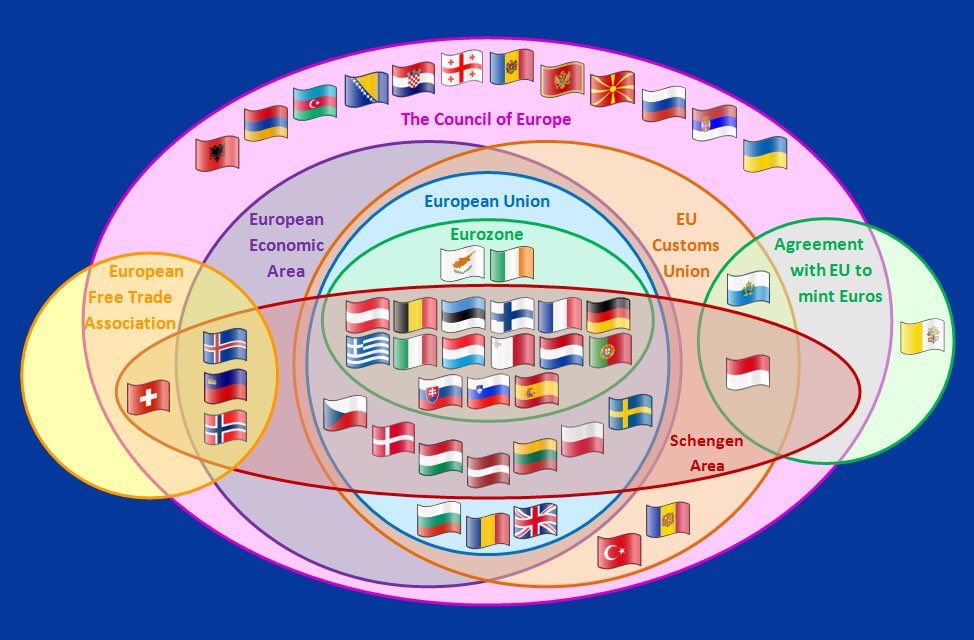


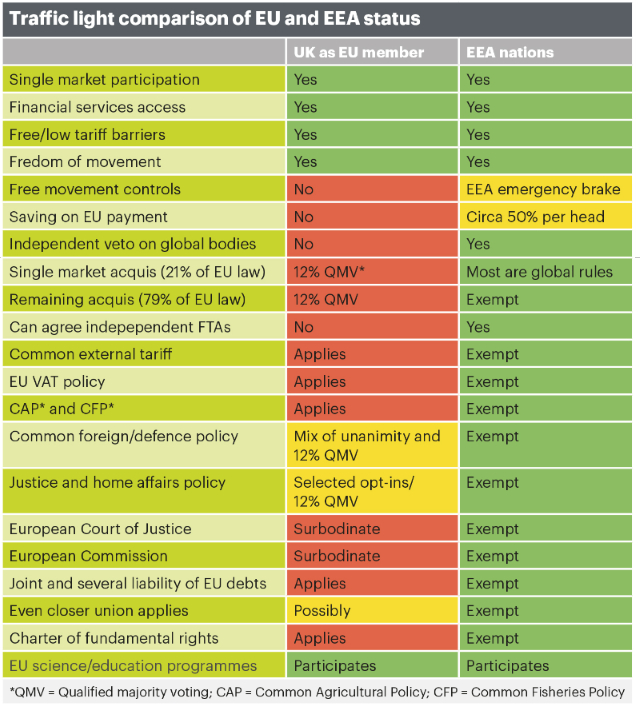

The EU in my eyes should aspire, to what the US has achieved already, being a large region, composed of quite a lot of different states, which are united, so that there are no arbitrary geographic borders limiting the freedom and the rights of the individual. This is not always easy, and it means, that the richer parts have to give to the poorer, but that is just basic humanity.
Especially I am sad for the young generation in the UK. A very large part (about 75%) voted to stay in Europe, and this future is taken from them. I would guess no small part of them will try to move to the remaining EU states.